
Imagine a country where the government officially bans cryptocurrency, yet hundreds of thousands of citizens trade it every day. This isn't a secret rebellion; it's daily life in Bangladesh. As of 2025, over 600,000 Bangladeshis are active users on platforms like Binance, a global cryptocurrency exchange that facilitates peer-to-peer trading. They do this while living under one of the strictest anti-crypto regimes in the world. The central bank warns against it, banks monitor transactions, and the law treats crypto as illegal tender. So, how does this massive underground economy survive? And what happens when the net tightens?
The Paradox of Bangladesh’s Crypto Landscape
Bangladesh sits in a unique corner of the global financial map. It is one of only ten nations-alongside China, Egypt, and Afghanistan-that maintain a total ban on cryptocurrency. Yet, the numbers tell a different story. The sheer volume of users suggests that prohibition hasn't stopped adoption; it has just pushed it into the shadows. This creates a "shadow economy" where digital assets flow freely despite official restrictions.
The legal framework here is tricky. There is no single law titled "The Cryptocurrency Ban Act." Instead, the Bangladesh Bank, the nation's central monetary authority, relies on older legislation to enforce the ban. Specifically, they cite the Foreign Exchange Regulation Act of 1947 and the Money Laundering Prevention Act of 2012. Under these laws, using crypto for foreign exchange or settling debts is a direct violation. The message from Dhaka is clear: cryptocurrencies lack official recognition and are not legal tender.
Here lies the contradiction. In 2020, the government released a National Blockchain Strategy that praised blockchain technology as essential for digital transformation. They want the tech but reject the token. For the average user, this distinction doesn't matter much. If you can buy Bitcoin with your Taka, the underlying technology is secondary to the asset itself.
How Users Bypass the Blockades
If the government wants to stop crypto, why is it so easy to find? The answer lies in the gap between policy and enforcement. You can still download apps like Binance and KuCoin directly from the Google Play Store in Bangladesh. There is no technical firewall blocking access to these platforms at the ISP level. This accessibility is the first crack in the dam.
But downloading an app is only step one. Getting money onto it is harder. Here is where the underground network gets sophisticated. Most users don't use credit cards because banks track USD transactions closely. Instead, they rely on two main methods:
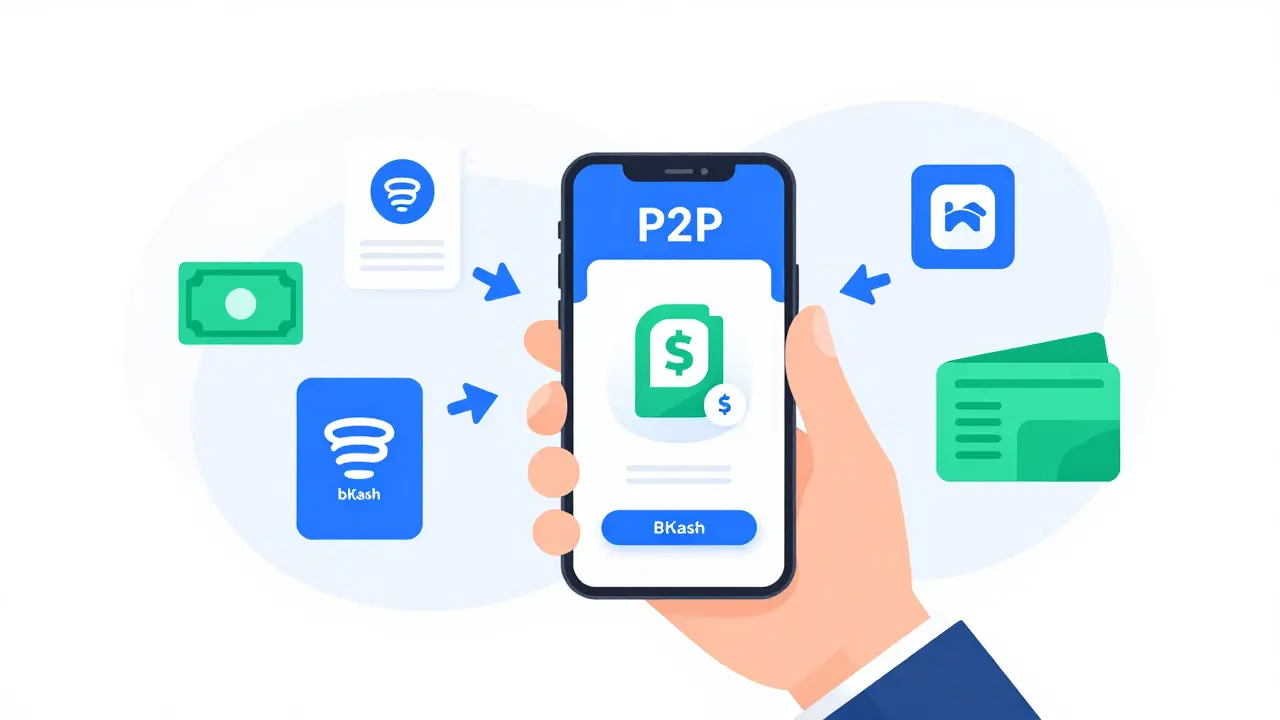
- Local P2P Agents: These are individuals who facilitate trades between Bangladeshi Taka (BDT) and stablecoins like Tether (USDT) or Bitcoin. They charge a small commission but offer convenience. You send BDT via local banking apps like bKash or Nagad, and they release crypto to your wallet. This method keeps the transaction off international wire networks.
- Crypto-to-Crypto Swaps: Some users acquire crypto abroad through family members and transfer it back home via decentralized exchanges, bypassing traditional banking channels entirely.
This peer-to-peer ecosystem thrives because it mimics informal value transfer systems that have existed in South Asia for decades. It’s fast, it’s accessible, and for many, it feels safer than dealing with volatile fiat currencies.
The Real Risks: Beyond Just Breaking the Law
Using crypto in Bangladesh isn't just about dodging a fine. The risks are multifaceted and can be severe. Let’s look at what actually happens when things go wrong.
Bank Account Freezes: This is the most common immediate risk. If a bank detects unusual patterns-such as frequent transfers to known P2P merchants-they may freeze your account pending investigation. While rare for small amounts, large transactions trigger alerts from the Financial Intelligence Unit (FIU), which monitors for money laundering. Once flagged, recovering funds can take months, if ever.
No Legal Recourse: When you trade with a local agent, there is no customer protection. If the agent disappears with your Taka, you cannot sue them in court because the transaction itself is illegal. You are operating outside the legal system, meaning you have zero recourse if you get scammed. This is a reality for thousands of users who lose savings to fraudulent P2P traders.
Tax Ambiguity: The National Board of Revenue does not have a specific tax code for crypto. However, they treat income from crypto trading under the general provisions of the Income Tax Ordinance of 1984. This means if you are audited, you must declare profits. But since the activity is banned, declaring it admits to breaking the law. It’s a catch-22 that leaves users vulnerable.
| Risk Type | Consequence | Likelihood |
|---|---|---|
| Bank Freeze | Account locked, funds inaccessible for weeks/months | Moderate (for high volumes) |
| P2P Scam | Total loss of funds sent to fraudulent agent | High (no legal protection) |
| Legal Action | Fines or imprisonment under Money Laundering Act | Low (rarely enforced for retail users) |
| Tax Audit | Penalties for undeclared income | Low to Moderate |
Why Bans Don’t Work: The Expert View
Academics and economists argue that the current approach is counterproductive. Dr. B M Mainul Hossain, a professor at Dhaka University, puts it bluntly: "Banning is not a solution." He points out that sitting back and doing nothing ignores the reality that crypto operates legally in most of the world. His argument is simple: if people are going to use it anyway, why not regulate it?
The logic follows what we’ve seen in other countries. Nigeria faced similar bans, leading to a booming P2P market. Eventually, regulators realized they couldn't stop the tide, so they started building levees. India, for instance, imposes heavy taxes and strict reporting requirements rather than a total ban. This brings the activity into the light, allowing for oversight and taxation.
In Bangladesh, the fear is primarily about capital flight and money laundering. The government worries that citizens will move wealth out of the country, destabilizing the Taka. However, by banning it, they haven't stopped the flow; they've just made it invisible. Invisible flows are harder to tax and harder to monitor. A regulated system would allow the Bangladesh Bank to see exactly how much crypto is moving in and out, giving them more control, not less.
Global Context: Where Does Bangladesh Stand?
To understand Bangladesh’s position, you have to look at its neighbors and global peers. By mid-2026, the regulatory landscape is shifting rapidly.
- India: Allows trading but prohibits payments. Heavy taxation applies.
- Sri Lanka: Lifted its ban after economic crisis, recognizing crypto as a tool for remittances.
- El Salvador: Adopted Bitcoin as legal tender, fully integrating it into the economy.
- Bangladesh: Maintains a total ban, relying on outdated forex laws.
This isolation hurts businesses. Companies trying to pay for software or services internationally face hurdles. Traditional banking channels are slow and expensive. Crypto offers a faster, cheaper alternative, but using it risks compliance violations. This forces businesses to choose between efficiency and legality, often choosing efficiency and accepting the risk.
What Comes Next for Bangladesh?
The pressure is mounting. With 600,000+ users on Binance alone, the underground market is too big to ignore indefinitely. Global trends are moving toward regulation, not prohibition. Countries like Russia and Indonesia have moved from bans to restrictive frameworks that allow investment but block payments.
For Bangladesh, the path forward likely involves three steps:
- Acknowledgment: Admitting that the ban is ineffective and that crypto usage is widespread.
- Education: Informing citizens about the risks of scams and volatility, rather than just warning them about illegality.
- Regulation: Creating a framework that allows licensed exchanges to operate, with KYC (Know Your Customer) checks and tax reporting.
Until then, the 600,000 users will continue to navigate the grey zone. They will use P2P agents, hide their tracks, and hope the bank doesn't flag their account. It’s a risky game, but for many, the benefits of accessing global markets outweigh the dangers of breaking the law.
Is it illegal to own cryptocurrency in Bangladesh?
Yes, effectively. While there is no specific law criminalizing mere ownership, the Bangladesh Bank prohibits trading, holding for investment purposes, and using crypto for transactions under the Foreign Exchange Regulation Act of 1947. Using crypto to settle foreign exchange is a direct violation.
Can I use my Bangladeshi bank card to buy crypto on Binance?
Technically yes, but it is highly risky. Banks monitor USD transactions closely. If they detect a purchase related to cryptocurrency, they may freeze your account or report you to the Financial Intelligence Unit. Most users avoid this by using P2P methods instead.
What happens if I get scammed by a P2P trader?
You likely have no recourse. Because the transaction involves illegal activities, you cannot easily file a police case or sue in civil court without admitting to breaking the law yourself. This is why verifying P2P merchants is critical.
Does Bangladesh tax cryptocurrency gains?
There is no specific crypto tax law, but the National Board of Revenue treats crypto income under the general Income Tax Ordinance of 1984. This means profits are taxable, but declaring them can expose you to legal scrutiny for engaging in banned activities.
Will Bangladesh lift the crypto ban soon?
It is uncertain. Experts argue that regulation is inevitable due to the size of the underground market, but the government remains cautious about capital flight. Any change would likely involve strict licensing and monitoring rather than full liberalization.
17 Responses
the whole thing is a setup. they want you to think its freedom but its just another way for the deep state to track your every move through the blockchain. its not about money its about control and surveillance capitalism on steroids. people are so dumb they dont see the strings attached to their digital wallets.
Look at the sheer volume of P2P transactions happening in Dhaka right now. The liquidity pools are getting deeper despite the regulatory headwinds from Bangladesh Bank. It's a classic case of regulatory arbitrage where the market demand overrides statutory prohibitions. The risk premium for local agents is skyrocketing because of the account freeze threats but the spread remains attractive enough to keep the ecosystem alive.
I have been following this situation closely for quite some time and it really highlights the disconnect between policy makers and the actual needs of the population. When you look at how many people are using bKash and Nagad to facilitate these trades it becomes obvious that the traditional banking sector is failing to provide adequate avenues for wealth preservation or international transfer. It is fascinating to observe how the underground economy adapts to fill the void left by ineffective legislation and I believe that eventually the government will have no choice but to acknowledge this reality and perhaps even embrace it as a tool for economic growth rather than viewing it solely as a threat to national security.
Agreed with the sentiment here. The ban is practically non-existent on the ground level. Everyone knows someone who trades USDT via P2P. It’s like banning water because it can drown you.
typical third world problem :D why cant they just follow american laws and be done with it. crypto is evil and should be banned everywhere not just there. we need to protect our borders from these digital scams before they infect us too
You need to understand the fundamental mechanics of why prohibition fails in the digital age. It is not merely a matter of stubbornness on the part of the users; it is a rational response to financial exclusion and currency devaluation. The Bangladeshi Taka has suffered significant depreciation against the dollar, driving citizens to seek alternative stores of value. Binance provides a gateway to global markets that the local banking system actively blocks. This creates a black market that is inefficient, dangerous, and prone to exploitation, yet it persists because the underlying economic pressures remain unaddressed. Regulation would bring transparency, tax revenue, and consumer protection, whereas bans only empower criminal elements and frustrate honest traders.
The legal ambiguity cited in the article is particularly concerning from a compliance standpoint. The reliance on the Foreign Exchange Regulation Act of 1947 demonstrates a severe lack of modern legislative framework. In professional practice we see similar issues in other emerging markets where outdated statutes are stretched beyond their original intent to cover new technologies. This creates a hazardous environment for both institutional investors and retail participants who operate under the constant threat of retroactive enforcement actions.
honestly this article is so basic. anyone who actually uses crypto knows this stuff already. the writing is pretentious and full of fluff words. waste of my time reading all this garbage when i could have just checked binance stats myself
why do you care so much about what happens in bangladesh? maybe you should focus on your own life instead of judging others for trying to survive. its none of your business if they use p2p or not. stop being such a buzzkill and let people make their own choices without your moralizing lecture
Let's break down the risk matrix presented here. The likelihood of a bank freeze is moderate for high volumes but the consequence is catastrophic for small businesses relying on those accounts for payroll. The lack of legal recourse is the most critical factor. If you engage in an illegal contract you cannot enforce it in court. This means trust is the only currency that matters in the P2P space. Users must vet their counterparties rigorously using reputation scores and trade history because the law offers them zero protection.
It is interesting to consider the philosophical implications of state sovereignty versus individual financial autonomy. The government claims the right to control the flow of capital to maintain stability but in doing so it infringes upon the natural rights of its citizens to manage their own assets. This tension is present in many societies but is exacerbated in countries with weak institutions and high inflation rates. The solution lies not in suppression but in education and gradual integration into the formal economy.
oh sure lets just ignore the fact that the banks are corrupt and steal from people anyway. why should they trust the system more than crypto? typical elitist take from someone who has never had their account frozen for no reason. good luck with that logic
We must recognize the resilience of the human spirit in the face of adversity. These individuals are not criminals; they are entrepreneurs navigating a broken system. They are finding ways to send remittances home faster and cheaper than Western Union ever allowed. We should applaud their ingenuity rather than condemn their methods. The path forward requires empathy and understanding from regulators who need to step out of their ivory towers and listen to the people they serve.
The comparison to India's regulatory approach is apt. By taxing and reporting requirements India has brought the activity into the light while still maintaining oversight. Bangladesh could learn from this model. A total ban drives activity underground making it harder to monitor for money laundering and terrorist financing. Transparency benefits everyone including the government which can then collect taxes and regulate the industry effectively.
I am worried about the average joe who gets scammed. The jargon used in the article makes it sound simple but in reality it is very complex. People lose their life savings because they do not understand the risks. We need better education programs to help them navigate this space safely. It is not just about profit it is about protecting vulnerable populations from predatory actors.
😂 look at these clowns thinking they can hide from the IRS or whatever agency bangladesh has. its impossible. every transaction is recorded on the blockchain forever. you might as well paint a target on your back. smart money stays off chain or uses privacy coins but even those are being tracked. enjoy your jail cell 🚔
This is exactly why America is superior. We have strong institutions that prevent this kind of chaos. Let them suffer in their backward country while we enjoy the benefits of a stable dollar and regulated markets. Don't let them drag us down with their failed policies.