

If you're in Chile, Colombia, Peru, or Argentina and want to buy Bitcoin or Ethereum without jumping through international banking hoops, Buda is probably the first exchange you’ve heard of. It’s not the biggest name globally, but in Latin America, it’s everywhere. Founded in 2015 as SurBTC and rebranded to Buda in 2018, it’s grown into the largest crypto exchange in Chile, Colombia, and Peru - with a 65% market share in Chile alone. For locals, it’s not just another app. It’s the bridge between pesos, soles, and pesos and digital assets.
What You Can Trade on Buda
Buda doesn’t try to be everything to everyone. It keeps things simple: just six cryptocurrencies. That’s Bitcoin (BTC), Ethereum (ETH), Litecoin (LTC), Bitcoin Cash (BCH), USDC, and Tether (USDT). You won’t find Shiba Inu, Solana, or Dogecoin here. If you’re looking for hundreds of altcoins, you’ll need to go elsewhere. But if you want to trade the big ones - especially against your local currency - Buda nails it.
You can trade these six coins against four local fiat currencies: Chilean Peso (CLP), Colombian Peso (COP), Peruvian Sol (PEN), and Argentine Peso (ARS). That’s the real win. No need for Wise, PayPal, or international wire transfers. You link your local bank account, deposit pesos directly, and buy Bitcoin in minutes. For many in Latin America, this is the first time they’ve ever bought crypto without using a middleman or paying crazy fees.
Trading Fees and Costs
Fees on Buda start at 0.5% per trade. That’s higher than Binance’s 0.1% or Coinbase’s 0.5%-0.6% for spot trades. But here’s the twist: if you trade more than $10,000 a month, your fee drops to 0.2%. And if you refer friends? You get 20% of their trading fees forever. That’s rare in this space. One user in Colombia told me he made $18 last month just from two friends who traded $500 each. That’s not a lot, but it’s free money.
Withdrawal fees are fixed and transparent. For Bitcoin, it’s 0.00011 BTC. For Ethereum, it’s 0.00053418 ETH on normal priority. USDC withdrawals cost 1.38 USDC normally, or 2 USDC if you need it fast. These are low compared to other regional platforms, and they’re clearly listed - no hidden charges.
Security: Cold Storage and Compliance
Buda doesn’t mess around with security. 90% of user funds are stored in offline cold wallets. That’s the same level as Coinbase, which keeps 98%. It’s not perfect, but it’s solid. They also use Chainalysis to monitor transactions for suspicious activity - something even big exchanges don’t always do. Plus, every login requires Dynamic Key authentication, a second layer beyond just a password.
But there’s a gap. Unlike Coinbase, which insures $255 million in customer assets, Buda doesn’t offer insurance. If something goes wrong - a hack, a system failure - your money isn’t protected by a third-party policy. That’s a risk you’re taking. And in early 2023, they shut down their Bug Bounty Program, which used to pay up to $5,000 to hackers who found flaws. That move raised eyebrows. Why remove a safety net if you’re serious about security?
How Easy Is It to Use?
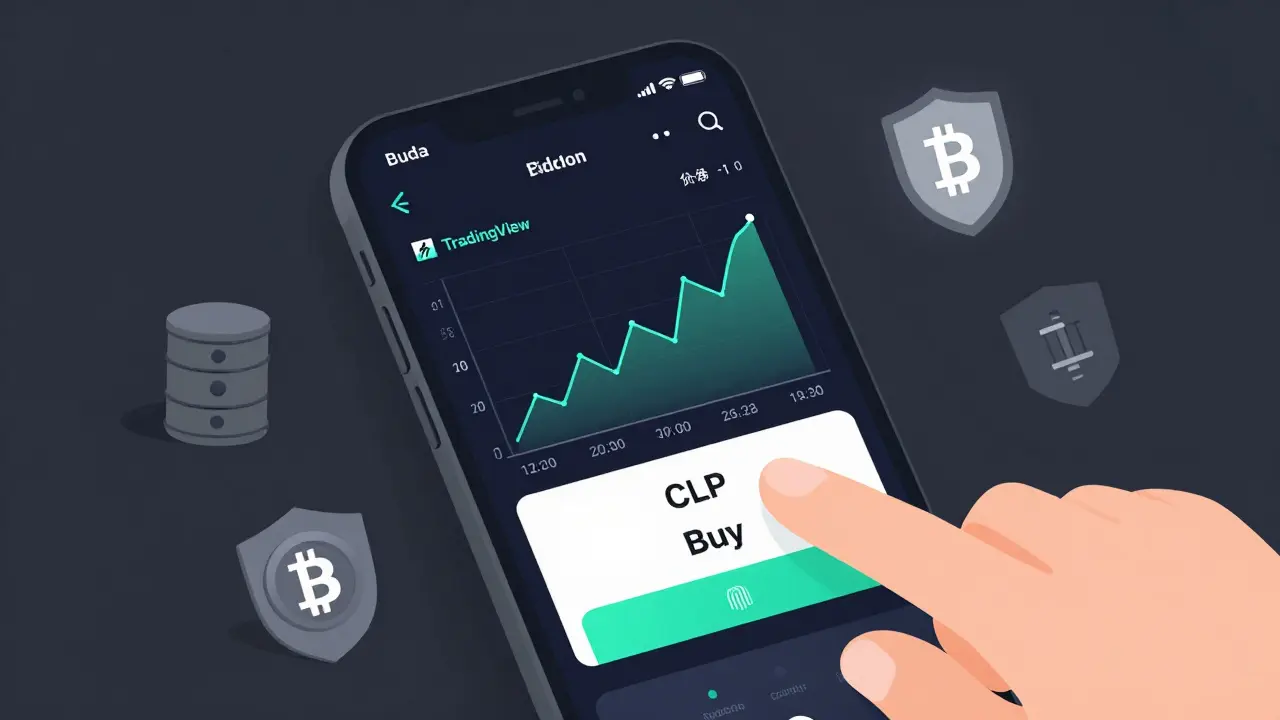
The interface is built on TradingView, which means it’s powerful but not beginner-friendly. If you’ve used TradingView before, you’ll feel right at home. Charts, indicators, order types - all there. But if you’ve never traded before? You’re on your own. There’s no tutorial, no demo account, no guided walkthrough. You just log in and start.
Users in Argentina and Colombia say it takes 3 to 5 trades before they stop feeling lost. One Reddit user wrote: “I thought I’d crash my account on day one. I didn’t. But I spent three days watching YouTube videos in Spanish just to understand how to place a limit order.”
Mobile apps for iOS and Android are clean and fast. No lag, no crashes. They even support fingerprint and face unlock. But again - no hand-holding. You’re expected to know what you’re doing.
KYC: It’s Strict, But Necessary
To use Buda, you must complete KYC. That means: email verification, government ID (passport or national ID), proof of address (a recent utility bill or bank statement), and a live selfie with your face. The whole process takes 24 to 72 hours. No exceptions.
Once verified, you can trade up to $10,000 per month. That’s enough for most retail traders. But if you want to move more - say, $50,000 - you’re out of luck. Buda doesn’t offer higher tiers for individuals. Institutional clients exist, but they’re a tiny fraction of users.
Why so strict? Because Buda complies with financial regulators in Chile, Colombia, Peru, and Argentina. They report to the Financial Analysis Unit in Chile, the Financial Superintendence in Colombia, and similar bodies elsewhere. That’s why they’re still operating - and why many global exchanges aren’t.
Customer Support and Local Language
All support is in Spanish. No English option. If you don’t speak Spanish, you’re stuck. That’s fine if you’re local. But if you’re a tourist or expat? You’ll struggle.
Response times are usually 12 to 24 hours via email. Phone support is available in Chile, but only for urgent issues. One user in Santiago told me he called during a market crash and got a real person in 11 minutes. That’s rare. Most exchanges take days.
There’s no live chat. No 24/7 help desk. If your withdrawal gets stuck, you wait. That’s a downside.
What Buda Doesn’t Offer
Let’s be clear: Buda is a spot exchange. That’s it. No margin trading. No futures. No staking. No crypto loans (though they’ve hinted at launching them). No copy trading. No savings accounts. If you want to earn interest on your Bitcoin, you can’t do it here. If you want to short Ethereum, forget it.
This makes Buda a poor fit for advanced traders. But for people who just want to buy Bitcoin, hold it, and sell it when the price goes up? Perfect.

How It Compares to Binance and Coinbase
Binance offers 500+ coins, margin trading, futures, staking, and low fees. But it doesn’t support direct CLP or COP deposits. You need to use a third-party P2P platform or transfer from another exchange. That adds risk and delay.
Coinbase is easier for beginners, has insurance, and supports 200+ assets. But you can’t deposit pesos directly. You need a bank account in the U.S. or Europe. That’s impossible for most in Latin America.
Buda doesn’t beat them on features. It beats them on access. It’s the only exchange that lets you buy Bitcoin with your Colombian bank account - no intermediaries, no currency conversion fees, no waiting days for a wire.
Real User Experiences
On Trustpilot, Chilean users give Buda 4.5 stars. Common praises: “90% cold storage gives me peace of mind,” and “Deposits from my bank happen instantly.”
On Reddit, Colombian users say CLP deposits are free, but credit card deposits cost up to 3%. That’s normal - most exchanges charge for cards.
But complaints are real. During Argentina’s peso crash in June 2025, one user reported a 48-hour delay in withdrawing COP. Another said the API went down for 3 hours during a Bitcoin spike in January. These aren’t deal-breakers - but they happen.
Who Is Buda For?
Buda isn’t for everyone. It’s not for crypto speculators chasing memecoins. It’s not for traders using leverage. It’s not for people outside Chile, Colombia, Peru, or Argentina.
But if you’re in one of those countries and you want to:
- Buy Bitcoin or Ethereum with your local bank account
- Keep your funds safe in cold storage
- Trade without paying international wire fees
- Use a platform that follows local laws
Then Buda is the best option you’ve got.
Final Thoughts
Buda isn’t flashy. It doesn’t have the global brand of Binance or the trust of Coinbase. But it doesn’t need to. In Latin America, it’s built on trust - trust that your pesos will convert cleanly, that your money is stored safely, and that the platform won’t vanish tomorrow. It’s slow to add new features, but it’s steady. It’s not perfect, but for its target audience, it’s the most reliable choice on the market.
If you’re just starting out in crypto and you live in South America - start here. Learn the basics. Get comfortable. Then, if you want more tools, you can move to another exchange later. But for now, Buda is the bridge you need.
19 Responses
Been using Buda for 8 months now - no issues, deposits hit instantly, and I actually sleep at night knowing my BTC is in cold storage. Simple? Yes. Perfect? Not quite. But it’s the only one that doesn’t make me feel like a criminal for using my own bank account.
Why limit to six assets? This is 2025. If you’re not offering DeFi integrations or staking, you’re already obsolete. Buda is a relic wrapped in local compliance.
Oh wow, a crypto exchange that doesn’t let me buy Dogecoin? How quaint. Did they also ban memes and TikTok trends? Maybe next they’ll require you to write a 500-word essay before buying BTC. Truly revolutionary.
Let’s be real - the fact that they shut down their bug bounty program is a huge red flag. I’ve seen this pattern before. First they say they’re secure, then they remove the external watchdogs. Then one day you wake up and your wallet’s empty and the devs are on a beach in Bali with your ETH. This isn’t security - it’s theater.
And don’t get me started on the lack of insurance. You think cold storage is enough? Tell that to the 200 people who lost everything in the 2022 Binance Colombia server breach. That wasn’t a hack. That was negligence dressed up as ‘compliance’.
They’re not protecting you. They’re protecting their license. And you’re the collateral.
Y’all need to chill 😌 Buda ain’t perfect but it’s the only thing that actually works for us in Latin America. I bought my first 0.02 BTC on here last year and now I’m teaching my abuela how to send USDT to her cousin in Lima 🤝 No fancy futures, no staking, no NFTs - just real people using real money. That’s worth something.
Also, the app doesn’t crash. That’s more than I can say for Binance lol 🙏
Of course they use Chainalysis… they’re working with the feds to track every peso transfer. You think this is about security? Nah. It’s about control. They’re building a financial surveillance state under the guise of ‘compliance’. Wait till they start freezing accounts based on ‘suspicious behavior’… like buying too much BTC in a week. You think this is freedom? It’s a gated community for crypto.
And don’t forget - they dropped the bug bounty right after the Argentine peso crash. Coincidence? I think not.
While the platform’s feature set is admittedly limited, its operational integrity within its jurisdictional scope cannot be understated. The regulatory alignment with Chilean, Colombian, Peruvian, and Argentine financial authorities represents a rare and commendable adherence to legal frameworks that many global platforms deliberately circumvent. This is not a flaw - it is a strategic and ethical positioning.
The absence of margin trading or staking is not a deficiency, but a deliberate prioritization of capital preservation over speculative leverage - a philosophy that, in the context of volatile emerging economies, may be the most responsible offering available.
One must ask: is the ability to trade 500 altcoins more valuable than the certainty that one’s funds are not exposed to offshore regulatory risk? In this case, the trade-off is not merely acceptable - it is necessary.
It’s charming how people treat this like some revolutionary fintech marvel. It’s just a local exchange with a decent UI and a few compliance checkboxes. If you’re impressed by cold storage and fixed withdrawal fees, you’ve never used a real exchange.
And calling it ‘the bridge’? Cute. It’s a walled garden with a Spanish-only help desk. That’s not innovation. That’s isolation.
They don’t offer insurance because they don’t want to be liable. That’s not a risk you take - that’s a scam you accept. You think your pesos are safe? What happens when the government freezes accounts under anti-money laundering laws? Who do you call then? The app doesn’t have a phone number for that. You’re on your own. And they’re fine with that. They’re not your friend. They’re your landlord.
And the referral program? That’s not generosity. That’s a pyramid. You’re not making $18 - you’re recruiting the next victim. You’re the middleman in a system that only benefits the top 1%.
They’re not building a platform. They’re building a dependency.
I came in skeptical but honestly - this is the first time I’ve felt like a crypto platform actually cared about regular people. I’m a teacher in Bogotá. I don’t need futures. I just want to buy a little BTC without my bank rejecting the transfer. Buda lets me do that. And the fact that they’ve been around since 2015? That’s not luck. That’s trust.
Yeah, the interface is rough for beginners. But so is driving a manual car. You learn. You adapt. And you don’t need a tutorial to understand safety.
It’s funny how we think ‘more features’ equals ‘better’. But what if the real innovation is not adding things… but removing distractions? Buda strips away the noise. You want to buy BTC? You can. You want to sell? You can. No hype. No memecoins. No influencers. Just you and the market. That’s rare.
Maybe the future isn’t in 500 altcoins. Maybe it’s in clarity.
Let me guess - you’re the type who thinks if you don’t trade futures, you’re not ‘serious’. Newsflash: most people in Latin America aren’t hedge fund managers. They’re nurses, teachers, mechanics. They just want to protect their savings from inflation. Buda lets them do that without becoming a crypto nerd.
Stop pretending your 100x meme coin portfolio is ‘real investing’. This is financial survival. And you’re judging it like it’s a TikTok trend.
As someone who grew up in Peru and now lives in the U.S., I can tell you - Buda is the only platform that made me feel like crypto was meant for people like me. Not Wall Street. Not Silicon Valley. Just a guy with a bank account and a dream.
Yes, it’s not perfect. But it’s real. And in a world of fake ‘decentralized’ apps that still answer to a CEO in Delaware, that’s worth more than all the staking rewards in the world.
They’re using Chainalysis? That’s not security. That’s a backdoor. Every transaction is being logged. Every peso transfer is being tracked. They’re not protecting you - they’re feeding data to the government. And you’re thanking them for it?
Wait till they start limiting withdrawals during market spikes. You think that’s coincidence? It’s control. And you’re the sheep.
Fee structure is inefficient. 0.5% base rate is predatory for retail. Tiered reductions incentivize volume over accessibility. Referral program is a disguised tax on social networks. Cold storage is table stakes. No insurance is unacceptable. Language barrier is exclusionary by design. This is not a platform. It is a localized oligopoly.
Did you know they’re owned by a shell company registered in the Caymans? And that the CEO used to work for a Chilean bank that got fined for money laundering in 2017? The ‘compliance’ is a front. The real goal is to collect your data, sell it to hedge funds, and then quietly freeze your account when the market dips. You think you’re safe? You’re the product.
And the ‘instant deposits’? They’re just delaying the actual settlement. You think your CLP is in your wallet? It’s in a pool. And when the bank runs? You’re last in line.
You’re not just buying crypto - you’re buying peace of mind. In a country where inflation eats your salary every month, having a way to protect your money without a passport or a foreign bank? That’s power. Don’t let anyone tell you it’s not enough. It’s everything.
There’s a deeper truth here: Buda isn’t a crypto exchange. It’s a social contract. In countries where trust in institutions is broken, this platform became the only reliable intermediary between people and their financial future. It’s not about features. It’s about reliability. It’s about showing up - day after day - even when the market crashes or the peso drops 20% overnight.
Most global exchanges are designed for speculation. Buda is designed for survival. And in Latin America, survival isn’t a niche market. It’s the entire economy.
Yes, they lack staking. Yes, they don’t have futures. But they also don’t have a CEO who tweets ‘to the moon’ while dumping their own tokens. They don’t have a team that disappears after a hack. They’re just… there. Quiet. Consistent. Human.
Maybe the future of finance isn’t about complexity. Maybe it’s about presence.
I appreciate the thoughtful analysis of Buda’s operational model. However, one must consider the ethical implications of promoting a platform that, while locally compliant, actively discourages financial innovation by restricting asset diversity. The absence of staking, lending, and cross-chain interoperability represents a missed opportunity to empower users with true financial sovereignty. Furthermore, the exclusion of English-language support reinforces linguistic and cultural marginalization. While accessibility is commendable, true inclusion demands more than localized fiat on-ramps - it requires equitable access to global financial tools. Buda may serve its immediate demographic well, but it does so at the cost of long-term financial autonomy.