
The Short Answer: It Is Illegal
If you are a business owner looking to expand into mainland China and wondering if you can accept Bitcoin or Ethereum as payment, the answer is a hard no. As of mid-2026, accepting cryptocurrency for commercial transactions in mainland China is not just discouraged; it is strictly prohibited and carries severe legal risks. The regulatory landscape has shifted from cautious oversight to absolute prohibition, culminating in legislation passed in May 2025 that criminalized personal ownership and commercial use of decentralized digital assets.
This isn't a gray area where you might slip through the cracks with a clever workaround. The Chinese government has built a comprehensive surveillance and enforcement infrastructure designed to eliminate any competition to its state-backed currency. For businesses, this means that attempting to integrate crypto payments will likely result in frozen bank accounts, heavy fines, and potentially criminal charges for both the company and its executives.
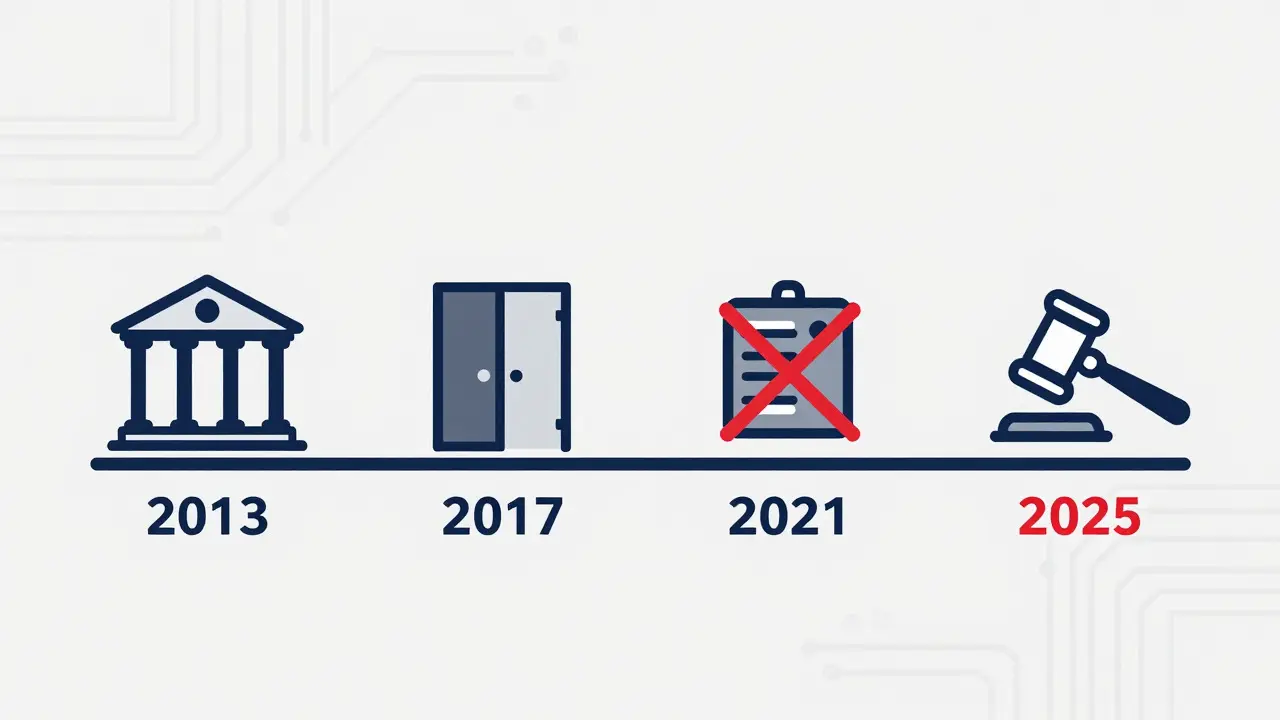
How We Got Here: A Timeline of Restrictions
To understand why the current rules are so strict, you have to look at how Beijing’s approach evolved over the last decade. It wasn't an overnight decision but a systematic tightening of screws aimed at maintaining financial sovereignty.
- 2013: The first official warning prohibited banks from handling Bitcoin transactions, signaling early skepticism.
- 2017: Initial Coin Offerings (ICOs) were banned, and domestic crypto exchanges were shut down, cutting off easy access for retail investors.
- 2019: Crackdowns on mining farms intensified, pushing energy-intensive operations out of the country.
- 2021: The People's Bank of China (PBOC) declared all crypto transactions illegal and banned mining nationwide, effectively killing the local industry.
- 2024: Enforcement escalated with arrests and asset seizures tied to unlicensed crypto activities, serving as a precursor to harsher laws.
- May 2025: Sweeping legislation was passed that criminalized the personal ownership of cryptocurrencies like Bitcoin and Ethereum, marking the final nail in the coffin for commercial acceptance.
This trajectory shows a clear intent: the government views decentralized currencies as a threat to capital controls and financial stability. By 2026, the legal framework leaves zero room for interpretation. Any business activity involving virtual currencies is classified as illegal financial activity.
The Rise of the Digital Yuan (e-CNY)
You might ask, "If they hate crypto, why do they care about digital money?" The key lies in the distinction between decentralized cryptocurrencies and the state-controlled Digital Yuan (e-CNY) is the world's most advanced central bank digital currency (CBDC), designed to replace cash while giving the government complete traceability of all transactions.
While Bitcoin offers anonymity and decentralization-features Beijing dislikes-the e-CNY offers efficiency and total transparency. The government wants businesses to adopt digital payments, but only those that feed data back to the state. The e-CNY allows for programmable money, instant settlement, and real-time monitoring of fund flows. This makes it an ideal tool for combating tax evasion, money laundering, and capital flight.
For businesses, the message is clear: adopt the e-CNY, or face penalties. The state is actively promoting the digital yuan through subsidies and integration with major platforms like Alipay and WeChat Pay. In contrast, private cryptocurrencies are viewed as competitors to monetary policy. By banning them, China ensures that the e-CNY remains the sole digital currency option for legitimate commerce.
| Feature | Bitcoin/Ethereum | Digital Yuan (e-CNY) |
|---|---|---|
| Legal Status (Mainland) | Criminalized (since 2025) | Legal Tender |
| Control | Decentralized | State-Controlled (PBOC) |
| Traceability | Pseudonymous | Fully Traceable |
| Business Acceptance | Banned | Encouraged/Mandatory for some sectors |
| Volatility | High | Stable (pegged to CNY) |
The Hong Kong Exception: A Different Jurisdiction
If you hear about crypto thriving in "China," people are usually talking about Hong Kong. It is crucial to distinguish between mainland China and the Special Administrative Region (SAR) of Hong Kong. While mainland China enforces a total ban, Hong Kong has adopted a regulated, open approach to become a global hub for virtual assets.
Hong Kong has introduced licensing regimes for crypto exchanges, custody services, and even stablecoins. Companies can legally operate there, offer trading services, and issue tokens under strict supervision by the Securities and Futures Commission (SFC). This creates a unique dynamic where a business could theoretically accept crypto in Hong Kong but would be committing a crime if it did so across the border in Shenzhen.
However, for mainland businesses, this doesn't offer much relief. Cross-border transactions are heavily monitored. While some mainland investors buy shares in Hong Kong-listed crypto firms as a workaround, direct business acceptance of crypto in mainland cities remains illegal. If your primary market is Shanghai, Beijing, or Guangzhou, the Hong Kong exception does not apply to your daily operations.

Enforcement Mechanisms: How They Catch You
You might think you can fly under the radar by using peer-to-peer transfers or obscure wallets. But China’s enforcement infrastructure is incredibly sophisticated. The Ministry of Public Security and the Cyberspace Administration work together to monitor financial flows with unprecedented granularity.
Financial institutions, including banks and non-bank payment providers like Alipay, are required to monitor customer funds for any links to virtual currency trading. This isn't just passive observation; it involves active reporting. If a business account receives funds that trace back to a known crypto exchange or wallet address, the transaction is flagged immediately. The system combines online tracking algorithms with offline inspections to identify illicit transactions.
Furthermore, internet companies are mandated to block and report crypto-related content. This means that even advertising your willingness to accept Bitcoin could trigger an investigation. The lack of traditional Know Your Customer (KYC) protections for crypto users works against businesses here; since crypto transactions are illegal, there is no legal recourse if you get scammed, and authorities view the mere participation as evidence of intent to commit financial crimes.

Risks for International Businesses
For foreign companies operating in China, the stakes are high. Many multinational corporations initially tried to navigate these rules by treating crypto payments as barter or using third-party processors outside China. Under the 2025 legislation, these loopholes have been closed.
The risks include:
- Bank Account Freezes: Banks will freeze corporate accounts linked to crypto transactions to prevent capital flight.
- Criminal Liability: Executives can face personal criminal charges for facilitating illegal financial activities.
- Reputational Damage: Being labeled as part of the "illegal financial sector" can blacklist a company from future government contracts or partnerships.
- Asset Seizure: Any crypto assets held by the company are subject to immediate seizure without compensation.
The coordinated multi-agency approach ensures that businesses cannot hide behind jurisdictional confusion. Whether you are a tech startup in Hangzhou or a manufacturing plant in Dongguan, the rule is uniform: no crypto.
What Should Businesses Do Instead?
If you want to leverage digital payment efficiencies in China, the path forward is clear. Embrace the digital ecosystem that the government supports. Integrate the e-CNY into your checkout systems. Most major payment gateways already support it, and adoption is growing rapidly among consumers who appreciate the speed and convenience.
For cross-border trade, stick to traditional fiat channels or approved cross-border e-commerce platforms that handle currency conversion within the legal framework. Avoid any third-party processors that promise "crypto-to-fiat" solutions for Chinese clients unless they are explicitly licensed in Hong Kong and your business structure is entirely separate from mainland operations.
In summary, while the rest of the world debates regulation, China has chosen prohibition. For businesses, compliance means staying away from decentralized cryptocurrencies and aligning with the state’s digital currency strategy. The cost of ignoring this reality is simply too high.
Is it illegal to own Bitcoin in China in 2026?
Yes. Since the legislation passed in May 2025, personal ownership of cryptocurrencies like Bitcoin and Ethereum has been criminalized in mainland China. Holding digital assets privately is considered a criminal offense.
Can I accept crypto payments if my business is registered in Hong Kong?
Yes, provided you comply with Hong Kong's licensing regime. Hong Kong allows regulated crypto businesses to operate, including accepting payments, as long as they have the necessary licenses from the Securities and Futures Commission. However, this does not extend to mainland China.
What happens if a mainland business accepts Bitcoin?
The business faces severe penalties, including frozen bank accounts, heavy fines, and potential criminal charges for executives. Authorities view this as illegal financial activity and money laundering risk.
Is the Digital Yuan (e-CNY) mandatory for businesses?
While not universally mandatory for every single small vendor yet, the government strongly encourages and in some sectors requires the acceptance of e-CNY. It is the only legal digital currency for business transactions in mainland China.
Are there any exceptions for blockchain technology in China?
Yes. China distinguishes between blockchain technology and cryptocurrencies. The government supports blockchain innovation for supply chain management, government services, and enterprise solutions, as long as it does not involve public token issuance or decentralized finance.