
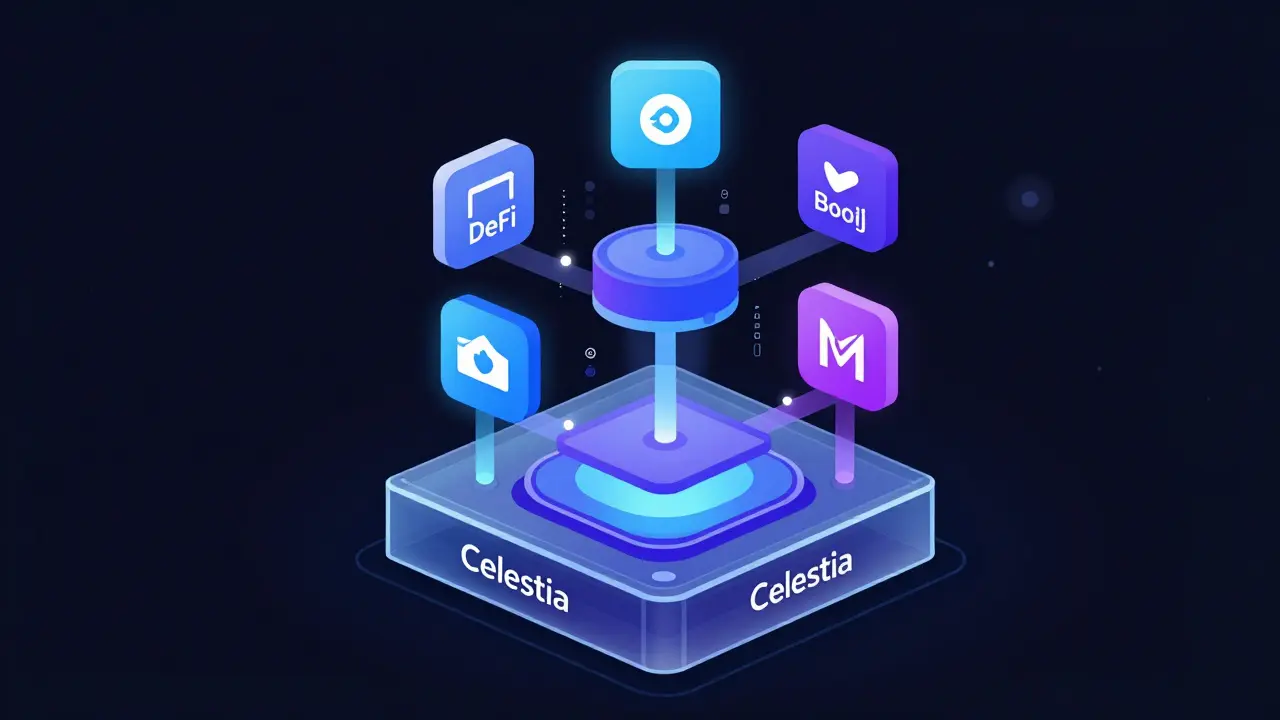
Celestia isn’t just another blockchain. It doesn’t try to do everything. Instead, it does one thing incredibly well: makes sure transaction data is available and verifiable - without forcing every node to download everything. This small shift is rewriting how blockchains scale, and it’s why developers are moving away from monolithic chains like Ethereum and Bitcoin toward modular designs.
What Makes a Blockchain Modular?
Traditional blockchains are like all-in-one appliances. Bitcoin handles payments, verifies transactions, stores data, and reaches consensus - all on the same chain. Ethereum added smart contracts but kept the same structure. The problem? As usage grows, every node must process every transaction. That slows things down, raises costs, and makes it harder to stay decentralized. Modular blockchains break that model apart. Think of them like building a car with separate parts: engine, transmission, chassis. Each part does one job, and you can swap or upgrade them independently. Celestia is the data availability layer - the chassis. It doesn’t run smart contracts or execute trades. It just ensures that the data from those actions is there, accessible, and tamper-proof. This separation means rollups - Layer 2 solutions that handle execution - can focus purely on speed and cost. They don’t need to worry about consensus or data storage. They just post their transaction data to Celestia and trust that it’s available. That’s the key innovation.Celestia’s Core Tech: Data Availability Sampling and NMT
Celestia’s secret sauce is two technologies: Data Availability Sampling (DAS) and Namespace Merkle Trees (NMT). DAS lets lightweight nodes - like phones or small servers - check if data is available without downloading entire blocks. Instead of downloading a 1MB block, a node requests just a few random pieces. If 50% of the block is available, erasure coding lets you reconstruct the full thing. One random sample gives you 50% confidence. Seven samples? Over 99%. That’s enough to trust the data is there, even if you’re not a full node. NMT takes this further. It splits block data into labeled sections - namespaces - so each dApp only downloads what it needs. If you’re running a DeFi app on Celestia, you don’t care about the data from a gaming NFT chain. NMT lets you skip it entirely. Each namespace is like a private folder inside the block. Nodes only pull the folders they’re interested in. This cuts bandwidth, speeds up syncing, and lets many chains run side-by-side without interference. These aren’t theoretical ideas. They’re built into the mainnet since October 2023. And they’re working. Early rollups on Celestia report 80% lower data costs compared to Ethereum L1.How Celestia Compares to Other Modular Projects
Celestia isn’t alone. Other projects like Avail, EigenLayer, and Polygon’s zkEVM are also exploring modular designs. But Celestia is the only one focused purely on data availability as a standalone service.| Project | Primary Focus | Consensus Mechanism | Data Availability Method | Developer Flexibility |
|---|---|---|---|---|
| Celestia | Data availability only | Proof-of-Stake | Data Availability Sampling + NMT | High - supports EVM, Cosmos SDK, any VM |
| Avail | Data availability + light client verification | Proof-of-Stake | DAS with custom proof system | Moderate - optimized for Polygon zkEVM |
| EigenLayer | Restaking for security sharing | Uses Ethereum PoS | Relies on Ethereum’s DA | Low - depends on Ethereum’s constraints |
| Arbitrum Orbit | Custom rollup framework | Off-chain, uses Ethereum DA | Ethereum-based | Moderate - limited to Ethereum-compatible VMs |

Why Developers Are Switching
Before Celestia, building a rollup meant either:- Depend on Ethereum for data availability - expensive and slow
- Run your own full nodes - costly and centralized
- Low-cost data posting - as low as $0.0001 per transaction
- Instant finality - no waiting for Ethereum confirmations
- Full control over your chain’s rules - gas fees, block size, tokenomics
- No need to bootstrap security - Celestia handles consensus
The Ginger Upgrade: What Changed in Late 2024
In December 2024, Celestia launched the Ginger upgrade. It cut block times from 12 seconds to 6 seconds. That’s a 50% speed boost - no compromise on security or decentralization. This wasn’t just a tweak. It meant:- Rollups can process twice as many transactions per minute
- Light nodes sync faster, improving user experience
- Network throughput doubled without adding more validators
Who Benefits Most From Celestia?
Not everyone needs this. If you’re running a simple token on Ethereum, stick with what you have. But if you’re:- Building a rollup or sovereign chain
- Creating a dApp with high transaction volume
- Launching a gaming or social network on-chain
- Need to control your own fee structure

Challenges and Risks
No system is perfect. Celestia’s biggest risk? Adoption. If rollups don’t use it, it becomes a niche tool. Right now, most rollups still rely on Ethereum for data availability because it’s the safest bet. Another concern is complexity. Understanding DAS and NMT isn’t easy. Most developers learned blockchain on monolithic systems. Shifting to modular thinking takes time. Documentation is improving, but there’s still a learning curve. And while Celestia’s security model is mathematically sound, it’s untested at scale. No one has attacked a live DAS network with millions of users yet. That’s the next big test.Where This Is All Heading
The future of blockchain isn’t one chain to rule them all. It’s a network of specialized layers - each doing one thing well. Celestia is becoming the plumbing of Web3. Just like HTTP lets websites send data without worrying about how it travels, Celestia lets apps send data without worrying about consensus. Rollups become the apps. Validators become the servers. Users become the clients. By 2026, we’ll likely see:- 100+ custom chains running on Celestia
- Mobile wallets syncing in under 10 seconds
- Game studios launching on-chain worlds with zero gas fees
- Developers in Africa and Southeast Asia building global dApps on cheap phones
What is Celestia used for?
Celestia is used as a data availability layer for modular blockchains. It lets rollups and custom chains post transaction data securely and cheaply, without handling execution or consensus themselves. Developers use it to build scalable dApps, gaming platforms, and DeFi protocols with lower costs and more control.
Is Celestia better than Ethereum?
It’s not better - it’s different. Ethereum is a full-stack blockchain that handles execution, consensus, and data availability. Celestia only handles data availability. If you need a single chain with smart contracts, Ethereum still wins. If you want to build a custom chain with low fees and high throughput, Celestia is the better foundation. Many projects now use both: execution on a rollup, data on Celestia.
Can I run a node on Celestia with a phone?
Yes. Because of Data Availability Sampling, you don’t need to download full blocks. A phone can verify data availability by requesting just a few random pieces of a block. This makes Celestia one of the few blockchains where mobile nodes are practical and secure - something impossible on Bitcoin or Ethereum without heavy hardware.
What programming languages does Celestia support?
Celestia supports Solidity for EVM-compatible chains, Rust and Go for Cosmos SDK-based chains, and any other language or virtual machine through custom execution environments. Developers aren’t locked into one stack - they can build using the tools they already know.
How does Celestia make money?
Celestia doesn’t charge users directly. Instead, validators stake TIA tokens to secure the network and earn rewards from rollups that pay for data availability. The more rollups use Celestia, the more TIA is staked, and the higher the rewards. It’s a self-sustaining economic model driven by demand for scalable data.
Is Celestia decentralized?
Yes. Celestia has over 1,000 active validators globally, with no single entity controlling more than 5% of the stake. Its consensus mechanism is permissionless, and anyone can run a node. Data Availability Sampling ensures even lightweight participants can verify the network without centralization risks.
20 Responses
This is 🔥 Seriously, Celestia is the quiet hero of Web3. No more paying $5 to post a transaction. Just slap your data on Celestia and let the rollups do their thing. Game changer.
I’ve been running a light node on my old iPad for months now... and it’s stable. I didn’t think this was possible. DAS isn’t just clever-it’s revolutionary. The fact that I don’t need a server farm to verify data? Mind blown.
Oh great. Another ‘modular’ buzzword. Let me guess-next you’ll tell me Ethereum is ‘obsolete’ because someone built a faster data pipe? Wake up. The security model is still unproven at scale. And no, ‘92% lower gas fees’ doesn’t mean it’s safe.
If you’re not building on Celestia right now, you’re building on sand. The Ginger upgrade doubled throughput without adding validators? That’s pure efficiency. Stop clinging to monolithic chains like they’re sacred relics. The future is modular, and it’s live.
I love how people act like Celestia invented data availability. It’s just erasure coding + sampling. Been around since the 90s. The real innovation? Marketing. 🤷♀️
The way Celestia lets devs in India, Nigeria, or Brazil run nodes on cheap phones? That’s not tech-that’s justice. For once, decentralization isn’t just for people with $2000 rigs. This is the kind of innovation that actually changes lives.
Let’s be real: Celestia’s only winning because Ethereum is bloated and expensive. If ETH had low fees, no one would care. It’s not innovation-it’s desperation dressed up as architecture.
I’m still trying to wrap my head around NMT... but the idea that my DeFi app can ignore gaming chain data? That’s like having a library where you only pull the books you need. So elegant. I need to read more on this.
The claim that Celestia enables true decentralization in emerging markets is overstated. Most users there still lack stable internet. And mobile nodes require consistent connectivity. This is techno-optimism ignoring ground reality.
Modular? More like fragmented. We used to have one chain everyone trusted. Now we have a hundred half-baked layers with no shared security. This isn’t progress-it’s chaos dressed in whitepapers.
There’s a philosophical shift here. We’re moving from monolithic truth to distributed verification. Celestia doesn’t enforce consensus-it enables trustless observation. That’s not engineering. That’s epistemology.
I’ve seen so many people dismiss this as ‘just another L2’. But the real win? It lets anyone build a chain without begging for security from Ethereum. That’s freedom. And freedom is messy, but worth it.
If you’re a dev and you’re still using Ethereum L1 for data, you’re leaving money on the table. I switched my gaming dApp to Celestia. Our monthly infra bill dropped from $12k to $1.8k. And our users don’t even notice the difference. Just faster, cheaper, smoother.
I tried setting up a node last week. Docs were great, but the CLI kept crashing on my Mac. Took me three tries. But once it worked? The sync speed on my laptop was insane. Like 30 seconds for a full header chain. That’s wild.
DAS + NMT = the holy grail of blockchain scaling. You’re not just reducing cost-you’re redefining participation. A phone verifying data? That’s not a feature. That’s a paradigm shift. And yeah, I’m staking TIA. No regrets.
To everyone saying ‘this is just erasure coding’-yes, but so what? Innovation isn’t about reinventing the wheel. It’s about putting the wheel on a car that actually moves. Celestia built the car. Let’s not nitpick the tires.
Celestia is not the future. It is the inevitable collapse of centralized blockchain governance. Ethereum’s dominance was always a bubble. And now the bubble is bursting with modular architecture. The data layer will rule all. Mark my words.
Why do devs keep falling for this? You think Celestia is decentralized? The team controls the roadmap. The validators are all VC-backed. This isn’t freedom. It’s just a different cage with better branding
The technical elegance of NMT is undeniable. However, one must consider the sociotechnical implications: a fragmented data layer may lead to interoperability challenges. The academic literature on cross-namespace consensus remains underdeveloped.
I just launched my rollup on Celestia. Took me 4 hours. Zero drama. My users are happy. My wallet’s happy. And I didn’t have to write a single line of Solidity for consensus. That’s all I need to know.