
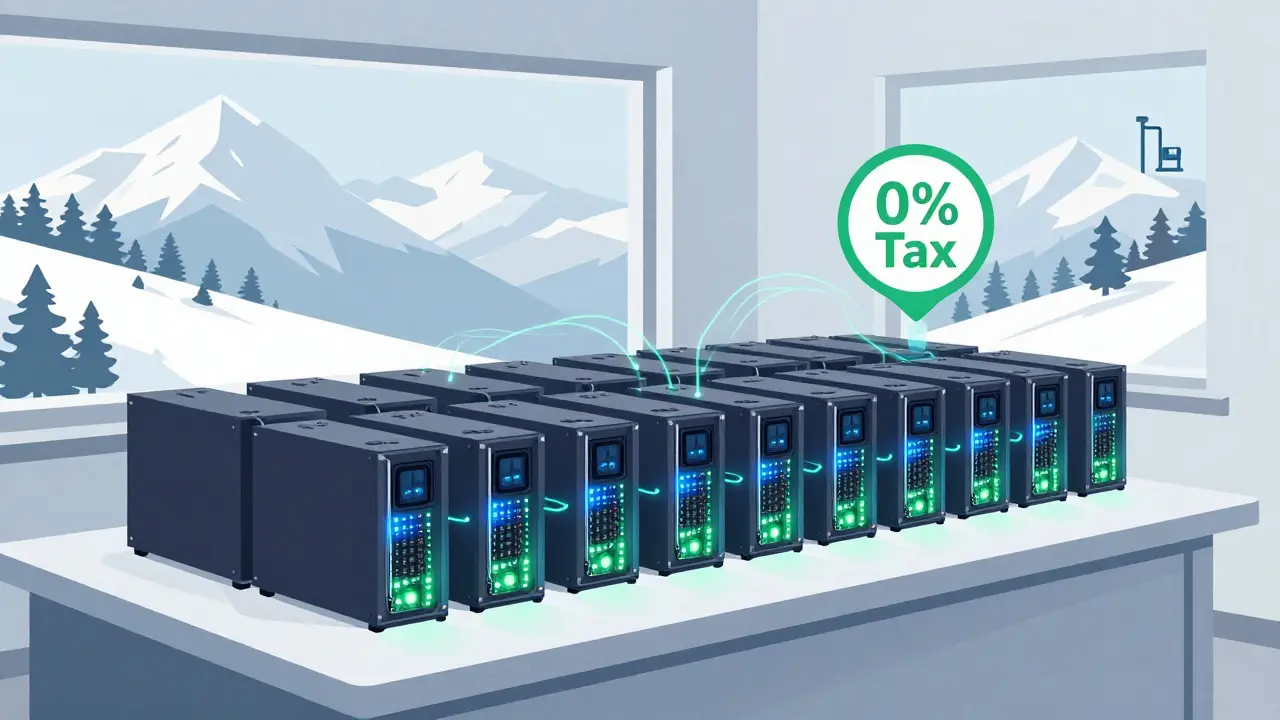
Imagine setting up a powerful Bitcoin mining rig where electricity costs are low, the climate keeps your hardware cool naturally, and the government doesn't just tolerate your business-it actively encourages it. For many miners, this isn't a fantasy; it's the reality of operating in the Republic of Georgia. As of June 2026, Georgia has solidified its position as one of the world’s top destinations for cryptocurrency mining, hosting roughly 5% of global hash power. But here is the catch: while the door is open, the rules inside have changed significantly since the early days.
If you are looking to mine crypto in Georgia, you need to understand that "legal" does not mean "unregulated." The landscape has shifted from a wild west environment to a structured financial ecosystem governed by the National Bank of Georgia (NBG). Whether you are an individual running a few rigs in a mountain cabin or a company planning a massive industrial farm in Tbilisi, the regulatory requirements differ drastically. Getting this wrong can lead to frozen assets or heavy fines. Let’s break down exactly how the system works, what licenses you actually need, and where the hidden traps lie.
The Legal Status of Crypto Mining in Georgia
First, let’s clear up the biggest misconception: Is crypto mining legal in Georgia? Yes. Absolutely. Unlike some neighboring countries that have banned or restricted mining due to energy concerns, Georgia treats cryptocurrency mining as a legitimate economic activity. In fact, the government views it as a way to monetize excess renewable energy, particularly hydroelectric power generated during spring and summer floods.
However, legality comes with definitions. Under Georgian law, cryptocurrencies like Bitcoin or Ethereum are classified as virtual digital assets, not legal tender. This distinction is crucial because it determines how your earnings are taxed and regulated. Since crypto is considered personal property rather than currency, the traditional banking rules don’t apply directly to the coins themselves, but they do apply heavily to the platforms and services used to manage them.
The National Bank of Georgia (NBG) oversees this space. Their goal isn’t to stop mining; it’s to prevent money laundering and terrorist financing. This means that while you can mine freely, moving that money into fiat currency (like USD or GEL) requires strict adherence to Anti-Money Laundering (AML) and Countering the Financing of Terrorism (CFT) protocols. If you plan to keep your profits in crypto, your regulatory burden is lighter. If you plan to cash out regularly, you are entering a highly monitored financial channel.
Individual Miners vs. Commercial Operations
The regulatory framework splits miners into two distinct categories: individuals and commercial entities. Your obligations depend entirely on which box you fall into.
For Individual Miners: If you are mining on your own, using your own equipment, and not hiring staff, you operate under a very favorable regime. Currently, individual miners in Georgia pay zero income tax on their cryptocurrency earnings. This is one of the biggest draws for solo operators. You do not need a special mining license. However, you must still comply with basic registration if your activities scale up. If you are just running a couple of ASICs at home, you likely won’t attract much attention. But remember, once you start selling crypto for fiat through local exchanges, those exchanges will require you to undergo Know Your Customer (KYC) checks.
For Commercial Mining Farms: Things get more complex when you incorporate a business. A commercial mining operation does not need a specific "mining license," but it must register as a standard limited liability company (LLC) or joint-stock company in Georgia. Here is where the confusion often starts: Does a mining farm need a Virtual Asset Service Provider (VASP) license? Generally, no. Pure mining-where you generate coins and hold them-is not considered a "service" under the VASP law. However, if your business model includes:
- Managing wallets for third parties
- Exchanging crypto for fiat on behalf of clients
- Providing custody services for other investors' funds
Understanding the VASP License Requirement
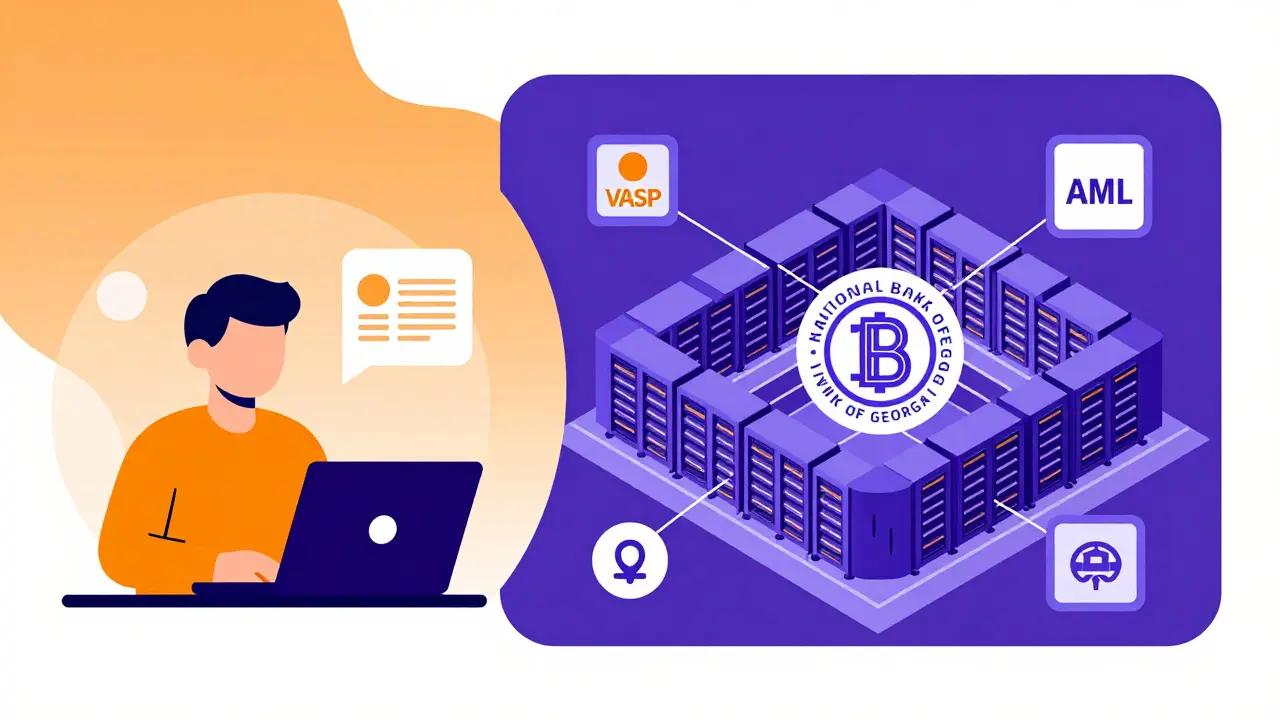
The cornerstone of Georgia’s current crypto regulation is the Virtual Asset Service Provider (VASP) registration and licensing framework. Enacted in 2023 and fully implemented by 2026, this law requires any entity providing services related to virtual assets to register with the National Bank of Georgia.
Even if you are a miner who doesn’t think you’re a VASP, understanding this process is vital because your partners (exchanges, wallet providers) are. The VASP framework imposes strict requirements:
- Registration: You must submit detailed information about your ownership structure, beneficial owners, and operational plans to the NBG.
- AML/CFT Compliance: You must implement robust internal controls to detect suspicious transactions. This includes screening customers against sanctions lists and reporting large or unusual transfers to the Financial Monitoring Service (FMS).
- KYC Procedures: You must verify the identity of all users interacting with your platform.
- Technical Security: Regular security audits are mandatory to ensure the safety of digital assets.
The Tbilisi Free Zone (TFZ) Alternative
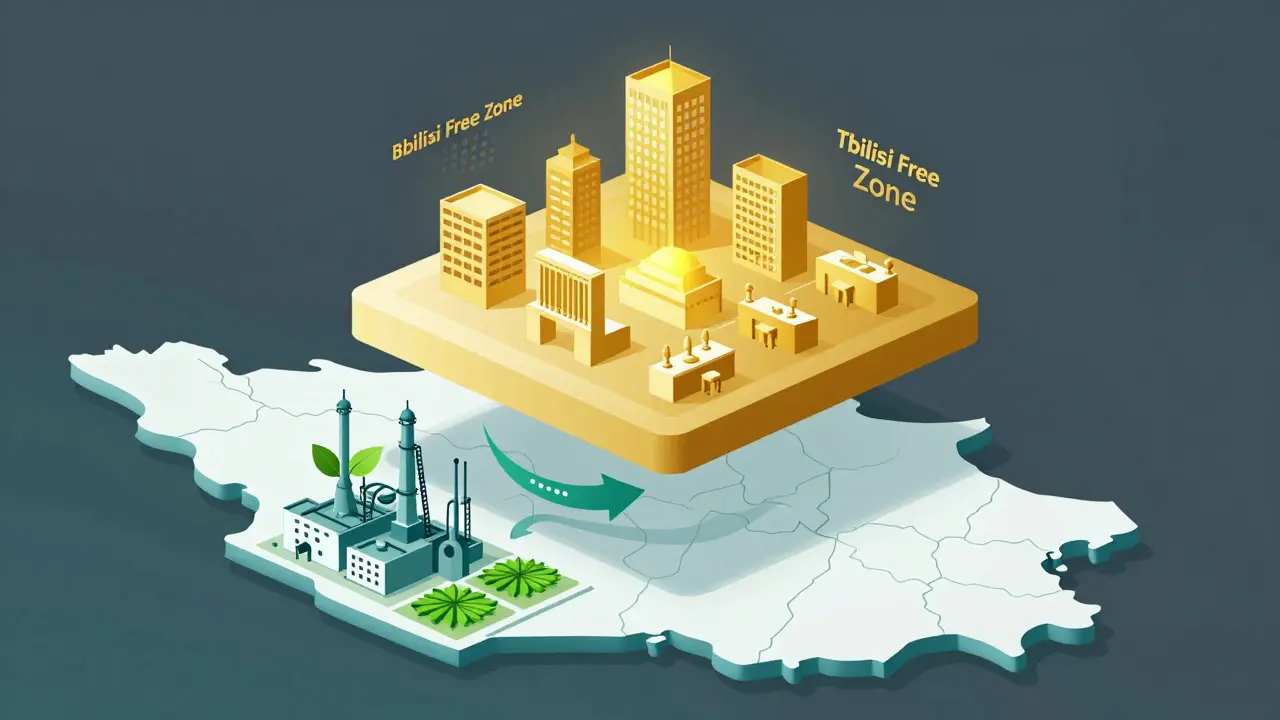
If the mainland VASP requirements feel too heavy, there is another path: the Tbilisi Free Zone (TFZ) special economic zone offering offshore-style benefits. Established to boost investment, the TFZ offers a unique set of incentives that make it attractive for crypto businesses, including mining operations.
Why consider the TFZ?
- Tax Benefits: Companies registered in the TFZ enjoy significant tax exemptions, including zero corporate income tax on certain activities and reduced social security contributions.
- Simplified Licensing: While you still need to comply with international standards, the administrative burden within the TFZ can be lighter than mainland VASP procedures for qualifying activities.
- Offshore Status: It allows for greater flexibility in international transactions and capital repatriation.
| Feature | Mainland Georgia (VASP Framework) | Tbilisi Free Zone (TFZ) |
|---|---|---|
| Tax Rate on Profits | Standard corporate tax (15%) unless individual | 0% corporate income tax for eligible activities |
| Licensing Complexity | High (Strict NBG oversight) | Moderate (Zone-specific administration) |
| Physical Location | Anywhere in Georgia | Must be within TFZ boundaries |
| Banking Access | Standard Georgian banks | Requires TFZ-compatible banking partners |
| Best For | Pure mining farms, local operations | Holding companies, international trading, HQs |
Taxation: What You Actually Pay
Taxes are where Georgia shines brightest for miners. Let’s look at the numbers. Individual Miners: As mentioned, you pay 0% income tax on crypto earnings. This applies regardless of whether you mined Bitcoin, Ethereum, or Solana. You also do not need to declare these earnings to the Revenue Service if you do not convert them to fiat through taxable channels. However, if you sell crypto for Georgian Lari (GEL) or USD via a local exchange, that transaction is recorded. The key is that the act of mining itself is not taxed.
Corporate Miners: If you operate as an LLC, you are subject to the standard 15% corporate income tax on your net profits. However, "profits" are calculated after deducting expenses. This means you can offset your tax bill against:
- Electricity bills
- Hardware depreciation
- Rent for facilities
- Salaries for technical staff
Energy Costs and Infrastructure Realities
Regulations matter, but economics drive mining. Georgia’s appeal lies in its energy profile. The country relies heavily on hydropower, which is abundant and relatively cheap, especially in the spring and summer months. Industrial electricity rates in Georgia range from $0.05 to $0.08 per kWh, depending on the contract and season. This is competitive globally, though not the cheapest in the world (compare that to parts of Texas or Kazakhstan). However, there is a seasonal twist. Winter energy prices can spike due to increased heating demand and lower hydro generation. Smart miners in Georgia use dynamic strategies: they ramp up hashing power in summer when electricity is cheap and surplus exists, and throttle back or maintain minimal operations in winter to stay profitable. Infrastructure-wise, Tbilisi and Kutaisi offer robust industrial zones with reliable grid connections. Smaller towns in mountainous regions may offer cheaper land and natural cooling, but grid stability can be an issue. Before signing a lease, always request a load capacity report from the local energy provider (Supra-Regional Transmission System Operator). Many older buildings cannot handle the high amperage required by modern ASIC miners without expensive upgrades.
Compliance Pitfalls to Avoid
Even with a friendly regulator, mistakes happen. Here are the most common ways miners get into trouble in Georgia:
- Ignoring Beneficial Ownership Rules: The NBG requires full transparency on who owns the mining company. Hiding behind shell companies or anonymous trusts will result in immediate rejection of any banking or licensing applications.
- Improper AML Reporting: If your mining pool or exchange partner flags a transaction as suspicious, you must cooperate fully. Failure to provide source-of-funds documentation can lead to account freezes.
- Misclassifying Services: Don’t assume you’re just a miner if you’re also helping friends store their keys or swapping tokens for them. These actions can trigger VASP obligations unexpectedly.
- Neglecting Environmental Permits: Large-scale mining generates heat and noise. While Georgia doesn’t have specific "crypto environmental laws," general industrial zoning and noise ordinances apply. Ensure your facility meets local municipal codes to avoid shutdowns from neighbors.
Future Outlook: What to Expect After 2026
With the full implementation of the VASP framework complete in 2026, the next phase for Georgia is integration. The National Bank is exploring how to integrate stablecoins and central bank digital currencies (CBDCs) into the existing framework. For miners, this likely means even smoother fiat off-ramps but stricter monitoring of cross-border flows. Also, watch for potential changes in energy policy. As global pressure mounts on carbon footprints, Georgia may introduce green energy certificates or incentives for miners who commit exclusively to renewable sources. Given Georgia’s hydro-heavy grid, this could become a major marketing advantage for Georgian-mined Bitcoin, appealing to ESG-conscious institutional buyers.
Do I need a license to mine Bitcoin at home in Georgia?
No, individual miners do not need a special license to mine cryptocurrency at home. You can operate legally without registering as a VASP, provided you are not offering services to others. You also benefit from zero income tax on your mining rewards.
Is it cheaper to get a crypto license in the Tbilisi Free Zone or mainland Georgia?
The Tbilisi Free Zone (TFZ) generally offers lower ongoing costs due to 0% corporate income tax and simplified administrative processes. However, initial setup costs and physical location restrictions may make the mainland option more practical for pure mining farms that need large industrial spaces outside the city center.
How much tax do companies pay on crypto mining profits in Georgia?
Companies registered in mainland Georgia pay a standard 15% corporate income tax on net profits. If registered in the Tbilisi Free Zone, eligible companies may pay 0% corporate income tax. Dividends distributed to shareholders are subject to a 5% withholding tax.
What happens if I don't comply with AML regulations as a miner?
Non-compliance with Anti-Money Laundering (AML) rules can result in heavy fines, revocation of banking relationships, and potential criminal charges. The Financial Monitoring Service actively investigates suspicious crypto transactions, so maintaining proper records and KYC procedures is essential.
Can foreign citizens own a crypto mining company in Georgia?
Yes, foreign citizens can fully own and operate crypto mining businesses in Georgia. There are no restrictions on foreign ownership for mining or VASP licenses. You will need to register a local entity (LLC or JSC) and obtain a residency permit if you plan to manage operations on-site.
19 Responses
Hey guys, just wanted to drop a quick note here because I've been looking into this for my own setup in Texas and Georgia looks insane right now. The 0% tax for individuals is basically unheard of in the US anymore, so if you're solo mining, it's a no-brainer financially speaking. Just make sure you don't cross that line into 'service provider' territory or the NBG will come knocking hard. 🚀⛏️
typical western propaganda trying to sell georgia as some utopia 😒 the reality is the grid collapses every winter and you end up paying more for diesel generators than you save on hydro. also the 'simple' licensing is a joke if you dont know the right people in tbilisi. stop believing the hype train.
You clearly lack the intellectual capacity to understand the nuance of emerging market regulatory frameworks. While the grid stability in rural areas can be... suboptimal, the industrial zones near Kutaisi are robust enough for serious operations. It is not about 'knowing people,' it is about understanding the VASP compliance matrix which most of you seem too dense to grasp. The tax arbitrage alone outweighs minor logistical inconveniences by orders of magnitude. Read the article again, perhaps slowly this time.
Is it not fascinating how we project our fears onto these new economic landscapes? The fear of the grid failing is real, yes, but so is the allure of freedom from heavy taxation. Perhaps the middle path lies in accepting that risk is inherent in any high-reward venture. We must look at the philosophical shift here: moving from state-controlled currency to decentralized value creation in a place that allows it. 🤔
i think both of u have valid points but maybe calm down a bit? karthikeyan seems pretty stressed about it lol. dinesh ur right about the kutaisi zones being better though, i read somewhere that the infrastructure there was upgraded specifically for data centers recently. just gotta do your due diligence on the load capacity reports before signing anything.
Thanks for sharing this info everyone. I am currently evaluating sites in the mountain regions and the noise ordinance point mentioned in the article is something I hadn't considered. Do you guys think local municipalities actually enforce those strictly for crypto farms or is it more of a theoretical risk?
Let me be clear: if you are setting up a commercial operation, assuming the locals won't complain about the constant hum of ASICs is amateur hour. I have seen projects shut down in less developed regions because they ignored basic zoning laws. Don't let the tax breaks blind you to the operational realities. You need to check with the specific municipal code where you plan to build. It is not optional.
I hear what you are saying, Verna, and it is definitely a smart precaution. Building relationships with the community early on can help mitigate those risks too. If you show up as a neighbor who contributes to the area rather than just an outsider extracting resources, people are often more forgiving. It’s all about communication and respect for the local environment.
why does everyone care so much about taxes anyway its just money the real issue is whether you can actually get the hardware shipped there without customs eating you alive i tried importing rigs last year and spent three months arguing with border officials in batumi while my hash rate dropped to zero
That is a very practical concern, Greg. Customs delays can indeed cripple a mining operation's profitability during the initial ramp-up phase. For anyone planning to import significant hardware, I highly recommend working with a local freight forwarder who specializes in tech imports. They can navigate the Georgian customs clearance process much faster than trying to do it yourself. Also, ensure your invoices are perfectly aligned with the HS codes for electronic components to avoid unnecessary scrutiny.
It is amusing how Americans flock to Georgia like lemmings. Why not fix our own energy grid instead of running overseas to mine worthless digital coins? The government should be taxing these miners heavily to fund domestic infrastructure, not letting them hide behind offshore-style loopholes in the Tbilisi Free Zone. This is capital flight disguised as innovation.
Sarcasm aside, Matthew, the global nature of crypto means capital flows where it is treated best. Georgia isn't hiding; they are competing. And honestly, if they want to invest our money in their grid, fine, but they can't force us to stay in a high-tax jurisdiction when options exist. It's just economics. 🌍💸
The sheer laziness of relying on a 'friendly regulator' is what gets people burned. I see so many amateurs reading this article and thinking 'oh easy money.' They miss the part about AML reporting. If you cannot document the source of your funds down to the satoshi, you are already dead in the water. The NBG doesn't play games. Stop acting like this is a hobby farm and start treating it like a regulated financial institution.
Exactly. And don't forget the beneficial ownership rules. Try hiding behind a shell company in BVI and see how long your bank account lasts in Tbilisi. The transparency requirements are brutal for those used to opacity. If you can't stand the light, don't enter the room. Simple as that.
its ironic how we preach decentralization but then beg for central bank approval to cash out. the whole system is a paradox waiting to collapse. but hey, enjoy your 15% corporate tax while it lasts before they realize they can just seize the assets directly. history repeats itself folks. 🙄
Meg, your cynicism is noted, but let's focus on the actionable intelligence here. The legal framework exists, and it is stable for now. Dismissing it as a temporary illusion ignores the significant investment infrastructure being built. For those ready to execute, the window is open. Seize the day, comply with the rules, and maximize your returns. Don't let paranoia paralyze your potential.
The distinction between individual and commercial entities is the most critical takeaway from this guide. Many operators fail because they scale up without changing their legal structure. Once you hire staff or manage third-party wallets, you are no longer an individual miner. You must transition to an LLC and navigate the VASP landscape immediately to avoid severe penalties.
Can someone clarify the exact threshold for 'commercial'? Is it based on revenue, number of rigs, or just having employees? The article says 'if you incorporate a business' but what if I'm a sole proprietorship making $10k a month? Do I need the full VASP license or just standard business registration? This jargon is confusing me.
I think the key is whether you are providing a service to others. If you are just mining your own coins, even as a sole prop, you might be okay with just standard registration. But if you are holding keys for friends or swapping for them, that triggers the VASP stuff. Best to talk to a local lawyer though, dont rely on reddit comments for legal advice! sorry if my spelling is bad today im tired.