
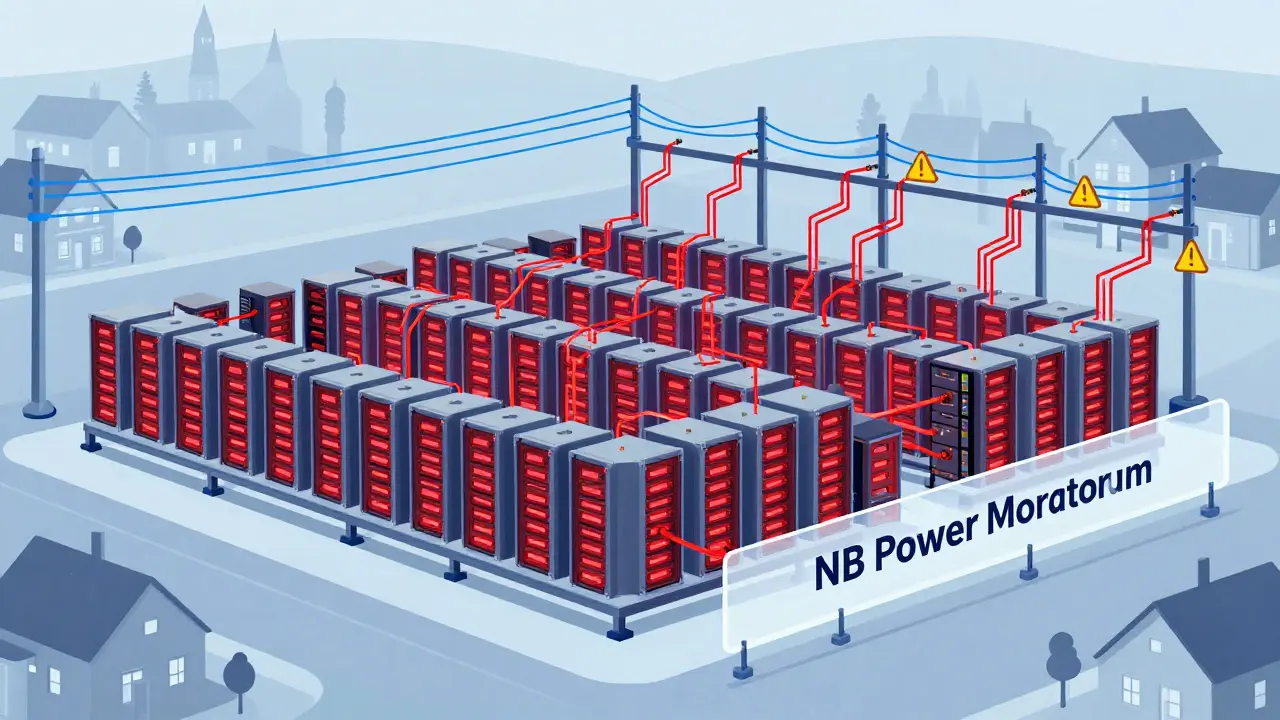
When New Brunswick shut down new cryptocurrency mining connections to its power grid in 2023, it didn’t just stop a few data centers-it stopped a potential surge that could have doubled the province’s electricity demand. This wasn’t a temporary pause. It wasn’t a review. It was a full, indefinite block on any new crypto mining operation from getting electricity from NB Power. And it’s had real consequences for miners, energy policy, and how Canada handles power in the age of Bitcoin.
Why New Brunswick Said No
The decision didn’t come out of nowhere. Back in March 2022, the provincial government ordered NB Power, the Crown-owned utility, to stop granting new electricity connections to cryptocurrency mining operations. At first, it looked like a delay. But by November 2023, that pause became a permanent moratorium. No new mines. No expansions. No exceptions. The reason? Electricity supply was already stretched thin. Crypto mining, especially Bitcoin mining using Proof of Work, eats power like a furnace. A single large mining facility can draw as much electricity as a small town. And New Brunswick had already seen interest from operators who, if connected, would have added 4,600 megawatts to the grid. That’s more than two-thirds of the province’s total capacity at the time. That’s not just a spike-it’s a complete overload. Imagine if every home in Fredericton suddenly added a second electric heater, and then a few dozen companies showed up with industrial-scale heaters the size of warehouses. That’s what crypto mining threatened to do.How the Moratorium Works
This isn’t a law passed by the legislature. It’s a utility policy enforced by NB Power. The utility has been told to refuse any new request for electricity service from a crypto mining operation. That means:- No new Bitcoin mines can connect to the grid in New Brunswick.
- Existing mines can’t increase their power usage, even if they’ve been operating for years.
- There’s no deadline for review. The ban is open-ended.
How Other Provinces Compare
Manitoba paused new connections in November 2022 and extended it until April 2026. That’s a fixed end date. British Columbia passed Bill 24 to give BC Hydro legal authority to limit power to miners. Hydro-Québec raised rates and capped allocations. But New Brunswick didn’t just raise rates or set limits-it cut off access entirely. Alberta is the opposite. It has no moratorium. In fact, its deregulated energy market and cheap power have made it a hotspot for crypto mining. Companies that were turned away in New Brunswick are now setting up in Alberta. The contrast is stark: one province saying no, the other saying yes-and cashing in.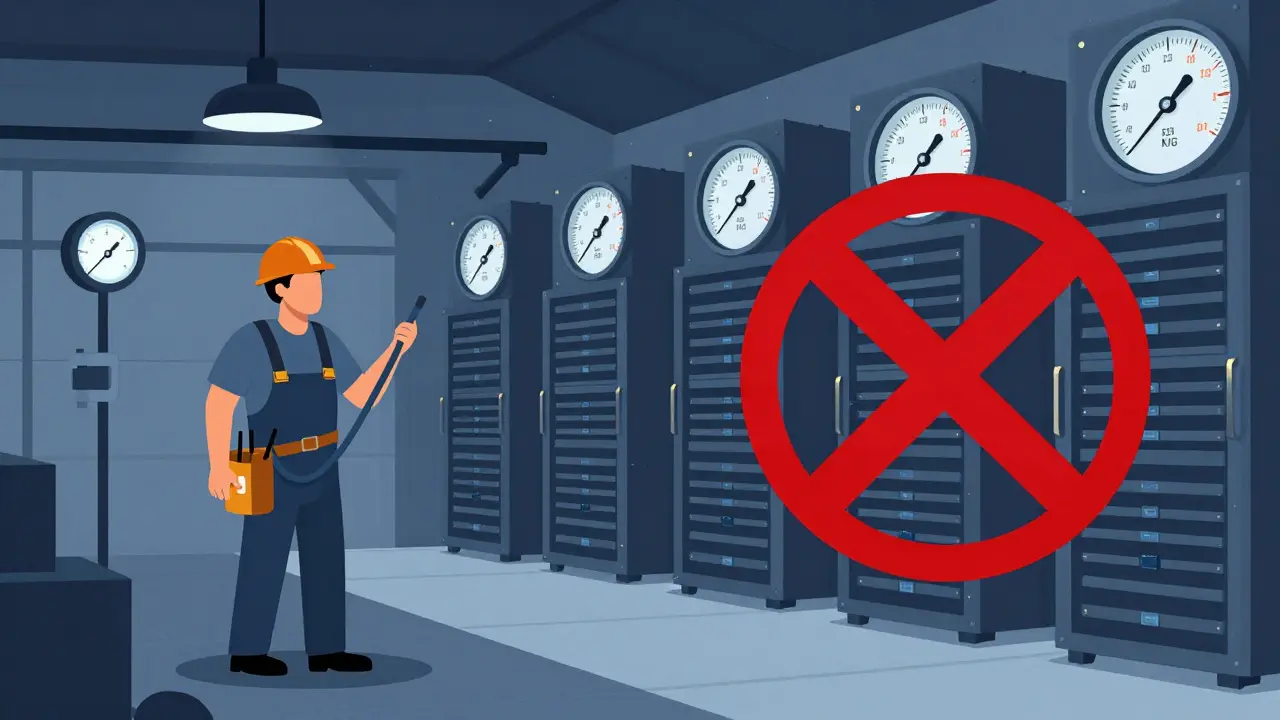
Why This Matters Beyond New Brunswick
New Brunswick’s move isn’t just local. It’s part of a global shift. China banned crypto mining in 2021 and shut down nearly 75% of the world’s Bitcoin mining capacity overnight. That sent miners scrambling. Many went to the U.S., especially Texas and Georgia. Now, Canadian provinces are stepping in to protect their own grids. The core issue isn’t Bitcoin. It’s electricity allocation. Should a province let a few hundred mining rigs use the same power that could run schools, hospitals, or electric vehicle charging stations? New Brunswick says no. And it’s not alone. At least eight countries have outright banned crypto mining. The European Union is debating strict limits. Even the U.S. federal government is starting to look at energy use as a factor in regulation. New Brunswick’s moratorium is a case study in how a province can use its control over its power grid to shape industry behavior.What’s Happening to Miners Now?
Miners who had plans in New Brunswick are now looking elsewhere. Some are relocating to Alberta. Others are moving to the U.S. Midwest, where cheap wind power and supportive local governments are attracting mining operations. A few are trying to restructure-using renewable sources, or switching to less power-hungry blockchains-but most are stuck. The moratorium has effectively frozen growth. No new mines. No expansions. No new jobs. No new tax revenue. For a province with a small economy, that’s a loss. But the government decided that protecting electricity prices and grid reliability mattered more.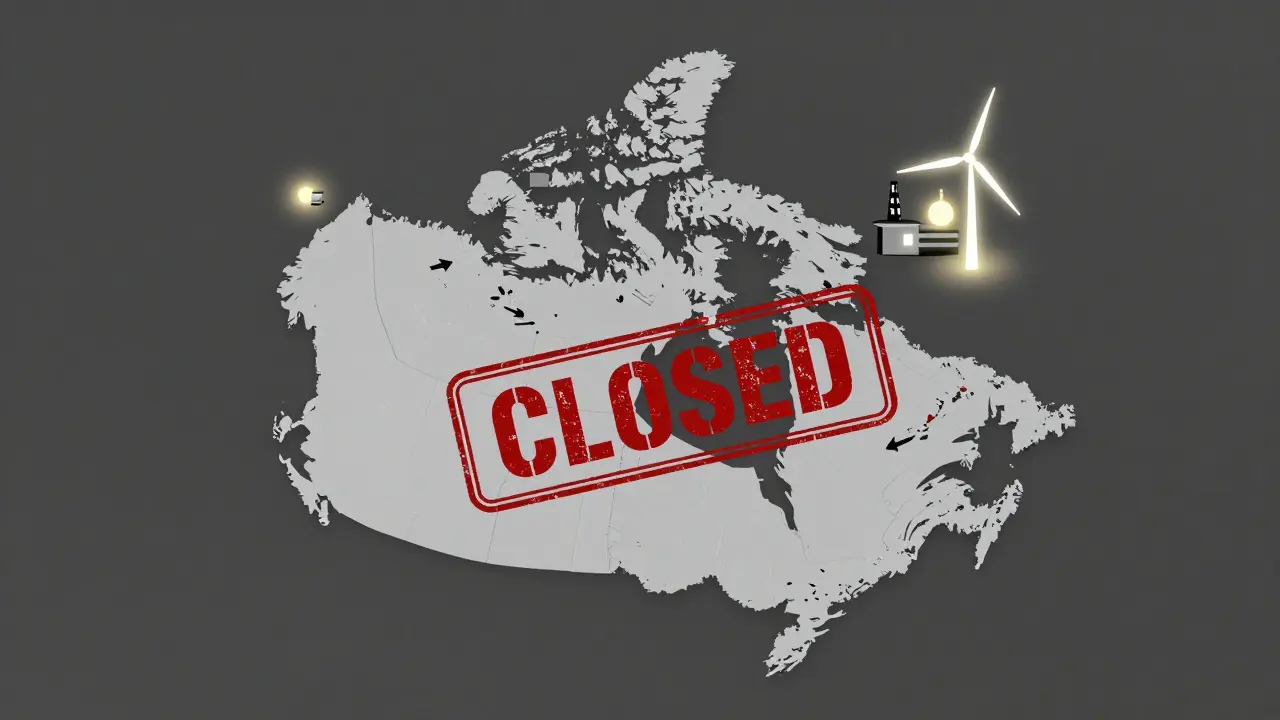
Environmental and Economic Trade-Offs
Crypto mining uses a lot of energy. Bitcoin alone consumes more electricity annually than some entire countries. Critics say it’s wasteful. Supporters argue it’s a necessary part of a decentralized financial system. But New Brunswick’s government didn’t debate philosophy. They looked at numbers. They saw that connecting every crypto miner who had expressed interest would have forced rate hikes for everyone else. They saw that the province’s hydroelectric dams couldn’t handle it without risking blackouts. And they saw the bigger picture: as the world moves toward electrifying cars, heating homes, and modernizing infrastructure, every megawatt counts. Mining Bitcoin with fossil fuels or grid power that could go elsewhere isn’t sustainable.Will This Last?
There’s no official review date. No committee. No timeline. The moratorium is indefinite. That means it could last five years. Ten years. Forever. That’s a gamble. If Bitcoin mining technology becomes 10 times more efficient, the argument for the ban weakens. If new nuclear or fusion projects come online, the grid might handle it. But right now, the province is betting that the risks outweigh the rewards. For miners, that means New Brunswick is closed. For the rest of Canada, it’s a warning: if your grid is already under pressure, don’t assume crypto mining will be welcome. New Brunswick didn’t ban Bitcoin. It banned the misuse of public infrastructure.What’s Next?
The moratorium isn’t going away soon. Until NB Power gets new capacity, or the government changes course, crypto mining in New Brunswick is at a standstill. Miners are moving on. The grid is stable. And the province is sending a clear message: energy isn’t a free commodity. It’s a public resource.Is crypto mining completely banned in New Brunswick?
Yes, for new operations and expansions. NB Power is legally prohibited from providing electricity to any new cryptocurrency mining facility or to existing ones seeking to increase their power usage. The ban is indefinite and applies to all Proof of Work mining, including Bitcoin.
Can I still mine Bitcoin at home in New Brunswick?
Technically, yes-but it’s impractical. Home mining with a few rigs won’t trigger the moratorium, since the ban targets grid-scale operations. But the electricity costs are high, and the returns are low. Most home miners in New Brunswick have shut down because it’s not profitable anymore.
Why not just build more power plants?
Building new power infrastructure takes years and billions of dollars. New Brunswick’s hydroelectric dams are already operating near capacity. Expanding them would require major environmental reviews, land use changes, and public approval. The government decided it wasn’t worth it for an industry with questionable long-term value.
What about miners who were already operating before the ban?
They’re grandfathered in-but only at their current power levels. They can’t add more rigs, upgrade hardware to use more power, or expand their facilities. If they shut down and restart later, they lose their connection. The ban is strict on growth.
Could New Brunswick change its mind?
It’s possible, but unlikely without major changes. If Bitcoin mining becomes dramatically more energy-efficient, or if the province gets a massive new power source (like offshore wind or nuclear), the policy might be reconsidered. But right now, there’s no indication the government plans to revisit it.
28 Responses
I've seen this play out in Texas too. When the grid gets stressed, they just throttle the miners first. Smart move by NB. Electricity isn't some infinite resource you can hand out to crypto bros who think they're building the future. It's the same grid that keeps my grandma's oxygen machine running. Priorities.
I mean, imagine if your neighbor showed up with a giant industrial fan and said 'I'm just using the same outlet you are!' and then plugged in 300 ASICs. You'd be like... dude, I'm trying to watch Netflix. This isn't a libertarian fantasyland, it's a province with real people needing real power. I respect NB for drawing the line.
This is why Canada is falling behind. You let a bunch of socialist bureaucrats in New Brunswick shut down an entire industry because they're scared of a little electricity use? Bitcoin is the future. The grid can handle it. We need more mining, not less. This is pure Luddite thinking. The US is laughing all the way to the bank while you guys are still debating whether to let miners plug in.
so like... the province just said no? no hearing? no vote? no law? just a utility saying 'nope' and thats it? like what even is this? i thought we lived in a democracy? also why are they even talking about bitcoin? its not like its the only crypto. what about litecoin? doge? this is so stupid. they should just let people mine if they want. its not like its hurting anyone. i mean, its just electrons. lol
this is what happens when you let western countries think they own the world. africa and asia are building real infrastructure. we dont waste power on fake money. you people think bitcoin is money? its just code. its not even real. new brunswick did the right thing. they protect their people. not some rich american dude who thinks he can mine his way to riches. you dont deserve power. you just want to burn it for no reason.
The moratorium is a classic case of infrastructure prioritization. When you have constrained capacity and competing demands - residential, healthcare, EV charging, industrial - you allocate to the highest social utility. Mining is a zero-sum load with no multiplier effect. It doesn't create jobs long-term, doesn't build tech, doesn't train engineers. It just consumes. NB's move is economically rational, not ideological.
I'm so proud of NB for doing this 🙌 It's not about hating crypto - it's about protecting what matters. Imagine if your kid's school had to cut heating because a warehouse was using 200 MW to mine coins. That's not innovation, that's theft. And honestly? I'm glad someone finally said 'no' to the crypto bros. You can mine on solar, sure - but not on the grid that keeps hospitals alive. 💙
The real tragedy here is not the moratorium - it's that New Brunswick didn't seize the opportunity to become a sovereign mining hub with its own microgrid and renewable integration. This isn't about power scarcity - it's about vision failure. They could have been the Tesla of energy policy. Instead, they chose fear. How profoundly unambitious.
I used to mine Bitcoin in my garage. Bought 6 rigs. Made $400 in six months. Paid $1200 in electricity. The math doesn't lie. Most home miners are just throwing money into a black hole. The real players are the ones with warehouse-sized ops. And yeah - those should be regulated. Or banned. Either way, the system isn't broken. It's just being exploited.
so like... if i have 3 asics in my basement i can still mine? but if i buy 10 more? nope? so its not about the power usage its about the number of rigs? thats so weird. like why not just cap the watts? why make it about how many machines? its so dumb. also i think this is just a way to stop tech progress. we should be embracing innovation not shutting it down. also i miss my dog
mining is a scam. it uses more power than some countries. and for what? digital money that no one uses? the only people making money are the ones selling the rigs. everyone else is just losing. nb did the right thing. stop pretending this is about freedom. its about greed. and i'm glad they said no.
I think it's important to remember that electricity isn't just a commodity. It's a public good. When you have a grid that's already near capacity, and you're being asked to choose between keeping the lights on in a rural hospital or letting a company run thousands of ASICs 24/7 - there's no real choice. This isn't anti-crypto. It's pro-community.
Let me break this down simply. The government didn't ban Bitcoin. It said: 'You can't use our public infrastructure to run a speculative, energy-intensive business that doesn't benefit the public.' That's not anti-innovation. That's responsible governance. We don't let people build nuclear reactors in their backyards. We don't let factories dump waste into rivers. This is the same principle. Energy is shared. It's not yours to hoard.
The entire argument is based on a fallacy. Bitcoin mining is not about consumption - it's about security. The energy used is the cost of decentralization. If you're against mining, you're against the entire premise of blockchain. You're not protecting the grid - you're protecting centralized control. The real enemy isn't the miners. It's the utility monopolies who don't want competition.
There's a nuance here that's being missed. The moratorium targets *grid-connected* large-scale operations. That's smart. It doesn't ban innovation - it redirects it. Miners should be incentivized to use stranded renewables, flared gas, or off-grid systems. The policy isn't anti-mining. It's pro-sustainability. The next step? Tax the grid load and fund renewable expansion with the proceeds.
I think this is one of the most mature policy decisions I've seen in years. It's not about hating tech. It's about not letting tech hijack public resources. Imagine if every city let a company take over 70% of its power to mine crypto - schools would close, hospitals would ration, elderly people would freeze. NB chose people over profit. That's leadership. I hope more places follow.
i think nb did good. we in india also have power problem. many places no electricity for 8 hours. so why give to crypto? i dont understand. miners are rich. they dont need our power. let them use solar or wind. not our grid. we need for school and hospital. thank you nb
OMG this is the WORST thing ever. They're destroying freedom. Bitcoin is the future. This is like when the government banned the internet in 2005. What's next? No more laptops? No more Wi-Fi? They're going to take my ASICs! I have a 100k investment! This is tyranny! I'm moving to Texas! I'm starting a petition! #FreeCryptoNB #StopTheBan
This decision reflects deep respect for public welfare. Energy is not a market commodity to be auctioned off to the highest bidder. It is the foundation of societal stability. New Brunswick's stance is not merely policy - it is ethics in action. Other provinces should study this model. Sustainability cannot be sacrificed for speculative gain.
Look, I get it. You're scared. You don't understand blockchain. You think miners are just burning electricity for fun. But here's the thing - this isn't about crypto. It's about control. The power company wants to keep the monopoly. They don't want decentralized energy. They don't want innovation. They want you to keep paying high rates. This ban? It's not about the grid. It's about power. And they're scared.
I mean... they banned mining... but what about the fact that the grid is powered by... coal? and natural gas? and hydro? isn't that also bad? so you're banning crypto because it uses energy... but you're fine with burning fossil fuels? that's hypocritical. also... why not just tax the miners? why ban them? this makes no sense. also i think this is stupid.
The real issue isn't energy use - it's accountability. If you're going to consume megawatts, you should be held to the same standards as a factory. No permits? No environmental review? No community input? That's not innovation - that's corporate exploitation. NB didn't ban mining. They banned *unregulated* mining. Big difference.
i think nb did the right thing. its not about bitcoin. its about the grid. if you cant even keep the lights on in your town because some guy in a warehouse is mining coins... thats not progress. thats just dumb. we should be using power for real stuff. not fake money. also i like cats
The fact that this is even a debate says a lot. We're treating electricity like it's infinite. It's not. We're treating grid capacity like it's a free-for-all. It's not. NB made the call: public infrastructure serves the public. Not the next billionaire who wants to turn a kilowatt into a bitcoin. That's not a loss. That's wisdom.
this is why western countries are dying. you let the rich take everything. miners are american billionaires. they dont care about new brunswick. they just want to steal your power. we in india have no power for 10 hours a day. you think we should let rich americans mine? no. you should be ashamed. this is not freedom. this is theft. and you call it innovation? laughable.
I've been following this for a while. The real win here isn't the ban - it's the clarity. NB didn't just say 'no.' They said: 'We know what our grid can handle. And we're not going to gamble with people's lives.' That's rare. Most places just kick the can down the road. This? This is leadership.
The legal and ethical precedent set here is significant. By treating electricity as a public utility with finite capacity - and by refusing to allow speculative, non-essential loads to override essential services - New Brunswick has affirmed a foundational principle of public infrastructure governance. This is not anti-technology; it is pro-society. Other jurisdictions would do well to emulate this model.
You're all just crying because you can't get your hands on cheap power. Meanwhile, Alberta is building mining farms with natural gas that would've been flared. That's circular economy. That's innovation. New Brunswick? They're just scared. And scared governments don't lead. They just block. The future belongs to those who say 'yes' - not 'no'.