

Did you know that simply paying a network fee with Bitcoin can trigger a taxable event in Australia? For many investors, this is the first shock when they sit down to file their taxes. The Australian Taxation Office (ATO) treats cryptocurrency not as money, but as property. This distinction changes everything about how you calculate your tax bill.
If you are holding digital assets in Australia, understanding Capital Gains Tax (CGT) is not optional-it is mandatory. The rules have tightened significantly since the initial guidance in 2014, and with new data-sharing agreements between the ATO and major exchanges like Swyftx and CoinSpot, the days of flying under the radar are over. This guide breaks down exactly how CGT applies to your crypto, how to use the 50% discount to save thousands, and what mistakes could cost you big time.
How the ATO Treats Cryptocurrency
To understand your tax liability, you first need to understand the classification. In Australia, cryptocurrencies like Bitcoin, Ethereum, and stablecoins are classified as property. They are not considered currency for tax purposes.
This means every time you dispose of crypto, you may trigger a Capital Gains Tax event. "Disposal" is a broad term. It includes:
- Selling crypto for Australian dollars (AUD).
- Trading one cryptocurrency for another (e.g., swapping BTC for ETH).
- Spending crypto on goods or services.
- Gifting crypto to someone else.
- Paying transaction fees using crypto tokens.
The ATO requires you to convert the value of these transactions into AUD at the exact time they occur. You cannot use an average annual price; you must use the spot price at the moment of the trade. This precision is why manual tracking is nearly impossible for active traders.
The Golden Rule: The 50% CGT Discount
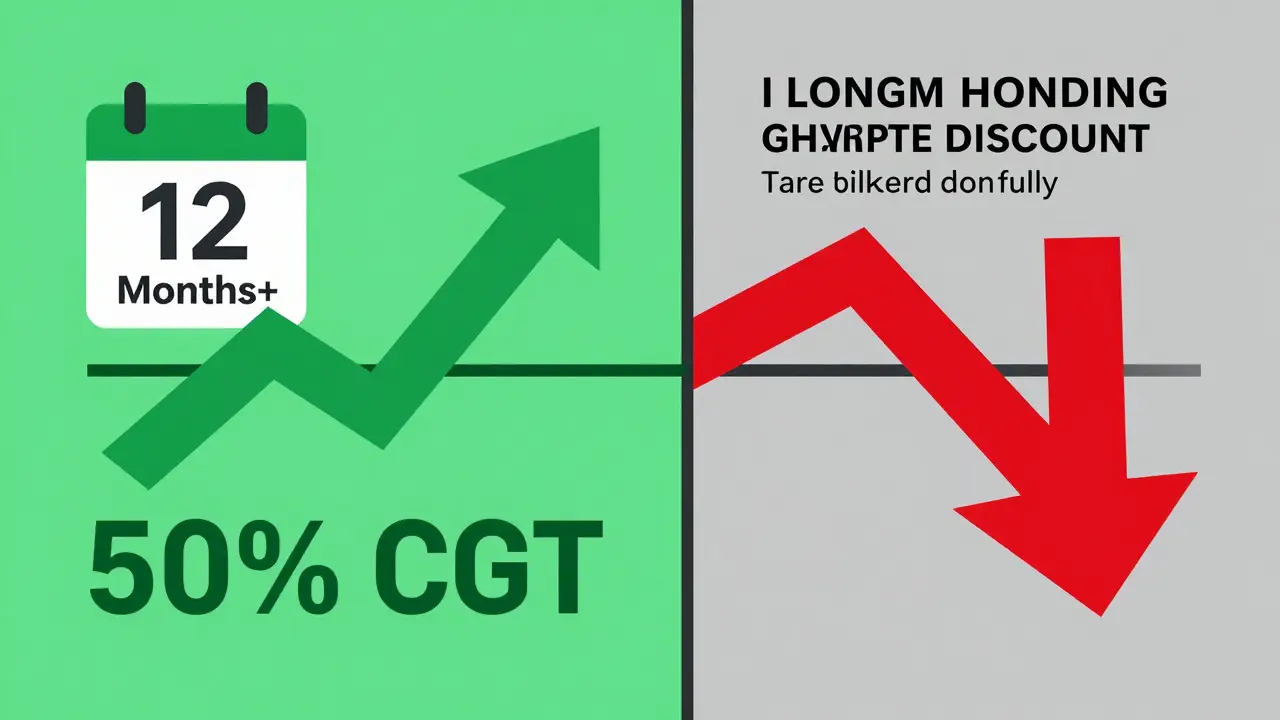
The most significant advantage for Australian crypto investors is the 50% Capital Gains Tax discount. If you hold a crypto asset for more than 12 months before disposing of it, you can halve your capital gain before adding it to your taxable income.
Here is how it works in practice. Let’s say you bought Ethereum for $2,000 AUD. One year and one day later, you sell it for $4,000 AUD. Your total capital gain is $2,000. Because you held it for longer than 12 months, you apply the 50% discount. Only $1,000 of that gain is added to your assessable income.
If you had sold it after only 11 months, the full $2,000 gain would be added to your income. For high-income earners taxed at the 45% marginal rate, this difference is massive. The discount effectively lowers the tax rate on long-term holdings, making "HODLing" a legitimate tax strategy rather than just a meme.
| Holding Period | Capital Gain | Taxable Amount Added to Income | Effective Tax Impact |
|---|---|---|---|
| Less than 12 months | $10,000 | $10,000 (Full amount) | Taxed at your full marginal rate (up to 45%) |
| More than 12 months | $10,000 | $5,000 (50% discounted) | Taxed at half the effective rate |
Investor vs. Trader: Which Category Are You?
Not all crypto activity falls under Capital Gains Tax. The ATO distinguishes between passive investors and active traders. This distinction is critical because it determines whether you pay CGT or ordinary income tax.
Passive Investors buy and hold assets for capital appreciation. They qualify for the 50% CGT discount if they hold for 12+ months. Their gains are treated as capital events.
Active Traders are considered to be carrying on a business. If the ATO determines you are trading frequently, buying and selling short-term, or operating with a commercial structure, your profits are treated as ordinary income. This means:
- No 50% CGT discount, regardless of holding period.
- Gains are added to your salary and other income.
- You may be able to deduct business expenses (like software subscriptions or home office costs), which investors generally cannot do as easily.
The ATO looks at several factors to make this determination: the frequency of trades, the volume of transactions, and whether you have a business plan. Assistant Commissioner Kath Anderson noted in 2025 that the ATO is specifically targeting individuals with 100+ transactions per year who may be misclassifying themselves as investors to access the CGT discount.
Calculating Your Cost Base
To work out your capital gain or loss, you need to determine your "cost base." This is not just the purchase price. Under Australian law, the cost base includes five elements:
- The market value of the land (if applicable, though rare for pure crypto).
- Incidental costs of acquisition (exchange fees, brokerage fees).
- Costs of ownership (holding costs, though often limited for crypto).
- Costs of disposal (selling fees, network gas fees).
- Other costs related to the asset.
For most retail investors, the key components are the purchase price plus any fees paid to acquire the asset, minus any fees received upon sale. However, complexity arises when you receive crypto through different methods:
- Mining: Mining rewards are treated as ordinary income at the market value when received. That market value becomes your cost base for future CGT calculations.
- Staking: Similar to mining, staking rewards are generally assessable income when received.
- Airdrops: Free tokens received via airdrop are usually treated as income at their fair market value at the time of receipt.
If you mix these assets in the same wallet, tracking the specific cost base for each coin becomes difficult. The ATO prefers the "Specific Identification" method, where you track individual coins from purchase to sale. If you cannot identify specific coins, you may need to use averaging methods, which can sometimes result in higher tax liabilities.
Common Pitfalls and Hidden Tax Events
Many taxpayers miss small but taxable events. Here are the most common traps:
The Network Fee Trap: When you send Bitcoin to another wallet, you pay a fee in Bitcoin. The ATO views this as a disposal of the portion of Bitcoin used for the fee. If the value of that Bitcoin has increased since you bought it, you have a capital gain on the fee itself. While the amounts are often small, they add up over hundreds of transactions.
The Personal Use Asset Myth: There is a $10,000 exemption for personal use assets. However, the ATO defines "personal use" strictly. It covers items like furniture or clothes. Most crypto investors fail this test because they intend to profit from the asset's growth. Unless you bought a small amount of crypto purely for personal enjoyment with no intent to profit (which is hard to prove), this exemption rarely applies to investment portfolios.
DeFi and Liquidity Pools: Providing liquidity in Decentralized Finance (DeFi) protocols triggers multiple CGT events. Depositing assets is often a disposal. Withdrawing them is another. Earning yield tokens is income. Without specialized software, tracking these events manually is virtually impossible.
Record Keeping and Compliance Tools
The ATO mandates that you keep records for five years. You need details for every single transaction: date, time, amount, AUD value at the time, and counterparty information. Given that 1.2 million Australians reported crypto transactions in the 2023-2024 tax year, the ATO is increasingly using data matching to verify returns.
Manual spreadsheets are prone to error and rarely capture the nuance of DeFi or complex swap routes. Most serious investors now use dedicated crypto tax software. Platforms like Koinly and CoinTracker connect directly to exchanges and wallets via API. They automatically categorize transactions, calculate cost bases using FIFO (First-In, First-Out) or Specific ID methods, and generate reports compatible with Australian tax filing systems.
While these tools cost money, the potential savings from correctly applying the 50% discount and identifying capital losses often outweigh the subscription fee. A survey by CoinLedger in 2025 found that users spent an average of 15-20 hours documenting their activity manually, whereas software reduced this to under two hours.
Offsetting Losses Against Gains
You don’t always have to pay tax on gains. If you have capital losses, you can offset them against your capital gains. For example, if you made $10,000 in gains on Bitcoin but lost $3,000 on an NFT project, your net capital gain is $7,000. You then apply the 50% discount (if eligible) to the $7,000.
If your capital losses exceed your gains, you can carry forward the unused losses to future financial years. This is crucial for volatile markets. Never ignore a losing position; even if you think the asset is worthless, reporting the loss provides a tax shield for future profits.
What Comes Next?
The regulatory landscape is evolving. The ATO has announced direct data sharing with major exchanges, and there are proposals for mandatory reporting of transactions over $10,000. Compliance is no longer optional. As we move through 2026, expect stricter scrutiny on high-frequency traders and clearer guidance on emerging areas like staking and DeFi.
For most investors, the strategy remains simple: hold for more than 12 months to secure the 50% discount, keep meticulous records using reliable software, and consult a tax professional if your trading volume suggests you might be running a business. The 50% CGT discount is your best friend in the Australian crypto tax system-make sure you use it.
Is crypto tax-free in Australia?
No, crypto is not tax-free in Australia. It is subject to Capital Gains Tax (CGT) or Ordinary Income Tax depending on how you use it. However, gains are tax-free if your total income (including crypto gains) is below the tax-free threshold of $18,200 AUD.
Do I pay tax if I hold crypto for more than 12 months?
You still pay tax, but you benefit from the 50% CGT discount. This means only half of your capital gain is added to your taxable income, significantly reducing your tax bill compared to short-term holdings.
What happens if I trade one crypto for another?
Swapping one cryptocurrency for another (e.g., BTC to ETH) is a taxable disposal event. You must calculate the capital gain or loss based on the AUD value of the crypto you gave up versus its original cost base.
How does the ATO know if I have crypto?
The ATO shares data directly with major Australian exchanges like Swyftx, CoinSpot, and Independent Reserve. They also cross-reference bank transfers and use data-matching programs to identify unreported crypto transactions.
Can I deduct my crypto losses?
Yes, capital losses can be offset against capital gains in the same financial year. If your losses exceed your gains, you can carry forward the remaining losses to offset future gains.
Are staking rewards taxable?
Yes, staking rewards are generally treated as ordinary income at their market value when received. This amount becomes your cost base for future CGT calculations when you eventually sell those rewards.
What is the difference between an investor and a trader for tax purposes?
Investors hold assets for capital growth and qualify for the 50% CGT discount after 12 months. Traders are seen as running a business; their profits are taxed as ordinary income with no CGT discount, but they may claim business expense deductions.
Do I need to report crypto gifts?
Yes, gifting crypto is a disposal event. You must calculate the capital gain or loss based on the market value of the crypto at the time of the gift. The recipient takes on your cost base and holding period.