
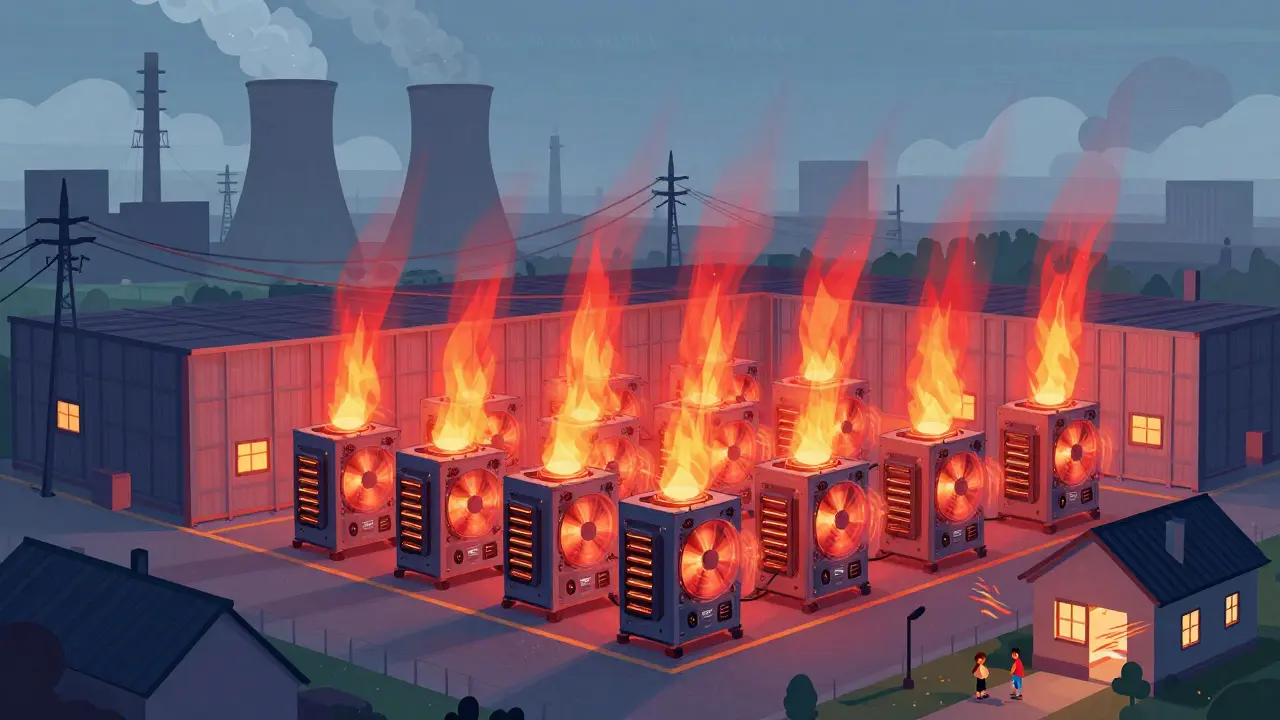
The environmental impact of cryptocurrency isn’t theoretical-it’s happening right now, in the air you breathe, the water you drink, and the power bills of your neighbors. Bitcoin alone uses more electricity each year than entire countries like Mexico and Italy. That’s not a guess. It’s a 2025 Cambridge Centre for Alternative Finance report backed by data from nearly half the global mining network. And it’s getting worse.
How Bitcoin Mining Burns Energy
Bitcoin doesn’t run on servers in a quiet data center. It runs on massive warehouses full of machines that scream, overheat, and guzzle electricity 24/7. These machines, called ASIC miners, solve complex math problems to validate transactions and earn new Bitcoin. This process is called proof-of-work, and it’s intentionally hard. That’s the whole point: to make the network secure. But it also means each Bitcoin transaction emits about 672 kg of CO₂-equivalent to driving a gas car for 1,600 kilometers. The scale is staggering. In 2025, Bitcoin mining consumed 150 terawatt-hours (TWh) of electricity globally. That’s more than the entire country of Argentina uses in a year. And it’s not just about the numbers. It’s about where that power comes from.Where Does the Power Come From?
A 2025 study found that 43% of Bitcoin mining runs on renewable energy-mostly hydropower in places like Canada and Kazakhstan, and some wind and solar in Texas. That sounds good, right? But here’s the catch: 57% still comes from fossil fuels. Natural gas makes up 38%, coal 9%. And that’s the problem. In the U.S., a March 2025 study from Harvard’s T.H. Chan School of Public Health tracked 34 of the largest Bitcoin mines. Between August 2022 and July 2023, those mines used 32.3 TWh of electricity-33% more than the entire city of Los Angeles. And 85% of that extra power came from fossil fuel plants. That’s not just carbon. That’s pollution. Fine particulate matter (PM2.5) linked to cancer, heart disease, and dementia. Millions of Americans living near these mines are breathing it in. It’s not just air. Mining operations in Texas have been fined for noise violations. Cooling fans run at 70-80 decibels-like a constant jackhammer outside your bedroom. Communities are pushing back. Some cities are banning new mining permits. Others are threatening to cut power.Why Proof-of-Work Is the Problem
Bitcoin’s proof-of-work system is like a car that burns a gallon of gas to go one mile. It’s inefficient by design. Ethereum, the second-largest cryptocurrency, fixed this in September 2022 with something called “The Merge.” It switched from proof-of-work to proof-of-stake. Energy use dropped by 99.95%. Overnight. No new hardware. No new mines. Just smarter code. Yet Bitcoin’s community still defends proof-of-work. They say it’s more secure. That’s true-but not if security comes at the cost of climate stability. The International Monetary Fund warns that by 2027, crypto and AI together could use 2% of global electricity and contribute 1% to global emissions. That’s not a small side effect. That’s a major driver.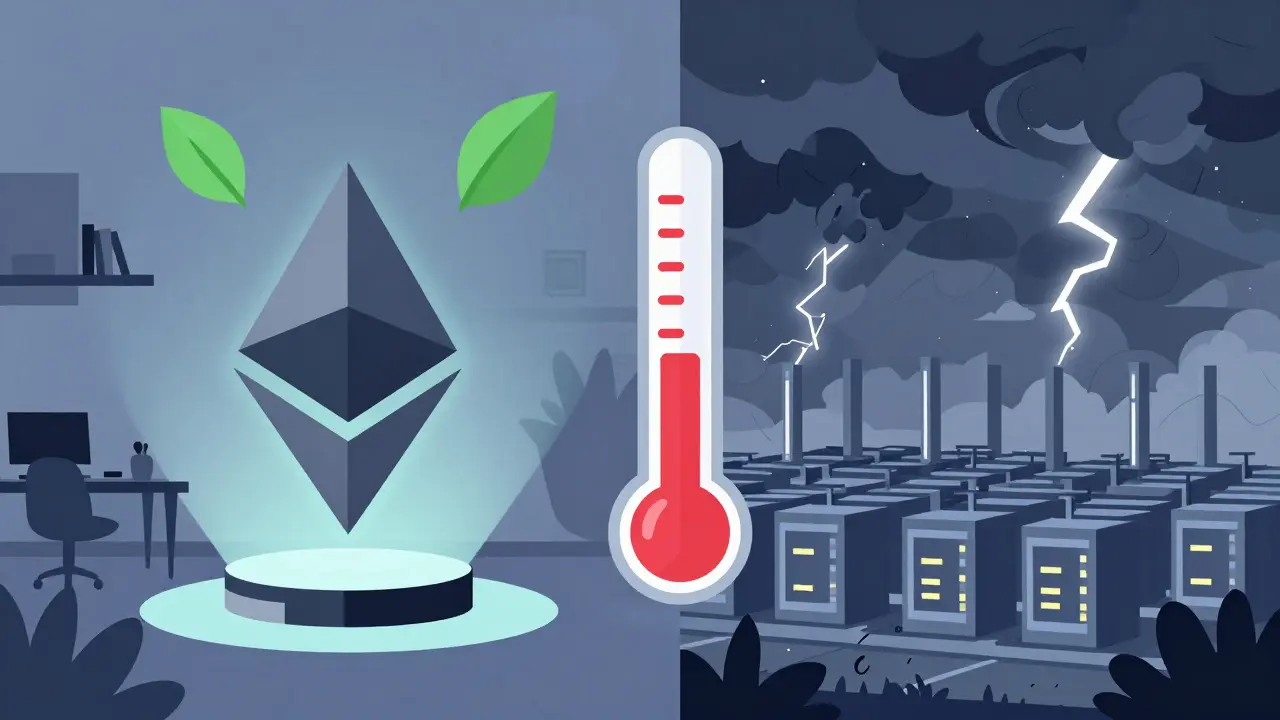
Global Inequality in Impact
The environmental cost of crypto isn’t spread evenly. In Canada and Scandinavia, miners use cheap, clean hydroelectric power. That’s low-carbon. But in places like Kazakhstan and Russia, miners plug into coal-heavy grids. In the U.S., mining booms in states with weak environmental rules-Texas, Kentucky, Pennsylvania. Meanwhile, countries like Kuwait have outright banned mining because it was overloading their national grid. Even renewable energy isn’t a free pass. When miners sign long-term contracts with wind or solar farms, they lock up clean power that could go to homes, hospitals, or schools. Mandy DeRoche from Earthjustice put it plainly: “If you use all that cheap, clean hydro for crypto mining, then humans and small businesses can’t use it-and then they have to go somewhere else for that energy. And often, it’s fossil fuel-based.”Who’s Trying to Fix It?
Some mining companies say they’re cleaning up. Marathon Digital, Riot Platforms, and CleanSpark claim they’re using waste methane from oil fields-gas that would’ve been burned off anyway-to power their rigs. That’s better than coal. But it’s still burning fossil fuel. And it’s expensive. CleanSpark spent $220 million connecting its Texas mines to solar farms. That’s not a small investment. Most miners can’t afford it. There’s also noise pollution. Immersion cooling-submerging servers in liquid to reduce fan noise-costs $15,000 per rack. That’s out of reach for small operators. The Bitcoin Mining Council, an industry group, says 61 of its 104 members aim for net-zero by 2030. But only 38% of major mining firms even report their data. Voluntary reporting isn’t enough.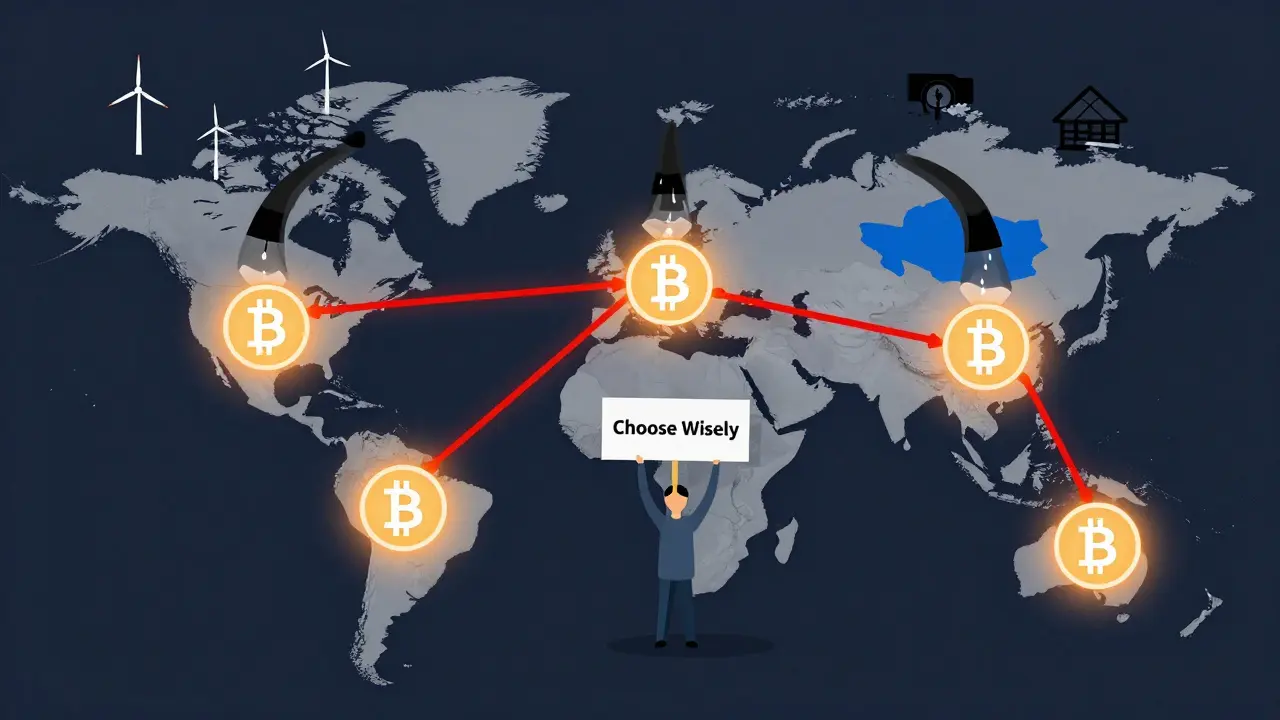
Market Reactions and Corporate Shifts
Big companies are pulling back. PayPal shut down its crypto services in February 2025, citing unresolved environmental concerns. Tesla briefly resumed Bitcoin payments in 2024-but only after demanding proof that every transaction was powered by 100% renewable energy. That’s hard to verify. Most miners don’t track it. The European Union’s MiCA regulation, which took effect in June 2024, requires crypto firms to report their environmental impact. But a Deloitte survey found 78% of EU exchanges are struggling to comply. They don’t have the data. Or the will. Meanwhile, the U.S. federal government is split. Some states are cracking down. Others, under the 2024 Trump executive order, rolled back environmental reviews for mining facilities. That’s a recipe for more pollution in places with weak oversight.What’s Next?
The science is clear: Bitcoin mining is accelerating climate change. A 2025 study in Scientific Reports found a direct, causal link between rising Bitcoin demand and worsening environmental degradation. The more the price goes up, the more energy gets burned. But there’s hope. Renewable energy use in Bitcoin mining has jumped from 39% in 2022 to 52% in 2025. That’s progress. Some miners are now using stranded renewables-wind power that would’ve been wasted because the grid couldn’t absorb it. That’s smart. But it’s still a drop in the bucket. The real solution? Move away from proof-of-work. The technology exists. Ethereum proved it. Bitcoin’s resistance isn’t technical-it’s ideological. Many miners believe the system must stay “pure,” even if it’s destroying the planet.What You Can Do
If you hold Bitcoin or other proof-of-work coins, ask yourself: Is the value worth the cost? A Reddit user named GreenCryptoGuy sold half his Bitcoin portfolio after reading the Harvard study on air pollution. He said, “I can’t support something that’s killing people.” You don’t have to give up crypto. But you can choose wisely. Use Ethereum, Solana, or Cardano-coins that use proof-of-stake. They’re faster, cheaper, and use 99.9% less energy. Support companies that report their emissions. Avoid miners in coal-heavy regions. And if you’re an investor, ask: What’s the carbon footprint of this asset? The climate crisis isn’t coming. It’s here. And cryptocurrency is adding to it. The question isn’t whether we can fix it. It’s whether we’re willing to.How much electricity does Bitcoin mining use annually?
As of 2025, Bitcoin mining consumes an estimated 150 terawatt-hours (TWh) of electricity per year-more than the annual usage of countries like Mexico and Italy. This figure is based on data from the Cambridge Centre for Alternative Finance, which surveyed mining firms representing nearly half the global Bitcoin network.
Is Bitcoin mining bad for the environment?
Yes, significantly. Bitcoin mining is responsible for about 0.7% of global CO₂ emissions. A 2025 Harvard study linked U.S.-based mining operations to increased air pollution, with 85% of the additional electricity demand coming from fossil fuel plants. This pollution contributes to respiratory illnesses, heart disease, and cancer. Mining also creates noise pollution and strains local power grids.
Are there eco-friendly cryptocurrencies?
Yes. Cryptocurrencies using proof-of-stake, like Ethereum (after The Merge in 2022), Solana, and Cardano, use 99.9% less energy than Bitcoin. Ethereum’s switch reduced its annual electricity use from 70 TWh to under 0.01 TWh. These networks validate transactions through staking rather than energy-intensive mining, making them far more sustainable.
Do renewable energy sources make crypto mining sustainable?
Not fully. While 52% of Bitcoin mining now uses renewable energy (as of 2025), that still leaves 48% reliant on fossil fuels. Even when renewables are used, they often displace clean power that could go to homes, hospitals, or industry. Experts warn that using scarce renewable resources for mining can force others to rely on coal or gas instead, worsening overall emissions.
What’s the difference between proof-of-work and proof-of-stake?
Proof-of-work requires miners to solve complex math problems using powerful computers, consuming massive amounts of electricity. Proof-of-stake selects validators based on how much cryptocurrency they hold and are willing to "stake" as collateral. No mining hardware is needed. Ethereum’s switch to proof-of-stake in 2022 cut its energy use by 99.95%, proving the model works at scale.
Are there any regulations targeting crypto’s environmental impact?
Yes. The European Union’s MiCA regulation, effective since June 2024, requires crypto firms to disclose their environmental impact. Kuwait banned mining entirely in 2025 due to grid strain. In the U.S., some cities have imposed noise and energy use limits. However, federal policy remains inconsistent, with some states rolling back environmental reviews for mining operations.
Can Bitcoin mining help renewable energy development?
Some argue it can-by using surplus wind or solar power that would otherwise be wasted. A few miners in Texas and Alberta have partnered with renewable farms to absorb excess output. But this is a small fraction of the market. Most mining still relies on grid power, and the industry’s growth often outpaces renewable expansion, leading to increased fossil fuel use overall.
Why hasn’t Bitcoin switched to proof-of-stake?
Bitcoin’s core community believes proof-of-work is essential for security and decentralization. They argue that changing the consensus mechanism would compromise the network’s integrity. While Ethereum proved proof-of-stake can work safely at scale, Bitcoin’s developers and miners see any major change as a risk to its identity as a censorship-resistant asset.
How does crypto mining affect local communities?
In areas with heavy mining, communities face rising electricity prices, noise pollution from cooling fans (70-80 decibels), and increased air pollution from fossil-fueled power plants. Some towns have seen health complaints rise. Others have passed ordinances to limit mining operations or cut power to new facilities. Legal battles are mounting-with 17 class-action lawsuits filed in the U.S. as of mid-2025.
What’s the future of crypto’s environmental impact?
If Bitcoin continues using proof-of-work, its energy use could reach 3-4% of global electricity by 2030, according to the IMF. That’s unsustainable. The only long-term solution is widespread adoption of proof-of-stake or other low-energy consensus mechanisms. Until then, environmental harm will grow alongside price spikes. The choice isn’t between technology and nature-it’s between choices that matter.
21 Responses
It’s wild to think we’re treating the planet like a disposable battery. We build these insane machines just to validate digital transactions, and then act surprised when the air gets thicker. But here’s the thing-we’re not powerless. We choose what we support. Every time we pick Ethereum over Bitcoin, we vote for a cleaner future. It’s not about giving up tech. It’s about demanding better from it.
Change doesn’t come from legislation alone. It comes from people like us, quietly shifting our habits. One wallet at a time.
I used to mine. I don’t anymore. Not because I was scared. Because I was ashamed.
Proof-of-work isn’t broken-it’s a feature. The system is designed to be wasteful so it can’t be easily corrupted. That’s the trade-off. You want security? You pay for it-in energy, in infrastructure, in environmental cost. But we’ve been conditioned to think efficiency is always better. Maybe it’s not. Maybe the inefficiency is the point.
People forget: Bitcoin was built to outlive governments. If we start optimizing it for comfort, we lose what makes it valuable.
Still… I wish there was a middle ground.
150 TWh? That’s nothing. The entire US military uses more. And you’re mad about crypto but not about Netflix streaming 4K? Or air conditioners in McMansions? Wake up. This is virtue signaling dressed as science.
Let’s be real here. The environmental impact of Bitcoin is real, but it’s being weaponized by central banks and fossil fuel lobbies to kill competition. You think the grid in Texas is bad? Try the Indian power grid-80% coal, 1.3 billion people without reliable electricity, and yet no one’s banning TikTok or WhatsApp for power usage. Why? Because they’re not a threat to the system.
Bitcoin mining in India is still tiny, but if it grows, you’ll hear the same screams. The real issue isn’t energy-it’s control. Who gets to decide what’s ‘legitimate’ value?
Also, the Harvard study? They used proxy data from 34 mines. That’s not a sample-it’s a guess. And the 85% fossil fuel number? That’s based on regional grid averages, not actual miner sourcing. Most miners are in places with no reporting. So how do we know?
Don’t get me wrong-I’d love to see proof-of-stake everywhere. But let’s not pretend this is a clean moral fight. It’s a power play. And the people screaming loudest are the ones who benefit most from the status quo.
Okay but imagine if we redirected all that energy into building solar farms instead? 🤔
What if every Bitcoin miner had to build a matching solar array? What if the energy used was tied to renewable production? That’s not a pipe dream-it’s a business model. Companies like CleanSpark are already doing it. We just need to make it mandatory.
Stop demonizing the tech. Start redesigning the incentives. We can have secure digital money AND a livable planet. We just need to stop being lazy about it.
people who care about this are the same people who think recycling plastic bottles saves the planet
i just read this and i cried. not because i’m emotional, but because i realized i’ve been part of the problem. i bought bitcoin in 2021 because i thought it was ‘the future’. but the future shouldn’t cost people their health. i sold half my coins last week. not for profit. because i couldn’t look at my kid’s asthma inhaler the same way again.
if you’re still holding proof-of-work coins… just ask yourself-what are you really protecting?
and yeah i typed this on my phone and there are typos. but the feeling is real.
As someone from India, I’ve watched our power grid struggle to keep lights on in rural villages while mining rigs in Texas consume more than entire towns. It’s not just about emissions-it’s about equity. Renewable energy should serve people, not profit-driven machines.
That said, I admire the innovation behind blockchain. But innovation without ethics is just noise. We need global standards-not just for reporting, but for access. If miners use renewable power, they must prove it doesn’t displace households or hospitals. That’s not regulation. That’s basic human responsibility.
Oh look, another article that conflates energy consumption with environmental harm. How quaint. The entire global financial system runs on fossil fuels. Banks, stock exchanges, gold mining, real estate-all far more wasteful. But we don’t call them criminals. Why? Because they’re polite. Bitcoin is loud. It’s disruptive. And that’s why it’s targeted.
Also, 99.95% energy reduction with Ethereum? Yes. But that’s because they abandoned decentralization. Their validators are concentrated in a handful of cloud providers. Bitcoin is the last truly decentralized money. Sacrificing that for ‘green’ is a Faustian bargain.
And yes, I know you’ll call me a fossil. I wear it as a badge.
Wow you people are so dramatic. Bitcoin uses less energy than the global chocolate industry. And you think a few mining rigs are killing the planet? Please. The real climate criminals are the ones driving SUVs to Whole Foods while pretending they’re saving the world with their reusable tote bags.
Also, the Harvard study? They didn’t even measure actual emissions from the miners. They estimated based on grid averages. That’s like blaming Walmart for the coal plants that power the whole state. Absurd.
There’s a quiet revolution happening. Miners are starting to become energy managers, not just consumers. They’re using flared gas, curtailed wind, off-peak nuclear. They’re stabilizing grids. The technology isn’t the enemy-it’s the lack of policy that lets them operate in the shadows.
We need incentives, not bans. Tax credits for renewable integration. Carbon pricing that includes crypto. Regulation that rewards innovation, not punishes it.
This isn’t about stopping Bitcoin. It’s about evolving it into something that doesn’t just survive the climate crisis-but helps solve it.
Proof-of-work is a scam. It’s just a way for rich dudes with ASICs to print money while pretending they’re securing a network. The energy use is insane. The emissions are real. And the ‘decentralization’ argument is just a cover for centralized mining pools.
Also, if you think Bitcoin is ‘digital gold’, then why does it take 10 minutes to send $100? Gold doesn’t need a 24/7 supercomputer to move.
I just saw a video of a miner in Texas with a baby monitor next to his rig. The fans are so loud, the baby can’t sleep. And people are like ‘it’s just energy’? No. It’s human. It’s families. It’s asthma. It’s kids waking up scared because the noise never stops.
How do you sleep at night knowing your ‘investment’ is keeping someone’s child awake? 😔
Wake up sheeple. This is all a psyop by the Fed and the IMF to kill Bitcoin and force CBDCs. The energy numbers are inflated. The Harvard study was funded by climate NGOs with ties to Wall Street. The EU’s MiCA? Designed to favor bank-backed tokens. Bitcoin is the only true money. Everything else is a puppet.
They don’t care about the planet. They care about control.
And if you believe this narrative, you’re already owned.
The argument that Bitcoin mining is worse than traditional finance is statistically invalid. Financial institutions use energy for data centers, ATMs, paper currency production, vaults, armored trucks, branch maintenance, and compliance staff. Bitcoin’s footprint is transparent and quantifiable. Traditional finance’s is a black box.
Furthermore, the claim that mining displaces residential power is misleading. In Texas, miners pay premium rates for excess grid capacity. They do not cause shortages-they stabilize prices during low-demand hours.
Do not confuse correlation with causation. The rise in emissions coincides with population growth and industrial expansion-not solely Bitcoin mining.
Look, I’m from India. We know what it means to live without reliable power. But I also believe in technology that empowers people. Bitcoin isn’t the villain here. The lack of clean energy infrastructure is.
What if we used mining as a bridge? Build solar farms in remote areas. Let miners use the surplus. Then, when the grid expands, those same farms power schools and clinics.
It’s not perfect. But it’s a path. We don’t need to ban Bitcoin. We need to build better systems around it.
The entire discourse is a classic case of misaligned externalities. The environmental cost is being socialized while the profits are privatized. But that’s not unique to crypto-it’s capitalism 101.
What’s missing is a proper carbon accounting framework for consensus mechanisms. Until then, we’re all just yelling into the void with cherry-picked stats.
Hey. I used to think this stuff was cool. Then I moved to a town where a mining farm opened up next to the elementary school. The noise? Unbearable. The power bills? Went up 20%. The kids started having headaches.
I didn’t know what to do. So I started talking to neighbors. We went to city council. We got a moratorium.
You don’t have to be an activist to make a difference. Just care enough to speak up.
And yeah-I still hold some crypto. But only proof-of-stake now. Because I don’t want to be part of the problem anymore.
Proof-of-work’s energy consumption is a feature, not a bug-it’s the economic security layer. But the environmental cost is a systemic externality that requires market-based correction, not moral outrage. Carbon pricing, energy taxes, and renewable procurement mandates would realign incentives without killing innovation.
Bitcoin’s resistance to change is ideological, yes-but so is the anti-crypto narrative. Both are dogmas. The solution lies in economic architecture, not virtue signaling.
That last comment about carbon pricing? Spot on. But here’s the thing-it won’t happen unless people stop treating this like a tech debate and start treating it like a public health crisis.
When a coal plant pollutes a town, we shut it down. When a mining farm does the same, we call it ‘market efficiency’. That’s not logic. That’s hypocrisy.
And if you think Bitcoin’s value is worth a child’s asthma attack… then you’re not protecting freedom. You’re just protecting greed.
Exactly. The real tragedy isn’t the energy-it’s that we’ve normalized sacrificing human well-being for abstract financial systems.
What if we taxed mining based on local air quality? What if miners had to fund community health clinics in exchange for grid access? That’s not socialism. That’s accountability.
Bitcoin could be part of the solution-if we stop letting it off the hook.