

Have you ever watched your crypto transaction sit in limbo for hours while paying a small fee, only to see someone else’s transfer confirm instantly because they paid double? That frustration is the heartbeat of blockchain economics. It isn’t just bad luck; it is a market at work. Every time you send money or interact with a smart contract on a decentralized network, you are participating in a high-stakes auction for limited space.
This system, known as fee market dynamics, is the economic mechanism that allocates scarce computational resources among competing transactions through market-based pricing. It determines who gets processed first, how much it costs, and whether the network stays secure. Understanding these dynamics is no longer optional for developers or serious users. As blockchains evolve from simple ledgers into complex global computers, the way we price access to them is changing rapidly.
The Core Mechanism: Supply, Demand, and Block Space
At its simplest, a blockchain has a hard limit on how much data it can process in a single block. Think of a block like a bus with a fixed number of seats. When only five people want to ride, everyone gets on easily, and the ticket price might be low or even free. But when fifty people show up, those willing to pay the most get the seats, and the price skyrockets.
In technical terms, this is about block space, which is the limited capacity within a blockchain block to store transaction data. The supply of this space is rigid. In Bitcoin, blocks are generated roughly every ten minutes, creating a predictable but constrained supply. In Ethereum, blocks arrive every twelve seconds, but the total data capacity per block is still capped by protocol rules.
Demand, however, is wildly volatile. It spikes during bull markets, NFT minting events, or when new viral applications launch. When demand exceeds the available block space, a queue forms. This queue is called the mempool, which is the waiting area where unconfirmed transactions reside until miners or validators select them for inclusion in a block. Validators (or miners) are profit-seeking entities. They scan the mempool and pick the transactions that offer the highest reward. This creates a competitive environment where users must bid against each other to ensure their transactions are included.
Bitcoin’s First-Price Auction Model
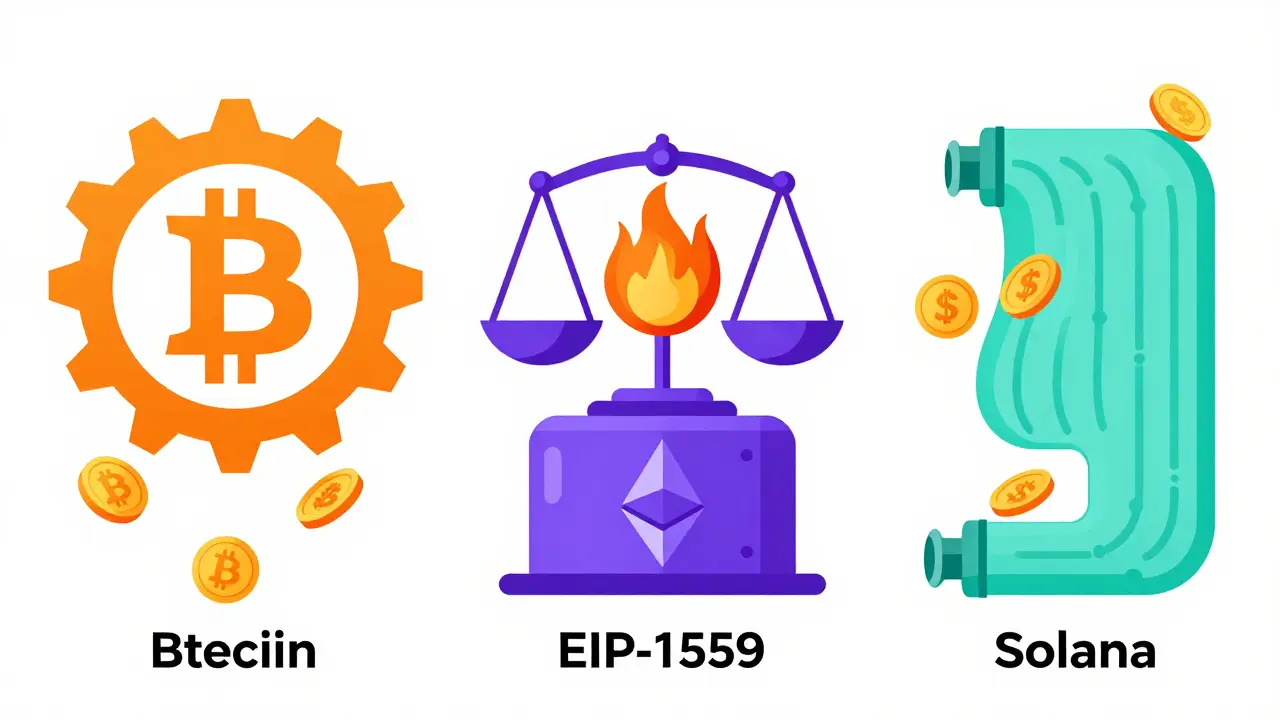
Bitcoin operates on what economists call a first-price auction, where bidders submit sealed bids, and the highest bidder wins and pays exactly what they bid. There is no base fee set by the protocol. Instead, users attach a fee rate (usually measured in satoshis per byte) directly to their transaction. Miners then sort all pending transactions by this fee rate and fill the block starting from the top.
This model is brutally efficient but unpredictable. If you underestimate the current congestion, your transaction might sit in the mempool for days. To fix this, Bitcoin introduced Replace-by-Fee (RBF), a feature that allows users to broadcast a new version of their transaction with a higher fee if the original one hasn’t been confirmed yet. However, not all wallets support RBF, leaving many users stuck.
A major shift occurred in early 2023 with the rise of Ordinals and BRC-20 tokens. These technologies allowed users to inscribe data (like images or metadata) directly onto individual satoshis. This created a massive new source of demand for block space. Suddenly, people weren’t just sending money; they were storing digital artifacts. This competition drove average Bitcoin fees from less than $1 to over $10 in some periods, fundamentally altering the fee landscape and proving that new use cases can instantly reshape economic incentives.
Ethereum’s EIP-1559: Predictability Through Burning
Ethereum took a different path. Before August 2021, Ethereum used a similar first-price auction to Bitcoin. But with the implementation of EIP-1559, the network introduced a two-component fee structure designed to stabilize prices and reduce speculation.
Under EIP-1559, every transaction has two parts:
- The Base Fee: This is a minimum fee calculated by the protocol itself, not by users. It adjusts dynamically based on network congestion. If a block is more than half full, the base fee for the next block increases (up to 12.5%). If it’s less than half full, the base fee decreases. Crucially, this base fee is burned-removed from circulation entirely-making Ethereum deflationary during busy times.
- The Priority Fee (Tip): This is an optional extra amount sent directly to the validator to incentivize them to include your transaction sooner. This part remains a competitive auction, similar to Bitcoin’s old model.
This design solves a key problem: uncertainty. Users can now look at the current base fee and know the minimum cost to get included in the next block. They don’t need to guess what others are bidding. The tip is usually small unless the network is extremely congested. This separation between the protocol’s price signal (base fee) and the validator’s incentive (tip) aligns interests better than Bitcoin’s pure auction model.
Solana and the Fixed-Fee Alternative
Not all blockchains rely on dynamic auctions. Solana employs a fixed-fee model, where transaction costs remain static regardless of network congestion levels. On Solana, the base fee is typically around 0.000005 SOL, which translates to fractions of a cent in USD.
Why does this work? Solana prioritizes high throughput, capable of processing thousands of transactions per second (TPS). By keeping fees artificially low and fixed, it encourages mass adoption and micro-transactions. However, this model has trade-offs. During extreme congestion, Solana doesn’t raise prices to ration demand; instead, it may experience latency or dropped packets. Critics argue this lacks the economic pressure needed to prevent spam attacks effectively compared to Bitcoin or Ethereum. But for users, the predictability is a major advantage.
| Blockchain | Fee Mechanism | Avg. Cost (USD) | Predictability | Primary Use Case |
|---|---|---|---|---|
| Bitcoin | First-Price Auction | $1 - $10+ | Low | Store of Value, Settlement |
| Ethereum | Base Fee + Tip (EIP-1559) | $2 - $15 | Medium-High | Smart Contracts, DeFi |
| Solana | Fixed Low Fee | <$0.01 | High | High-Frequency Trading, Gaming |
| Polygon | Fixed/Low Dynamic | <$0.01 | High | Scalability Layer for Ethereum |
The Next Frontier: Multidimensional Pricing
Current fee models treat all resources as interchangeable. In Ethereum, everything is priced in "gas," a single unit that bundles computation, storage, and bandwidth together. But this is inefficient. A transaction that uses a lot of storage but little computation should theoretically cost differently than one that does the opposite.
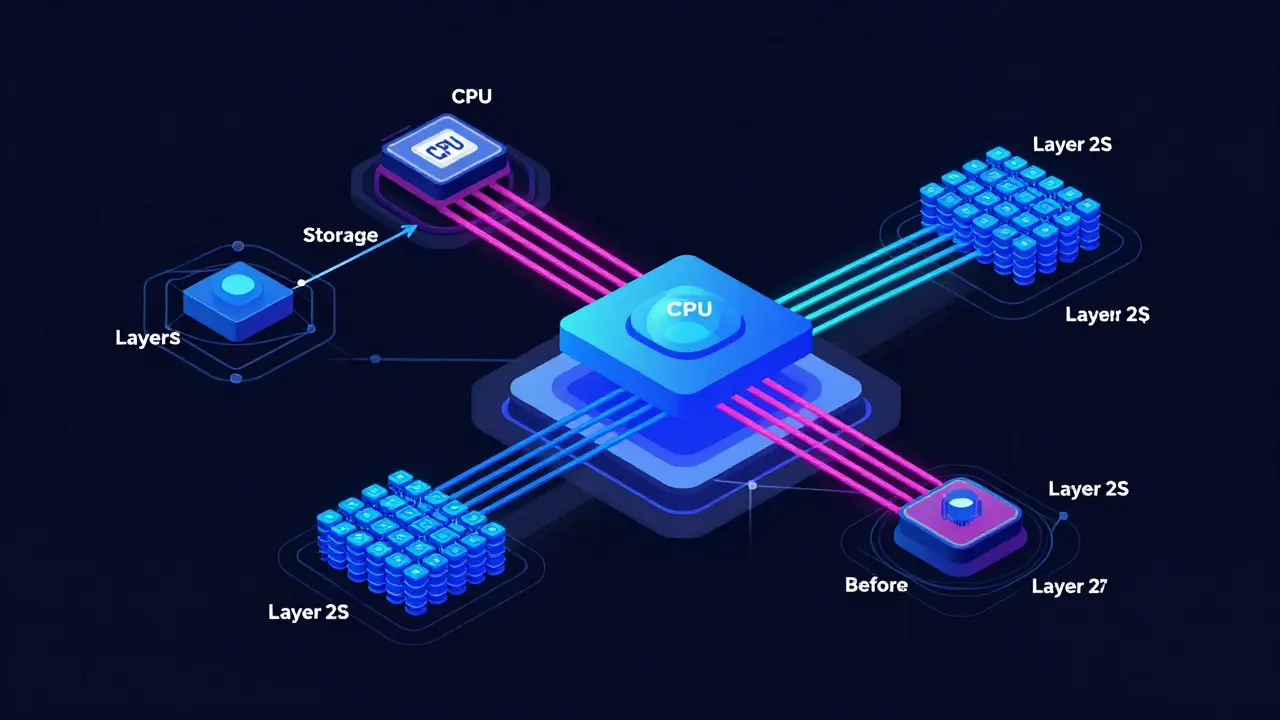
This is where multidimensional fee markets come in. This emerging concept involves pricing transactions along multiple resource axes simultaneously-such as CPU cycles, memory usage, network bandwidth, and storage. Instead of one composite fee, users would pay separate rates for each resource they consume.
Academic research suggests this approach is economically optimal. It allows for finer price discovery and more efficient packing of blocks. For example, EIP-4844 (also known as Proto-Danksharding) introduced blob gas, a new resource type specifically for large data blobs used by Layer 2 networks. Blob gas has its own fee market, separate from regular execution gas. This means Layer 2 sequencers can post large amounts of data to Ethereum at a fraction of the previous cost, without clogging the main execution layer.
This shift acknowledges that blockchains are becoming multi-resource systems. As networks handle diverse workloads-from simple transfers to complex AI computations-a single fee metric becomes a bottleneck. Multidimensional pricing enables parallel execution and better scalability by reflecting true demand vectors for each specific resource.
Challenges and User Experience Friction
Despite these advancements, fee markets remain a major pain point for everyday users. Here are the core issues:
- Volatility: Fees can change drastically within minutes. A transaction that was affordable an hour ago might be too expensive now, or vice versa. This makes budgeting difficult.
- Complexity: Understanding the difference between base fees, tips, gas limits, and priority fees requires technical knowledge. Most users just want to "send money" and shouldn’t need to understand auction theory.
- Exclusion: High fees during congestion price out smaller transactions. This favors wealthy users or large institutions who can afford to pay premiums, potentially undermining the decentralization ethos of public blockchains.
- Estimation Errors: Wallets often guess the appropriate fee. If they guess too low, the transaction fails or stalls. If they guess too high, the user overpays. While EIP-1559 helps, it doesn’t eliminate the need for accurate estimation.
Future Outlook: Layer 2s and Beyond
The future of fee dynamics lies in moving activity off the main chain. Layer 2 solutions like Arbitrum, Optimism, and zkSync maintain their own fee markets, which are significantly cheaper than their underlying Layer 1 chains. By batching thousands of transactions into a single proof submitted to Ethereum, they dilute the cost per user.
As these Layer 2 networks mature, the fee experience will become invisible to most users. You won’t think about gas; you’ll just click "swap" or "mint." Meanwhile, Layer 1 blockchains will focus on security and settlement, using fee markets primarily to protect the network from spam rather than to generate revenue for users.
We may also see standardized interfaces for fee estimation across wallets, powered by AI-driven predictions of network congestion. Imagine a wallet that automatically holds your transaction and broadcasts it at the lowest possible moment before your deadline. This level of automation could finally bridge the gap between complex blockchain economics and seamless user experience.
What causes blockchain fees to spike?
Fees spike when the demand for block space exceeds the available supply. This happens during periods of high network activity, such as bull markets, popular NFT launches, or viral meme token trends. Since block size is fixed, users compete by offering higher fees to validators to prioritize their transactions.
How does EIP-1559 differ from Bitcoin's fee model?
Bitcoin uses a first-price auction where users bid freely, leading to unpredictable fees. Ethereum's EIP-1559 introduces a base fee determined by the protocol, which adjusts automatically based on congestion and is burned. Users add a small optional tip to validators. This makes Ethereum fees more predictable and reduces strategic bidding.
What are multidimensional fee markets?
Multidimensional fee markets price transactions based on multiple specific resources (like computation, storage, and bandwidth) rather than a single combined unit. This allows for more efficient resource allocation and lower costs for transactions that use fewer resources, as seen with Ethereum's blob gas introduction via EIP-4844.
Why do Layer 2 networks have lower fees?
Layer 2 networks process transactions off the main blockchain and then batch them together to submit a single proof or data record to the main chain. This sharing of costs among thousands of users dramatically reduces the fee per transaction compared to doing everything directly on Layer 1.
Can I increase my fee after sending a transaction?
It depends on the blockchain. Bitcoin supports Replace-by-Fee (RBF), allowing you to broadcast a new version of the transaction with a higher fee. Ethereum transactions generally cannot be modified once sent, but you can sometimes speed them up by sending a replacement transaction with a higher gas price to the same nonce, depending on your wallet's capabilities.