
Remember the panic of November 2022? When FTX collapsed, millions of traders realized that handing over their private keys to a centralized company was a massive gamble. Since then, the search for a safe, non-custodial alternative has defined the crypto market. Enter GMX, a decentralized exchange built on the Arbitrum and Avalanche blockchains. It promises the speed and leverage of a centralized exchange like Binance or Bybit, but with the security of self-custody. But does it actually work for serious traders, or is it just another DeFi experiment with high fees?
In this review, we break down exactly how GMX operates on Arbitrum in 2026. We’ll look at its unique profit-sharing model, the reality of its leverage limits, and whether it’s truly better than competitors like dYdX or Hyperliquid. If you are tired of worrying about exchange solvency while trying to trade Bitcoin or Ethereum futures, this guide will tell you if GMX is your next home.
What Is GMX and How Does It Work on Arbitrum?
GMX is not just another token; it is a fully on-chain perpetual exchange. Originally launched in September 2021 as "Gambit," it rebranded to GMX and quickly became a pillar of the Arbitrum ecosystem. Today, it handles billions in volume and represents nearly half of all Total Value Locked (TVL) on the Arbitrum network. That is a huge chunk of money trusting one protocol.
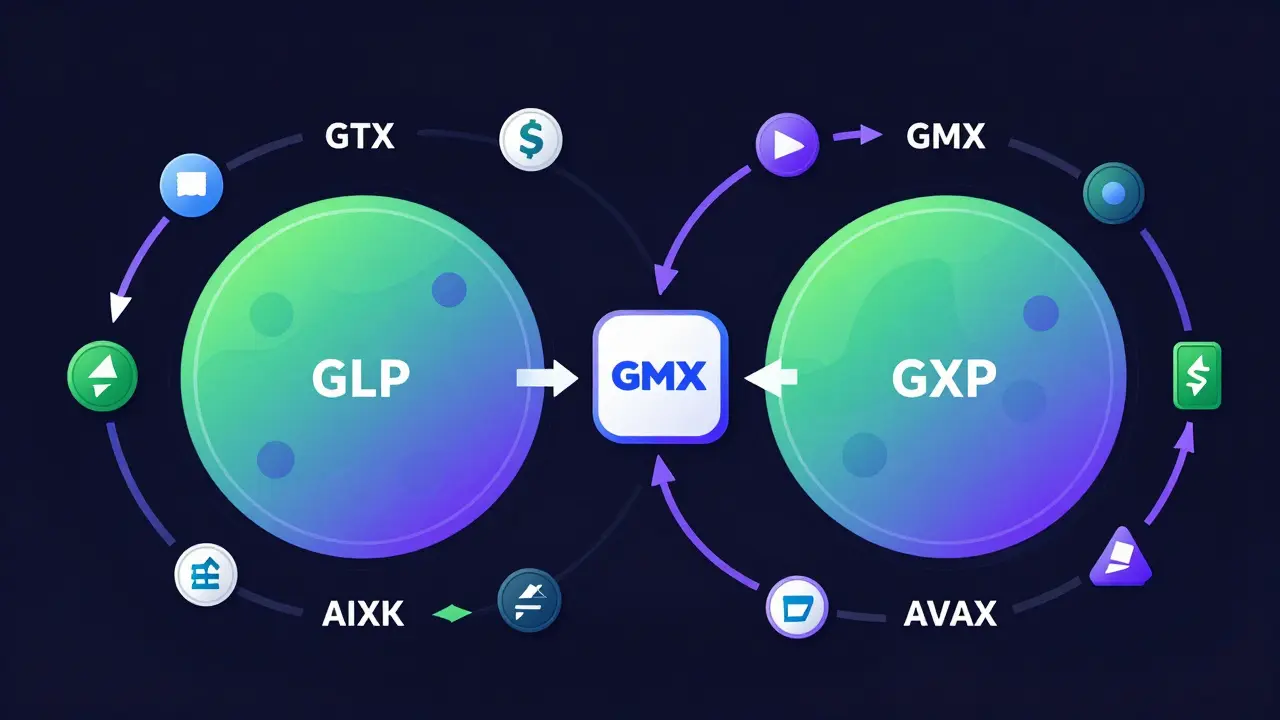
The core innovation here is the liquidity model. Most decentralized exchanges use an Automated Market Maker (AMM), which often leads to slippage when you make large trades. GMX uses a different approach. It relies on two main liquidity pools: GLP and GXP. When you open a position, you are trading against these pools, not other individual users. This means you get deep liquidity and minimal price impact, even on larger orders.
Here is the kicker: the platform shares most of its trading fees with the people providing that liquidity. If you hold GLP tokens or stake GMX tokens, you earn rewards in ETH (on Arbitrum) or AVAX (on Avalanche). This creates a flywheel effect-more traders mean more fees, which means higher yields for stakers, which attracts more liquidity.
Key Features: Leverage, Assets, and Fees
If you are moving from a centralized exchange, the first thing you will notice is the asset selection. GMX focuses on quality over quantity. You can trade major pairs like BTC, ETH, SOL, AVAX, and ARB. You won’t find hundreds of obscure altcoins here. For many professional traders, this is a feature, not a bug-it keeps the markets tight and liquid.
Let’s talk about leverage. GMX offers up to 50x leverage on most assets. While some platforms advertise 100x, GMX caps it lower to protect both traders and the liquidity pool from extreme volatility risks. In practice, 50x is plenty for aggressive strategies without inviting instant liquidation from minor wicks.
| Feature | Details |
|---|---|
| Network | Arbitrum One (Layer 2) |
| Max Leverage | Up to 50x |
| Trading Pairs | BTC, ETH, SOL, AVAX, ARB, DOGE, LINK, UNI |
| Fee Structure | 0.1% opening fee, 0.1% closing fee (varies by utilization) |
| Gas Costs | $0.05 - $0.10 per transaction |
| KYC Required | No |
Fees are competitive but not the cheapest. You pay roughly 0.1% to open and 0.1% to close a position. These fees go directly into the liquidity pool, boosting the value of GLP/GXP. Compare this to centralized exchanges where fees might be lower but counterparty risk is infinite. On Arbitrum, gas fees are negligible, averaging less than $0.10 per trade, making frequent adjustments affordable.
Security and Non-Custodial Safety
This is why people choose GMX. Your funds never leave your wallet until you execute a trade. Even then, the smart contract holds them, not a corporate bank account. There is no KYC (Know Your Customer) process. No email verification. No frozen accounts during market crashes.
GMX’s code has been audited multiple times, and they run a $5 million bug bounty program. However, remember that DeFi carries smart contract risk. If there is a critical vulnerability in the code, funds could be drained. That said, GMX has survived several bear markets and black swan events since 2021, proving its resilience. The platform also uses oracle price feeds from Chainlink and Pyth to ensure fair pricing and prevent manipulation during flash crashes.
GMX vs. Competitors: dYdX, Hyperliquid, and Centralized Exchanges
You have options. So how does GMX stack up against the rest?
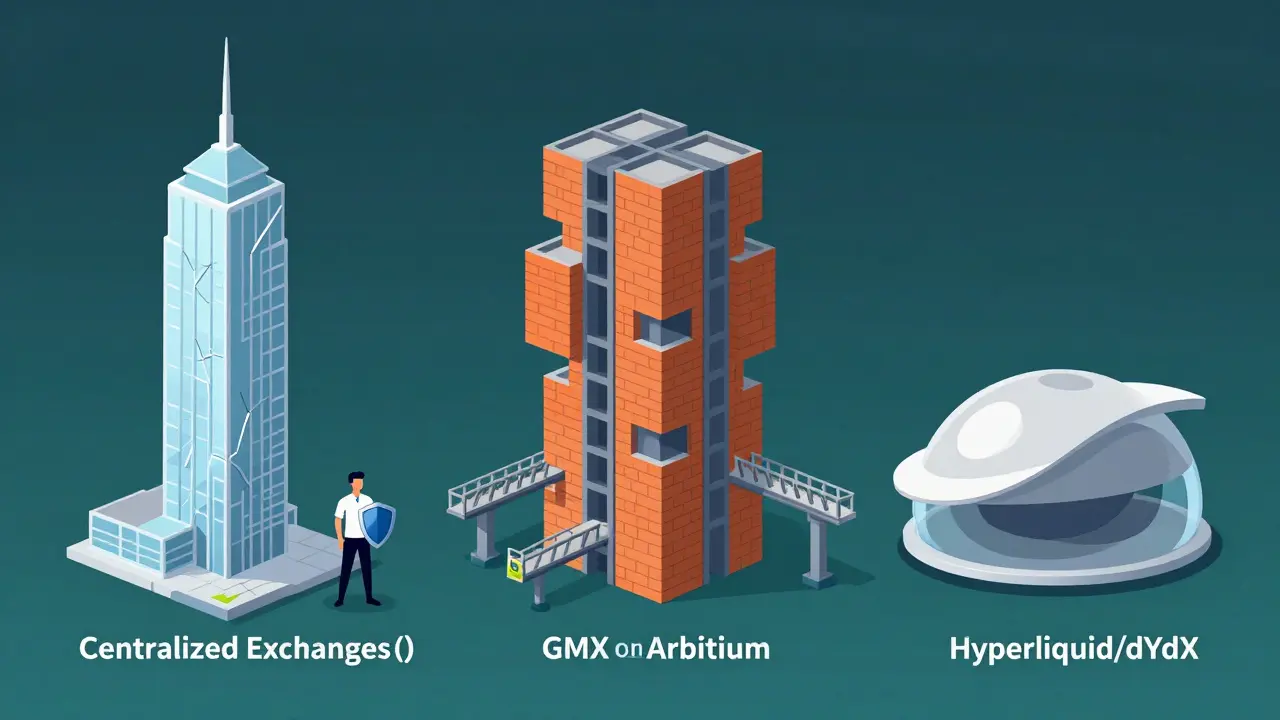
dYdX: dYdX is GMX’s biggest rival. It also offers non-custodial trading but uses a different order book model. dYdX has recently migrated to its own Layer 2 blockchain, which makes it faster but isolates it from the broader Ethereum ecosystem. GMX stays on Arbitrum, benefiting from deeper integration with other DeFi apps. If you prefer an order-book interface similar to traditional stock trading, dYdX might feel more familiar. If you want simplicity and yield sharing, GMX wins.
Hyperliquid: This newer platform is gaining traction with ultra-low latency and high performance. It appeals to high-frequency traders who need millisecond execution. GMX is slower because it settles on-chain, but it is more transparent. Every transaction is visible on the blockchain. With Hyperliquid, you still trust their central sequencer to some extent.
Centralized Exchanges (CEX): Binance or Bybit offer cheaper fees and more coins. But after FTX, do you really want to sleep knowing your $10,000 balance sits in a company’s ledger? GMX gives you peace of mind. You control the keys. You control the exit.
User Experience and Learning Curve
Be honest: DeFi interfaces can be clunky. GMX has improved significantly with its V2 update, but it is not as polished as Binance. You need a Web3 wallet like MetaMask or Rabby. You must bridge funds to Arbitrum first. For beginners, this takes time. Expect to spend 2-5 hours learning the ropes before you feel comfortable managing positions.
Once you are in, the dashboard is clean. You can see your PnL (Profit and Loss), liquidation price, and margin level clearly. The platform provides tools like a liquidation calculator to help you manage risk. Community support is strong, with a Discord server of over 65,000 members ready to answer questions. Just don’t expect live chat support from a human agent at 3 AM.
Is GMX Right for You in 2026?
GMX is ideal for traders who prioritize security and transparency over convenience. It is perfect for those who want to trade Bitcoin and Ethereum futures without trusting a third party. The profit-sharing model adds a nice bonus-you aren’t just paying fees; you are participating in the protocol’s success.
However, if you trade low-cap altcoins or need sub-second execution for scalping, GMX might frustrate you. The limited asset list and on-chain settlement speed are real constraints. Also, understand that high leverage is dangerous. Even with good technology, poor risk management will wipe out your account. Use stop-losses and monitor your positions closely.
Do I need to complete KYC to use GMX on Arbitrum?
No. GMX is a non-custodial decentralized exchange. You only need a compatible Web3 wallet like MetaMask. There is no identity verification required, preserving your privacy completely.
How much leverage does GMX offer?
GMX offers up to 50x leverage on most supported assets like BTC and ETH. This limit is designed to balance trading opportunities with risk management for both traders and liquidity providers.
Can I earn passive income on GMX?
Yes. By staking GMX tokens or holding GLP/GXP liquidity tokens, you earn a share of the trading fees generated on the platform. Rewards are paid in ETH on Arbitrum and AVAX on Avalanche, plus esGMX tokens.
Is GMX safer than centralized exchanges like Binance?
In terms of custody, yes. Your funds remain in your wallet until traded, eliminating the risk of exchange insolvency or theft by operators. However, you face smart contract risk, which is inherent to all DeFi protocols.
What are the gas fees like on GMX Arbitrum?
Because GMX runs on Arbitrum, a Layer 2 solution, gas fees are extremely low. Typically, each transaction costs between $0.05 and $0.10, making it cost-effective for regular trading compared to Ethereum Mainnet.