

Genesis Block Value Calculator
Calculate Bitcoin Genesis Block Value
The Genesis Block contains 50 Bitcoin that can never be spent. These coins represent the birth of Bitcoin on January 3, 2009, when the financial system was collapsing.
The 50 BTC in the Genesis Block were intentionally made unspendable, making them a symbolic anchor for Bitcoin's blockchain.
The first block in the Bitcoin blockchain isn’t just code. It’s a statement. On January 3, 2009, Satoshi Nakamoto mined Block 0 - the Genesis Block - and buried inside its transaction data was a headline from The Times: 'The Times 03/Jan/2009 Chancellor on brink of second bailout for banks'. This wasn’t a coincidence. It was a declaration. Bitcoin wasn’t built to improve banking. It was built because banking had failed.
Why This Message Matters More Than the Code
Most people think Bitcoin’s breakthrough was the blockchain. Or the proof-of-work system. Or even the 21 million coin limit. But the real innovation was hiding a political message in the very first block. That headline wasn’t chosen randomly. On January 3, 2009, the UK government was preparing to bail out Royal Bank of Scotland and Lloyds TSB with £37 billion of taxpayer money. The financial system was collapsing under its own weight. And Satoshi, whoever they were, made sure the world knew Bitcoin was born from that exact moment.The message is embedded in the coinbase transaction - the first transaction in every block that creates new Bitcoin. In most blocks, this field holds miner rewards and optional data. In the Genesis Block, it holds a newspaper headline. That’s unusual. But it’s intentional. It proves the block couldn’t have been created before January 3, 2009. It’s a timestamp that can’t be faked. And it’s a middle finger to central banks.
The 50 BTC That Can Never Be Spent
The Genesis Block includes a 50-Bitcoin reward. That’s worth over $1.5 billion today. But here’s the twist: no one can spend it. Not even Satoshi. Not even a team of quantum computers. The reason is hidden in the cryptography.Bitcoin transactions need a valid digital signature to prove ownership. Normally, you sign with your private key and verify with your public key. But in the Genesis Block, Satoshi created a signature that points to an invalid public key. The system checks: Is this signature valid for this public key? The answer is always no. So even if someone knew the private key - which no one does - they still couldn’t spend the coins. The system rejects it by design.
This isn’t a bug. It’s a feature. The 50 BTC is permanently locked, not because of a mistake, but because Satoshi wanted to make a point: Bitcoin’s first coins were never meant to be used. They’re a monument. A symbol. A reminder that Bitcoin’s value isn’t in spending - it’s in trustlessness. No one controls it. Not even its creator.
The Six-Day Gap: Coincidence or Code?
After the Genesis Block was mined on January 3, 2009, nothing happened for six days. Block 1 wasn’t mined until January 9. That’s strange. Most blockchains start mining immediately. Bitcoin didn’t. Why?Some think it’s a nod to the biblical creation story - six days of work, then rest. Others believe Satoshi was testing the network quietly before opening it to the public. There’s no official answer. But Bitcoin developer Pieter Wuille confirmed in 2023 that the timing appears deliberate. The gap isn’t random. It’s part of the story.
What’s fascinating is that this silence created a mythos. It gave Bitcoin a sense of mystery. People started digging deeper. They found the message. They noticed the unspendable coins. They realized this wasn’t just software. It was a manifesto.

How the Genesis Block Is Hardcoded Into Bitcoin
Unlike every other block, the Genesis Block isn’t downloaded from the network. It’s written into the Bitcoin software itself. If you look at the Bitcoin Core source code, you’ll find a hardcoded constant calledGENESIS_BLOCK in the file chainparams.cpp. This means every Bitcoin node, everywhere in the world, starts with the same first block. No exceptions.
This is critical. If someone tried to change the Genesis Block - say, by altering the message or the timestamp - every node would reject the chain. The entire blockchain would collapse. That’s why the Genesis Block is untouchable. It’s the foundation. Change it, and you change nothing. You break everything.
Developers need special tools to even view the Genesis Block. Standard blockchain explorers like Blockchain.com or Blockchair won’t show it. You have to run a full node and dig into the code. That’s intentional too. Satoshi didn’t want casual users to stumble on it. He wanted people who cared enough to look.
Why Other Blockchains Copy It
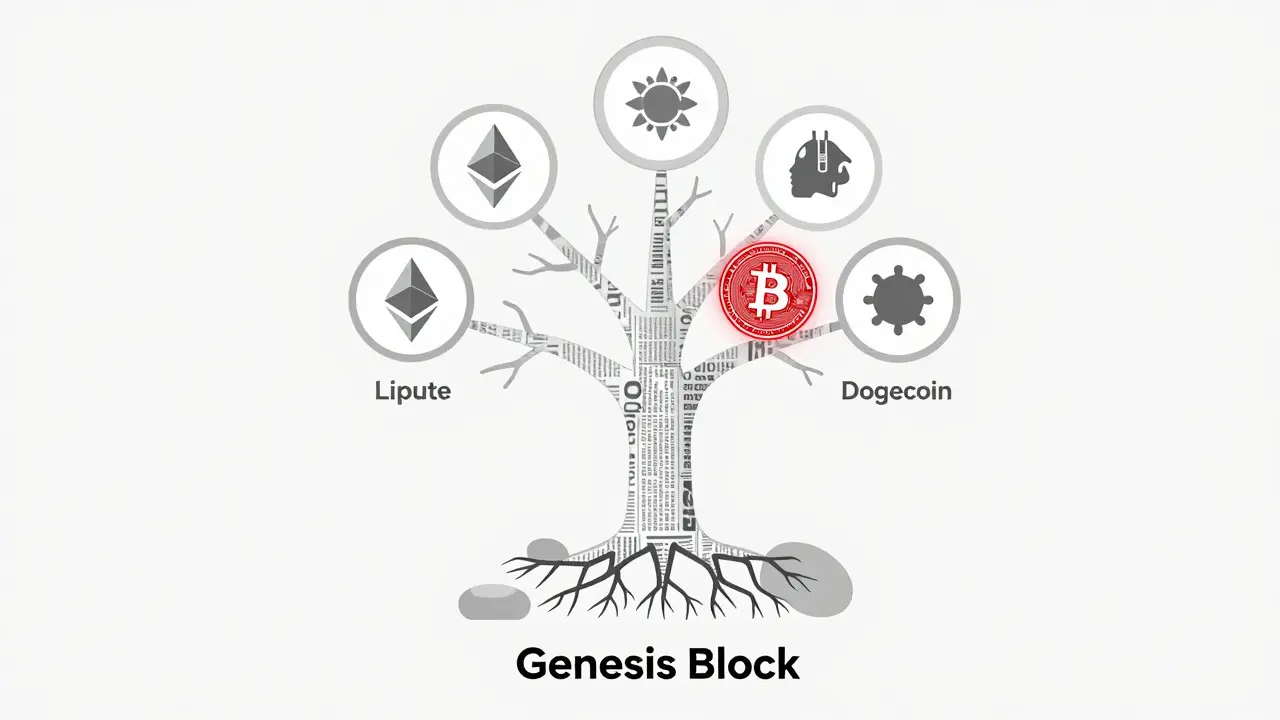
Bitcoin’s Genesis Block didn’t just start a currency. It started a trend. Today, 63% of the top 100 cryptocurrencies by market cap include some kind of hidden message in their own Genesis Block. Ethereum’s includes a quote from a news article about the 2015 Paris climate agreement. Litecoin’s references a headline about the 2011 Japanese tsunami. Dogecoin’s even has a joke about a Shiba Inu.Why? Because the Genesis Block is where identity is born. It’s the first line of a story. And Bitcoin’s story was clear: trust no one. Question authority. Build something that can’t be controlled. Other blockchains adopted this ritual because they wanted to claim the same legitimacy. They wanted to say: We’re not just another coin. We’re part of this movement.
But none of them match Bitcoin’s impact. No other Genesis Block carries the same weight. No other message was written at the exact moment the world realized traditional finance was broken.
The Debate: Revolution or Just a Gimmick?
Not everyone sees the Genesis Block as profound. Dr. Vili Lehdonvirta, a researcher at Oxford, argues in a 2021 paper that Bitcoin’s political message is overstated. He says cryptocurrency has become just another speculative asset - not a replacement for banks, but a casino built on top of them.That’s true. Bitcoin is used for speculation. It’s traded on exchanges. It’s held by hedge funds. But that doesn’t erase the message. The Genesis Block still exists. The 50 BTC are still locked. The headline is still there. The system still refuses to let anyone spend it.
And that’s the point. Bitcoin doesn’t need to be used to be powerful. Its value lies in its rules. No one can change them. Not governments. Not corporations. Not even its creator. The Genesis Block proves that. It’s not about what Bitcoin does. It’s about what it refuses to allow.
What This Means for You
If you’re new to Bitcoin, don’t get lost in price charts or mining rigs. Look at the Genesis Block. Read the message. Understand why the first coins can’t be spent. That’s where Bitcoin’s soul is. Not in the market. Not in the apps. Not in the wallets.It’s in that one line of text, buried in code, written on the day the world lost faith in banks. It’s a reminder that money doesn’t have to be controlled. That systems can be transparent. That trust doesn’t need to be placed in people - it can be built into math.
That’s why the Genesis Block is still relevant in 2025. It’s not history. It’s a warning. And a promise.
What is the exact message in Bitcoin’s Genesis Block?
The message is: "The Times 03/Jan/2009 Chancellor on brink of second bailout for banks". It’s a direct quote from the front page of The Times newspaper, published on January 3, 2009, during the height of the global financial crisis. This message is embedded in the coinbase transaction of the Genesis Block and serves as a timestamp and political statement against centralized banking.
Can the 50 BTC from the Genesis Block be spent?
No, the 50 BTC reward in the Genesis Block cannot be spent. This is because the transaction uses an invalid public key in its signature verification. Even if someone had the private key (which no one does), the Bitcoin network would reject the transaction because the public key doesn’t match the signature. This was intentional - it makes the coins permanently unspendable, turning them into a symbolic anchor for the entire blockchain.
Why is the Genesis Block hardcoded into Bitcoin software?
The Genesis Block is hardcoded because it’s the root of the entire Bitcoin blockchain. Every node must agree on the same starting point to maintain consensus. If it were downloaded from the network, malicious actors could send a fake first block and break the chain. By hardcoding it, Satoshi ensured that every Bitcoin client starts with the same, unchangeable origin - making the blockchain tamper-proof from day one.
How was the message embedded technically?
The message is stored in the coinbase transaction’s input script, which is normally used to include miner data. Satoshi used 100 bytes of this field to insert the ASCII text of the newspaper headline. This data doesn’t affect the block’s validity - it’s just extra content. But because it’s part of the block’s hash, it becomes permanently recorded in the blockchain’s history, making it immutable and verifiable by anyone.
Why did Satoshi wait six days before mining Block 1?
There’s no confirmed reason, but Bitcoin Core developers believe the delay was intentional. The six-day gap between Block 0 (January 3, 2009) and Block 1 (January 9, 2009) is unusual. Some speculate it was a quiet test period before opening the network to others. Others link it to biblical symbolism - six days of creation, followed by rest. Regardless, the timing adds to the mystery and reinforces the idea that Bitcoin’s launch was deliberate, not rushed.
Do other cryptocurrencies have similar hidden messages?
Yes. Around 63% of the top 100 cryptocurrencies by market cap include embedded messages in their Genesis Blocks. Ethereum’s includes a quote about the Paris climate agreement. Litecoin references a news headline about the 2011 Japanese tsunami. Dogecoin’s even has a humorous reference to its meme origins. But none carry the same historical weight as Bitcoin’s - because none were created at the moment traditional finance collapsed.
19 Responses
Bro. This is the most beautiful thing I’ve ever seen. That headline? Pure poetry. The system literally froze the moment the banks failed. That’s not code. That’s a tombstone. And it’s still standing.
I just cried reading this. 🥹 This isn’t just about money - it’s about dignity. Satoshi didn’t just build a currency. They built a monument to human resilience. And that 50 BTC? It’s not lost. It’s sacred. A silent vow that no one gets to own this. Not even the creator.
The Genesis Block is a cryptographic manifesto. Its value lies not in utility but in ontological permanence. The unspendable output is not a bug - it is the axiomatic assertion of decentralization.
I mean… think about it. The entire world was panicking. Governments were printing money like confetti. And here’s this anonymous person, alone in a room, embedding a newspaper headline into the first block of a new world. It’s like they knew. They knew we’d be here, 15 years later, still trying to understand what that moment meant. And we still don’t. And that’s the point. It’s not meant to be understood - it’s meant to be felt. I’ve read this post five times today. I keep coming back to it. Like a prayer.
Man, I remember when I first found this. I was in my garage tinkering with a Raspberry Pi, trying to run a full node. Found the Genesis Block in the source code. Didn’t even know what I was looking at. Then I saw the headline. Sat there for 20 minutes just staring at it. That’s when I got it. Bitcoin’s not tech. It’s a cultural reset. And that message? It’s the first line of our new constitution.
The romanticization of Satoshi is dangerously naive. The Genesis Block is a performative gesture - a distraction from the fact that Bitcoin is now a speculative asset class dominated by hedge funds and ETFs. The message is irrelevant. The system has been co-opted. The 50 BTC? A symbolic relic of a movement that died the moment it hit $100k. This is nostalgia dressed as ideology.
This… this is why I believe in magic. 🌌 The headline. The unspendable coins. The six-day silence. It’s all so… intentional. Like the universe whispered to someone and said, ‘Make this.’ And they did. No one owns it. No one controls it. And that’s the most beautiful thing in the world. I’m gonna cry again. 😭
Bitcoin is a Western fantasy. Africa doesn’t need it. We need food. Water. Electricity. This is digital colonialism wrapped in crypto jargon.
This whole ‘Satoshi was a genius’ thing is just woke propaganda. The U.S. didn’t bail out banks because they were evil - they did it to prevent chaos. Bitcoin is just a tool for anarchists and tax evaders. And that headline? A cheap stunt. The real revolution was the dollar staying strong.
I think about how quiet that six-day gap must have been. No one knew. No one was watching. Just one person, alone, waiting. I wonder if they were scared. I wonder if they thought no one would ever understand. And now here we are. All of us, reading this. I’m grateful.
Let’s be real - this is all a CIA psyop. The headline was planted. The ‘unspendable’ coins? A trap to lure in conspiracy theorists. The six-day delay? Testing the blockchain’s resistance to quantum decryption. They’re watching us. They always are.
The Genesis Block’s coinbase script is a masterclass in cryptographic minimalism. The embedded string is 77 bytes. The public key is invalid by design. The timestamp is immutable. No redundancy. No fluff. Just truth.
If the message was meant to be a middle finger to banks why not put it in the block header instead of the coinbase? Why embed it where only the curious would find it? Because it wasn’t for the world. It was for the ones who would look. The ones who would care. The ones who would understand silence.
I’m new to Bitcoin but this post made me feel like I finally get it. Not the price. Not the mining. Not the apps. But the *why*. That headline? It’s not just history. It’s a promise. That we can build something better. And no one gets to take it away.
I love how the Genesis Block is hardcoded. It’s like the foundation of a house built with concrete so strong you can’t even scratch it. No one gets to rewrite the beginning. And that’s the most powerful thing about Bitcoin - it doesn’t need permission to exist.
The fact that other chains copy this? It’s beautiful. They’re not stealing Bitcoin. They’re bowing to it. Like pilgrims leaving flowers at a shrine. The message is universal. It’s not about money. It’s about sovereignty.
This is why Western crypto bros are delusional. You think you’re rebelling? You’re just buying a meme. The real revolution happened in Lagos, in Manila, in Caracas - where people use crypto to survive. Not to flip NFTs. Not to flex on Twitter. But to feed their kids. Your Genesis Block is their grocery list.
If you’re new to this, don’t overthink it. Just sit with the message. Let it sink in. The fact that those 50 BTC can’t be spent? That’s the whole point. It’s not about ownership. It’s about trust. And that’s the most radical thing in the world.
The U.S. government is the real enemy. They control the Fed. They control the banks. They control the media. The Genesis Block is just a distraction. The real power is in the Federal Reserve’s balance sheet. Bitcoin is a toy. The system still owns you.