

You might have heard the term Virtual Assets Ordinance 2025 floating around in crypto circles, expecting a single law that changed everything overnight. Here is the reality check: there isn’t just one ordinance. Instead, Hong Kong rolled out a comprehensive regulatory framework in 2025 designed to turn the city into a global digital asset hub. This framework includes the newly effective Stablecoins Ordinance and proposed licensing regimes for dealing and custody services.
If you are operating in or targeting Hong Kong investors, these rules matter. They replace the gray areas of the past with strict definitions, capital requirements, and a dual-regulator system involving the Securities and Futures Commission (SFC) and the Hong Kong Monetary Authority (HKMA). Let’s break down what this actually means for your business, your investments, and your compliance strategy.
The Core of the Framework: It’s Not Just One Law
To understand the landscape, you need to look at the structure. The Hong Kong Financial Services and Treasury Bureau (FSTB) issued Policy Statement 2.0 on June 26, 2025. This statement reaffirmed the government's commitment to building a trusted digital asset ecosystem under their 'LEAP' vision. LEAP stands for Legal streamlining, Expanding tokenised products, Advancing use cases, and People development.
This vision translates into three main pillars:
- The Stablecoins Ordinance: Took effect on August 1, 2025, creating a specific licensing regime for fiat-referenced stablecoin issuers.
- VA Dealing Licensing Regime: Proposed in June 2025, this regulates who can trade virtual assets with clients.
- VA Custody Licensing Regime: Also proposed in June 2025, this controls who holds and safeguards digital assets.
The consultation period for the dealing and custody regimes closed on August 29, 2025. While the Stablecoins Ordinance is already live, the full implementation of the dealing and custody licenses is expected in 2026. This phased approach gives firms time to adapt, unlike some jurisdictions that dropped regulations all at once.
Stablecoins Ordinance: What Counts as a Stablecoin?
The Stablecoins Ordinance is the first concrete piece of legislation in this package. It defines a stablecoin very specifically. To fall under this ordinance, a digital asset must be:
- A cryptographically secured digital representation of value.
- Expressed as a unit of account or store of economic value.
- Used as a medium of exchange accepted by the public.
- Transferable, storable, or tradable electronically.
- Operating on a distributed ledger.
- Purporting to maintain stable value with reference to assets.
Crucially, the ordinance initially focuses only on Fiat-Referenced Stablecoins (FRS). If you issue a token pegged to the US Dollar or Hong Kong Dollar, you need a license. However, the law explicitly excludes limited purpose digital tokens, securities tokens, stored value facility deposits, banking deposits, and central bank digital currencies (CBDCs). This exclusion prevents regulatory overlap with existing banking laws.
Why does this distinction matter? Because it creates clarity. Previously, firms spent hundreds of hours debating whether their product was a security, a payment token, or something else. Now, if it fits the FRS definition, you know exactly which regulator to talk to.
Licensing Requirements: Capital, Staff, and Security
Getting licensed in Hong Kong is not cheap, and it is not easy. The regulators want to ensure that only serious, well-capitalized players operate in the market. Here are the key hurdles you will face when applying for a VA Dealing or Custody license:
| Requirement | Details |
|---|---|
| Minimum Capital | HK$129,730 (benchmarked against Type 3 SFO licence) |
| Responsible Officer | At least one officer with 3+ years of virtual asset portfolio management experience |
| Supervision | Mandatory 24-hour active supervision of portfolios |
| Wallet Whitelisting | Dual approval system required for adding new wallet addresses |
| Penalties for Violation | Up to HK$5 million fine and/or 7 years imprisonment |
The requirement for 24-hour active supervision is particularly challenging for smaller teams. You cannot just set up automated scripts and walk away. You need human oversight around the clock. Additionally, the dual approval system for wallet whitelisting adds a layer of security but also slows down operations. Industry surveys indicate that this specific rule increased transaction processing times by 30-40% for early adopters.
The Dual-Regulator Model: SFC vs. HKMA
Hong Kong uses a unique dual-regulator approach. Understanding who does what is critical for your compliance strategy.
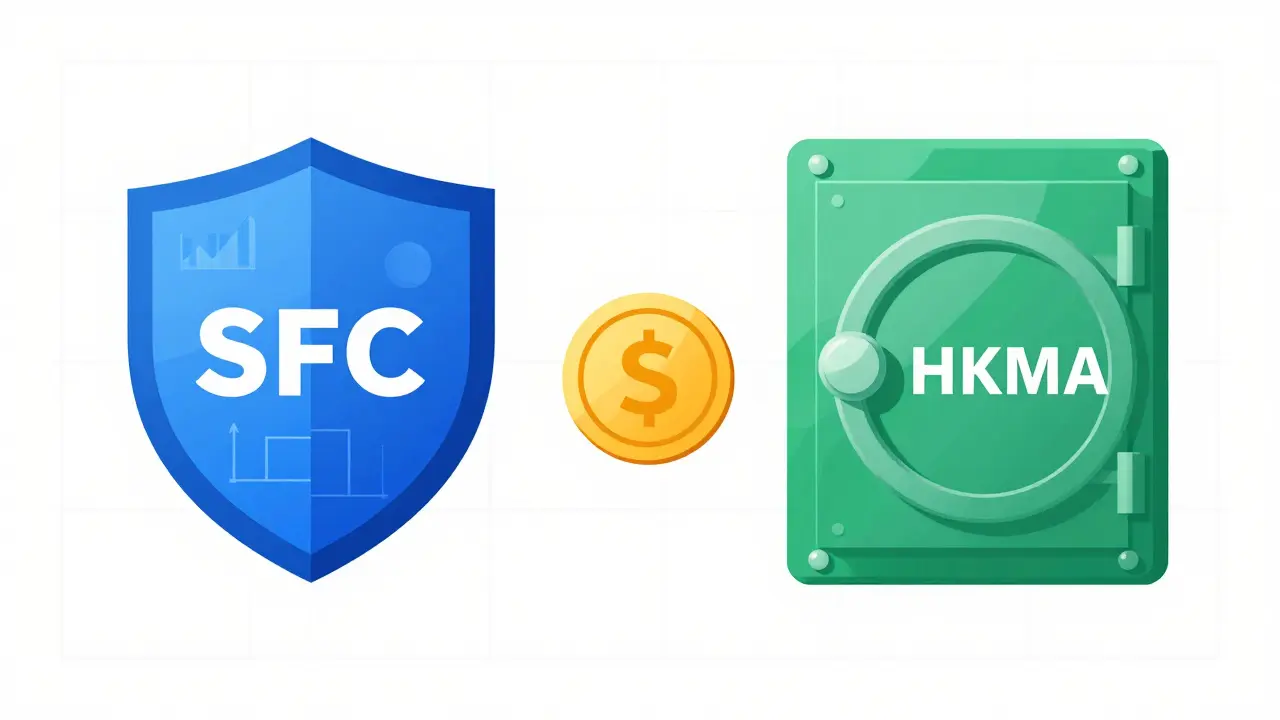
The Securities and Futures Commission (SFC) acts as the standard-setter. They establish the regulatory requirements, define the rules for trading platforms, and oversee asset managers. If you are running a crypto exchange or managing a virtual asset fund, the SFC is your primary contact.
The Hong Kong Monetary Authority (HKMA) serves as the frontline regulator for banks and Stored Value Facility (SVF) licensees. If you are a traditional bank offering crypto custody or dealing services, you report to the HKMA. However, even banks must register with the SFC for certain activities.
This model aims to combine the expertise of both bodies. The SFC understands market integrity and investor protection, while the HKMA understands financial stability and anti-money laundering (AML). However, some industry participants worry about operational friction. With 41% of surveyed firms expressing concern about regulatory overlap, you need to ensure your internal processes can handle reporting to two different authorities.
Extraterritorial Reach: Targeting Hong Kong Investors
One of the most significant aspects of this framework is its extraterritorial application. You do not need to be physically located in Hong Kong to fall under these rules. If you are making offers to Hong Kong residents or inducing them to enter into agreements, you are subject to the licensing regimes.
This closes a major gap that existed in other Asian jurisdictions like Singapore, where only locally incorporated entities often required licensing. For offshore exchanges, this means you cannot simply ignore Hong Kong users. You either need to obtain a license or block access from Hong Kong IP addresses entirely. The SFC has been aggressive in enforcing this, sending warning letters to unlicensed platforms.
Comparison with Global Standards
How does Hong Kong’s approach stack up against other major hubs? Let’s compare it briefly with Singapore, the EU, and the U.S.
Vs. Singapore: Singapore regulates stablecoins under its broader Payment Services Act. Hong Kong’s dedicated Stablecoins Ordinance is more specialized. However, Singapore’s framework is fully implemented, while Hong Kong is still rolling out its dealing and custody licenses. Hong Kong’s extraterritorial reach is stricter than Singapore’s.
Vs. EU MiCA: The EU’s Markets in Crypto-Assets (MiCA) regulation shares a similar risk-based approach. However, MiCA was implemented simultaneously across member states, whereas Hong Kong is phasing in its rules. This phased approach allows Hong Kong firms more time to prepare but creates uncertainty during the transition period.
Vs. U.S.: The U.S. suffers from fragmented jurisdiction between the SEC, CFTC, and state regulators. Hong Kong provides clear boundaries between the SFC and HKMA, reducing legal ambiguity for businesses.
Market Impact and Future Outlook
Despite the stringent requirements, the market response has been largely positive. Hong Kong currently holds 18.7% of Asia’s institutional crypto custody market, growing at 32% year-over-year. By comparison, Singapore holds 28.3% but is growing at only 19%. This suggests that institutions are betting on Hong Kong’s future regulatory clarity.
Institutional activity dominates the scene, representing 83% of virtual asset activity in Hong Kong versus just 17% retail. This aligns with the SFC’s focus on professional investors. Retail access remains restricted, with intermediaries required to assess clients’ virtual asset knowledge before onboarding them. This protects unsophisticated investors but limits mass adoption.
Looking ahead, several developments are on the horizon:
- Q1 2026: The FSTB plans a legal review on tokenization, focusing initially on bonds. This could open the door for tokenized real-world assets (RWAs).
- December 15, 2025: The SFC will publish detailed guidance on stablecoin reserve requirements, addressing current concerns about asset composition.
- Q2 2026: The HKMA will launch a regulatory sandbox for cross-border stablecoin transactions, involving major banks like Standard Chartered and HSBC.
- 2027: Expected expansion of regulations to cover Non-Fungible Tokens (NFTs).
For now, the focus is on getting the basics right. If you are planning to enter the Hong Kong market, start preparing your compliance infrastructure today. The 3-6 month learning curve reported by early adopters is no joke. Engage with local legal experts, implement robust blockchain analytics tools, and ensure your team has the necessary experience. The window of opportunity is open, but the barriers to entry are high.
Is there a single "Virtual Assets Ordinance 2025" in Hong Kong?
No. There is no single ordinance with that exact name. The term refers to a comprehensive regulatory framework introduced in 2025, which includes the Stablecoins Ordinance (effective August 1, 2025) and proposed licensing regimes for virtual asset dealing and custody services, expected to be implemented in 2026.
Who regulates cryptocurrency in Hong Kong?
Two main regulators are involved: the Securities and Futures Commission (SFC) and the Hong Kong Monetary Authority (HKMA). The SFC sets standards for trading platforms and asset managers, while the HKMA regulates banks and stored value facilities providing virtual asset services.
What is the minimum capital requirement for a crypto license in Hong Kong?
The proposed minimum capital requirement for virtual asset dealing and custody licenses is HK$129,730. This amount is benchmarked against the Type 3 Securities and Futures Ordinance (SFO) license.
Does the Hong Kong crypto regulation apply to offshore companies?
Yes. The framework has extraterritorial application. If an offshore company targets Hong Kong investors or makes offers to residents, it may be required to obtain a license or cease such activities. This is stricter than some other Asian jurisdictions.
When will the VA Dealing and Custody licensing regimes take effect?
The consultation period for these regimes closed on August 29, 2025. Based on typical regulatory timelines, full implementation is expected in 2026. Firms should prepare their compliance structures in anticipation of this date.
Are NFTs regulated under the 2025 framework?
Not yet. The current framework focuses on fiat-referenced stablecoins and general virtual asset dealing/custody. The FSTB has indicated that it will review the regulatory approach to NFTs following the implementation of the current framework, likely around 2027.
What are the penalties for violating the virtual asset regulations?
Violations can result in severe penalties, including fines of up to HK$5 million and/or imprisonment for up to 7 years. These strict penalties highlight the seriousness with which Hong Kong treats unauthorized virtual asset activities.