
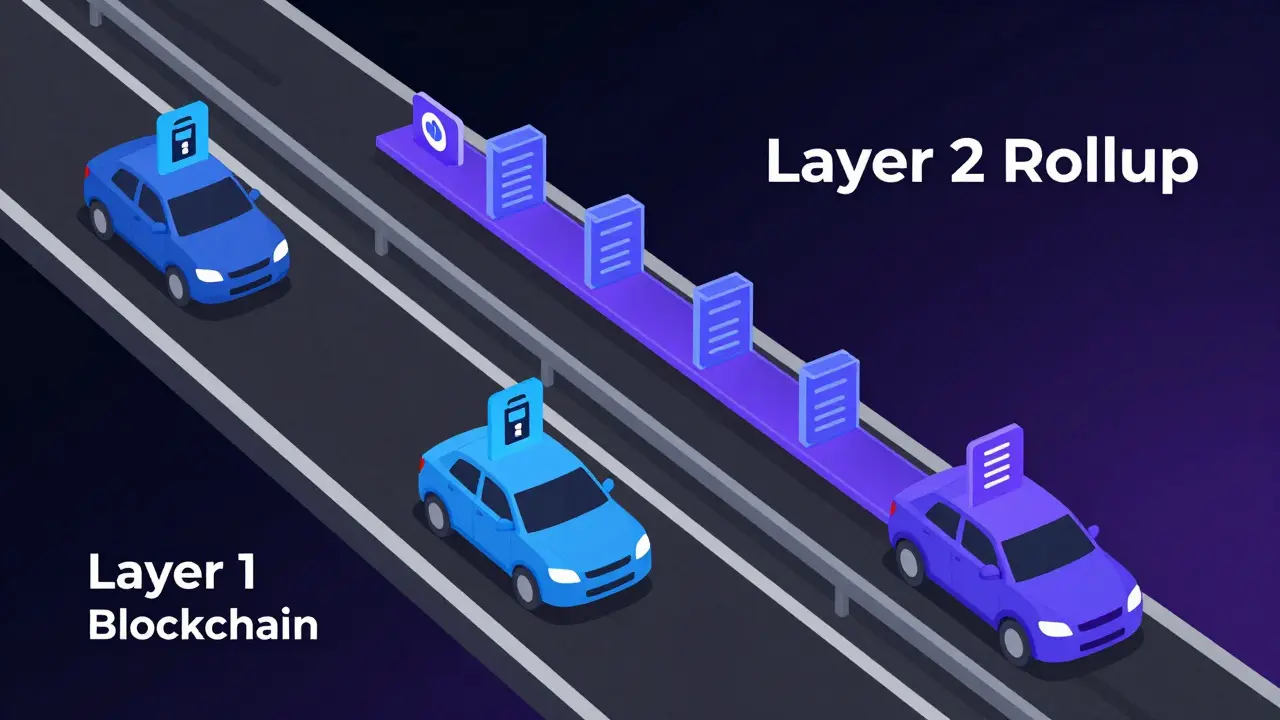
Ever wonder why sending a small payment on Ethereum can cost more than a coffee, or why transactions sometimes take minutes to confirm? It’s not broken-it’s just overloaded. The core blockchain, called Layer 1, was never built to handle millions of daily transactions. That’s where Layer 2 comes in. It doesn’t replace the blockchain. It Layer 2 makes it work like a highway with express lanes-keeping the main road safe and secure while moving most of the traffic off it.
Why Layer 1 Can’t Handle the Load
Bitcoin and Ethereum were designed to be secure, decentralized, and tamper-proof. That’s their strength. But that strength comes at a cost. Every transaction has to be checked by every node in the network. That’s great for security. Terrible for speed. Ethereum can process about 15-30 transactions per second. Visa handles over 1,700. That’s not a small gap-it’s a canyon. When demand spikes-like during an NFT drop or a DeFi surge-gas fees skyrocket. People pay $50 to send $10. Miners get rich. Users get frustrated. The network slows to a crawl. This isn’t a bug. It’s the design. Layer 1 blockchains prioritize security and decentralization over speed. But for everyday use-paying for coffee, sending tips, playing games-that’s not enough.What Is Layer 2, Really?
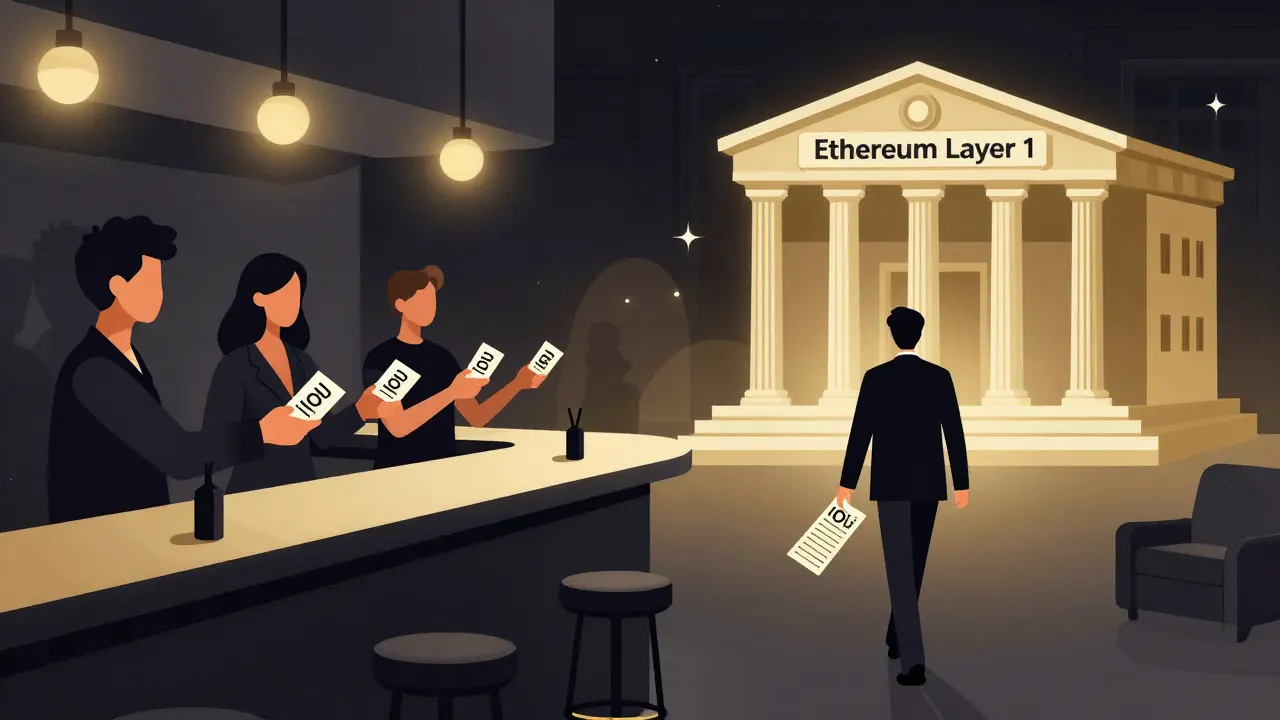
Layer 2 isn’t another blockchain. It’s a sidekick. It runs on top of Layer 1, using its security like a safety net. Think of it like a private club that only reports its final balance to the main registry. You and your friends can trade IOUs all day long. No one else knows. But when you’re done, you walk into the bank (Layer 1) and say, “Here’s what we ended up with.” The bank records it once. Done. No one else had to verify every single trade. Layer 2 solutions take thousands of transactions off the main chain, bundle them up, and submit just one proof back to Layer 1. That one proof is enough to prove all the others happened correctly. The result? Fees drop by 90%. Speed jumps from seconds to milliseconds. And the main chain stays calm.The Three Main Types of Layer 2
Not all Layer 2 solutions are the same. There are three big ones, each with different trade-offs.- State Channels: These are private, two-way pipes between users. The Lightning Network for Bitcoin is the most famous example. You open a channel, send 100 payments back and forth, then close it and record the final balance on-chain. Perfect for small, frequent payments.
- Sidechains: These are separate blockchains that connect to Layer 1 through a two-way bridge. They can have their own rules, faster blocks, and different consensus. Polygon’s early sidechains were used to run DeFi apps with lower fees. But they don’t inherit Layer 1’s full security-so they’re riskier.
- Rollups: These are the current leaders. They process transactions off-chain but post compressed data back to Layer 1. There are two types: Optimistic Rollups (like Arbitrum and Optimism) and Zero-Knowledge Rollups (like zkSync and StarkNet). Optimistic ones assume transactions are valid unless someone challenges them within a week. ZK-rollups use math proofs to prove everything is correct right away. ZK-rollups are faster and more secure, but harder to build.
Rollups are winning because they don’t sacrifice security. They still rely on Ethereum to store data and settle disputes. That’s why they’re now handling over 80% of all Ethereum Layer 2 traffic.
How Rollups Actually Work
Let’s say you want to send 1,000 small payments on Ethereum. On Layer 1, that’s 1,000 separate transactions. Each one costs gas. Each one waits in line. On a ZK-rollup, you bundle those 1,000 payments into one group. The rollup runs them off-chain. Then it generates a tiny cryptographic proof-called a zk-SNARK-that says, “These 1,000 transactions are valid.” That proof is only a few hundred bytes. You send it to Ethereum as one transaction. Ethereum checks the proof in seconds. If it’s valid, it updates the state. All 1,000 payments are now confirmed. The cost? One transaction fee. The speed? Under a minute. The security? Same as Ethereum. That’s why companies like PayPal and Stripe are testing ZK-rollups for payments. They need low cost and high trust. Rollups give both.Security: Is Layer 2 Safe?
A common fear: “If it’s not on the main chain, is it safe?” The answer is: mostly yes-but it depends. State channels are safe as long as both parties stay honest. If one disappears, the other can still close the channel and claim their funds on-chain. Sidechains are riskier because they have their own validators. If those validators are hacked or go rogue, your money could be at risk. Rollups? They’re the gold standard. They don’t trust the off-chain system. They require proof. Even if the rollup operator is malicious, users can still withdraw their funds directly to Ethereum. No one can steal your crypto. The worst they can do is delay your withdrawal by a few days. That’s the magic: Layer 2 doesn’t replace trust. It just makes it more efficient. You still get the security of Bitcoin or Ethereum. You just don’t pay for it on every single transaction.
Real-World Impact: What This Changes
Before Layer 2, blockchain was great for storing value or running big DeFi trades. Not so great for apps people actually use every day. Now? Games like Immutable X let players trade NFTs without paying gas. Social apps like Lens Protocol let users post and tip with near-zero fees. Even remittance services are using Layer 2 to send money across borders for pennies. In 2025, over 60% of all Ethereum activity happens on Layer 2. That’s not a niche experiment. That’s the new normal. And it’s not slowing down. The average gas fee on Ethereum Layer 2 is now under $0.05. On Layer 1? $5-$20. The difference isn’t just technical-it’s human.What’s Next?
Layer 2 isn’t done evolving. Developers are working on cross-rollup communication so you can move assets between Optimism and zkSync without going back to Ethereum. There’s also progress in making ZK-proofs smaller and faster to verify. Soon, even smartphones might run full nodes for Layer 2 apps. The goal? A blockchain that feels as fast and cheap as the web you use every day-but still as secure as the one that launched Bitcoin. Layer 2 is the bridge. And it’s already built.Should You Use Layer 2?
If you’re sending crypto regularly, using DeFi, or playing on-chain games-yes. Use Layer 2. Most wallets (MetaMask, Rainbow, Phantom) now auto-detect the cheapest route. You don’t need to understand the tech. Just pick the option with the lowest fee. If you’re holding large amounts long-term? Keep them on Layer 1. It’s the safest place. Layer 2 is for movement. Layer 1 is for storage. The bottom line: Layer 2 doesn’t make blockchain better. It makes it usable.Is Layer 2 safer than Layer 1?
No, Layer 2 isn’t safer than Layer 1-it relies on Layer 1 for security. But for most users, it’s just as safe in practice. Rollups, the most popular Layer 2 type, use cryptographic proofs that are verified on Ethereum. Even if the Layer 2 operator is hacked, your funds can still be withdrawn to the main chain. The risk is lower than most centralized exchanges.
Can I lose money using Layer 2?
Yes, but only in rare cases. If you use a sidechain with weak validators, you could lose funds if the chain is compromised. State channels can be risky if you don’t monitor them and someone tries to cheat. But with rollups, your funds are always recoverable on Ethereum. Always use trusted wallets and avoid unknown apps.
Do I need to switch wallets to use Layer 2?
No. Most modern wallets like MetaMask, Trust Wallet, and Phantom support Layer 2 automatically. You just select the network-like Arbitrum or zkSync-and your balance updates. No new keys, no new seed phrases. It’s the same wallet, just a different network.
Why not just upgrade Layer 1 instead?
Layer 1 upgrades-like Ethereum’s sharding-are complex and take years. They require global consensus and can risk network stability. Layer 2 solutions can be built and deployed by teams without changing the core protocol. That’s why they’ve scaled faster. Layer 1 stays secure. Layer 2 handles the traffic.
Are Layer 2 solutions only for Ethereum?
No. While Ethereum has the most adoption, Bitcoin uses the Lightning Network for fast, low-cost payments. Other chains like Solana and Polygon also have their own scaling layers. But Ethereum’s rollups are the most advanced and widely used today.
25 Responses
So let me get this straight-we’re using a blockchain to send coffee money, but the coffee costs more than the transaction? Brilliant. I’d rather just hand someone a $5 bill and call it a day.
Layer 2 isn’t magic. It’s just capitalism with cryptography.
Also, why does every crypto article sound like a TED Talk from a guy who just got his first Lambo?
Anyway. ZK-rollups are cool. Let’s move on.
THIS IS THE FUTURE!!! THIS IS THE REVOLUTION!!! WE DON’T NEED BANKS ANYMORE!!! EVERYTHING IS ON BLOCKCHAIN NOW!!! YOU CAN’T STOP THIS!!! I SENT 0.0001 ETH TO MY CAT AND IT WORKED!!!
Okay but imagine if your wallet was a therapist and Layer 1 was your abusive ex who keeps showing up at 3am screaming about gas fees 😭
Layer 2? That’s your new partner who’s chill, pays for dinner, and doesn’t make you cry every time you swipe left.
Also, I just sent $0.02 to a stranger on zkSync and felt like a god. I cried. Not because it worked-because it was ELEGANT.
Someone please write a poem about this.
Also also-can we make NFTs of these feelings? I want to sell it as ‘The Moment I Finally Understood Crypto’.
😭🙌
It’s important to note that while Layer 2 solutions reduce fees, they also introduce a subtle centralization risk. The operators of rollups, even if they’re technically permissionless, become de facto gatekeepers. And while users can withdraw, the UX is not always intuitive. Many users, especially those new to crypto, will simply abandon their funds if withdrawal takes more than three clicks.
Also, the notion that ‘Layer 2 is safer’ is misleading. It’s not safer-it’s *different*. Security is still derived from Layer 1, but the attack surface expands. You’re trusting not just Ethereum, but also the proving system, the sequencer, the data availability layer, and the bridge contract.
Don’t be fooled by marketing. This isn’t a panacea. It’s a compromise.
And yet… it’s still better than what we had.
So you’re telling me we built a super secure, decentralized system… and then we just hid all the traffic behind a curtain?
That’s not innovation. That’s lying to your accountant.
Also, ‘near-zero fees’? Lol. I paid $0.12 to send $1. That’s not zero. That’s just ‘I’m too lazy to count the zeros’.
And why does everyone act like ZK-proofs are magic? They’re math. Math isn’t magic. It’s just math that takes 100 computers to verify.
Stop selling this like it’s the second coming.
It’s a band-aid. A very expensive, very clever band-aid.
The architectural elegance of Layer 2 solutions lies in their ability to preserve the core tenets of decentralization while enabling scalability through off-chain computation. This is a significant advancement in distributed ledger technology, as it allows for the separation of consensus from transaction throughput.
However, one must remain cognizant of the potential for economic centralization, particularly when sequencers are operated by a limited set of entities. While the cryptographic guarantees remain intact, the operational model introduces new vectors for coordination failure.
Nonetheless, the progress made in the past 18 months is remarkable, and the trajectory suggests a sustainable path forward for blockchain adoption at scale.
Okay but have you considered that Layer 2 isn’t solving scalability-it’s just abstracting the pain? We’re not reducing load, we’re just moving the bottleneck from Layer 1 to the sequencer layer.
And don’t get me started on the gas fee illusion. You think $0.05 is cheap? Try explaining that to someone who doesn’t know what a ‘rollup’ is.
Also, the ZK-proofs are so computationally intensive that only 3 companies in the world can actually produce them efficiently. That’s not decentralization. That’s a cartel with a whitepaper.
And the ‘users can withdraw’ thing? Yeah, right. Try withdrawing $500 from Arbitrum when the sequencer is down. Good luck with that.
Don’t get me wrong-I’m excited. But let’s stop pretending this is a utopia.
Layer 2? More like Layer ‘Oh God Not Again’.
You know what’s worse than high gas fees? When you realize the whole ecosystem is just a series of increasingly complex Rube Goldberg machines built to simulate decentralization.
Rollups? Cute. They’re just sidechains with better PR.
And the fact that everyone acts like ZK-proofs are some kind of divine revelation… it’s embarrassing. It’s math. It’s not holy. Stop treating it like the Holy Grail.
Meanwhile, I’m still waiting for the day someone actually uses blockchain to do something useful.
Like… pay rent.
Still waiting.
OMG I JUST SENT A TIP TO MY FAVORITE ARTIST ON ZKSYNC AND IT COST LESS THAN A STICK OF GUM??!! 🥹💖
Like… I didn’t even think this was possible. I used to avoid crypto because of the fees. Now I’m sending $0.10 to strangers who post cute dog pics. I’m basically a digital angel.
Also, my wallet auto-switched to Arbitrum and I didn’t even notice. Like… it just WORKED. That’s the real magic.
Can we all just… be happy for once? 🙏✨
Also, I’m crying. Not because it’s perfect. But because it’s… possible.
Thank you, devs. You’re heroes.
Layer 2 works because it respects the original design: secure base layer, scalable application layer.
No need to overcomplicate it.
Use it.
Don’t overthink it.
And if you’re holding large amounts? Keep them on Ethereum. Simple.
Done.
One must critically examine the epistemological underpinnings of Layer 2 scalability solutions. The assumption that transactional efficiency equates to societal utility is a fallacy rooted in techno-optimist dogma. The blockchain, as a trust-minimized system, was never intended to facilitate microtransactions for digital memes or NFT avatars.
Furthermore, the proliferation of rollups introduces a dangerous fragmentation of liquidity and user experience. The notion that ‘most wallets auto-detect’ the optimal path is a dangerous illusion-most users do not understand the implications of cross-chain bridges, and many have lost funds due to misconfigured network settings.
Additionally, the claim that Layer 2 is ‘just as safe’ is empirically false. The attack surface has expanded exponentially. The security model is not equivalent-it is derivative. And derivatives are inherently less secure than primitives.
Let us not mistake convenience for progress.
And yet… I still use it. Because I am human.
And humans are weak.
It’s funny how we treat technology like it’s a moral choice. Layer 2 isn’t good or bad. It’s just a tool. Like a hammer. You can build a house with it-or you can smash a window.
The real question isn’t whether it works.
It’s what we’re building with it.
And I’m not sure we’ve answered that yet.
The emergence of Layer 2 solutions represents a significant milestone in the evolution of decentralized networks. The technical ingenuity involved in preserving security while enabling scalability is commendable. In developing economies, where transaction costs are a barrier to financial inclusion, these innovations hold profound potential.
It is essential, however, to ensure that accessibility is not overshadowed by complexity. Education must accompany innovation.
With careful stewardship, this paradigm can uplift communities globally.
Let us proceed with both optimism and responsibility.
Rollups are just a scam to make devs look smart. Layer 1 should’ve been upgraded. End of story. Everyone’s just pretending this is a breakthrough. It’s not. It’s a workaround. A fancy workaround. But still a workaround.
My mom just sent $5 to her sister in Mexico using a Layer 2 app. No bank. No fees. No waiting.
She didn’t know what a ‘rollup’ was.
She just clicked ‘send’.
That’s the real win.
Not the tech.
The people.
Oh so now we’re calling it ‘usable’? Like, we gave up on the dream and settled for ‘not terrible’?
Great. So Ethereum’s now the new PayPal. With more gas fees.
And you call that progress?
Meanwhile, I’m still waiting for the day I can use crypto without reading a 10-page blog post first.
Also, ZK-proofs? Cute. But they’re still slower than my microwave.
And why is everyone acting like this is the endgame?
It’s not. It’s the beginning of the next 10 years of bickering.
My wallet auto-switches to the cheapest layer now. I don’t even think about it. That’s how you know it’s working. Not because it’s perfect. But because I stopped caring.
That’s the real victory.
Layer 2? More like Layer ‘I Miss When Crypto Was Just a Messy, Beautiful Disaster’.
Remember when we all lost money because we didn’t know what a private key was? That was fun.
Now we lose money because we didn’t read the 47-page whitepaper on sequencer slashing conditions.
Progress? Or just more paperwork?
Okay I just tried to send $0.03 to a friend on zkSync and my wallet asked me if I wanted to ‘optimize for speed or cost’ and I panicked and sent it to the wrong chain and lost $0.02 and now I’m crying into my cereal 🥲
But then I realized-I DID IT. I used crypto for something small. Like a normal person.
And even though I messed up… I didn’t give up.
That’s the real win.
Also I just bought a sticker that says ‘I survived Layer 2’ and I’m wearing it to my job interview.
Wish me luck. I need it.
Also-can we make a meme about this? PLEASE?
🥺✨
The architectural evolution from Layer 1 to Layer 2 represents a necessary and thoughtful adaptation to real-world usage patterns. While the foundational principles of decentralization and security remain intact, the implementation of scalable transaction processing through cryptographic proofs is a landmark achievement in distributed systems engineering.
It is imperative that developers, users, and regulators continue to collaborate to ensure equitable access and transparent governance of these systems.
This is not the end of blockchain’s evolution-it is its maturation.
layer 2 good. gas fee low. i use. no prob. 🤙
Finally! Someone who gets it! Layer 2 is the bridge we’ve been waiting for! The fact that we can now do DeFi, gaming, and social apps without bankrupting ourselves? That’s not progress-it’s liberation!
And yes, ZK-proofs are complex. But so is quantum computing. And we didn’t stop there.
Stop being cynical. This is the future. And it’s already here.
Let’s build it together. 💪🚀
There’s something poetic about building a system that doesn’t demand perfection from its users.
Layer 2 doesn’t ask you to understand cryptography.
It just lets you send money.
And that… is quiet revolution.
Not loud.
Not flashy.
Just… there.
And yet, the fact that we’re even having this conversation means we’re already past the point of no return.
It’s not about whether Layer 2 is perfect.
It’s about whether we’re willing to accept a system that’s good enough.
Turns out… we are.
YES. THIS. I just want to send $0.05 to someone who made me laugh today. That’s all. I don’t need to be a blockchain engineer to do it.
That’s the dream.
And it’s real.
Thank you for saying it.
💙