
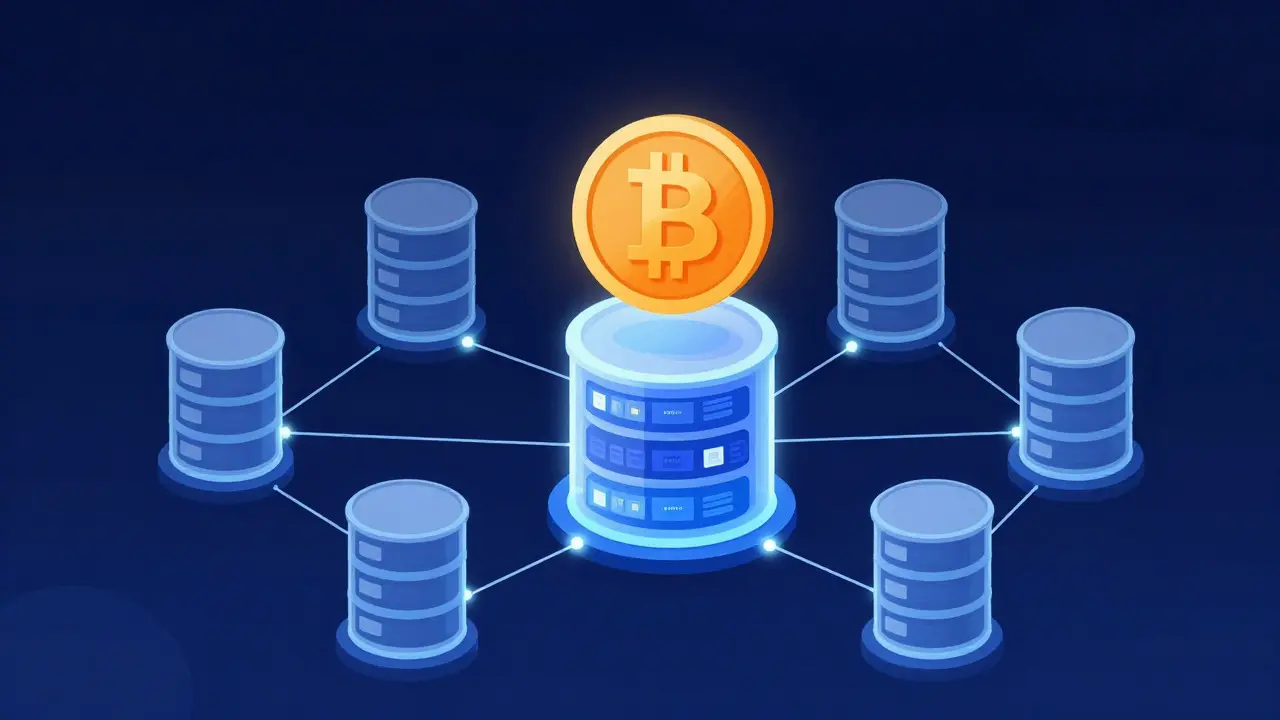
Imagine you’re at a busy restaurant. You order your food, but it doesn’t hit your table immediately. It sits in the kitchen queue, waiting for a chef to pick it up. In the Bitcoin mempool is a distributed temporary storage system where unconfirmed Bitcoin transactions wait to be included in blocks. Unlike a single kitchen line, there isn’t just one mempool. Every full node on the network runs its own independent version of this queue. This decentralized setup means that when you send a transaction, it’s not going into a central bank’s ledger; it’s being broadcast to thousands of computers worldwide, each deciding whether to keep it in their local pool.
Understanding how this works is crucial if you’ve ever wondered why some transactions confirm in minutes while others take days. The mempool is the bridge between sending money and having it finalized on the blockchain. It determines speed, cost, and even security. If you’ve ever paid a high fee during a market spike, you were directly interacting with the dynamics of the mempool. Let’s break down exactly what happens behind the scenes, from the moment you click “send” to the final confirmation.
What Exactly Is the Bitcoin Mempool?
At its core, the mempool is a cache of valid, unconfirmed transactions. When you create a transaction in your wallet, it contains essential data: the sender’s address, the recipient’s address, the amount, and the fee. Before this transaction can be added to the blockchain, it must be validated by the network. Nodes check if the sender actually has enough Bitcoin and if those funds haven’t already been spent elsewhere (preventing double-spending). Once a node deems the transaction valid, it adds it to its own mempool.
Here’s the key nuance: because every node maintains its own mempool, the network view is slightly fragmented. However, standard configurations keep these views aligned. By default, Bitcoin Core is the reference implementation for running a full Bitcoin node, setting default parameters for network consensus. It sets a maximum mempool size of 300 MB per node. This limit prevents nodes from running out of memory while storing pending transactions. Additionally, there’s a default expiry period of 336 hours, or two weeks. If a transaction hasn’t been confirmed after this time, most nodes will drop it from their mempool unless the user replaces it with a higher-fee version.
The Five-Step Lifecycle of a Transaction
Tracking a transaction through the mempool follows a precise sequence. Understanding these steps helps explain why delays happen. Here is the workflow:
- Broadcast: Your wallet sends the transaction to connected peers. These peers then relay it to their neighbors, spreading the transaction across the global network within seconds.
- Validation: Each receiving node checks the transaction against consensus rules. This includes verifying signatures, ensuring inputs are unspent, and confirming the fee meets the minimum relay threshold (typically 1 satoshi per virtual byte).
- Storage: If valid, the transaction enters the node’s mempool. It stays here, competing with other transactions for attention.
- Selection: Miners scan the mempool to build the next block. They don’t just pick transactions randomly; they prioritize based on fee rates to maximize their revenue.
- Confirmation: Once a miner includes your transaction in a newly mined block, it becomes confirmed. Simultaneously, it is removed from all mempools across the network.
This process highlights a critical point: miners are the gatekeepers. They have the power to choose which transactions make it into the next block. Since block space is limited (roughly 1-4 MB depending on transaction size), only the highest-paying transactions get priority. This creates a natural auction for block space.
Why Fees Matter More Than Ever
In traditional banking, processing fees are fixed. You pay $5 to wire money, whether the bank is busy or quiet. In Bitcoin, the fee is dynamic. It acts as a signal of urgency. If the mempool is empty, you can pay a tiny fee and still get confirmed quickly. But if the mempool is congested with thousands of pending transactions, low-fee transactions get stuck at the bottom of the queue.
Miners calculate profitability based on the fee rate, measured in satoshis per virtual byte (sat/vB). A transaction paying 100 sat/vB is more attractive to a miner than one paying 10 sat/vB, assuming both are otherwise identical. This mechanism ensures that users who need fast service pay more, subsidizing the network for those who can wait. It’s a market-driven approach to prioritization that keeps the network efficient without central control.
| Feature | Traditional Banking | Bitcoin Mempool |
|---|---|---|
| Transaction Queue | Centralized, single-point-of-failure | Distributed, multiple independent pools |
| Fee Structure | Fixed regardless of demand | Dynamic, based on network congestion |
| Priority Mechanism | Internal bank policies | Market-driven fee bidding |
| Transparency | Opaque internal processes | Fully public and verifiable |
| Censorship Risk | High (bank can freeze accounts) | Low (nodes must relay valid txs) |

Monitoring the Mempool: Tools and Strategies
You don’t need to run your own node to understand the current state of the mempool. Several public tools provide real-time data on network congestion and recommended fee rates. Websites like mempool.space allow you to see the number of pending transactions, the average fee rate for different confirmation times, and historical trends. These tools use statistical models to estimate how long a transaction might take to confirm at various fee levels.
For advanced users, running a full node offers deeper insight. Using the Bitcoin RPC method getrawmempool, you can query your local node to see exactly which transactions are in your mempool. This is useful for developers or institutions that need to monitor specific addresses or transaction patterns. For the average user, however, sticking to the recommended fee rates provided by your wallet software is usually sufficient. Most modern wallets integrate fee estimation algorithms that adjust automatically based on current network conditions.
A practical tip: avoid sending large transactions during peak hours if possible. Network activity often spikes during high-volatility market periods or when major exchanges settle trades. Checking a mempool explorer before sending can save you significant fees. If you’re not in a rush, waiting for a dip in congestion can reduce costs by 50% or more.
Common Misconceptions About the Mempool
One widespread myth is that the mempool is a centralized database controlled by miners. In reality, miners only influence which transactions *they* include in their blocks. Other nodes may still hold those transactions in their mempools until they are confirmed globally. Another misconception is that low-fee transactions are permanently lost. Unless they expire after two weeks, they remain in the mempool. Users can also use Replace-By-Fee (RBF) to bump up the fee of an unconfirmed transaction, effectively moving it up in the queue.
Some people believe that the Lightning Network eliminates the need for the mempool entirely. While Lightning reduces on-chain traffic for small payments, the base layer mempool remains essential for settling larger amounts and anchoring channels. The two systems work together, with the mempool handling final settlement and Lightning providing instant, off-chain speed.

Future Developments and Scaling
As Bitcoin adoption grows, mempool management continues to evolve. Recent updates to Bitcoin Core have improved how nodes handle transaction relay and fee estimation, making the system more resilient to congestion. Future developments may include more sophisticated fee prediction models and better integration with Layer 2 solutions. However, the fundamental role of the mempool as a buffer between users and the blockchain is unlikely to change. It remains a critical component of Bitcoin’s security and decentralization, ensuring that anyone with a valid transaction can eventually get confirmed, provided they are willing to pay the market price for space.
Frequently Asked Questions
Is there only one Bitcoin mempool?
No, there is no single centralized mempool. Every full node on the Bitcoin network maintains its own independent mempool. These pools are synchronized through peer-to-peer communication, but they are technically separate entities stored on different computers.
How long does a transaction stay in the mempool?
By default, transactions expire after 336 hours (two weeks) if they haven’t been confirmed. However, they can be removed earlier if the mempool reaches its size limit and lower-fee transactions are displaced, or if the user broadcasts a replacement transaction with a higher fee.
What happens if I pay too low a fee?
Your transaction will likely sit in the mempool for a longer period, potentially days or weeks, until network congestion decreases or miners decide to include it. If it expires after two weeks, it will be dropped from most mempools, and the funds will return to your available balance.
Can I change my fee after sending a transaction?
Yes, if your transaction supports Replace-By-Fee (RBF), you can broadcast a new version of the same transaction with a higher fee. This bumps your original transaction up in the miner’s priority queue. Not all wallets enable RBF by default, so check your settings before sending.
How do miners choose which transactions to include?
Miners typically prioritize transactions with the highest fee rates (satoshis per virtual byte) to maximize their profit. They fill the block starting with the highest-paying transactions until the block is full. This creates a competitive market for block space.
26 Responses
It is truly a marvel of modern engineering that we have allowed the most critical financial infrastructure in history to be governed by the whims of miners who treat block space like a high-stakes auction house. One must admire the sheer audacity of a system where your ability to move money depends entirely on how much you are willing to pay for the privilege, a concept that would make any traditional banker faint from the shock of such unregulated chaos.
I actually really liked the restaurant analogy at the start. It makes it way less intimidating than reading through all the technical jargon about consensus rules and validation nodes. I always get confused when people talk about the mempool as if it's some magical black box, but thinking of it as just a waiting line helps me understand why fees go up when everyone wants to eat at once.
This is a great summary! : )
One thing I’d add is that if you’re using a hardware wallet, sometimes the fee estimation can be a bit off depending on which node it’s connected to. I’ve had instances where my wallet suggested a very low fee because it was looking at a slightly different view of the network congestion than what the rest of the world was seeing. Always double-check with an external explorer before sending large amounts!
Oh, darling, do tell us more about this 'distributed' nonsense. : O
It sounds terribly inefficient compared to the sleek, centralized efficiency of our local banks. Why on earth would anyone want to wait in a digital queue that is essentially run by strangers? It feels like stepping back into the stone age of commerce, don't you think?
DARLING! The audacity!
To think that the fate of our national currency is being dictated by these... 'miners'. Who are they? The chosen ones? The elite class of tech wizards who decide who gets their lunch served first? It is a travesty of justice that the American dream is now contingent on paying a toll to a faceless algorithm! We need to take back control of our own ledgers, or at least demand better service from these so-called 'nodes'!
🤔 There’s something almost poetic about the decentralization here.
We often criticize Bitcoin for its volatility, but the mempool is actually a pretty elegant solution to the problem of trust. Instead of trusting a bank not to freeze your account, you trust the math and the market. It’s a shift from institutional trust to mathematical certainty, which is a profound change in how we think about value. 🌱
Oh wow!! This is SO helpful!! 😍
I’ve been trying to figure out why my transactions keep getting stuck for days!!! And nobody ever explains it clearly like this!!! The part about the 336-hour expiry is super important!!! I didn’t even know that!!! Thanks for breaking it down!!! It’s like a whole new world opening up!!! 💡✨
Great read. The explanation of RBF (Replace-By-Fee) was particularly useful. Many people assume that once a transaction is sent, it is set in stone, but knowing you can bump the fee is a lifesaver during high congestion periods. It gives users a bit more control over their funds without needing to contact customer support.
You’re still missing the point! : (
It doesn’t matter if you can replace the fee, the real issue is that the system is designed to punish those who don’t pay enough. It’s a moral failing of the community to let the rich buy speed while the poor wait. We should all be boycotting high fees to show our solidarity with the common man!
The mempool is merely a shadow of the true blockchain spirit.
It represents the struggle between order and chaos, between the desire for instant gratification and the patience required for true security. To ignore the mempool is to ignore the heartbeat of the network itself. Do you feel the weight of every satoshi waiting in the void? It is a meditation on time and value.
Just to clarify for the skeptics: the 300MB limit is per node, not global. So if you run a full node, you are responsible for managing your own memory usage. If you are running a light client, you don't have to worry about this, but you also lose some privacy and verification capabilities. It's a trade-off that many people overlook when they complain about 'centralization'.
US MADE BITCOIN IS THE BEST!
Forget about all these foreign miners trying to game the system. Our guys are the best at building blocks. We need to make sure our domestic mining farms are getting priority access to the best txs. No way we let the Chinese or Russians dictate our fee markets. Let's pump the US mining sector! 🇺🇸
One might argue that the entire premise of the mempool is a form of technological obsolescence in disguise.
Why bother with a distributed cache when one could simply implement a more efficient consensus mechanism? The reliance on fee markets suggests a lack of fundamental architectural innovation, a testament to the limitations of proof-of-work in the modern era. It is, quite frankly, a relic of early internet design thinking.
It is highly probable that the mempool dynamics are being manipulated by deep state actors to suppress inflation.
Notice how the fee spikes always coincide with major geopolitical events. It is not a coincidence. The miners are working in concert with central banks to create artificial scarcity. You must look at the metadata of the transactions to see the hidden patterns. Wake up, sheeple.
I find the comparison to traditional banking quite apt, though perhaps a bit too optimistic about the transparency of the Bitcoin system. In practice, the complexity of tracing transactions through the mempool and onto the chain is far greater than most users realize. The idea that it is 'fully public and verifiable' is technically true, but practically difficult for the average person to execute without specialized tools.
How tedious.
Another long-winded explanation of a process that is fundamentally broken. The mempool is just a glorified waiting room for the impatient. Why do we even tolerate this inefficiency? It is a testament to our collective laziness in seeking better solutions. 🙄
OMG THIS IS SO COOL!!! 😲
I never knew there was so much going on behind the scenes! It’s like a little economy within an economy! I’m so excited to try checking the mempool.space myself now! Thanks for making it easy to understand! Let’s keep learning together! 🚀
Here’s the deal: stop overthinking it.
If you’re not a developer or a miner, just use a reputable wallet that handles fee estimation for you. The article is great for understanding the theory, but for daily use, you just need to know that higher fees mean faster confirmation. That’s it. Don’t let the complexity scare you away from using Bitcoin. Just send your coins and move on with your life!
Actually, that’s not entirely accurate.
While wallets do estimate fees, they often rely on third-party APIs which can be inaccurate or biased. For serious users, running a full node and using RPC calls is the only way to ensure you’re getting the best possible rate based on your specific network view. Trusting a default setting is a risk you shouldn’t take if you’re moving significant capital.
Good point.
But for the casual user, the overhead of running a node is often not worth it. The marginal difference in fee optimization is rarely enough to justify the electricity and storage costs for most individuals. Simplicity wins for the masses.
Man, this stuff is wild tho.
I always thought the blockchain was just a giant ledger that got updated instantly. Turns out it’s more like a slow-moving river of data. The idea that you can basically 'bid' on your place in line is kinda genius if you think about it. It’s like a dynamic pricing model but for money movement. Pretty cool stuff honestly. 🤯
The drama of it all is exhausting.
Every time there’s a spike in fees, it’s a new crisis. But really, it’s just supply and demand. If you can afford to wait, wait. If you can’t, pay. It’s not a conspiracy, it’s economics. Stop whining and start understanding the basics. 📉
Oh, please.
Economics? It’s a rigged game! The big players always win. They dump their coins when fees are low and hoard them when fees are high. It’s all calculated. You’re just a pawn in their grand scheme. Wake up! 👑
Mempool variance is a key metric for assessing network health.
High variance indicates potential congestion issues or speculative activity. Monitoring the depth of the mempool at different fee tiers provides insight into the price elasticity of demand for block space. It’s a complex interplay of behavioral economics and cryptographic incentives.
Typical.
Always hiding behind jargon to sound smart. Most people don’t care about 'price elasticity of demand'. They care about whether their money will arrive on time. Keep it simple, or stay silent. The average user is not a PhD student in game theory.
Nice write-up.
I appreciate the focus on the practical aspects like RBF and fee estimation. It’s often overlooked in favor of the more theoretical discussions about scalability. For those of us who just want to use Bitcoin as a payment method, these details are what really matter in the day-to-day experience.