

Imagine buying a single stock because your neighbor mentioned it. If that company fails, you lose everything. Now imagine doing the same with cryptocurrency, where prices can swing 50% in a week. That’s exactly what most beginners do-they chase the hottest narrative, whether it’s AI tokens or meme coins, and ignore the rest of the market. The result? Emotional stress and often significant losses.
Building a balanced crypto portfolio isn’t about picking the next Bitcoin. It’s about constructing a resilient mix of assets that protects your capital during crashes while still capturing growth when the market rallies. In 2026, with institutional players like BlackRock and Fidelity deeply embedded in the space, the rules have changed. You no longer need to gamble; you need a system.
The Core Framework: Allocation by Market Cap
The foundation of any balanced portfolio is diversification across risk levels. Think of this as building a house: you need a solid concrete base (large caps), sturdy walls (mid caps), and maybe some decorative accents (small caps). According to Morgan Stanley’s Global Investment Committee, a robust structure typically follows these percentages:
- Large-Cap Coins (40-50%): These are the anchors. Bitcoin and Ethereum dominate this category, holding over 52% of the total market cap as of late 2025. They offer lower volatility compared to the rest of the market and act as your primary store of value.
- Mid-Cap Coins (25-30%): These projects have proven utility but room for growth. Examples include Layer 2 solutions like Arbitrum and Polygon, which handle massive transaction volumes.
- Small-Cap Gems (10-20%): High risk, high reward. This includes emerging narratives like AI-integrated blockchains (e.g., Fetch.ai) or Real World Asset (RWA) tokenization protocols.
- Stablecoins (5-10%): Cash on standby. Assets like USDC and USDT allow you to sit out volatility or quickly buy dips without selling other assets into a crash.
Why does this matter? Token Metrics surveyed over 12,000 investors in 2025 and found that 68.7% of profitable traders used quarterly rebalancing within this framework, compared to just 22.3% of those who lost money. The math doesn’t lie: structure beats speculation.
Diversifying Across Ecosystems
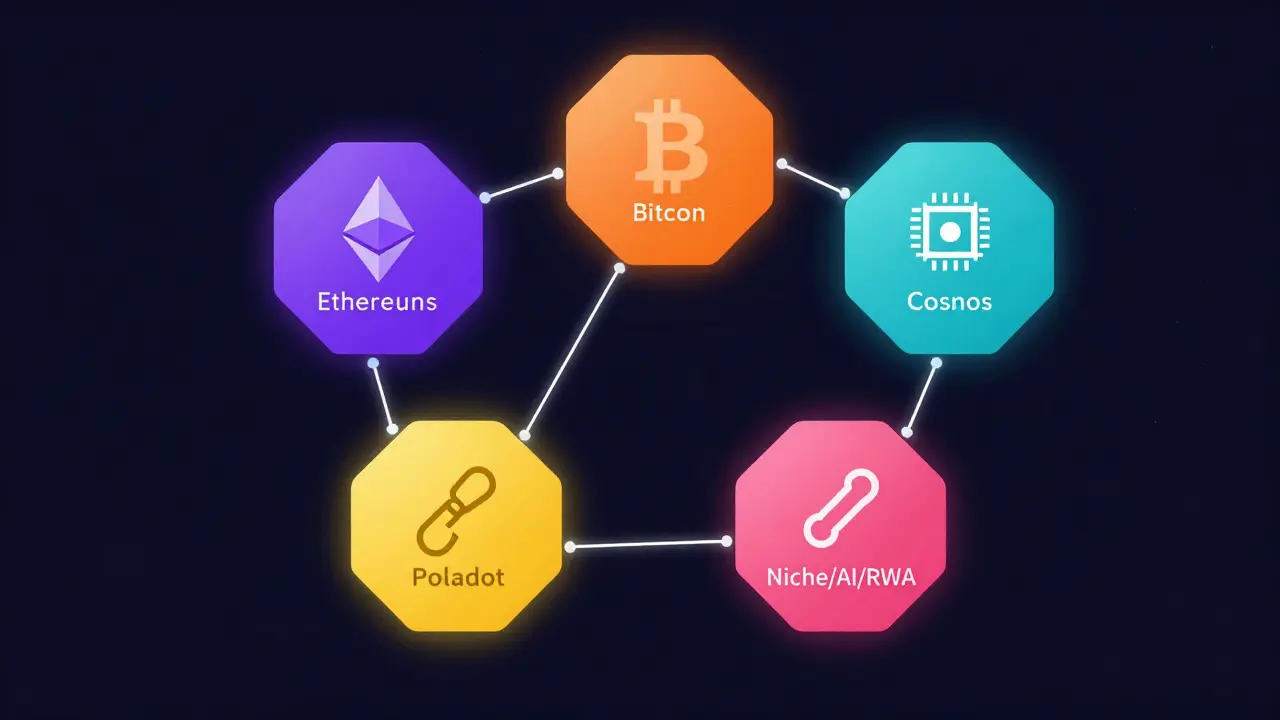
Allocating by size is only half the battle. You also need to spread risk across different blockchain ecosystems. If you put all your eggs in the Ethereum basket, you’re exposed to smart contract bugs or regulatory issues specific to that chain. A balanced approach looks at the broader landscape:
| Ecosystem | Target Allocation | Key Focus Areas |
|---|---|---|
| Ethereum & L2s | 30% | DeFi, NFTs, Scaling Solutions (Arbitrum, Optimism) |
| Bitcoin | 20% | Store of Value, Lightning Network payments |
| Cosmos | 15% | Interoperability, App-specific chains |
| Polkadot/Solana | 10% | High-throughput dApps, Parallel processing |
| Other/Niche | 25% | AI, RWA, Gaming, Privacy |
This distribution ensures that if one ecosystem faces technical hurdles or regulatory headwinds, your entire portfolio doesn’t collapse. For instance, when DeFi narratives cooled in Q3 2025, portfolios heavily weighted toward Ethereum suffered. However, balanced portfolios that had exposure to RWA tokenization captured gains elsewhere, limiting overall drawdowns.
The Art of Rebalancing
Here’s where most people fail. They buy their ideal mix, then watch one coin skyrocket. Suddenly, Bitcoin makes up 70% of their portfolio instead of 40%. The natural instinct is to hold onto the winner, hoping for more gains. But this destroys balance and increases risk.
Rebalancing means selling winners and buying losers to return to your target percentages. It sounds counterintuitive-why sell something that’s going up? Because you’re locking in profits and resetting your risk profile. Binance Research backtested thousands of portfolios in 2025 and found that triggering rebalances when an asset deviates by 5% from its target weight optimized the trade-off between transaction costs and risk control.
For example, if your mid-cap allocation targets 30% but surges to 35% after a bull run, you sell 5% worth of those mid-caps. You then use those funds to buy undervalued large-caps or stablecoins. This discipline prevents emotional decision-making during market frenzies. Tools like CoinGecko Portfolio or Zapper.fi can automate alerts, saving you hours of manual tracking.
Risk Management Protocols
A balanced portfolio isn’t just about what you buy; it’s about how you protect it. Volatility in crypto is asymmetric-drops happen faster than rises. To mitigate this, implement strict position sizing and stop-loss strategies.
- Position Sizing Limits: Never let a single asset exceed 5% of your total portfolio unless you have explicit justification. The TerraUSD collapse in 2022 taught us harsh lessons: investors with >15% exposure to that single stablecoin lost nearly 90% of that allocation overnight.
- Stop-Loss Orders: Use automated stop-losses to exit positions before they destroy your capital. For small-cap assets, set stops at 25-30% below entry. For large-caps like Bitcoin, a wider band of 35-40% is appropriate due to higher liquidity and lower relative volatility.
- Tax-Aware Trading: Rebalancing triggers taxable events. In the US, tax-loss harvesting can offset gains. Koinly’s 2025 analysis showed that strategic harvesting saved investors 18-22% in taxes. Always consult a tax professional familiar with crypto regulations in your jurisdiction.
Glassnode’s volatility analysis of 200+ assets confirms that disciplined risk management reduces maximum drawdowns by nearly half compared to unmanaged portfolios. It’s not about avoiding losses entirely-it’s about surviving them.

Navigating Narratives vs. Fundamentals
Crypto moves in cycles driven by narratives: AI, Gaming, Metaverse, RWA. It’s tempting to go all-in on the latest hype. However, Electric Capital’s Developer Report revealed that only 17% of AI-focused projects maintained active development teams in 2025. Most were vaporware.
A balanced portfolio acknowledges trends but doesn’t bet the farm on them. Allocate a portion of your small-cap bucket to high-potential narratives, but keep the core grounded in fundamentals. Look for organic growth metrics: increasing non-exchange addresses, rising developer activity, and sustainable tokenomics. Nansen CEO Alex Svanevik noted that wallets focusing on organic growth outperformed hype-driven ones by 27% in 2025.
Also, beware of over-diversification. a16z’s Chris Dixon warned that holding 30+ marginal projects creates hidden liquidity risks. Quality curation matters more than quantity. Aim for 15-25 carefully selected assets rather than a scattered mess of low-cap coins.
Tools and Resources for Implementation
You don’t need to be a coding wizard to build this portfolio. Leverage existing tools to streamline the process:
- Portfolio Trackers: Use CoinGecko or Zapper.fi to visualize your allocations. Their rebalancing alerts help you stay on track without constant manual checks.
- Research Platforms: Token Metrics offers AI-driven insights and weekly webinars. Messari provides deep-dive project reports. Read at least 15-20 industry reports monthly to stay informed.
- Exchange Features: Major exchanges like Binance and Coinbase offer educational resources and automated trading bots. Binance Academy’s rebalancing course helped 287,000 users in 2025 alone.
Start small. Spend 8-10 hours initially defining your risk tolerance and selecting assets. Then, commit to quarterly reviews. The goal isn’t perfection; it’s consistency. As the market matures in 2026, with ETFs and institutional adoption driving stability, a disciplined approach will separate the serious investors from the gamblers.
What is the ideal percentage for Bitcoin in a balanced crypto portfolio?
Most experts recommend allocating 40-50% of your crypto portfolio to large-cap coins, with Bitcoin typically making up the majority of this share. Given its status as digital gold and lowest volatility among major cryptos, Bitcoin serves as the anchor. However, exact percentages depend on your risk tolerance; conservative investors may lean closer to 50%, while aggressive ones might reduce it to 30% to allocate more to altcoins.
How often should I rebalance my crypto portfolio?
Quarterly rebalancing is widely considered optimal. Data from Token Metrics shows that 68.7% of profitable investors rebalance every three months. Alternatively, you can use a threshold-based approach, rebalancing whenever an asset deviates by 5% from its target weight. This method responds to market changes dynamically without unnecessary trading frequency.
Is it better to hold many small coins or few large ones?
Quality outweighs quantity. While diversification is key, holding 30+ marginal projects introduces liquidity risk and management complexity. a16z research indicates that portfolios with 15-25 carefully curated assets outperform those with excessive diversification by nearly 20%. Focus on strong fundamentals and active development rather than sheer number of holdings.
Do I need stablecoins in my crypto portfolio?
Yes, maintaining 5-10% in stablecoins like USDC or USDT is crucial. They provide liquidity to buy dips during market corrections without selling other assets at a loss. Stablecoins also act as a safe haven during extreme volatility, preserving capital until opportunities arise. Avoid algorithmic stablecoins with weak backing, sticking to fully reserved fiat-backed options.
How does regulatory news affect my balanced portfolio strategy?
Regulatory clarity, such as the EU's MiCA framework or US ETF approvals, generally boosts institutional adoption and reduces long-term volatility. However, sudden regulatory crackdowns can cause short-term shocks. A balanced portfolio mitigates this through diversification across jurisdictions and asset types. Stay informed via reputable sources like CoinDesk or official SEC announcements, but avoid panic-selling based on headlines alone.
15 Responses
thats all just propaganda from the suits who want you to hold their bags while they dump on retail. i dont buy it for a second. the whole idea of diversification is a lie told by people who cant pick winners. if you really knew what you were doing you would be all in on one coin and laughing all the way to the bank. but no lets play it safe and make 10% instead of 1000%. typical sheep mentality. also why do they keep mentioning blackrock? its always about blackrock now. suspicious af.
I appreciate the structured approach here, though I must emphasize that discipline is paramount in this volatile landscape. The suggestion to allocate 40-50% to large caps is sound advice for those seeking stability amidst chaos. We must not let emotion dictate our financial decisions. It is imperative that we adhere to these guidelines to ensure long-term sustainability. Let us remain focused and avoid the pitfalls of speculation. Your capital deserves protection above all else.
The alpha here is undeniable when you look at the tokenomics and the underlying utility of the L2s mentioned. Arbitrum and Polygon are not just names; they are infrastructure plays with massive TVL retention rates. You need to understand that mid-caps offer the best risk-adjusted returns if you can handle the volatility spikes. Most degens don't have the stomach for the drawdowns required to catch the parabolic moves in these assets. Stop chasing memes and start looking at developer activity metrics. That is where the real value accrues over time.
The framework presented is logically consistent and adheres to established principles of modern portfolio theory adapted for digital assets. Diversification across market capitalizations mitigates idiosyncratic risk effectively. One must consider the correlation coefficients between different blockchain ecosystems during periods of systemic stress. Rebalancing quarterly ensures that the portfolio remains aligned with the investor's initial risk tolerance parameters. This methodical approach reduces emotional bias which is often detrimental to investment performance.
This is a very solid guide for anyone looking to get serious about crypto investing in 2026. I agree completely with the point about rebalancing because it forces you to sell high and buy low automatically. Many people forget this basic principle when they get greedy. The section on stablecoins is also crucial since having dry powder allows you to act quickly during market dips without panic selling your core holdings. Great insights overall.
I find the emphasis on ecosystem diversification particularly compelling given the regulatory uncertainties surrounding specific chains. By spreading exposure across Ethereum, Cosmos, and Solana, investors can hedge against chain-specific failures or regulatory crackdowns. It is fascinating how the data supports the notion that structure beats speculation consistently. I wonder if the inclusion of AI-integrated blockchains will shift these percentages significantly in the coming quarters as that narrative gains traction among institutional players.
lol another article telling americans to trust foreign tech companies with their money. wake up sheeple. the government wants to control your wealth through these digital tokens. why should we listen to some random guy talking about blackrock and fidelity? its all part of the plan to destroy privacy. keep your gold and cash under the mattress if you want to stay free. this crypto stuff is just legalized gambling for the elite :)
oh wow such a groundbreaking discovery that you shouldnt put all your eggs in one basket. thanks for sharing this obvious tip with us peasants. i bet you charge thousands for this 'exclusive' strategy. typical clickbait content designed to farm views from inexperienced traders who actually believe they need a 'system'. please stop pretending you know better than the market.
We need to talk about the practical implementation of these stop-loss orders because slippage can be a major issue in smaller cap coins. If you set a stop loss at 25% below entry for a small cap with low liquidity you might end up getting filled at 40% below entry during a crash. This is a critical detail that many guides overlook. Always check the order book depth before setting automated exits. It protects your downside more effectively than just relying on the percentage trigger alone.
The philosophical underpinning of this strategy is rooted in the acceptance of uncertainty and the rejection of predictive certainty. We cannot know the future price of any asset but we can manage our exposure to unknown risks. This aligns with the Stoic principle of focusing only on what is within our control. The portfolio allocation is merely a tool to maintain equanimity in the face of market turbulence. True wealth preservation comes from mental discipline rather than financial optimization alone.
I remember losing half my portfolio in 2022 because I ignored exactly these principles. I was so convinced that Bitcoin was going to zero that I sold everything at the bottom. Then I chased the meme coins and lost even more. Reading this brings back painful memories but also hope. If I had followed this simple framework I would still be invested today. It is heartbreaking to think about the missed opportunities due to lack of discipline.
Oh great another guru telling you to buy the dip like a good little monkey. Have you ever actually made money trading or do you just copy paste articles from finance blogs? The market doesn't care about your feelings or your rebalancing schedule. It will crush you regardless of how 'balanced' your portfolio is. Save your time and go touch grass instead of reading this nonsense.
This analysis is superficial at best and ignores the macroeconomic headwinds facing the entire sector. Interest rates remain elevated which puts pressure on risk assets like crypto. Furthermore the regulatory landscape is shifting rapidly with MiCA in Europe creating compliance burdens that could stifle innovation. Relying on historical data from 2025 is dangerous because the current cycle dynamics are fundamentally different. You are leading beginners into a trap with this outdated information.
The tax implications discussed here are spot on especially regarding the wash sale rule and cost basis tracking. Using tools like Koinly is essential for anyone holding multiple assets across different exchanges. I highly recommend setting up a dedicated spreadsheet to track your entries and exits manually as well just in case the API integrations fail. Data integrity is key for accurate tax reporting. Don't rely solely on third-party software for your legal obligations 📊💼
In Asian markets we see a lot more aggressive rotation into small caps compared to Western portfolios. However the principle of maintaining a core holding in Bitcoin remains universal across cultures. The cultural difference lies in the risk appetite for altcoins which tends to be higher in emerging markets. Understanding these regional nuances can provide additional alpha for global investors. We should respect the diversity of strategies while adhering to fundamental risk management protocols.