

India Crypto Transfer Tax Calculator
Calculate Your Tax Liability
Determine your tax burden when sending crypto abroad from India
Tax Breakdown
Capital Gains
₹0.00
30% Tax
₹0.00
1% TDS
₹0.00
18% GST
₹0.00
Net Amount After Taxes
₹0.00
FEMA Transfer Limits
India allows up to $250,000 ($₹2.1 crore) per year for crypto transfers abroad without special approval.
Current year transfer amount: ₹0
Remaining limit: ₹2,100,000
Want to move your crypto from India to another country? It’s not as simple as sending a wire. By 2025, India has built one of the strictest frameworks in the world for moving digital assets overseas. If you’re thinking about sending Bitcoin, Ethereum, or even NFTs abroad, you need to know the real rules - not the rumors. This isn’t about avoiding taxes. It’s about staying legal while doing what you need to do.
India treats crypto as property, not money
India doesn’t recognize cryptocurrencies as legal tender. That means you can’t use Bitcoin to pay for groceries or rent. But you can own it, trade it, and send it overseas - as long as you follow the rules. The government calls all digital assets Virtual Digital Assets (VDAs). This label matters because it changes how taxes, reporting, and transfers work. VDAs are treated like stocks or real estate - not cash. That means every time you move them, you’re triggering tax and compliance obligations.As of July 2025, over 107 million Indians hold crypto. That’s more than any other country. But despite the massive user base, India ranks 48th globally in crypto adoption. Why? Because the rules make it hard to move assets freely. The government wants control, not innovation. And they’re enforcing it.
The 30% tax that eats your profits
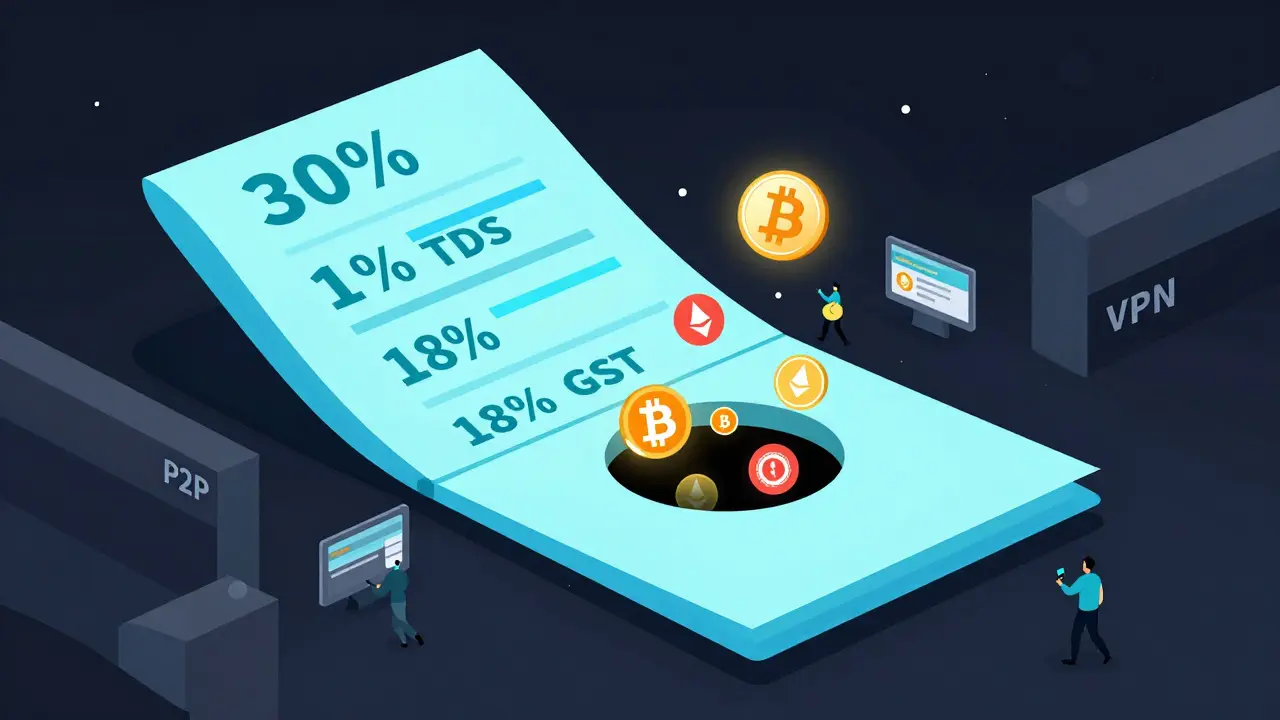
If you sell or transfer crypto and make a profit, you pay 30% in capital gains tax. No deductions. No loss offsets. Even if you lost money on other trades this year, you still pay 30% on whatever you gained. That’s higher than most countries. The U.S. has progressive rates. The U.K. has exemptions. India? Flat 30%.And it gets worse. Every time you transfer crypto - even if you’re just moving it to your own wallet abroad - you trigger a 1% Tax Deducted at Source (TDS). That’s automatic. Your exchange takes it out before you even get the transaction confirmed. If you’re sending $10,000 worth of ETH to a wallet in Singapore, $100 vanishes right away. No warning. No choice.
On top of that, an 18% Goods and Services Tax (GST) applies to almost every crypto activity since July 2025. That includes withdrawals, staking, and even swaps between tokens. For many users, the total tax burden on a single transfer can hit 50% or more. Experts say this is intentional - to discourage movement.
FEMA rules: The hidden barrier
The Foreign Exchange Management Act (FEMA) governs all money leaving India. Crypto is now classified as "intangible movable property" under FEMA. That means you need approval to send large amounts abroad.Here’s the hard limit: you can send up to $250,000 per year without special permission. That’s about ₹2.1 crore. Anything above that? You need written approval from an authorized dealer bank - usually your savings or current account bank. And they don’t just rubber-stamp it. They’ll ask for:
- Proof of how you acquired the crypto
- Tax payment receipts
- Details of the destination wallet
- Why you’re moving it
Many users report delays of 7-14 days just to get this approval. Some banks refuse outright. One Reddit user said WazirX froze their account after they tried to send 2 BTC to Coinbase Pro - and demanded FEMA documents within 72 hours. No grace period. No warning.
The Travel Rule: Every single transaction is tracked
Most countries only track crypto transfers over $1,000. India doesn’t care about the amount. Every transfer - even ₹100 - triggers the FATF Travel Rule. That means your exchange must collect and send this info to the Indian Financial Intelligence Unit (FIU-IND):- Your full legal name
- Your PAN number
- Your Aadhaar number
- Your physical address
- Your date of birth
- The recipient’s full name and wallet address
This isn’t optional. It’s built into every transaction. Even if you’re sending crypto to a friend in Canada, the exchange has to report it. And they’re required to do it within 24 hours.
Chainalysis found Indian cross-border crypto flows hit $24.7 billion in the first half of 2025. But that’s down 32% since January. Why? Because people are scared. They know every move is logged. And the government is watching.
What happens if you don’t report?
Not reporting foreign crypto holdings is a serious offense. The Income Tax Department requires you to declare all VDAs held overseas in Schedule VDA of your ITR-2 or ITR-3. If you don’t, and they find out later - even years later - you face:- A 60% penalty on the undisclosed asset value
- Potential criminal charges
- Asset seizure
Section 158B of the Income Tax Act, introduced in February 2025, makes this real. The government has already started audits. One user on CryptoWire’s July 2025 survey said their friend was audited after transferring 15 ETH to a Swiss wallet in 2023. The tax department demanded proof of purchase, tax payments, and bank records going back five years. The user ended up paying ₹18 lakh in penalties - even though they’d already paid the 30% tax.
Which countries are people sending crypto to?
The top destinations for Indian crypto transfers in 2025 are:- Singapore (28%) - popular for its clear rules and crypto-friendly banks
- United States (22%) - mostly to Coinbase, Kraken, and Bitstamp
- United Arab Emirates (18%) - Dubai’s growing crypto hub
- Switzerland (12%) - for privacy-focused users
- Germany and the UK (combined 15%)
But here’s the catch: exchanges like Binance, KuCoin, and Bybit were issued notices by the Enforcement Directorate in June 2025. They were told: comply with Indian KYC rules for Indian users, or face blocking. Many of these platforms don’t collect Aadhaar or PAN. So they’re now restricted for Indian users. That means even if you want to send crypto to a non-Indian exchange, you might not be able to - unless you use a local Indian exchange that’s compliant.

What about peer-to-peer (P2P)?
With banks and exchanges tightening controls, more people are turning to P2P platforms like LocalBitcoins, Paxful, or even Telegram groups. P2P transaction volumes rose 28% in the first half of 2025. But this isn’t a loophole. The government knows. The FIU-IND is actively monitoring P2P payment flows. If you’re buying crypto with UPI from someone in the U.S. and then sending it abroad, that’s still a reportable transaction. The law doesn’t care how you move it - only that you moved it.One user told CryptoWire: "I bought BTC from a U.S. seller using PayPal, then sent it to my Ledger. No exchange involved. Two months later, I got a notice from the tax department asking for proof of the PayPal transaction." They didn’t keep records. They paid a penalty.
What should you do if you want to move crypto abroad?
If you’re serious about doing this legally, here’s your checklist:- Keep detailed records of every purchase, sale, and transfer - including dates, amounts, wallet addresses, and exchange receipts.
- Calculate your capital gains accurately. Use the RBI’s daily exchange rate on the day you transferred the asset.
- Pay all taxes - 30% capital gains, 1% TDS, and 18% GST - before you send anything.
- If your total transfer exceeds $250,000 in a year, apply for FEMA approval through your bank. Start early - it takes weeks.
- Declare all foreign holdings in your ITR using Schedule VDA. Don’t wait until the last minute.
- Use only RBI-registered Indian exchanges. Avoid unregistered offshore platforms.
There’s no shortcut. No gray area. The government has spent the last two years building systems to catch you. And they’re not stopping.
What’s next?
The Finance Ministry is expected to release a draft crypto bill in the Winter Session of Parliament in late 2025. But don’t expect liberalization. Finance Minister Nirmala Sitharaman has said clearly: "Cryptocurrencies cannot be a legal currency in India." That’s not a slip of the tongue. It’s policy.Experts believe India will keep pushing for global alignment - especially with the Financial Stability Board’s peer review in October 2025. That means more automatic data sharing with other countries through the Crypto-Asset Reporting Framework (CARF). Your crypto history could soon be shared with the IRS, HMRC, or Swiss tax authorities without you ever being asked.
Right now, India is the world’s biggest crypto market by users - but also one of the most restrictive. If you want to move assets abroad, you’re not just sending crypto. You’re navigating a legal minefield. Do it wrong, and you risk penalties, audits, or worse. Do it right, and you still pay more than almost anyone else on the planet.
There’s no magic trick. No hack. Just paperwork, taxes, and patience.
Can I send crypto abroad without paying tax in India?
No. India taxes crypto as property, not currency. Every transfer that results in a gain triggers a 30% capital gains tax, plus 1% TDS and 18% GST. Even if you’re moving crypto to your own wallet abroad, the tax still applies. There’s no exemption for personal transfers.
Is it legal to use a VPN to access foreign crypto exchanges?
Using a VPN to access Binance, KuCoin, or other offshore exchanges is not illegal by itself. But if you trade or transfer crypto through them while living in India, you’re still subject to Indian tax and reporting laws. The Enforcement Directorate has already targeted these platforms for non-compliance. Your transactions are still tracked through payment gateways, bank records, and blockchain analytics.
What happens if I transfer crypto to a family member abroad?
It doesn’t matter if it’s to a family member. The Indian tax department treats all crypto transfers as taxable events if there’s a gain. You still need to report the transfer, pay taxes, and comply with FEMA limits. If the recipient is a non-resident, they may face tax obligations in their country too. Double taxation is possible.
Can I avoid reporting by using a hardware wallet?
No. A hardware wallet doesn’t hide your transaction history. The exchange you used to buy or sell the crypto already reported the transaction to FIU-IND. The blockchain is public. The Indian government uses Chainalysis and other tools to trace transactions. Not reporting your holdings is a criminal offense under Section 158B, regardless of where you store them.
Are NFTs treated the same as crypto?
Yes. Since February 2025, NFTs are explicitly included under the definition of Virtual Digital Assets. Selling, buying, or transferring an NFT triggers the same 30% tax, 1% TDS, and 18% GST. You must report NFT holdings abroad in Schedule VDA of your tax return.
How do I value my crypto for tax purposes when transferring abroad?
The Central Board of Direct Taxes (CBDT) requires you to use the Indian Rupee value of the asset on the exact date of transfer. Use the RBI’s daily exchange rate published on its website. Do not use the price on Binance or Coinbase. The tax department will cross-check with RBI data. If you use a different rate, you risk penalties.
20 Responses
Just moved 5 BTC to my Ledger last week. Paid the 30% + 1% TDS + 18% GST. Total tax hit 49.2%. Worth it to sleep at night.
India’s rules are brutal but clear. No drama. Just do the paperwork.
bro i used a vpn to binance and sent eth to my friend in thailand… then i got a notice from it dept like 8 months later 😭
they knew i bought it on wazirx in 2022 😭
blockchain is a lie 😭
we are all being watched 👁️👁️
I get why India’s doing this. So many people got burned by scams. So many lost life savings to fake coins.
But now it feels like they’re punishing the honest ones too.
I’m not trying to hide anything. I just want to move my assets to a place where I can actually use them.
Why does every transfer feel like a crime?
I paid my taxes. I kept records. I followed every rule.
And still, I feel like the system sees me as a criminal before a citizen.
It’s not about control anymore.
It’s about fear.
And fear doesn’t build innovation.
It just builds silence.
And silence is the real loss here.
OMG this is insane!! 50% tax?? On a transfer??
Like… what even is this??
India is turning crypto into a nightmare for its own people.
And don’t even get me started on the Travel Rule.
They’re collecting AADHAAR NUMBERS for every single transaction??
That’s not regulation.
That’s surveillance.
And it’s disgusting.
They think they’re stopping money laundering?
No. They’re stopping freedom.
And it’s terrifying.
30% tax? That’s the real problem. Not the rules.
Most countries tax gains. India taxes existence.
And TDS on every transfer? That’s not tax. That’s extortion.
And GST on staking? Absurd.
They’re not regulating.
They’re confiscating.
End of story.
Just wanna say - if you’re thinking of moving crypto out of India, don’t panic.
It’s a pain, yeah.
But it’s doable.
Keep receipts.
Use only registered exchanges.
Start your FEMA paperwork early.
It’s not fun, but it’s safer than trying to sneak it out.
Been there. Done that.
Worth the hassle to avoid a nightmare later.
lol you guys think this is bad?
wait till the government starts taxing your NFT profile pics.
next thing you know, they’ll charge GST on your dogecoin meme.
India doesn’t want crypto.
It wants to own it.
And if you’re not paying 50% to the state, you’re a thief.
Simple.
So many people don’t realize - the 1% TDS isn’t just a tax.
It’s a tracking mechanism.
Every time you move crypto, the exchange logs your wallet, your ID, your IP.
They’re building a database of every Indian crypto user.
And they’re sharing it with the FIU.
It’s not about revenue.
It’s about control.
And we’re all just data points now.
I’ve been helping friends navigate this for months.
It’s heartbreaking.
One woman sold her apartment to buy crypto in 2021.
Now she wants to move it to her daughter in Canada.
She’s been waiting 11 weeks for FEMA approval.
Her bank keeps asking for ‘proof of origin’ for every single ETH she bought.
She has receipts from 2021.
They still won’t accept them.
They want screenshots from the exchange.
But the exchange doesn’t keep them that long.
She’s being punished for being early.
That’s not justice.
That’s bureaucracy as punishment.
Wow. So you’re telling me I can’t even send crypto to my own wallet abroad without paying 50%?
And I have to give them my Aadhaar and PAN?
And my address?
And my date of birth?
And the recipient’s wallet?
And they’ll audit me five years later?
Then why even own crypto?
Just keep your money in a bank.
At least they don’t ask for your soul.
Of course India’s crushing crypto.
They’re scared.
They’re not a real economy.
They’re a country that still thinks taxes are a gift from the people.
And now, people are using tech to bypass their control?
They’d rather burn the whole house down than let someone else light a candle.
Pathetic.
And predictable.
India doesn’t want innovation.
It wants obedience.
And if you’re not obedient?
You’re a criminal.
Case closed.
Let’s be clear: this isn’t unique to India.
Most advanced economies are tightening crypto reporting.
But India’s implementation is uniquely aggressive - and uniquely poorly designed.
30% capital gains tax without loss offset? That’s economically irrational.
1% TDS on every transfer? That kills liquidity.
18% GST on staking and swaps? That’s a tax on participation.
And the Travel Rule applied to ₹100 transactions? That’s not compliance.
That’s overreach.
What’s needed isn’t more control.
It’s clarity, proportionality, and recognition of digital ownership as a right - not a privilege.
India’s system is a warning to the world: regulation without wisdom becomes oppression.
Wait - you think this is bad?
Wait until the EU and US start sharing data under CARF.
They’re already building a global crypto surveillance net.
India is just the first domino.
Soon, your entire crypto history - every swap, every transfer, every wallet - will be shared with the IRS, HMRC, and Europol.
There’s no privacy left.
And the governments? They’re not protecting you.
They’re building a ledger of your life.
And you? You’re just a transaction ID with a name.
They say ‘compliance’.
They mean ‘control’.
They say ‘anti-money laundering’.
They mean ‘anti-innovation’.
They say ‘tax compliance’.
They mean ‘confiscation’.
And they’re proud of it.
Because they know you’ll pay.
Because you have no choice.
And that’s the real victory here.
Not the tax revenue.
The submission.
Who even cares about crypto anymore?
It’s all just gambling with numbers.
And now India’s making you pay for the gamble?
Good.
Let them pay.
They knew the risks.
And if they can’t handle the tax?
Then they shouldn’t have played.
Simple as that.
Stop whining.
Get a job.
As someone who has navigated international asset transfers for over a decade, I can confirm: India’s framework, while severe, is not unprecedented.
Many jurisdictions impose reporting obligations on cross-border digital asset movements.
What distinguishes India is the breadth of data collected and the cumulative tax burden.
Legally, compliance is possible - but it demands meticulous recordkeeping and professional guidance.
For individuals, the cost of non-compliance far exceeds the cost of adherence.
Prudence, not defiance, is the only sustainable path forward.
They’re coming for your NFTs next.
They already know you bought that Bored Ape.
They’ve matched your wallet to your PAN.
They’re building a database of every meme you ever owned.
And soon, they’ll tax you for owning it.
And if you don’t pay?
They’ll take your house.
They’ll take your car.
They’ll take your children’s future.
And you’ll thank them for it.
Because you’re too scared to fight back.
Pathetic.
As a compliance officer in a registered Indian exchange, I can tell you: the FIU-IND receives over 2.3 million crypto transaction reports per month.
Every single one.
Even the ₹500 transfers.
They cross-reference with bank data, Aadhaar logs, and geolocation.
They’ve already flagged 87,000 users for potential non-declaration.
And the audits? They’re automated now.
One algorithm matches your wallet to your ITR.
One mismatch? Notice sent.
There’s no hiding.
And anyone who says otherwise? They’re either lying - or already under investigation.
I know it feels overwhelming.
But please - don’t give up on crypto.
It’s not about the money anymore.
It’s about autonomy.
Even if you have to pay 50% in taxes, at least you own your assets.
Not a bank.
Not a government.
Not an exchange.
YOU.
And that’s worth the paperwork.
That’s worth the wait.
That’s worth the pain.
Because one day, when the world changes?
You’ll be the one who held on.
And you’ll be ready.
Keep going.
You’re not alone.
I moved $180k worth of crypto to Switzerland last month.
Took me 14 weeks.
Had to submit 47 documents.
My bank called me 12 times.
They asked if I was a terrorist.
They asked if I was funding ISIS.
They asked if my wallet was ‘legit’.
I cried.
But I did it.
And now I sleep better.
Not because I’m rich.
But because I followed the rules.
And I didn’t let fear win.
That’s the real win.