
Running your own blockchain nodes is a nightmare. If you are trying to accept Bitcoin, Ethereum, and Solana on the same checkout page, you need three completely different software stacks, massive hard drives, and constant maintenance. One server crashes, and your customers can't pay. The good news? You do not have to do it anymore.
In 2026, accepting multi-chain cryptocurrency without running your own nodes is standard practice for smart merchants. Instead of managing servers, you use third-party payment gateways and unified APIs that handle the heavy lifting. These services let you support dozens of networks with a single integration. This guide breaks down how this works, which tools actually deliver on their promises, and why choosing the right architecture matters more than just picking a popular brand.
The Three Ways to Accept Multi-Chain Payments
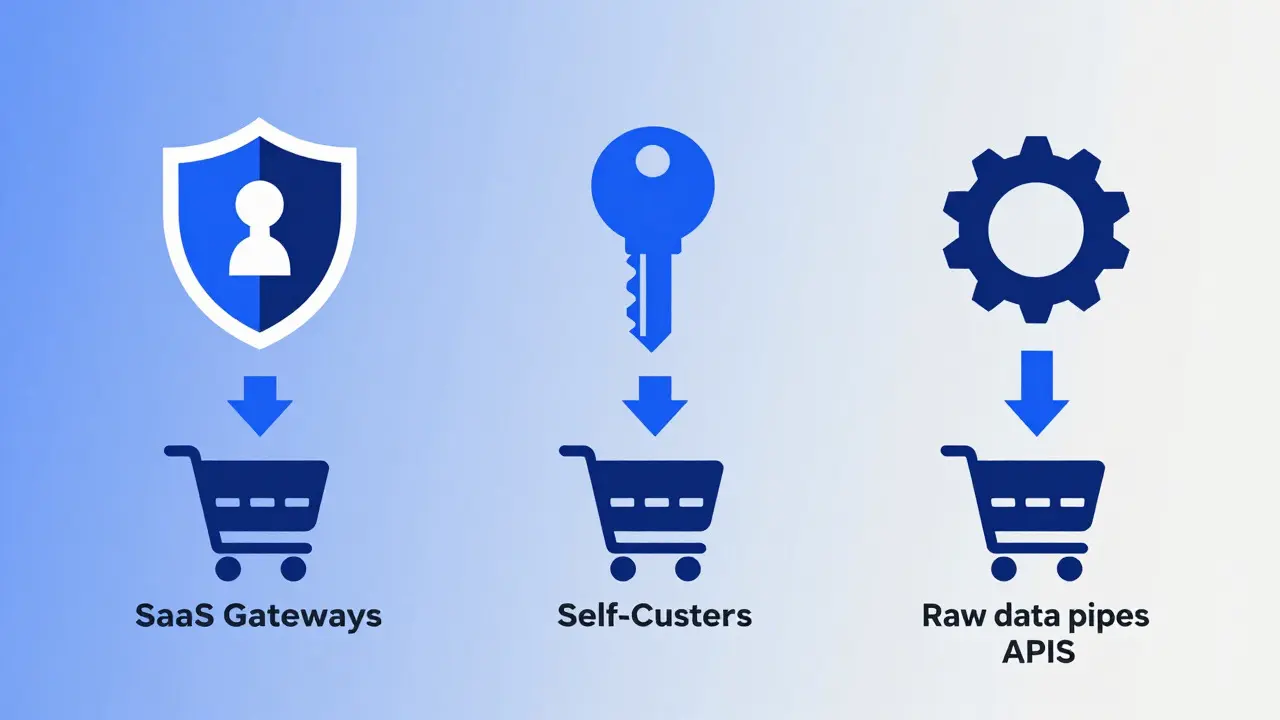
When you look at the market, every solution falls into one of three buckets. Knowing which bucket fits your business model is the first step to avoiding headaches later.
| Model | Custody (Who holds keys?) | Fees | Risk Profile | Best For |
|---|---|---|---|---|
| Custodial SaaS Gateways | The provider (e.g., Coinbase Commerce) | Typically 1% per transaction | High freeze risk; platform controls funds | Sellers who want zero technical setup and don't mind fees |
| Self-Hosted Non-Custodial Gateways | You (the merchant) | Zero platform fees (only network gas) | Low freeze risk; you control the wallet | Founders and developers who value sovereignty |
| Infrastructure / Data APIs | Depends on implementation | Usage-based or subscription | Moderate; requires custom coding | Dev teams building bespoke checkout flows |
Custodial gateways like Coinbase Commerce or CoinGate are easy to start. You sign up, verify your identity, and paste a widget code. They hold the money until you withdraw it. The problem? They take a cut (usually 1%) and they can freeze your account if compliance flags trigger. If you run a high-risk business or just hate giving away margins, this model feels restrictive.
Self-hosted non-custodial gateways flip the script. Tools like BTCPay Server or newer options like Xcash run on your own server via Docker. You keep the private keys. The platform charges nothing because they never touch your money. You only pay the blockchain's native gas fee. This is the preferred route for solo founders and indie hackers who want full control over their revenue.
Then there are infrastructure providers like Chainstack or Uniblock. These aren't checkouts; they are raw pipes. They give you access to RPC endpoints for hundreds of chains. You build the invoice logic yourself. This offers maximum flexibility but demands serious engineering resources.
Why "One Chain" Is No Longer Enough
A few years ago, supporting Ethereum was enough. Today, forcing a customer to pay on a congested chain is a conversion killer. Gas fees spike unexpectedly, transactions stall, and users abandon carts.
Multi-chain acceptance solves this by letting the buyer choose the path of least resistance. A user in Southeast Asia might prefer paying with USDT on Tron because it's cheap and fast. A European developer might prefer Polygon or Arbitrum. By offering multiple rails, you capture sales that would otherwise slip away.
Consider the stability factor. If Ethereum mainnet goes slow, your customers can still pay via BNB Chain or Solana. You are not held hostage by one network's performance. This redundancy is critical for any serious e-commerce operation.
Top Tools for Multi-Chain Billing in 2026
The landscape has matured significantly. Here is how the leading platforms stack up based on current capabilities.
Specialized Multi-Chain Gateways
NOWPayments remains a heavyweight here. They support over 300 cryptocurrencies and settle into 75+ fiat currencies. Their strength is breadth. If you need to accept obscure altcoins alongside major stablecoins, they cover it. However, being custodial means you rely on their withdrawal speed and security policies.
MugglePay focuses heavily on stablecoins. They support USDT and USDC across at least 11 chains including Celo, Arbitrum, Ton, and Stellar. Their claim to fame is speed-setup takes about five minutes. This is ideal if you just want to accept dollars digitally without worrying about price volatility.
BchainPay targets developers directly. They offer a REST API for stablecoin payments on Ethereum, Polygon, Solana, Tron, and BNB Chain. They use signed webhooks and idempotent requests, which makes them reliable for automated systems. They are actively adding Base, Arbitrum, and Avalanche to their roadmap.
The Modern Non-Custodial Contenders
If you want to avoid the 1% fee and the custodial risk, look at self-hosted or hybrid models. Xcash is an open-source, MIT-licensed gateway. You deploy it via Docker. It supports Bitcoin plus over 100 EVM chains. You hold the keys. There are no platform fees. It is powerful but requires some comfort with server administration.
For those who find Docker deployment too complex but still want non-custodial benefits, newer platforms like TxNod are gaining traction among solo founders and vibe-coders. TxNod connects directly to your hardware wallet (Ledger or Trezor) via the browser. You plug in your device, connect your public keys, and the gateway generates invoices. Funds go straight to your wallet. There is no middleman balance, no KYC from the platform, and no monthly percentage fees-just a flat subscription cost. It supports seven chains including Bitcoin, Ethereum, TRON, Cardano, Polygon, BNB Smart Chain, and TON. This bridges the gap between enterprise-grade security and indie-hacker simplicity.
Infrastructure Giants
For teams building custom solutions, Chainstack provides managed nodes for over 70 blockchains. Bitquery decodes data from 40+ chains into a single GraphQL schema. Uniblock claims access to 300+ blockchains through a unified API layer. These are not plug-and-play checkouts; they are building blocks for engineers who need deep data access or specific transaction routing.
How to Implement Multi-Chain Payments
The technical steps vary by tool, but the core workflow is consistent. Here is what you need to do to get live.
- Select your chains: Don't try to support everything. Start with Bitcoin, Ethereum, and one low-fee L2 like Polygon or Arbitrum. Add Solana or Tron if your audience demands them.
- Choose your custody model: Decide if you trust a third party with your funds (SaaS) or if you want to manage keys yourself (Non-Custodial). For most small businesses, non-custodial is safer against account freezes.
- Integrate the API: Most modern gateways provide a simple REST endpoint. You send a request with the amount and currency. They return an invoice ID and a QR code payload.
- Set up webhooks: This is crucial. When a payment arrives, the gateway sends a signal to your server. Verify the signature of this webhook to ensure it didn't come from a hacker. Then update your database to mark the order as paid.
- Handle conversions: Crypto prices move. Use the gateway's real-time rate feed to calculate the exact crypto amount needed for a fixed USD price. Never lock in a rate for more than a few minutes.
If you are using a developer-centric tool like TxNod or BchainPay, you will likely work with TypeScript SDKs. These libraries handle the math and address generation for you. If you are using a SaaS like NOWPayments, you might just embed a JavaScript widget.

Security and Trust: What to Watch Out For
Just because you aren't running nodes doesn't mean you can ignore security. The biggest risk in crypto billing is counterparty risk.
With custodial gateways, if the company gets hacked or shuts down, your funds are stuck. With self-hosted gateways, if you lose your private key backup, your funds are gone forever. There is no customer support to call.
Always verify the destination address. In a truly non-custodial setup, the payment address should be derived from your public key. Advanced SDKs allow you to re-derive this address locally before showing it to the customer. If the address matches your derivation, you know the gateway isn't tricking you into sending money elsewhere.
Also, watch out for "finality" traps. Some chains confirm transactions faster than others. Bitcoin takes longer. Solana is near-instant. Configure your webhook listeners to wait for the appropriate number of confirmations for each chain. Don't ship goods after one confirmation on Bitcoin.
Future-Proofing Your Checkout
The crypto space moves fast. New chains launch weekly. Layer-2 solutions evolve daily. Your payment system needs to be adaptable.
Look for providers that update their supported chain lists regularly. Check their GitHub repositories or changelogs. If a provider hasn't added a new major chain in six months, they might be falling behind.
Also, consider the rise of AI agents in development. Tools that offer MCP (Model Context Protocol) compatibility or clean, schema-first documentation make it easier to integrate payments quickly. As more developers use AI assistants to write code, having a gateway that speaks clearly to these agents will save you hours of debugging.
Multi-chain acceptance is no longer a niche feature. It is a requirement for robust digital commerce. By leveraging third-party infrastructure, you remove the operational burden of node management while keeping your options open for growth. Choose a tool that aligns with your risk tolerance and technical capacity, and focus on serving your customers rather than maintaining servers.
Do I need to run a node to accept Bitcoin?
No. Most payment gateways use third-party node providers or indexers to detect transactions. You simply generate an address and listen for webhook notifications when funds arrive.
Is it safer to use a custodial or non-custodial gateway?
Non-custodial gateways are generally safer regarding fund control because you hold the private keys. Custodial gateways are easier to use but introduce counterparty risk where the provider could freeze your account or go bankrupt.
What are the fees for multi-chain crypto payments?
Custodial SaaS platforms typically charge around 1% per transaction. Self-hosted non-custodial gateways usually charge 0% platform fees, meaning you only pay the blockchain's native network gas fee.
Can I accept stablecoins on multiple chains?
Yes. Many modern gateways support USDT and USDC across Ethereum, Polygon, Tron, BNB Chain, and others. This allows customers to pay with the same dollar-value asset on the cheapest available network.
How long does it take to integrate a multi-chain gateway?
Integration time varies. SaaS widgets can be embedded in minutes. Developer-focused APIs with webhooks may take a few hours to set up properly. Self-hosted Docker solutions require initial server configuration but then run autonomously.
Which chains should I support first?
Start with Bitcoin for broad recognition, Ethereum for DeFi users, and one low-fee L2 like Polygon or Arbitrum for cost-effective transactions. Add Solana or Tron if your specific audience prefers them.