
Picture this: you’ve saved up for months, found the perfect entry point for Bitcoin or Ethereum, and click "Sign Up" on OKX, a leading global cryptocurrency exchange. But instead of a welcome screen, you get a cold, hard rejection. "Country Restriction." It’s a frustrating moment that hits thousands of traders every day. If you’re wondering whether you can use OKX in your location, the answer isn’t always black and white. It depends entirely on where you live, what features you want to use, and how strictly you follow the rules.
As of August 2026, OKX serves users in roughly 160 countries, but it enforces strict bans in others. This guide cuts through the confusion. We’ll break down exactly which countries are blocked, which ones have limited features, and why these rules exist. Whether you’re in the U.S., Canada, or a partially restricted region like Australia, knowing the lay of the land saves you time, money, and potential account closures.
The Three Tiers of OKX Restrictions
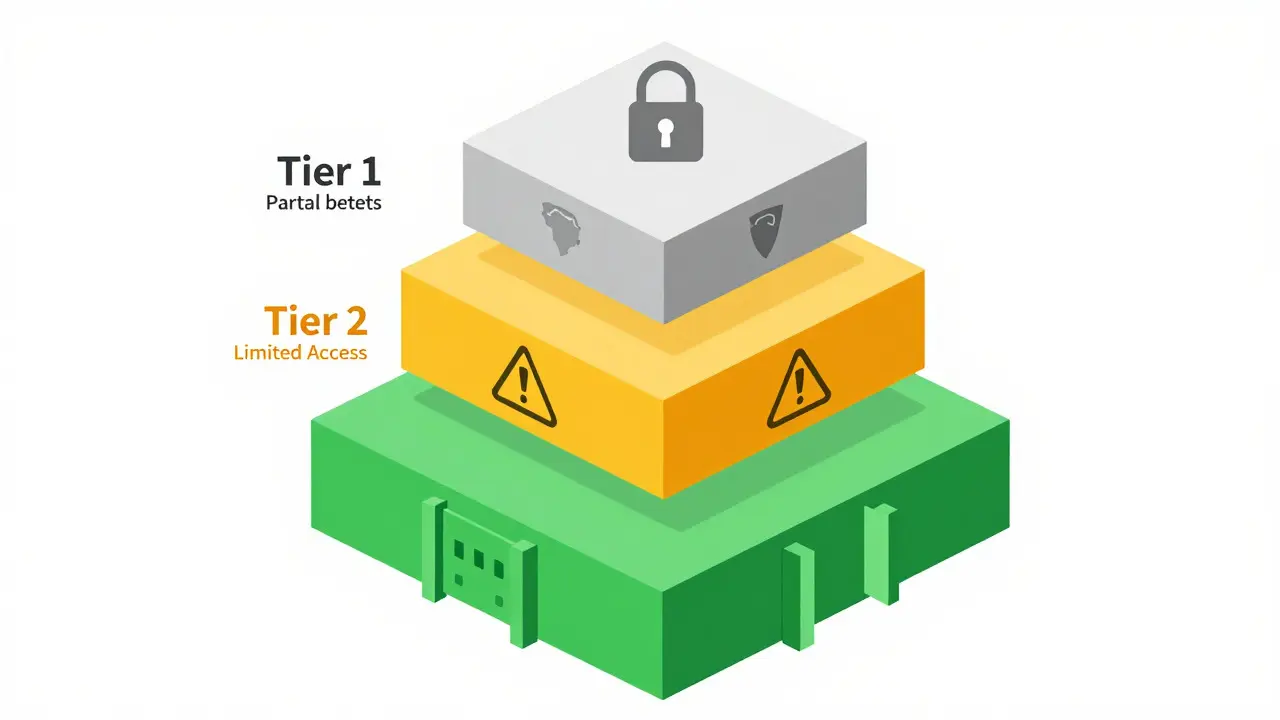
OKX doesn’t just ban countries randomly. Their restrictions fall into three clear categories based on regulatory pressure and compliance needs. Understanding these tiers helps you predict what kind of access you’ll have-or if you’ll have any at all.
Tier 1: Complete Service Bans
In these jurisdictions, OKX blocks access entirely. You cannot create an account, deposit funds, or trade. This list includes major economies like the United States and Canada, as well as countries under international sanctions like Iran, North Korea, and Syria. Other notable bans include Malaysia, Singapore (for the global platform), the Bahamas, and the United Kingdom. The reason? These regions either have aggressive local regulators or are subject to strict international financial sanctions administered by bodies like the Office of Foreign Assets Control (OFAC).
Tier 2: Partial Restrictions and Territories
Some places aren’t fully banned but face heavy hurdles. This tier includes U.S. territories like Puerto Rico, Guam, and the U.S. Virgin Islands. Countries like Bangladesh, Bolivia, and Malta also fall here. In these regions, you might be able to sign up, but deposits, withdrawals, or specific trading pairs could be locked. The rules change frequently, so checking the latest compliance updates is crucial.
Tier 3: Feature-Limited Access
This is where it gets tricky for many users. In countries like Australia, Brazil, and South Korea, you can use OKX, but not everything is available. For example, derivatives trading-like futures and perpetual contracts-is often prohibited due to local laws protecting retail investors. However, spot trading (buying and holding actual crypto) usually remains open. Similarly, while the UK is on the Tier 1 ban list for the global platform, some users report accessing limited services through regional entities, though this is risky and subject to change.
Why Does OKX Block Certain Countries?
It’s easy to blame corporate greed, but the reality is mostly about survival. OKX operates under multiple regulatory frameworks simultaneously. To stay in business globally, they must comply with:
- The U.S. Bank Secrecy Act: Requires strict reporting and anti-money laundering (AML) measures. Since OKX isn’t registered as a Money Services Business in the U.S., they block U.S. residents to avoid massive fines.
- EU’s 5th Anti-Money Laundering Directive: Forces exchanges to verify customer identities rigorously. This led to the creation of OKX Europe, a separate entity tailored to EU laws.
- International Sanctions: OFAC lists certain countries as high-risk for terrorism financing or human rights abuses. Trading with them means losing access to the global banking system.
By restricting access, OKX protects its license to operate in compliant markets. As Dr. David Carlisle from Chainalysis noted in August 2025, this multi-entity approach is one of the most sophisticated compliance strategies among non-U.S. exchanges. It allows them to keep serving millions while dodging the worst legal pitfalls.
How OKX Enforces These Rules
You might think using a Virtual Private Network (VPN) will trick the system. Think again. OKX uses a combination of technologies to catch rule-breakers:
- IP Geolocation: They track your IP address with 99.2% accuracy. If your IP says you’re in Texas, but your ID says Germany, red flags go up.
- Device Fingerprinting: Your browser and device leave unique digital footprints. If you’ve previously accessed OKX from a banned country, your new "clean" account might still get flagged.
- KYC Verification: Know Your Customer checks are mandatory. You upload a passport or driver’s license. The issuing country matters more than your current location. If your ID is from a banned nation, you’re out.
In September 2025 alone, OKX closed over 14,000 accounts for "geolocation fraud." The penalty isn’t just a warning-it’s total account termination and frozen funds until verification clears. It’s a harsh reminder that bypassing restrictions is rarely worth the risk.
Comparing OKX to Other Exchanges
If OKX blocks you, does another exchange work better? Here’s how OKX stacks up against competitors in terms of geographic reach:
| Exchange | Key Restricted Regions | Unique Approach |
|---|---|---|
| OKX | USA, Canada, UK, Singapore (Global) | Separate regulated entities (OKX Europe, OKX Japan) for nuanced access. |
| Binance | USA, Canada, UK, Australia (partial) | Recently restructured into Binance.com and regional entities after $4.3B fine. |
| Coinbase | Limited to USA + 41 compliant countries | Fully regulated in the U.S., making it the go-to for American users. |
| Kraken | Iran, North Korea, Canada (limited) | Strong privacy focus but maintains limited operations in complex markets. |
While Coinbase dominates the U.S. market, it lacks the global footprint of OKX. Binance has a wider reach but faces ongoing legal scrutiny. OKX sits in the middle, offering a robust platform for users in Asia, Africa, and parts of Europe who want advanced features without U.S.-level bureaucracy.
Navigating the Gray Areas: Special Cases
Some situations confuse even experienced traders. Let’s clarify two common headaches:
Singapore Residents: Singapore appears on the global ban list, but there’s a twist. OKX Singapore is a separate entity regulated by the Monetary Authority of Singapore (MAS). If you’re a resident meeting specific criteria, you might access this localized version. However, trying to use the global OKX platform from Singapore will likely result in a block. Check which entity you’re signing up for.
U.K. Users: The U.K. is technically banned from the global platform due to stringent Financial Conduct Authority (FCA) rules. However, some users report accessing limited spot trading through regional partnerships. This status is volatile. Always check the latest terms before depositing.
Australia: Australians can use OKX, but forget about leverage and futures. The Australian Securities and Investments Commission (ASIC) restricts derivative products for retail traders. Stick to spot trading to stay compliant.
What Happens If You Try to Bypass Restrictions?
We’ve seen Reddit threads full of users sharing VPN tricks. Here’s the reality: it’s a gamble. Yes, you might get past the initial sign-up. But when you try to withdraw profits, OKX’s compliance team reviews your activity. If they detect inconsistencies-like a U.S. IP address linked to a German ID-they freeze your account.
User u/CryptoTraderUS shared on Reddit in July 2025: "Tried to verify my account from Texas... got rejected with 'country restriction' message despite using a passport." His experience mirrors thousands of others. Trustpilot data shows that 37% of negative reviews mention false positives or inconsistent enforcement. The stress isn’t worth it. If you’re in a banned country, consider local alternatives like Coinbase (for U.S.) or CoinSpot (for Australia).
Future Outlook: Will Restrictions Ease?
The landscape is shifting. In October 2025, reports surfaced that OKX is discussing plans to launch a U.S.-compliant entity. While no timeline exists, this signals intent to enter the world’s largest crypto market. Meanwhile, they’ve invested $230 million in compliance infrastructure since early 2025, focusing on hubs like Switzerland and the UAE.
Regulatory trends suggest fragmentation will continue. The EU’s MiCA regulations, fully effective since December 2024, forced OKX to restrict derivatives for all EU residents. Conversely, they expanded derivatives access to 18 new countries, including Thailand and Vietnam, in late 2025. Gartner predicts that by Q2 2026, OKX will establish compliant operations in 35 previously restricted countries through local partnerships. So, if you’re currently blocked, keep an eye on official announcements. Your region might open up sooner than expected.
Practical Tips for Users in Restricted Zones
If you’re in a gray area or facing feature limits, here’s how to protect yourself:
- Verify Early: Complete KYC before depositing large sums. Level 1 verification allows $10,000 daily; Level 3 jumps to $1,000,000. Higher levels require more docs but offer peace of mind.
- Check Local Laws: Just because OKX allows it doesn’t mean your government does. In South Korea, for instance, real-name bank accounts are required for crypto purchases.
- Avoid VPNs: Save your account from accidental closure. Use your real IP and ID.
- Monitor Support Channels: Response times vary. European users see 8.2-hour averages, while developing markets wait 24+ hours. Plan accordingly.
Can I use OKX in the United States?
Currently, no. OKX blocks all U.S. residents and IPs due to SEC regulations and lack of domestic licensing. Reports suggest a U.S.-compliant entity may launch in the future, but as of August 2026, Americans should use Coinbase or Kraken.
Is OKX safe for users in Europe?
Yes, via OKX Europe. This separate entity complies with EU MiCA regulations. Note that derivatives trading is restricted for retail EU users, but spot trading remains fully accessible and secure.
Will using a VPN let me access OKX from a banned country?
Technically yes, but it’s risky. OKX uses device fingerprinting and KYC checks. If your ID reveals your true residence, your account will likely be terminated and funds frozen. It’s safer to use a locally compliant exchange.
Why is Singapore banned if OKX has a Singapore entity?
The global OKX platform bans Singaporeans to avoid MAS (Monetary Authority of Singapore) penalties. However, eligible residents can use the separate, MAS-regulated OKX Singapore service. Ensure you’re signing up for the correct regional version.
What happens if OKX suddenly bans my country?
You’ll typically receive a notice allowing time to withdraw funds. However, new deposits and trades may stop immediately. Keep your withdrawal addresses updated and monitor news for regulatory changes in your region.
25 Responses
Their entire compliance infrastructure is a facade designed to harvest your biometric data while pretending to protect you from yourself. The state demands surveillance, and these exchanges are merely the willing accomplices in the great digital panopticon. They claim it is about AML but we know it is about control. Every time you submit your passport you are feeding the beast that seeks to eliminate financial privacy entirely. Do not trust them with your identity.
One must consider the philosophical implications of such geographic arbitrage. If value is decentralized, why should borders dictate access? It suggests that the concept of the nation-state still holds undue power over digital assets which theoretically exist outside physical jurisdiction. This contradiction at the heart of crypto adoption is fascinating yet troubling.
Oh please, everyone knows VPNs work if you just pick the right server location :P I have been using one for years without any issues so stop spreading fear. It is only risky if you are stupid enough to use a bad provider or forget to turn it on before opening the app. Simple really.
the system is rigged against the little guy they want us poor and dependent on their fiat sludge okx is just another bank in sheep clothing wake up sheeple
the ontological status of a banned account is quite interesting isn't it when you are blocked do you cease to exist in the ledger or are you merely hidden from view this raises questions about the nature of ownership in a permissioned environment where the gatekeepers hold the keys to your existence within the network
Actually I think most people here are missing the point because while the article says restrictions are strict I bet there are loopholes everywhere if you look hard enough like maybe using a friend's phone or something silly like that anyway it is not as bad as they make it out to be because technology always finds a way around bureaucracy eventually even if it takes forever
Hey folks! Just wanted to drop some quick tips for those struggling with KYC levels. Make sure your lighting is good when taking photos of your ID. Bad lighting causes rejections more than anything else. Also keep your documents handy so you can upload them quickly. Hope this helps you guys get verified faster! :)
They are watching your IP address 😱😱😱 Device fingerprinting is real people! They know who you are before you even sign up. It is all part of the global surveillance grid. Trust no one. 🕵️♂️👁️
It is absolutely preposterous that they enforce these rules with such draconian measures. The sheer audacity of blocking entire continents based on arbitrary regulatory frameworks is insulting to the intelligence of the user base. One would expect better from a platform claiming to be global. It is nothing short of discriminatory practice disguised as compliance.
hey there! i totally get the frustration but honestly just stick to spot trading if you are in a gray area. no need to risk your funds on futures if the regs say no. stay safe out there and dont let the haters get you down! crypto is wild but fun if you play smart.
The regulatory landscape is fragmented; therefore, users must adapt. Compliance is not optional; it is mandatory for survival. OKX acts rationally within the constraints of international law. Do not complain about rules you did not help write.
i mean its pretty obvious why they block us but like cmon man come on already we are waiting for ages just give us access already dude
Oh wow, what a surprise! Another exchange playing hide and seek with regulators 🙄 Like seriously, do they think we are dumb? But hey, at least they are honest about it now. Maybe next year they will let us in... probably not though 😂
it is sad really how much trust we have lost in institutions. we used to believe in open markets now we need passports to buy digital coins. perhaps we should reflect on what freedom means in this new age.
greaat articl! very helpful info thanks for sharing this with us all hope everyone stays safe and sound in their trading journey!
why is everything so complicated cant they just let us trade?? i am so tired of all these rules it makes me wanna cry sometimes
America is the problem! Everywhere else works fine but here we are stuck behind walls built by greedy politicians. Shame on them for holding back progress. We deserve better than this second-class citizenship in the crypto world!!
Keep calm and carry on friends. There will always be challenges but also opportunities. Stay positive and keep learning. You got this!
It is disgusting how they treat users from certain countries. Pure bias and discrimination. They should be ashamed of themselves for enforcing such unfair policies. No wonder people are losing faith in centralized exchanges.
The moral decay of our society is evident in how casually we accept these restrictions. We have surrendered our liberty for the illusion of security. It is pathetic really. One expects more dignity from the human spirit but alas, we are sheep following the slaughterhouse door willingly.
I completely understand the frustration everyone feels. It is truly disheartening to see barriers put up where there should be bridges. Let us support each other through this transition period and remember that knowledge is power. Together we can navigate these complex waters with grace and resilience.
its so annoying that they ban singaporeans from the global site but then have a local one. why not just make it simple?? i hate dealing with all this confusion.
look i am not saying i am an expert but i think the whole thing is bogus. they just want your money and dont care about rules. live free or die i guess.
My dear friends, the tapestry of regulation is woven with threads of deceit! To think one can simply bypass these digital sentinels is folly of the highest order. Your device whispers secrets to the machine, betraying your true location with every click. Embrace the chaos, for order is but a prison cell disguised as safety!
Let us celebrate diversity in regulation!!! Different countries have different needs! It is beautiful really! We should respect these boundaries instead of fighting them! Keep smiling and trading responsibly!!!