

Remember the chaos of Ethereum gas fees back in 2021? That was the golden era for alternative blockchains like Harmony, a blockchain designed to offer fast, cheap transactions as an alternative to congested networks. During that time, dozens of decentralized exchanges popped up overnight. One of them was OpenSwap. If you are digging through your old browser history or hearing about it from a friend today, you probably want to know one thing: is it safe to use right now?
The short answer is no. OpenSwap on Harmony appears to be inactive, with untracked trading volumes and no recent development updates. Using it in 2026 carries significant risks, primarily due to a lack of liquidity and potential security vulnerabilities from unmaintained code. This review breaks down why this once-promising platform has faded away and where you should put your money instead.
What Was OpenSwap Supposed to Be?
To understand why OpenSwap failed, we have to look at what it promised when it launched around May 2021. It positioned itself as a "deflationary token burning" decentralized exchange. In simple terms, most exchanges charge a fee and distribute it to token holders or developers. OpenSwap took a different approach.
They implemented a unique mechanism where half of all collected trading fees were permanently burned. Burning means sending tokens to an address from which they can never be recovered. The goal was to reduce the total supply of their native token over time, theoretically increasing its value through scarcity. At launch, they offered a 0.3% trading fee structure, which was standard for Automated Market Makers (AMMs) at the time.
They also tried to attract users with aggressive incentives. In their first month, they distributed 13 million tokens to liquidity providers. They planned to mint 1 million new tokens every month indefinitely. While this sounds generous, it created a problem: without hard caps on supply, inflation could outpace the deflationary burn if trading volume didn't stay high enough.
The Current State: Dead or Dormant?
If you check major data aggregators like CoinMarketCap today, you will see a red flag. OpenSwap is listed as an "Untracked Listing." This isn't just a minor technical glitch; it means the platform does not meet the minimum requirements for tracked volume reporting. Specifically, there is no available market data for any trading pairs.
When a DEX shows "No data is available now," it usually points to three scenarios:
- Zero Liquidity: There is no money in the pools. You cannot swap tokens because there is nothing to trade against.
- Technical Failure: The smart contracts might still exist on the blockchain, but the frontend interface is broken or the backend services are offline.
- Cessation of Operations: The developers have abandoned the project.
In OpenSwap's case, the absence of community discussion on Reddit or Twitter suggests the third option. Successful DeFi protocols generate constant chatter about yields, bugs, and updates. Silence is rarely a good sign in crypto.
Why Did It Fail? A Look at the Competition
OpenSwap didn't fail in a vacuum. It entered a crowded market dominated by giants. Even on the Harmony network, users had better options. Let's compare OpenSwap to established players that survived the post-2021 crash.
| Platform | Status (2026) | Liquidity Depth | Security Audits | User Base |
|---|---|---|---|---|
| OpenSwap | Inactive / Untracked | Negligible | Unknown / Outdated | Gone |
| SushiSwap | Active (Multi-chain) | High | Regular Updates | Large Global Community |
| OpenOcean | Active (Aggregator) | Very High | Established | Strong Developer Support |
| Harmony Staking | Active (Native) | N/A (Staking) | Core Protocol | All ONE Holders |
SushiSwap and OpenOcean expanded to multiple chains, including Harmony. They maintained consistent development teams, regular security audits, and active governance communities. OpenSwap lacked these structural advantages. When the market cooled down after the 2021 boom, projects without strong utility or community backing evaporated quickly.
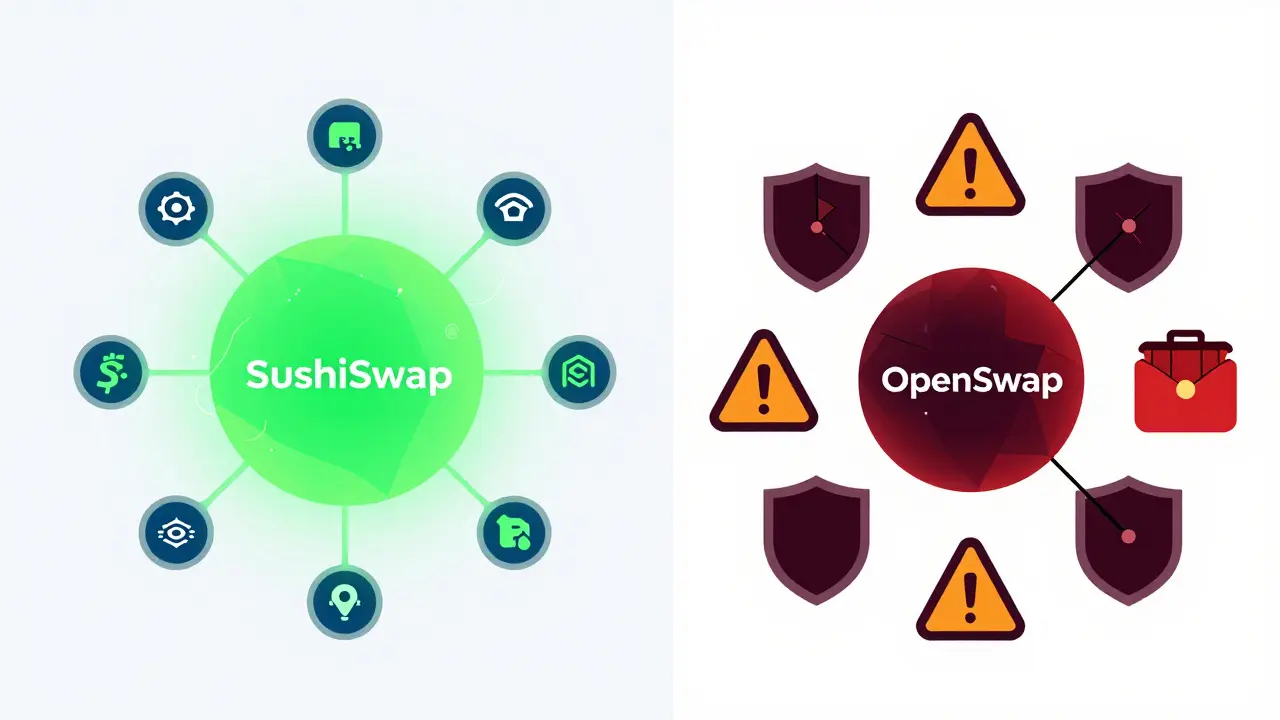
Security Risks of Using Abandoned DEXs
You might think, "Well, if I connect my wallet, maybe I can still find some dust left in the pools." Please don't do this. Here is why using an abandoned exchange like OpenSwap is dangerous:
- Smart Contract Vulnerabilities: Security patches are critical in DeFi. If a bug is discovered in the underlying code, an active team fixes it. An abandoned project leaves those doors open forever. Hackers often scan for inactive contracts with known exploits.
- Rug Pull Potential: Without active developers monitoring the liquidity pools, malicious actors can manipulate prices or drain remaining funds if the contract permissions allow it.
- Frontend Phishing: Since the official site may be down or bought by squatters, anyone claiming to host "OpenSwap" is likely a phishing scam designed to steal your private keys.
The Harmony blockchain itself uses Effective Proof-of-Stake (EPoS), which is secure. However, the applications built on top of it are only as safe as their maintainers. OpenSwap has no maintainers.
Better Alternatives on Harmony Today
If you hold ONE, the native token of the Harmony blockchain, and want to engage in DeFi, you have safer and more profitable options. The ecosystem has matured since 2021.
1. Native Staking: The most straightforward way to earn yield on Harmony is through direct staking. Validators offer returns ranging from 9% to 10.5% APY. This is built into the core protocol, meaning it doesn't rely on a third-party exchange's solvency. You can stake directly from wallets like MetaMask or Trust Wallet.
2. Aggregators like OpenOcean: If you need to swap tokens, use an aggregator. OpenOcean routes your trade across multiple liquidity sources to get the best price. It supports Harmony and other chains, ensuring you always have access to deep liquidity pools rather than empty ones.
3. Established Multi-Chain DEXs: Platforms like SushiSwap continue to operate on Harmony. They benefit from cross-chain liquidity, meaning the pools are deeper because they pull from users across different networks. This reduces slippage and makes trading more efficient.
How to Spot Dead Projects Early
OpenSwap isn't an isolated incident. Many DeFi projects from the 2021 boom have died. How can you avoid losing money to dead platforms in the future? Look for these signs:
- Volume Trends: Check CoinGecko or CoinMarketCap. If volume drops to zero for weeks, run.
- GitHub Activity: Does the developer team commit code regularly? If the last update was years ago, the project is likely abandoned.
- Community Engagement: Join their Discord or Telegram. Are real people talking about features, or is it just bots spamming links? Silence is a bad sign.
- Audit Recency: Smart contracts need regular re-audits as standards evolve. An audit from 2021 is useless in 2026.
By focusing on these metrics, you can filter out zombie projects before they cost you money.
Final Verdict
OpenSwap on Harmony was an interesting experiment in deflationary tokenomics during the DeFi summer of 2021. However, it failed to retain users, liquidity, or developer support. Today, it is effectively a ghost town. Connecting your wallet to it offers no financial benefit and exposes you to unnecessary security risks.
For anyone looking to trade or earn yield on the Harmony network, stick to verified, active protocols. Stake your ONE tokens directly for steady returns, or use reputable aggregators like OpenOcean for swaps. The crypto market moves fast, and staying ahead means knowing when to leave a sinking ship behind.
Is OpenSwap on Harmony still operational in 2026?
No, OpenSwap appears to be inactive. Major data trackers list it as "untracked" with no available trading volume or market data, suggesting it has ceased operations or lacks sufficient liquidity to function.
Can I recover tokens stuck in OpenSwap?
It is highly unlikely. With no active development team or liquidity, there is no mechanism to withdraw assets. Attempting to interact with the smart contract could expose your wallet to security risks.
What happened to the OpenSwap token?
The token lost all value due to lack of demand and liquidity. Without active trading pairs, the token cannot be exchanged for other assets like ETH or USDC on reliable platforms.
Is it safe to use Harmony blockchain despite OpenSwap failing?
Yes, the Harmony blockchain itself remains secure and functional. The failure of OpenSwap reflects poor project management, not a flaw in the underlying network. Other apps on Harmony continue to operate normally.
What are the best alternatives to OpenSwap on Harmony?
For swapping, use aggregators like OpenOcean or multi-chain DEXs like SushiSwap. For earning yield, consider native Harmony staking, which offers competitive APYs with lower risk than providing liquidity to small pools.