

Imagine sitting on a terrace in Lisbon, watching the sun set over the Tagus River, while your portfolio quietly appreciates. Now imagine that when you finally decide to sell, you owe the government nothing on those gains because you held them long enough. For many traders and digital asset enthusiasts, this isn't just a fantasy-it's the reality of living in Portugal is a country offering one of Europe's most favorable tax regimes for cryptocurrency holders, specifically exempting long-term capital gains from taxation. But here is the catch: getting there and staying compliant is no longer as simple as it was five years ago. The landscape has shifted dramatically. Between the implementation of the European Union's strict Markets in Crypto-Assets (MiCA) regulation and domestic legislative gaps, navigating the Portuguese system requires more than just good luck. You need to understand the rules before they change again. If you are considering moving to Portugal or expanding your trading operations into the country, you need to know exactly how the tax breaks work, what the regulatory hurdles look like right now, and whether the current uncertainty is worth the potential reward.
The Golden Rule: Long-Term vs. Short-Term Gains
The primary reason traders flock to Portugal is the tax structure. It is straightforward but comes with a critical condition: time. Under the current tax code, which was solidified in recent budget plans, the treatment of your crypto profits depends entirely on how long you hold the assets.
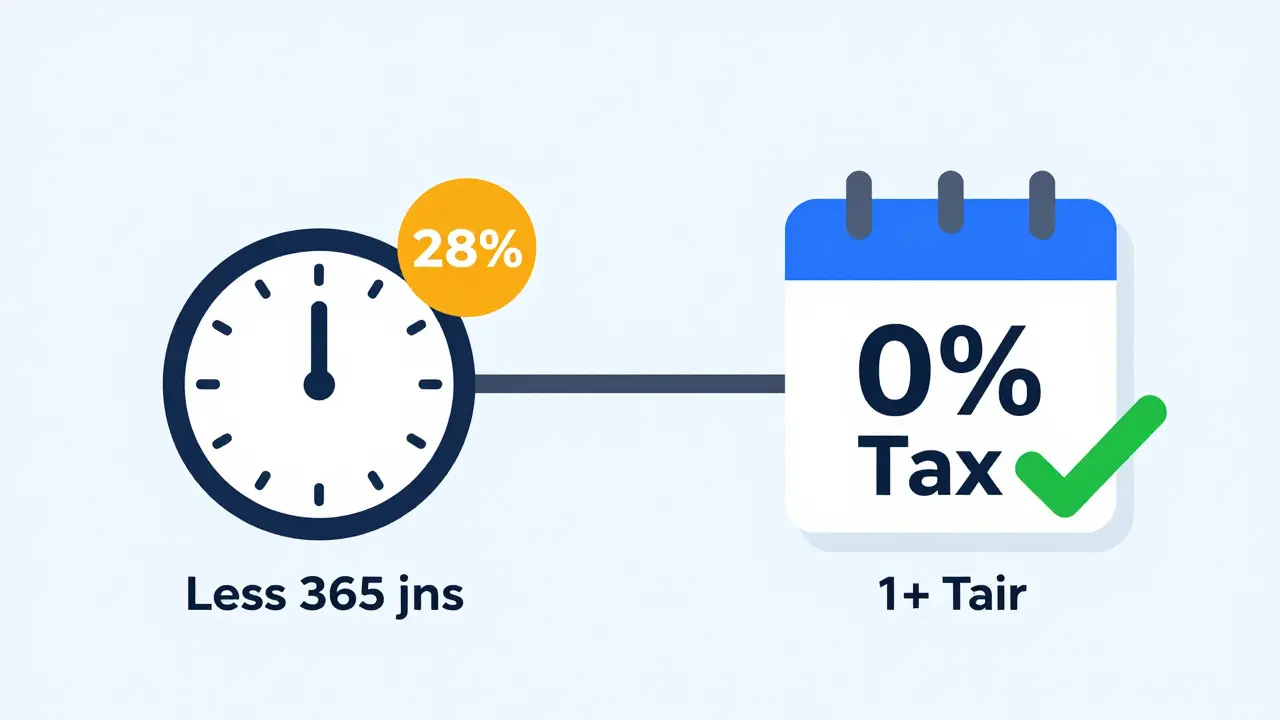
If you buy Bitcoin, Ethereum, or any other token and hold it for less than 365 days, any profit you make is considered short-term capital gain. This income is taxed at a flat rate of 28%. While 28% might seem high compared to some offshore havens, it is significantly lower than the rates in neighboring countries like France or Germany, where combined income and wealth taxes can push effective rates much higher.
However, if you hold that same asset for one year or more, the game changes completely. Long-term capital gains from cryptocurrencies are currently exempt from personal income tax (IRS). This means if you buy an altcoin today, wait until next year, and sell it for double the price, you keep 100% of the profit. This exemption applies to individuals, not corporations, so structuring your holding vehicle matters immensely.
This distinction creates a unique behavioral incentive for traders. Instead of day-trading based on minute-by-minute volatility, many expats adopt a 'HODL' strategy, aligning their financial behavior with the tax calendar. It forces patience, which ironically often leads to better investment outcomes in volatile markets.
Navigating the Regulatory Maze: MiCA and Local Laws
Tax benefits are great, but they mean little if you cannot legally operate or access services. Here is where things get complicated. Portugal is part of the European Union, which means it must adhere to MiCA is the Markets in Crypto-Assets regulation, a comprehensive EU framework designed to regulate crypto issuers and service providers across member states. MiCA became fully effective in late 2024, aiming to create a single market for crypto assets within the EU. However, transposing these EU laws into national Portuguese legislation has been slower than expected.
As of mid-2026, Portugal is still finalizing its domestic implementation of MiCA. This created a peculiar situation earlier in the decade. In early 2025, the Banco de Portugal is the central bank of Portugal responsible for supervising virtual asset service providers and ensuring compliance with anti-money laundering laws announced it could temporarily pause new authorizations for crypto service providers due to the lack of specific national laws. Existing businesses continued operating under transitional arrangements, but new entrants faced a wall of bureaucracy.
For individual traders, this mostly means you don't need a license to trade your own money. But if you are running a business, managing funds for others, or launching a token, you are in uncharted territory. The regulatory body responsible for determining if your token is a security or a utility is the CMVM is the Portuguese Securities Market Commission, which evaluates whether specific crypto tokens qualify as financial instruments requiring stricter oversight. They decide on a case-by-case basis, which adds a layer of unpredictability for startups.
The good news? The government is actively working to close this gap. Recent parliamentary debates have focused on strengthening supervision while protecting consumers. The goal is to have a fully compliant framework by the end of 2026, aligning with the EU's transitional deadlines. Until then, existing players operate in a gray zone that is technically legal but administratively confusing.
Who Watches the Watchers? The Compliance Ecosystem
You might think that because regulations are lagging, compliance is optional. Think again. Even without full MiCA implementation, Anti-Money Laundering (AML) and Countering the Financing of Terrorism (CFT) rules are strictly enforced. If you are setting up a Virtual Asset Service Provider (VASP), you must register with Banco de Portugal. This registration does not give you a 'license to print money,' but it is mandatory to operate legally.
Here is what compliance looks like in practice:
- Registration: You must appoint an AML/CFT officer and register with the central bank before offering any services.
- Due Diligence: For any transaction involving €1,000 or more in virtual assets, you must conduct customer due diligence. This means knowing who your client is and verifying their identity.
- Enhanced Scrutiny: High-risk situations require enhanced due diligence. If something smells fishy, you dig deeper.
- Reporting: Suspicious transactions must be reported immediately to the Financial Intelligence Unit (UIF is the Portuguese Financial Intelligence Unit responsible for receiving and analyzing suspicious transaction reports related to money laundering and terrorist financing).
There is no minimum share capital required for crypto licenses, which lowers the barrier to entry for small businesses. However, the administrative burden remains high. Companies often hire specialized law firms to navigate the intersection of Portuguese AML law and incoming MiCA requirements. Expect to spend significant time and resources on legal counsel during the setup phase.
The Non-Habitual Resident (NHR) Advantage
For foreign traders moving to Portugal, the NHR Program is the Non-Habitual Residence tax regime, which offers special tax benefits to new residents, including fixed rates on certain incomes and exemptions on foreign-sourced earnings is a game-changer. While the classic NHR regime underwent changes recently, variations and similar incentives remain attractive for digital nomads and skilled professionals.
Under favorable interpretations of the current tax treaties, eligible individuals can benefit from a 20% flat tax rate on qualifying Portuguese income. More importantly, for many expats, foreign-sourced income-which can include crypto gains realized outside of Portugal-may be exempt from Portuguese taxation, provided it is taxable in the source country. This creates a powerful arbitrage opportunity for global citizens.
Many traders relocate from high-tax jurisdictions like Switzerland, the UK, or Northern Europe specifically to leverage this status. The process involves obtaining residency first, often through a D7 visa or Golden Visa, and then applying for NHR status. It is not automatic, and the rules are tight. You need to prove you haven't been a tax resident in Portugal in the last five years. Once approved, the benefits can last for ten years, giving you a decade of optimized tax planning.
Market Reality: Is Portugal Still Worth It?
Despite the regulatory hiccups, money keeps flowing into Portugal. Why? Because the ecosystem is resilient. Blockchain technology commands roughly 36% of all venture funding in the country, making it one of the top hubs in Europe for crypto investment. This isn't just about retail traders; it's about serious infrastructure building.
Adoption rates are climbing. Approximately 8.2% of the Portuguese population owns cryptocurrency, with a significant portion being foreign residents drawn by the tax policies. Enterprise adoption is slower-only about 12% of businesses accept crypto payments-but this is changing as consumer demand grows.
Compared to competitors like Malta or Switzerland, Portugal offers a different value proposition. Switzerland has clearer regulations but higher costs of living and stricter banking secrecy laws. Malta has a well-established licensing framework but lacks the same level of tax exemption for long-term holdings. Portugal sits in the middle: cheaper, warmer, and tax-friendly, but with a bit more red tape to wade through.
| Feature | Portugal | Switzerland | Malta |
|---|---|---|---|
| Long-Term Capital Gains Tax | 0% (after 1 year) | Varies by Canton (often low/exempt) | 35% Corporate / Variable Personal |
| Short-Term Capital Gains Tax | 28% | Included in Income Tax (up to 40%) | Variable Income Tax |
| Regulatory Clarity (MiCA) | Implementing (Gap exists) | Advanced (FINMA Guidelines) | Established (VFA Act) |
| Licensing Cost & Complexity | Low Capital Req, High Admin | High Cost, Strict Supervision | High Cost, Clear Process |
| Cost of Living | Moderate | Very High | Moderate-High |
Practical Steps for Traders Moving to Portugal
If you are ready to make the move, here is a realistic roadmap to avoid common pitfalls.
- Secure Residency First: Don't start trading with Portuguese tax implications until you have your NIF (tax number) and residency status sorted. Apply for the NHR status immediately upon arrival to lock in the benefits for the ten-year period.
- Audit Your Holdings: Calculate your cost basis carefully. If you bought assets years ago, ensure you have records proving the purchase date. Without proof of holding duration, the tax authority may assume short-term gains and charge the 28% rate.
- Choose the Right Bank: Traditional Portuguese banks can be skeptical of crypto. Some may freeze accounts if they see large inflows from exchanges. Consider using fintech solutions or banks known for crypto-friendliness, and always declare the source of funds clearly.
- Hire a Specialist Accountant: Generalist accountants often misunderstand crypto. Find someone who specializes in IRS rules for digital assets. They will help you navigate the reporting requirements for both short-term and long-term positions.
- Monitor MiCA Updates: Subscribe to updates from the Banco de Portugal and CMVM. The rules are evolving monthly. What is legal today might require additional disclosures tomorrow.
The learning curve is steep. Industry estimates suggest it takes 40-60 hours just to understand the dual framework of local AML laws and upcoming MiCA requirements. But once you get it right, the payoff is substantial. You get to live in one of Europe's most beautiful countries, enjoy a high quality of life, and keep more of the wealth you create.
Portugal is not perfect. The regulatory limbo is frustrating, and the bureaucracy can be slow. But for traders willing to do the homework, it remains one of the best places in the world to build a crypto-centric lifestyle. The key is patience-with your investments, your paperwork, and the government.
Is crypto trading legal in Portugal?
Yes, crypto trading is legal for individuals. You do not need a license to trade your own assets. However, if you run a business providing crypto services, you must register with Banco de Portugal and comply with AML regulations.
How much tax do I pay on crypto gains in Portugal?
If you hold crypto for less than one year, you pay 28% capital gains tax. If you hold it for one year or more, long-term capital gains are currently tax-exempt for individuals.
Does the NHR program apply to crypto income?
The NHR program primarily affects foreign-sourced income. For Portuguese-sourced crypto gains, the standard 28%/0% rule applies. However, NHR can provide benefits for other types of income, making it valuable for overall tax optimization.
When will MiCA be fully implemented in Portugal?
Portugal aims to fully transpose MiCA into national law by the end of 2026, aligning with the EU's transitional deadline. Currently, the country operates under a mix of existing AML laws and provisional measures.
Do I need a license to launch a crypto project in Portugal?
It depends on the type of token. Utility tokens generally do not require prior authorization, but issuers must publish a white paper. Asset-referenced tokens (ARTs) and electronic money tokens (EMTs) require strict authorization from regulators.
Can US citizens benefit from Portugal's crypto tax laws?
US citizens are subject to worldwide taxation by the IRS regardless of residence. While Portugal may not tax your long-term gains, the US likely will. You should consult a cross-border tax expert to manage FBAR and FATCA reporting obligations.
What happens if I fail to report my crypto transactions?
Failure to report can lead to penalties from the Autoridade Tributaria e Aduaneira (AT). Penalties can include fines based on the undeclared amount and back taxes. Banks are increasingly sharing data with tax authorities, so non-compliance carries significant risk.
Is mining cryptocurrency profitable in Portugal?
Mining is taxed as business income, not capital gains. Profits are subject to corporate or personal income tax rates depending on your structure. Electricity costs and heat management are also factors to consider in profitability calculations.