

PowerTrade isn’t another crypto exchange trying to be Binance or Coinbase. It doesn’t offer spot trading, staking, or NFTs. Instead, it does one thing - and does it differently: crypto options with 10-minute expirations. If you’re a day trader or scalper who needs to hedge or bet on price swings in real time, PowerTrade might be the only place that actually works for you. But if you’re looking for safety, deep liquidity, or regulatory comfort, you’ll find serious gaps.
What PowerTrade Actually Offers
PowerTrade launched in 2021 with a clear mission: fix the lag between spot trading and traditional options. Most platforms force you to wait hours or days for your options to expire. PowerTrade lets you open a contract that expires in 10 minutes. That’s not a gimmick - it’s the core product. You can trade options on Bitcoin, Ethereum, Solana, and over 100 other tokens with expirations at 10 minutes, 1 hour, or standard weekly cycles. No other major exchange offers 10-minute options. Deribit’s shortest is 1 hour. Bybit offers 30 minutes. PowerTrade is alone here.
The platform runs on a proprietary engine that handles 50,000 orders per second with an average latency of 8.2 milliseconds. That matters when you’re trying to close a position before a 10-minute timer hits zero. The interface is clean, mobile-friendly, and built for speed. You don’t need to be a quant to use it - but you do need to understand how options work. New users report spending 3 to 5 hours just learning how settlement works. A lot of beginners lose money because they forget to manually exercise in-the-money options. The platform doesn’t auto-exercise them. You have to click the button.
How Fees and Leverage Work
PowerTrade’s fee structure is aggressive for active traders. For options trading, taker fees are 0.07% and maker fees are 0.02%. Perpetual swaps cost 0.05% taker and 0.01% maker. That’s cheaper than most derivatives exchanges. Minimum contract sizes are $10 for options and $50 for perpetuals. Leverage on perpetuals goes up to 50x. That’s high, but not unusual in crypto. The real risk isn’t the leverage - it’s the timing. With 10-minute options, price moves can wipe out positions faster than you can react.
They support deposits in BTC, ETH, and USDC. You can also wire fiat, but only if you’re in an approved region. Withdrawals are processed within 1-4 hours. No instant withdrawals, but no delays either. The platform integrates with MetaMask, WalletConnect, and Ledger hardware wallets. API access is fully documented for algorithmic traders, with both REST and WebSocket endpoints available.
Security and Regulatory Reality
PowerTrade claims strong security: 95% of funds are in cold storage, multi-sig wallets are used for hot balances, and they’ve been audited by OpenZeppelin as recently as September 2025. That’s good. But here’s the catch - they’re not regulated by the SEC, FCA, or any major financial authority. They hold a provisional license from the Marshall Islands Financial Services Authority. That’s like having a fishing license to run a bank. It’s legal, but it doesn’t protect you if things go wrong.
There’s no investor compensation fund. No insurance pool. No recourse if the exchange gets hacked or decides to freeze accounts. That’s not unique in crypto - but it’s risky when you’re trading high-leverage, short-term options. In September 2025, during a Bitcoin flash crash, 63% of in-the-money 10-minute options expired worthless because the price bounced back before settlement. Users lost money not because they misread the market - but because the timing was too tight. PowerTrade didn’t cause it, but their product amplifies the risk.
Market Position and Competition
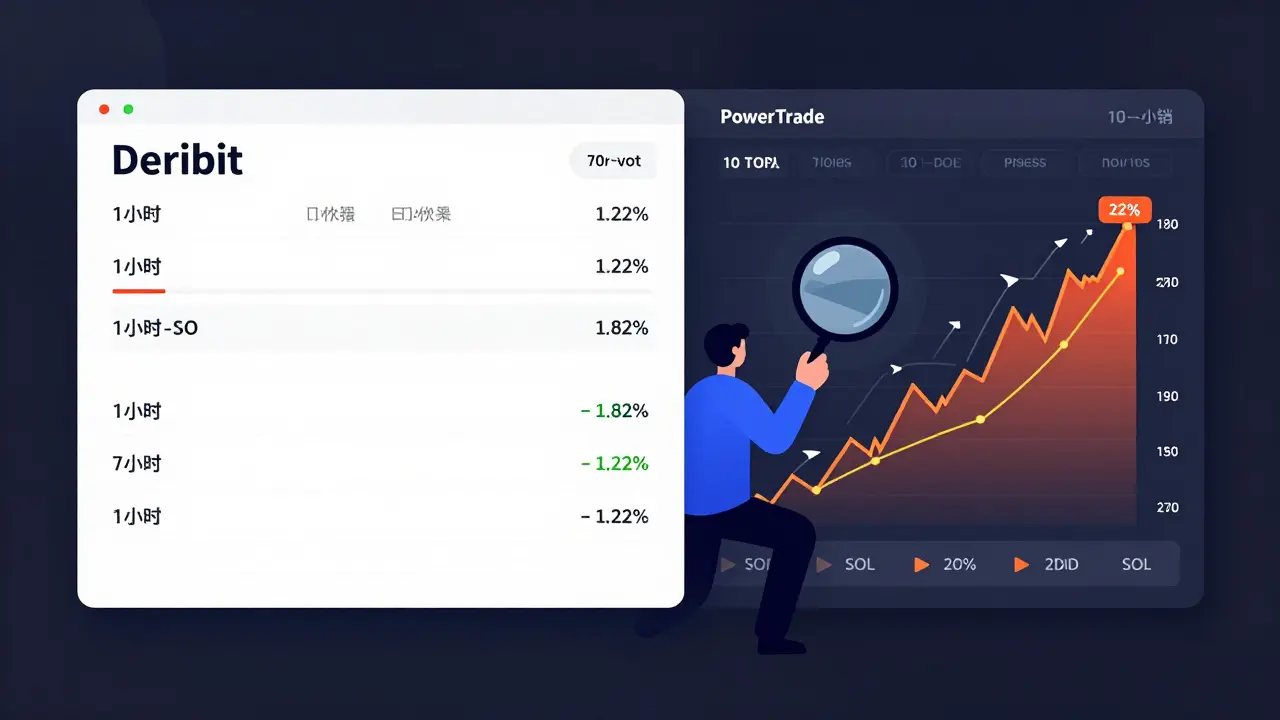
PowerTrade trades about $85 million a day in options. That’s tiny next to Deribit’s $1.2 billion or Bybit’s $800 million. But here’s the twist: PowerTrade controls 12% of the ultra-short-dated options market (under 1 hour). That’s their entire niche. Deribit and Bybit don’t compete here - they don’t offer 10-minute contracts. So PowerTrade isn’t trying to beat them. It’s trying to serve a different crowd: retail traders who need to hedge against news events, exchange listings, or volatility spikes.
For example, during the Coinbase listing of $SOL on August 28, 2025, traders used PowerTrade to buy 10-minute call options on SOL. When the price spiked 22% in 7 minutes, they closed the trade for a 400% profit. That’s the kind of move that’s nearly impossible on longer-dated platforms. But if you’re holding a long-term BTC position and want to hedge for a week? PowerTrade won’t help. You’ll need Deribit.
Who Should Use PowerTrade - And Who Should Avoid It
Use PowerTrade if:
- You trade crypto actively, often multiple times a day
- You understand how options expiration and settlement work
- You’re comfortable with high risk and fast-moving markets
- You’re outside the U.S., Canada, or EU (where PowerTrade is blocked)
- You want to hedge or speculate on short-term volatility without waiting hours
Avoid PowerTrade if:
- You’re new to crypto trading or options
- You want regulatory protection or insurance
- You’re trading large amounts (over $5,000 per trade)
- You’re in the U.S., Canada, or most EU countries (access is blocked)
- You expect deep order books - PowerTrade’s liquidity thins during Asian hours
Common Pitfalls and User Complaints
Most users who lose money on PowerTrade aren’t bad traders - they just misunderstand the mechanics. 28% of new users accidentally let profitable options expire because they didn’t manually exercise them. The platform doesn’t auto-settle. You have to click. That’s not a bug - it’s a feature. But it’s confusing.
Another big issue: slippage. During low-volume periods (usually 2-6 AM UTC), the order book gets thin. One user reported 1.2% slippage on a $2,000 trade - that’s $24 lost just from execution. Deribit’s slippage on the same trade? 0.3%. That’s a huge difference for scalpers.
And then there’s the scam problem. There are at least 8 fake sites using names like “Powertrades-app.com” and “Powertrade-bd.com.” They promise automated trading, block withdrawals, and pressure users to deposit more. The real PowerTrade (power.trade) has no auto-trading bots. No referral bonuses. No guaranteed returns. If a site promises any of that - it’s a scam.
The Future: Can PowerTrade Survive?
PowerTrade just raised $15 million from Pantera Capital in August 2025. They’re planning to integrate Ethereum Layer 2 solutions to cut settlement times. That’s smart. But their biggest threat isn’t competition - it’s regulation. The CFTC warned in October 2025 that ultra-short crypto options are a high-risk product likely to face crackdowns in 2026. The SEC is drafting a rule called the “Short-Dated Derivatives Rule,” expected in Q1 2026. If it passes, PowerTrade might have to shut down its core product.
Delphi Digital gives PowerTrade a 65% chance of surviving through 2027 if they get proper licensing. Galaxy Digital says only 40%. That’s a wide gap. But one thing’s clear: if they survive, they’ll be the only exchange offering 10-minute crypto options. That’s a powerful moat.
Final Verdict
PowerTrade isn’t for everyone. It’s not a safe place to store your life savings. It’s not a beginner-friendly platform. It’s not even a good choice for long-term holders.
But if you’re an active trader who needs to react to volatility in real time - and you’re outside the U.S. and EU - PowerTrade is the only tool that gives you true 10-minute options. It’s fast, cheap, and innovative. The interface works. The execution is solid. The security is decent. The risks? High. But they’re known.
If you’re comfortable with that, it’s worth trying. Start small. Learn the settlement mechanics. Watch the order book. Don’t trade more than you can afford to lose. And always double-check you’re on power.trade - not some copycat site.
18 Responses
I tried this platform and lost $300 in 12 minutes because I forgot to click 'exercise'. Like, why isn't this automatic??? I'm not a quant. I just want to hedge my ETH. This isn't innovation, it's a trap. 😒
There's a philosophical irony here: we've created a system where time is the ultimate variable, and yet we treat it like a commodity. The 10-minute option isn't a tool-it's a symptom of our collective impatience. We don't trade markets anymore; we trade entropy. And entropy always wins.
PowerTrade doesn't offer liquidity. It offers existential risk.
LMAO they say 'no auto-exercise' like it's some deep feature. It's a user-experience failure wrapped in a 'you're not smart enough' aesthetic. Deribit lets you set auto-exercise. So does Bybit. This is just a way to siphon money from people who don't read the fine print. And don't get me started on that 63% expiration rate during the flash crash. That's not market risk-that's predatory design.
You think the real issue is the 10-minute window? No. The real issue is that this entire model is built on the assumption that retail traders can outmaneuver institutional algos. They can't. Not even close. The platform doesn't care if you win or lose. It just wants volume. And the more you lose, the more you come back. That's not trading. That's gambling with a financial engineering veneer.
I read the whole thing. Didn't learn anything new. Too much fluff. Just say: 'It's risky. Don't use it unless you're a pro.' Why do people write 1000-word essays on crypto platforms? It's just a website.
The regulatory posture of PowerTrade is not merely legally precarious; it is epistemologically indefensible. To operate under a provisional license issued by a jurisdiction with no established financial oversight infrastructure is not innovation-it is institutionalized negligence. One cannot build a financial instrument on the foundation of legal ambiguity and expect anything other than systemic failure.
I'm from India and I actually love this platform. I use it to hedge during Indian market openings when BTC moves fast. The interface is simple, and I've made decent profits. But yeah, I always double-check I'm on power.trade. I've seen so many fake sites. Also, I set a reminder on my phone to click 'exercise'-it's a habit now. 😊
The liquidity profile during Asian hours is a non-trivial operational risk for any retail participant engaging in ultra-short-dated derivatives. The slippage metrics reported-particularly above 1% on $2k trades-constitute a material deviation from industry benchmarks. One must question whether the fee structure compensates for the execution inefficiency. This is not a feature. It's a liability.
I can't believe people are still using this. My cousin lost $12k last month because he thought '10-minute option' meant he could just 'set it and forget it'. He didn't even know he had to manually exercise. And now he's trying to 'get it back' by depositing more. Classic. I told him to stop. He called me jealous. I'm not jealous. I'm just not stupid.
If you're outside the US/EU/Canada, you're already in the risk zone. This isn't a product-it's a loophole. And loopholes get closed. The CFTC is coming. Mark my words.
I've been using PowerTrade for 8 months now. Started with $50. Learned the hard way. Now I only trade $10 contracts. Always set a manual exercise reminder. Don't trade during 2-6 AM UTC. Use USDC deposits. It's not perfect, but it's the only place that lets me hedge during crypto news spikes. If you're careful, it works. Just don't be lazy.
The claim that PowerTrade is 'innovative' is a deliberate mischaracterization. Innovation implies progress toward a better system. What we have here is a high-frequency gambling engine disguised as a financial tool. The absence of regulatory oversight is not a feature-it is a red flag painted in neon. This platform is a regulatory time bomb.
I'm a new trader and I read this whole thing. Honestly? I'm scared now. I thought options were just 'buy low, sell high'. I didn't know about manual exercise. Or slippage. Or fake sites. I'm sticking to spot for now. Thanks for the warning.
Everyone's acting like PowerTrade invented this. Nah. It's just the first to market with 10-minute expirations. The real innovation is how they monetize user ignorance. They don't need to be regulated-they just need enough people to be dumb enough to trade. And they're getting them.
Ah yes, the classic 'it's not for everyone' cop-out. Every predatory platform says that. It's code for: 'We know you'll lose, but we hope you don't notice until it's too late.' The fact that they're planning to integrate Layer 2? That's not progress. It's a rebranding effort before the regulators come knocking.
I appreciate the depth of this review. The mechanics are clearly explained, and the risks are not downplayed. That’s rare. But one thing’s missing: the psychological toll. Trading 10-minute options isn’t just about money. It’s about stress. Your heart races. Your hands shake. You start checking the clock every 30 seconds. It’s not trading. It’s performance art. And the audience? The exchange.
Let me break this down for the Americans who think they're smart. PowerTrade is not a platform. It is a psychological experiment. The 10-minute window is designed to trigger dopamine loops. Every tick, every second, every countdown-your brain thinks you're winning. Even when you're losing. That's why people keep coming back. They're not trading crypto. They're addicted to the rhythm of the timer. The platform doesn't care about your portfolio. It cares about your pulse. And your pulse is profitable. This isn't finance. It's behavioral engineering. And they're winning.
The final verdict is correct. But the entire article reads like a marketing brochure with footnotes. It's too balanced. It doesn't convey the real danger: this is a product designed to extract capital from traders who don't understand the mechanics, and then blame them when they lose. That's not a business model. That's a Ponzi with a UI.