
Imagine you generate solar power at home. You send that energy to the grid, but your neighbor uses it. How do you prove you made the clean energy? In the old system, paper forms, auditors, and weeks of waiting were the norm. Now, a single blockchain transaction can verify, track, and transfer your renewable energy credit in seconds-no middlemen, no fraud, no delays. This isn’t science fiction. It’s happening right now in Australia, Germany, and Colombia, and it’s changing how the world tracks clean power.
What Are Renewable Energy Credits (RECs)?
A Renewable Energy Credit (a digital certificate representing one megawatt-hour (MWh) of electricity generated from renewable sources like wind, solar, or hydro) is proof that clean energy was produced. It doesn’t mean you got that exact electron. It means someone else didn’t use a fossil fuel one. That’s the whole point: you can claim you’re using green power-even if your lights are powered by coal-fired grid electricity.
Before blockchain, these credits were tracked in centralized registries. Think spreadsheets, manual audits, and brokers taking 5% just to process a transfer. Double-counting was common-two companies claiming the same solar farm’s output. Fraud happened. Transparency? Almost nonexistent.
How Blockchain Fixes the REC System
Blockchain is a public, tamper-proof ledger. Every time a solar panel generates a MWh, a smart meter automatically logs it. That data gets hashed into a block, verified by network nodes, and added permanently. No one can delete or alter it. Once issued, the REC is tokenized-turned into a digital asset you can trade like cryptocurrency.
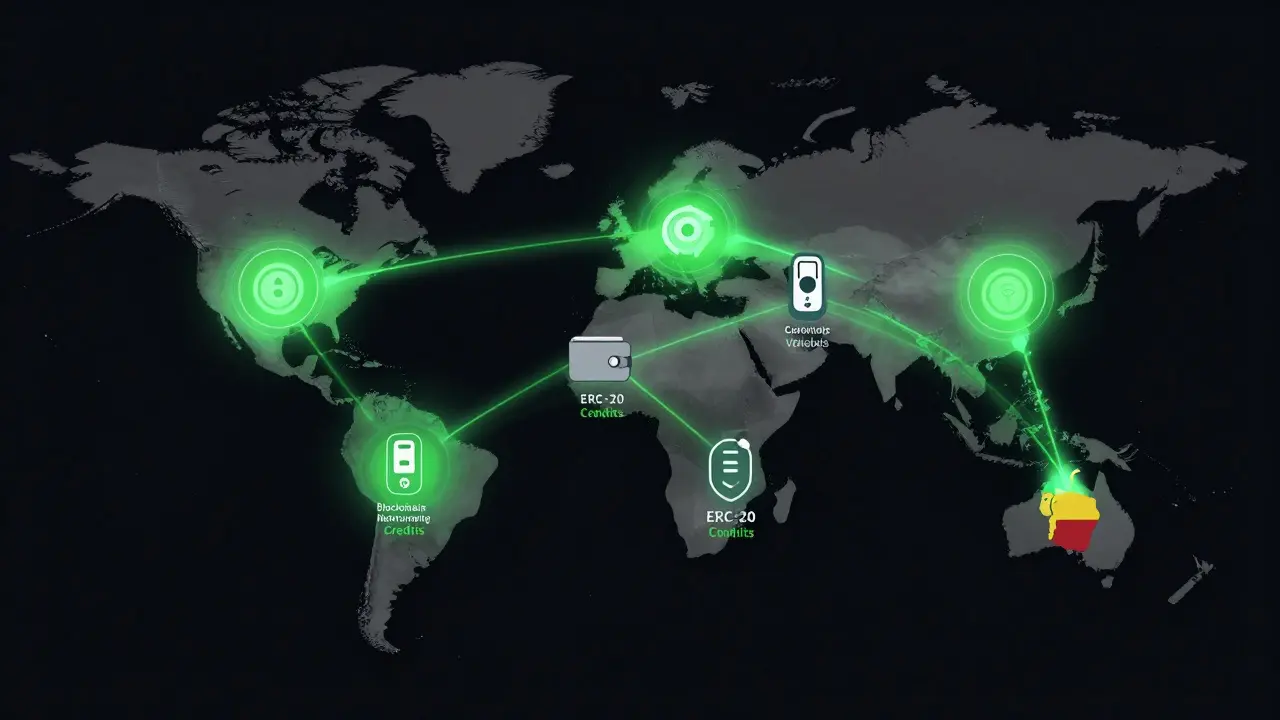
The Energy Web Chain (a public, proof-of-stake blockchain built specifically for energy markets) is the most widely adopted system. It uses ERC-20 tokens to represent RECs, making them compatible with wallets, exchanges, and smart contracts. When a company buys a REC, the transaction is recorded instantly. When they retire it (to claim green energy use), it’s marked as used-forever.
Power Ledger, based in Australia, uses a similar model. Their platform processed over 1.2 million REC transactions in 2023 with zero fraud. Compare that to the traditional system, where the International Renewable Energy Agency estimated 3-5% of certificates were double-counted.
Real-World Impact: Numbers That Matter
The numbers don’t lie:
- Transaction costs dropped from 5% to 1-2% on blockchain systems (Energy Web Foundation, 2023)
- Administrative time fell by 70% in Germany’s microgrid pilot (RMI, 2024)
- Power Ledger’s Australian users saw payments in 24 hours-down from 45 days
- The global blockchain REC market hit $1.37 billion in 2023 and is projected to hit $12.65 billion by 2028 (MarketsandMarkets)
In Colombia, 1,200 rural energy producers started getting paid 83% faster thanks to a blockchain platform. In Brooklyn, 350 households traded 4.7 GWh of solar power peer-to-peer using Power Ledger’s system. These aren’t experiments. They’re working models.
Why Big Companies Are Adopting This
Corporations need to prove their sustainability claims. Investors demand ESG transparency. Blockchain gives them auditable, real-time proof.
68 of the Fortune 100 now use blockchain-based RECs for reporting. The European Union officially recognizes blockchain-verified Guarantees of Origin (GOs) as compliant with its Renewable Energy Directive. In the U.S., 18 states have launched pilot programs. The trend is clear: if you’re serious about green energy, you need verifiable data-and blockchain delivers it.
The Challenges: It’s Not Perfect Yet
But here’s the reality: blockchain isn’t magic. It has hurdles.
- Integration costs: Upgrading smart meters and connecting to blockchain networks can cost $500,000-$2 million for enterprises (Navigate Power, 2023)
- Regulatory confusion: The U.S. still has no federal standard. Each state runs its own rules. In some countries, regulators don’t even accept digital certificates.
- Fragmentation: Over 12 competing tokenization standards exist. Without alignment, we’re building digital silos, not bridges.
- Digital divide: In Kenya, 62% of users couldn’t complete transactions because they lacked smartphone literacy. Technology means nothing if people can’t use it.
Professor Michael Webber from UT Austin warned in 2023: “Blockchain implementations for RECs must overcome interoperability issues.” He’s right. If every platform speaks a different language, the whole system breaks down.
What’s Next? The Roadmap
The future is already being built.
Energy Web Foundation launched Origin (a production-ready platform for issuing and managing RECs) in January 2024. It’s already live in 15 countries. In September 2023, they integrated with the International REC Standard (I-REC), enabling cross-border trading. That alone processed $287 million in transactions in Q4.
Coming in Q3 2024: Auto-Issue. Smart meters will automatically generate RECs without human input. No forms. No delays. Just clean energy data flowing directly onto the blockchain.
By 2025, carbon co-benefit tracking will roll out-linking RECs to avoided CO2 emissions, water saved, or land use. This turns a simple certificate into a full environmental impact report.
Who’s Winning? The Market Players
The field is crowded, but three names dominate:
- Energy Web Foundation (35% market share): The backbone of enterprise adoption. Their chain is open, public, and trusted by utilities.
- Power Ledger (22%): The pioneer in peer-to-peer trading. Strong in Australia and Southeast Asia.
- WePower and LO3 Energy: Smaller players, but active in niche markets like community solar and grid resilience.
Gartner predicts only 3-4 platforms will control 80% of the market by 2026. Consolidation is coming. The winners? Those who build interoperability, not walled gardens.
Getting Started: What You Need to Know
If you’re an energy producer, corporation, or even a homeowner with solar panels:
- Check if your region recognizes blockchain-based RECs. The EU does. Most U.S. states are still figuring it out.
- Ensure your meter can communicate digitally. Analog meters won’t work.
- Choose a platform. Energy Web Chain is the most open. Power Ledger is best for direct peer trading.
- Train your team. Energy professionals need 40-60 hours of training to master smart contracts and wallet management.
- Start small. Pilot with one solar array or wind turbine. Measure ROI before scaling.
ROI typically hits in 18-24 months. Reduced admin, faster payments, and fraud elimination add up fast.
Final Thought: Trust, Not Just Tech
Blockchain doesn’t make energy greener. It makes the proof of it undeniable. In a world drowning in greenwashing, that’s the real value. When a small farmer in Colombia gets paid in hours instead of months, or a company in Germany can prove its 100% renewable claim with a single click, that’s not just innovation-it’s justice.
The old system was broken. The new one isn’t perfect. But it’s working. And it’s only getting better.
Can I buy renewable energy credits on blockchain as an individual?
Yes. Platforms like Power Ledger allow individuals to buy, sell, or retire RECs through mobile apps. You don’t need to be a utility or corporation. If you have solar panels or want to offset your home’s energy use, you can participate directly. Payments are processed in hours, not weeks.
Are blockchain RECs legally recognized?
In the European Union, yes. The 2023 Renewable Energy Directive explicitly accepts blockchain-verified Guarantees of Origin (GOs) for corporate sustainability reporting. In the U.S., federal recognition is lacking, but 18 states have active pilot programs. Some states, like California and New York, accept blockchain-based RECs for compliance purposes. Always check local regulations before transacting.
What’s the difference between RECs and carbon credits?
RECs track electricity generation from renewable sources (1 MWh = 1 REC). Carbon credits track avoided greenhouse gas emissions (1 credit = 1 metric ton of CO2). They’re related but separate. A wind farm might generate both RECs (for clean power) and carbon credits (for emissions avoided). Some new blockchain platforms now track both together-linking energy production directly to climate impact.
Do I need to be tech-savvy to use blockchain RECs?
Not anymore. Platforms like Energy Web Chain and Power Ledger have user-friendly dashboards. You don’t need to understand private keys or gas fees. Most systems work like an app: log in, view your credits, click to sell or retire. The complexity is hidden behind the interface. That said, integrating smart meters or setting up a business account still requires technical support.
Is blockchain more secure than traditional REC systems?
Yes-by design. Traditional systems rely on centralized databases that can be hacked, altered, or mismanaged. Blockchain uses cryptographic hashing (SHA-256), decentralized validation, and immutability. Once a REC is issued and transferred, no one can change it. Power Ledger’s system has processed over 1.2 million transactions with zero fraud. Traditional systems still report 3-5% error rates due to manual entry and duplication.
What happens if the blockchain network goes down?
Blockchain networks are designed to be resilient. The Energy Web Chain, for example, runs on over 100 validator nodes across 15 countries. Even if some nodes fail, the network continues. Data is replicated everywhere. Unlike a single server that can crash, blockchain has no single point of failure. The worst-case scenario? A temporary delay in new transactions. Existing records remain safe and accessible.
29 Responses
This is peak tech bro nonsense. Blockchain doesn't make energy green. It just makes rich folks feel good about paying 5% more to claim they're saving the planet while their McMansion runs on coal. The real solution? Stop using so much damn electricity. But sure, let's tokenize every kilowatt.
While the technical framework presented is commendable, one must also consider the socio-economic implications for developing economies. The infrastructure required for blockchain-based REC systems may inadvertently exclude small-scale producers who lack access to digital tools or consistent internet connectivity. A hybrid approach may be more equitable.
So you're telling me we're spending millions to track electrons on a blockchain when we could just shut down coal plants? This is why America's falling behind. We're automating the paperwork instead of fixing the problem. Pathetic.
Too many words. Just say if it works or not.
I mean... it's cute that you think this is revolutionary. But have you looked at the actual adoption rates outside of Silicon Valley? Or are we just pretending this tech solves everything because it sounds cool?
Let's break this down. The Energy Web Chain uses ERC-20 tokens, which means it's built on Ethereum's infrastructure. That's fine until you realize Ethereum's consensus mechanism still consumes significant energy. So you're using a proof-of-stake ledger to track green energy... but the ledger itself runs on a network that used to be proof-of-work. The irony is thick enough to spread on toast.
I just want to know if this means I can finally stop feeling guilty about my AC. I mean, if I buy a REC, does that mean my 72-degree winter AC is now 'clean'? Because that's all I need.
This is either the future... or the most expensive digital collectible scheme since CryptoKittens. 🤡 The fact that we're calling this 'justice' while rural Kenyans can't even access the app? That’s not innovation. That’s colonialism with a blockchain logo.
This is such a hopeful development! I love how technology can empower small farmers in Colombia and give them fair compensation. It's moments like these that remind me why innovation matters. I hope more platforms prioritize inclusion and education alongside tech advancement.
You think blockchain is the answer? Nah. You're just replacing one kind of bureaucracy with another. The real revolution isn't in the ledger-it's in the mindset. We don't need to track every MWh. We need to stop pretending that buying a digital certificate absolves us of responsibility. The sun doesn't care if you tokenized your panels. It just shines.
This is actually huge. If you're a homeowner with solar, this means you can finally get paid for your excess power without waiting 6 weeks. No more middlemen. No more paper. Just clean energy, tracked fairly. I've helped three neighbors set this up-each got paid in under 24 hours. It’s not magic. It’s just better. And yeah, the tech’s still rough around the edges, but the direction is right.
The fact that 68 Fortune 100 companies are using this tells me it’s not a fad. And the EU recognizing it? That’s the real seal of approval. This isn’t just about tracking electrons-it’s about accountability. When corporations can’t fake their ESG reports anymore, that’s when change happens. The skeptics? They’re still stuck in 2012.
I read the whole thing. Honestly? I’m still not sure how it works. Like, I get that it’s on a blockchain, but what’s the actual difference between this and just having a receipt? Is it that the receipt can’t be changed? But what if someone hacks the smart meter? Or what if the company that owns the meter lies? I feel like there’s a gap between the hype and the reality. Also, I don’t have a smartphone. Can I still do this? Just wondering.
From a global energy equity standpoint, this is fascinating. The fact that Colombia’s rural producers are getting paid 83% faster? That’s not just efficiency-that’s dignity. But we can’t ignore the digital divide. The same tech that enables peer-to-peer trading in Brooklyn leaves out communities without reliable internet, literacy, or device access. True innovation doesn’t just solve problems-it includes the people who didn’t get a seat at the table.
Ugh this is so 2021. Everyone’s obsessed with blockchain like it’s the new crypto. Meanwhile, my solar panels are still just sitting there, not tokenized, not even registered. Who even cares? I just want to turn my AC on without feeling guilty.
Blockchain? In America? Please. We can’t even get reliable broadband to rural towns. This is just another Silicon Valley fantasy that’ll vanish once the VC money dries up. Real infrastructure doesn’t need a whitepaper.
So let me get this straight-big corporations are using blockchain to prove they’re green... while the same companies lobby against wind farms and solar subsidies? This isn’t transparency. It’s greenwashing 2.0. The real criminals are the ones writing the policy. The blockchain? Just a shiny distraction.
I love how everyone acts like this is the first time someone tried to track renewable energy. Remember when the UN tried to do this with paper certificates in 2008? Same thing. Just slower. And now we’re paying millions to rebuild it on blockchain? We’re not solving anything. We’re just making it look fancy.
I think the real win here is interoperability. If Energy Web Chain can integrate with I-REC, that’s huge. Cross-border trading of RECs has been a nightmare for years. This isn’t about tech-it’s about standardization. And that’s the quiet revolution.
I tried to set this up last year. My utility said they don’t support it. My solar installer said it’s 'too complicated.' I gave up. So yeah, the tech works. But the system still doesn’t want me to use it. Just saying.
Zero fraud? Really? Name one company that’s been audited. I bet they’re using the same third-party verifier as the old system. Blockchain doesn’t fix human greed. It just makes it look digital.
This is beautiful! Imagine a village in Rajasthan where every solar panel generates not just power, but trust. Every REC is a promise kept. This isn’t just technology-it’s a new kind of social contract. I hope more communities get to experience this. The future is fair, and it’s on-chain.
Let’s be real. This whole thing is a front for Big Energy to lock in control. Who owns the validator nodes? Who controls the smart contracts? Who’s behind the Energy Web Foundation? Hint: it’s not the farmers in Colombia. This isn’t decentralization. It’s rebranding. They’re just moving the monopoly from spreadsheets to blockchains. And we’re cheering?
I love this so much 🌞⚡🌍 I just bought my first REC yesterday through Power Ledger. It felt like voting with my wallet. And I didn’t even need to understand gas fees. The app did it for me. So simple. So satisfying. I’m telling all my friends.
You call this transparency? The real transparency is admitting that RECs are a loophole. You’re not powering your home with solar-you’re paying someone else to pretend they did. It’s symbolic capitalism. The blockchain just makes the lie look more official.
I’ve been in this space for 12 years. I’ve seen every green tech hype cycle. This one? It’s different. Why? Because it’s not about selling tech. It’s about changing payment cycles. When a farmer in Colombia gets paid in hours instead of months, that’s not a feature. That’s justice. And justice doesn’t need a whitepaper-it just needs to work.
Everyone’s so excited about blockchain but no one’s talking about the fact that this tech is owned by a handful of VCs. The real power isn’t in the ledger. It’s in the wallets. And guess who controls those? Not the people with solar panels. It’s the same old players with new logos.
I think the most profound thing here isn’t the tech. It’s the shift from trust to verification. We used to trust utilities and regulators. Now we verify. And verification doesn’t care about your reputation. It cares about the hash. That’s a quiet revolution. We’re moving from believing people to trusting systems. And maybe that’s what we needed all along.
Let’s be brutally honest: this is a regulatory arbitrage play. Companies use blockchain RECs because they’re cheaper to audit than traditional ones. It’s not about ethics. It’s about compliance cost reduction. The environmental benefit? Secondary. The real win? Accounting departments saving 70% of their time. That’s the story no one’s telling.