
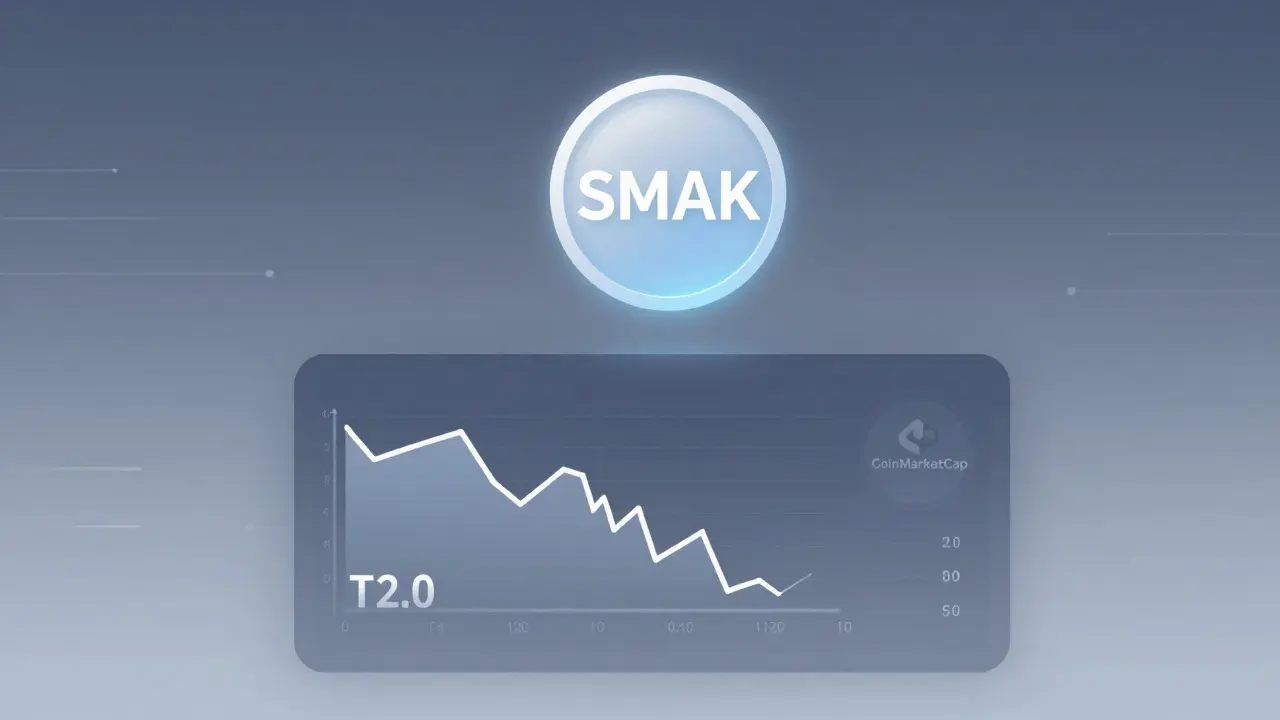
Back in September 2021, a small cryptocurrency project called Smartlink launched an airdrop on CoinMarketCap worth $20,000 in SMAK tokens. It sounded like a simple win: sign up, follow a few steps, and get free crypto. But three years later, that same token trades at less than a penny, with almost no trading volume. What went wrong? And why did a campaign backed by one of the biggest crypto data sites end up as a ghost story in Web3 history?
What Was the SMAK Airdrop?
The SMAK X CoinMarketCap airdrop wasn’t some shady side project. It was run by Smartlink, a team that claimed to be building a decentralized escrow service for Web 3.0. The idea was simple: if you’re buying or selling something online with crypto, you need trust. Traditional escrow services like PayPal or Escrow.com are centralized. Smartlink wanted to replace them with a blockchain-based system that didn’t rely on a middleman. The airdrop ran from September 13 to September 23, 2021. Participants had to claim SMAK tokens directly through CoinMarketCap’s platform. It wasn’t just a token giveaway-it was a marketing push. Smartlink posted YouTube videos a week before the airdrop started, explaining how the platform worked. They even used CoinMarketCap’s official airdrop badge, which gave it instant credibility. Millions of people visit CoinMarketCap daily to check prices. Getting your project listed there meant exposure. The reward? $20,000 worth of SMAK tokens, split among thousands of users. For most, that meant a few hundred to a few thousand tokens. At the time, SMAK was trading around $0.02. That’s $200 in pocket change for five minutes of clicking.How Smartlink Was Supposed to Work
Smartlink wasn’t just another meme coin. It had a real use case: decentralized escrow. Think of it like a digital notary for crypto trades. If you’re buying a laptop from someone you don’t know, you send the crypto to a Smartlink smart contract. The seller gets the item, confirms delivery, and the contract releases the funds. If there’s a dispute, the contract holds the money until both sides agree-or a third party votes on the outcome. The platform was built on Tezos, a blockchain known for low fees and energy efficiency. That made sense. Ethereum was expensive. Solana was volatile. Tezos offered stability. Smartlink also built out:- Smartlink Payment Processing - Instant crypto payments with milestone tracking
- Decentralized Marketplace - A place to list goods and services, paid in crypto
- SMAK Token Utility - Holders got fee discounts and staking rewards
The Token’s Price Crash: A Story of Empty Wallets
Here’s where things fell apart. After the airdrop, SMAK briefly popped to $0.02. Then it started sliding. By early 2022, it was at $0.005. A year later, $0.0024. As of February 2026, it’s trading between $0.000113 and $0.000137. That’s a 94.6% drop from its peak after the airdrop. The numbers don’t lie:- 24-hour trading volume: $0.00
- 7-day price drop: 47.22%
- 30-day drop: 60.27%

Why Did It Fail?
There are three big reasons Smartlink didn’t survive. 1. No Real User Base Airdrops bring in people looking for free tokens-not users. Most people claimed SMAK, sold it immediately, and moved on. There was no incentive to stick around. No app. No community. No support. Just a token with no place to be used. 2. The Product Never Launched Smartlink promised a decentralized escrow platform. But three years later, there’s no live product. No website with active listings. No user testimonials. No transaction history. The whitepaper looked good. The demo videos were polished. But the platform? It never went live. 3. No Exchange Support If you can’t trade a token on major exchanges, it’s invisible. SMAK only trades on Gate.io-a smaller exchange with low liquidity. No Binance. No Coinbase. No KuCoin. That’s a death sentence for any token trying to gain traction.What Happened to the CoinMarketCap Airdrop?
CoinMarketCap isn’t responsible for the project’s failure. They just hosted the airdrop. Their job was to list it, verify the team, and let users claim tokens. They did that. The rest? That was on Smartlink. The airdrop itself worked as intended. It got attention. It brought in users. But without a working product, those users vanished. The campaign didn’t fail. The project did.Is SMAK Still Worth Anything?
Technically, yes. A few people still hold it. A few exchanges still list it. But its value isn’t in utility-it’s in speculation. You could buy 10 million SMAK tokens for under $1.20. But what’s the point? No one’s using them. No one’s trading them. No one’s building on them. If you still have SMAK from the 2021 airdrop, you’ve got a digital artifact. A reminder of a time when Web3 was full of promises and few products.
What Can We Learn?
This isn’t just the story of one failed token. It’s a lesson in how not to build a crypto project.- Airdrops don’t build communities-they attract speculators.
- Marketing can’t replace product.
- Listing on CoinMarketCap doesn’t guarantee survival.
- If your token has no use, it has no value.
What’s the Future of Decentralized Escrow?
The problem Smartlink tried to solve still exists. People need trust in peer-to-peer crypto trades. But now, other projects are stepping in. Projects like Arweave, Polygon, and even Ethereum Layer-2 solutions are integrating escrow-like smart contracts into their ecosystems. Some are built into marketplaces like OpenSea. Others are standalone apps with real users. Smartlink didn’t innovate. It just copied. And without execution, copying doesn’t work.Final Thoughts
The SMAK X CoinMarketCap airdrop was a flash in the pan. It gave people free tokens. It gave Smartlink a moment of visibility. But it didn’t give them users, revenue, or traction. Crypto doesn’t reward promises. It rewards results. If you’re thinking about joining an airdrop today, ask yourself: Is this project actually doing something-or just talking about it? Because in the end, the only thing more dangerous than a bad project is a project that looks good on paper but never leaves the drawing board.Was the SMAK airdrop legitimate?
Yes, the SMAK airdrop on CoinMarketCap was legitimate. It was hosted on CoinMarketCap’s official airdrop platform, which verifies projects before listing them. Smartlink provided a whitepaper, team details, and a working demo. However, legitimacy doesn’t mean success. Many legitimate airdrops lead to projects that never deliver on their promises.
Can I still claim SMAK tokens from the 2021 airdrop?
No. The airdrop ended on September 23, 2021. The claim window is permanently closed. If you didn’t claim your tokens during that 10-day window, you missed your chance. Any website claiming to offer late claims is likely a scam.
Why is SMAK’s price so low now?
SMAK’s price collapsed because the project never delivered a working product. The decentralized escrow platform was never launched, so there was no reason for people to hold or use the token. Without utility, demand vanished. Combined with low liquidity and no exchange listings, the price dropped over 94% from its peak.
Is Smartlink still active?
There’s no evidence Smartlink is still active. Their website hasn’t been updated since 2022. Their social media channels are silent. No new announcements, no team updates, no product releases. The project appears abandoned. The token continues to trade on Gate.io, but with zero volume, it’s essentially inactive.
Should I buy SMAK tokens now?
No. SMAK has no utility, no active development, and no trading volume. Buying it now is pure speculation with no upside. Even if the price drops to $0.00001, there’s no reason to believe it will recover. Treat it like a collectible-not an investment.
How did CoinMarketCap benefit from hosting this airdrop?
CoinMarketCap benefited by increasing user engagement on their platform. Airdrops drive traffic. People visit to claim tokens, check prices, and explore new projects. This boosts ad revenue and platform visibility. CoinMarketCap doesn’t endorse projects-they simply provide a trusted channel for distribution. The success or failure of the project is entirely up to the team behind it.
Are there any similar airdrops still active today?
Yes, but they’re different. Modern airdrops are tied to live products-like DeFi protocols, wallet integrations, or Layer-2 networks. Projects now require users to complete real actions (e.g., using a dApp, staking tokens, or referring friends) instead of just signing up. The bar for participation is higher, and so is the chance of long-term value.
23 Responses
The SMAK airdrop was a perfect storm of hype without substance. I remember claiming my tokens, thinking, 'Hey, free crypto!' But then I checked back a month later-no app, no updates, no community. Just a token sitting in my wallet like a dusty trophy from a garage sale. The team looked professional on paper, but real innovation doesn’t come from YouTube demos and CoinMarketCap badges. It comes from shipping. And they never shipped. I’ve seen this movie before. The script is always the same: whitepaper porn, airdrop blitz, then radio silence. The only thing that grew was the number of people selling their tokens on Gate.io. And now? It’s a ghost town. The real tragedy isn’t that it failed-it’s that so many people believed it could’ve worked.
People keep saying 'airdrops attract speculators,' but that’s not the full picture. It’s that projects like Smartlink *relied* on speculators to create legitimacy. They didn’t build for users-they built for price charts. And in crypto, if you’re not solving a real problem for real people, you’re just printing digital Monopoly money. I’m not mad. I’m just… disappointed. We could’ve had something useful. Instead, we got a footnote.
Three years later, I still have 8,000 SMAK tokens. I don’t sell them. I don’t buy more. I just keep them. A reminder. A museum piece. The last relic of when Web3 still pretended it was building something.
And now? I look at new airdrops and I pause. I ask: 'Is this real? Or is this just another coin with a nice logo and a LinkedIn page?'
I wish I could say I learned from this. But honestly? I’m still tempted. That’s the problem. The dream is too pretty to ignore.
Maybe one day someone will revive it. Maybe not. Either way, I’ll still be here, watching the graveyard grow.
And yeah, I know. I’m probably the only one who still checks the price every week. But someone has to remember.
Even ghosts deserve to be remembered.
Still waiting for that decentralized escrow app. Still waiting.
Still hoping.
Still wrong.
Let’s be clear-this wasn’t a failure of execution, it was a failure of architecture. Smartlink didn’t just underdeliver; they fundamentally misunderstood the value proposition of tokenomics. You can’t build a decentralized escrow system on Tezos and expect users to adopt it if you don’t embed economic incentives into the core protocol. Staking rewards? Fee discounts? Pathetic. Real utility requires *sunk cost asymmetry*-users need to feel the weight of their participation. No one holds SMAK because there’s no friction to exit. No lockups. No governance. No slashing. Just a static token with zero embedded scarcity. It’s like handing out gold coins in a world where Bitcoin already exists. You don’t need a better product-you need a better *economic model*. And Smartlink? They thought marketing was a substitute for mechanism design. That’s not incompetence. That’s arrogance wrapped in a whitepaper.
Also, the fact that CoinMarketCap listed this without requiring a minimum liquidity threshold or vesting schedule is damning. They’re not a curator-they’re a commodity vendor. And now they’re part of the problem.
STOP pretending this was a 'lesson.' This was a scam. Full stop. People got free tokens? So what? That’s bait. The team vanished. The website died. The GitHub repo? Last commit in 2021. They didn’t fail-they *ran*. And CoinMarketCap? They knew. They had to. They have compliance teams. They have due diligence. They let this through? Then they’re complicit. Don’t give me this 'it’s not their fault' crap. If you host an airdrop, you owe users more than a badge. You owe them accountability. And they gave zero. Now we have 305 million tokens floating in the void with no owners and no purpose. That’s not a market failure. That’s a crime against crypto. And the people who made this? They’re still out there, launching the next one. I hope they burn in hell.
I find myself deeply unsettled by the emotional residue of projects like SMAK. The promise of decentralization, the quiet hope that this time-*this time*-the technology would serve humanity rather than extract from it. To witness such a carefully constructed illusion collapse under the weight of its own emptiness… it feels like mourning a ghost. The tokens were never meant to be held. They were meant to be sold, traded, discarded. And yet, some of us clung to them, believing in the narrative. The silence that followed was not merely absence-it was erasure. A quiet violence against trust. I keep my SMAK tokens in a cold wallet, not for their value, but as a relic of a moment when I still believed in the dream. I do not blame the users. I blame the architects of false hope. And I wonder… how many more are still waiting for a signal that will never come?
No product. No users. No future. That’s the whole story.
Anyone who still holds SMAK is either delusional or a bot. This wasn’t a project-it was a rug pull dressed up as a whitepaper. The fact that people are still talking about it like it had potential is embarrassing. You don’t need a PhD in blockchain to understand: if there’s no working product after three years, it’s dead. End of story. Stop romanticizing failure. It’s not a lesson-it’s a warning label.
What’s wild is how many people still think this was about the token. It wasn’t. It was about the *idea*. Decentralized escrow? That’s a real problem. But Smartlink didn’t solve it-they just slapped a token on top of it and called it innovation. Real builders don’t wait for airdrop season to start coding. They ship first. Then they fund. Then they market. Smartlink did it backward. And now we’re stuck with a token that’s less valuable than the paper it was printed on. I’m not mad. I’m just… tired of seeing the same script play out. Every. Single. Time.
lol. I remember claiming SMAK. Thought it was gonna be big. Checked the price today. 0.00012. That’s like 800k tokens for $1. I still have ‘em. Not selling. Not buying. Just… keeping. Like a weird crypto fossil. 🤷♂️
Meanwhile, my dog has more utility than this token.
I want to offer a different perspective: maybe SMAK wasn’t a failure-it was a prototype. The team didn’t have the resources. Maybe they got acquired. Maybe they pivoted quietly. We don’t know. But here’s the thing: the *idea* of decentralized escrow is still alive. Look at Arweave’s smart contracts. Look at Polygon’s marketplace integrations. The foundation was laid. Smartlink might’ve been the first to try, but they weren’t the last. We don’t bury projects because they didn’t explode-we learn from them. And honestly? I’m glad someone tried. Because now we know what not to do. That’s progress. So I don’t mourn SMAK. I thank it. For the lesson. For the warning. For the spark.
While the narrative surrounding the SMAK airdrop is predominantly framed as one of failure, it is imperative to acknowledge the structural conditions under which such initiatives operate. The regulatory ambiguity surrounding token distribution, coupled with the absence of standardized verification protocols for blockchain-based escrow mechanisms, renders even well-intentioned ventures vulnerable to obsolescence. Furthermore, the liquidity constraints imposed by peripheral exchanges such as Gate.io, combined with the lack of institutional market-making infrastructure, effectively precluded any meaningful price discovery. One must therefore refrain from attributing the collapse solely to the project’s shortcomings, as systemic market failures played an equally significant role. The tragedy lies not in the absence of execution, but in the absence of ecosystemic support.
man smak was a scam 4 real. team ghosted, site down, no update. coinmarketcap let this happen? lol. they got paid to list it. they dont care. i seen this 100x. airdrop then vanish. ppl still claimin new ones like its 2021. wake up. crypto aint about free money. its about buildin. they built nothin. just a token. lol. i got 500k smak. still got em. not sellin. just laughin.
I still have my SMAK tokens. Not because I think they’ll rise. But because I believe in the idea behind them. Decentralized escrow? Still needed. Still important. Maybe one day, someone will pick up where Smartlink left off. And when they do, I’ll be glad I held on. Not for profit. For hope. 🌱
The SMAK saga is a masterclass in how not to launch a crypto project, but it’s also one of the most honest stories in Web3 history. No one lied. No one stole. They just… didn’t deliver. And that’s worse. Because it means they believed their own hype. They thought a demo video and a CoinMarketCap badge were enough. They didn’t build for users. They built for the next airdrop hunter. And that’s the real rot in crypto-not the scams, but the well-meaning fools who confuse marketing for momentum. I still have 2 million SMAK. I don’t sell. I don’t buy more. I just… look at them sometimes. Like a photo of a dream I once had. And I whisper: 'Next time, build first.'
And maybe… just maybe… someone will listen.
It’s ironic. The airdrop was legitimate. The team was real. The whitepaper was detailed. And yet, the product never materialized. That’s not fraud. That’s negligence. And in crypto, negligence is just as deadly. I used to think the industry needed more optimism. Now I think it needs more discipline. No more ‘we’ll build it later.’ No more ‘we’ll launch next quarter.’ If you can’t ship in six months, you shouldn’t be minting tokens. The market doesn’t reward potential. It rewards execution. And Smartlink? They never even started.
10M SMAK for $1.20? I bought 50M. 🤷♂️
Worth it for the meme.
coinmarketcap is a scam too. they let every fake project in. they get paid. they dont care if you lose money. smak was just one of many. i know people who lost 50k on this. theyre still claiming new airdrops. brainwashed. the whole system is rigged. dont trust anyone. not even the 'legit' ones.
still have my smak 🫶
its my crypto teddy bear
Oh please. You people are so dramatic. It’s a token. It crashed. Big deal. You think crypto is about ‘building’? Nah. It’s about flipping. You held SMAK? You’re the problem. You’re the one keeping dead projects alive. Sell it. Move on. Stop romanticizing failure. This isn’t a TED Talk. It’s a market. And markets don’t care about your feelings.
The SMAK case exemplifies a critical deficiency in the current Web3 ecosystem: the absence of enforceable post-airdrop obligations. Unlike traditional securities offerings, where post-launch reporting and performance metrics are mandated, crypto projects operate in a regulatory vacuum. CoinMarketCap, as a de facto gatekeeper, lacks the authority-and arguably, the incentive-to enforce post-distribution accountability. Consequently, projects are permitted to tokenize speculative visions without any obligation to deliver. The resulting market distortion is not merely inefficient; it is structurally corrosive. Until regulatory bodies or decentralized governance frameworks impose mandatory milestones, such failures will remain endemic.
Decentralized escrow? Cute. You think anyone needs that when PayPal, Stripe, and even Solana’s built-in escrow contracts exist? This wasn’t innovation. It was vaporware with a LinkedIn page. The token’s value isn’t zero because the market is inefficient. It’s zero because the use case was never real. And you people who still hold it? You’re not believers. You’re hoarders. And hoarders don’t build ecosystems. They just clutter them.
dead token. move on.
Interesting how the original commenters are still clinging to the idea that ‘the idea was good.’ The idea was never the issue. The *economics* were broken. A token with no burn mechanism, no staking utility, no governance, no liquidity mining-just a static supply dumped via airdrop-isn’t a protocol. It’s a Ponzi with a whitepaper. And now we’re supposed to feel bad because it didn’t work? No. We’re supposed to demand better. Not just from teams-but from platforms that host these things. CoinMarketCap needs to require minimum liquidity, vesting schedules, and active development updates before listing. Otherwise, they’re just a casino with a .com domain.
I appreciate your critique, but I think you’re conflating economic design with moral responsibility. Even a poorly designed token can be a catalyst. SMAK didn’t just vanish-it inspired. Look at how many new escrow projects now include vesting schedules and liquidity locks. That’s direct lineage. You don’t need to love the corpse to honor the lesson it left behind.