
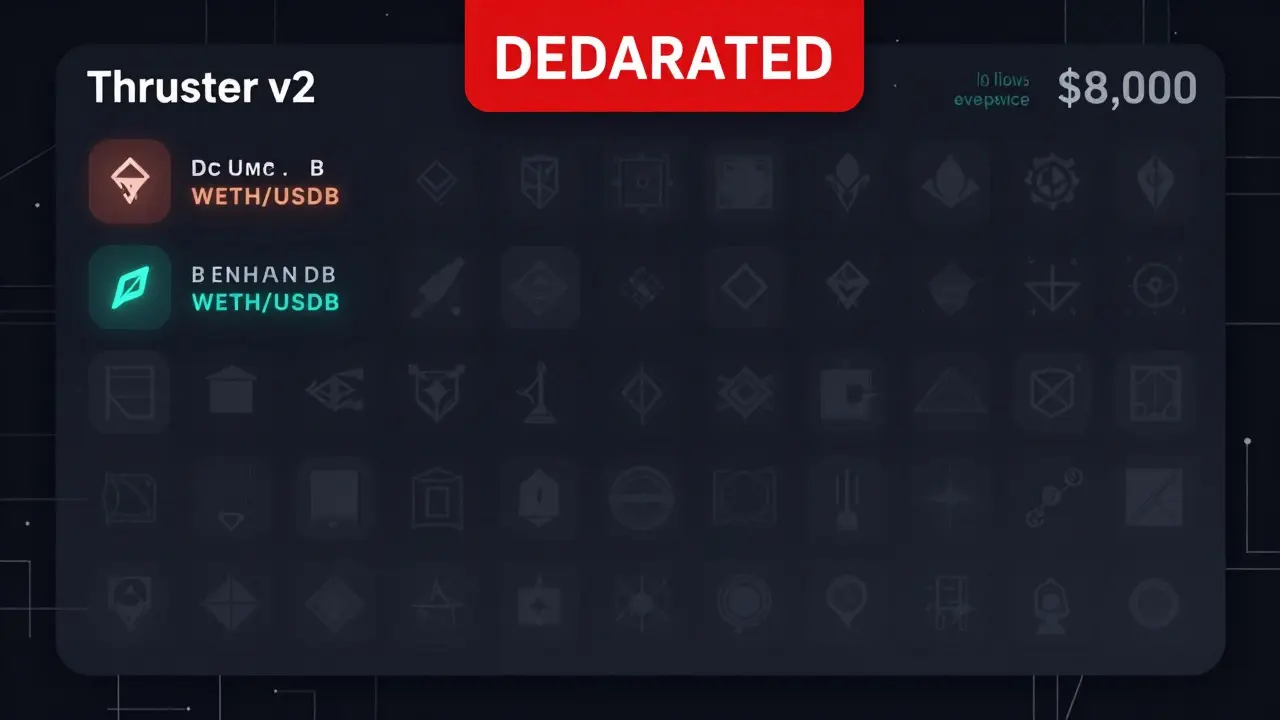
By March 2026, if you're still using Thruster v2 as your main crypto exchange, you're likely running on borrowed time. This isn’t just another DEX - it’s a relic of Blast’s early days, clinging to life while its successor, Thruster v3, takes over everything. The platform still lists 14 tokens and charges a flat 0.3% fee per trade, but the numbers tell a different story: daily volume hovers around $8,000, down 18% month-over-month since last year. That’s less than 0.001% of Uniswap’s traffic. For context, a single trade on Uniswap moves more value than all of Thruster v2’s daily activity combined.
What Thruster v2 Actually Is
Thruster v2 is a decentralized exchange built exclusively for the Blast Layer-2 blockchain. It doesn’t support Bitcoin, Ethereum mainnet, or even BSC. You can only trade tokens native to Blast - things like WETH/USDB, BLAST/USDB, or obscure tokens from early Blast projects. To use it, you need a wallet like MetaMask already connected to the Blast network. No KYC. No account creation. Just your private keys and a blockchain explorer.
Its fee structure is simple: 0.3% on every swap. That’s on par with SushiSwap and higher than some newer DEXs like MM Finance on Arbitrum, which charges 0% for makers. But here’s the catch - Thruster v2 doesn’t offer anything beyond basic swaps. No limit orders. No staking. No yield farming. No advanced charting. You get a barebones interface with a price chart that updates every 10 seconds, and a confirmation screen that sometimes takes 45 seconds to load during peak hours.
Why It Still Exists (And Why You Should Care)
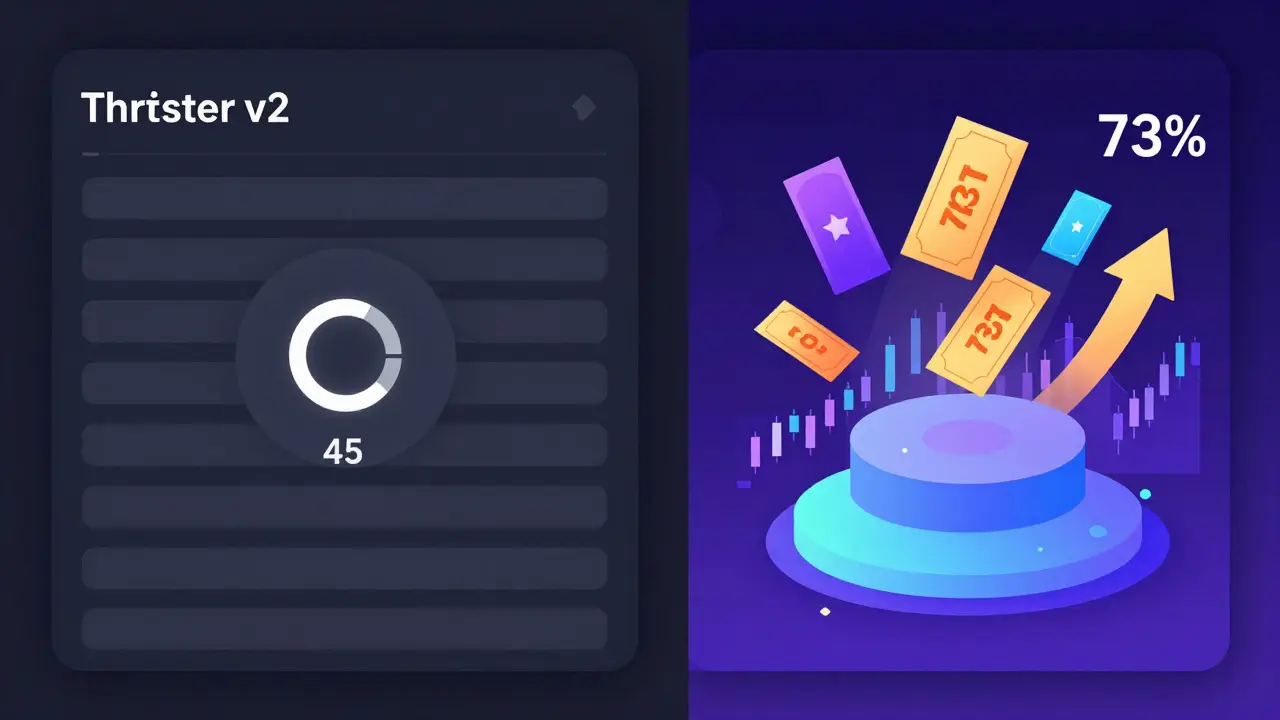
Thruster v2 was never meant to be a long-term product. It was a prototype. A testbed. A way for the Blast Foundation to see how traders would interact with a new chain before building something better. And they did - Thruster v3 launched in August 2024 with concentrated liquidity pools, stablecoin swaps, and integrated reward tokens called Treasure Tickets. Since then, v3 has captured 73% of all Blast DEX volume. Thruster v2? It’s down to 0.4%.
So why does it still exist? Because it’s still the only place where early Blast token holders can cash out. If you bought $BLAST in its first week or traded a new Blast-native meme coin before it hit CoinGecko, Thruster v2 might be your only exit route. But if you’re trying to trade anything beyond WETH/USDB, you’re in for a rough ride. Slippage on lesser-known pairs often exceeds 5%. Liquidity is so thin that a $500 trade can move the price by 10%.
The Real Problem: Liquidity and Slippage
Every DEX lives or dies by liquidity. Thruster v2 has almost none. On CoinGecko’s November 2025 data, WETH/USDB accounted for 92% of all trading volume. That means 9 out of 10 trades were between just two tokens. The other 21 pairs? They’re ghosts. Try trading $BLAST for $STAKED or $MINE for $GAS - you’ll get quoted prices that don’t match what’s actually available. The order book is empty. The price is pulled from a single pool with $12,000 total liquidity. That’s less than a single liquidity provider on Uniswap.
Users report slippage over 8% on small trades. One Reddit user, DeFiNomad2025, swapped $300 of $BLAST for $USDB and ended up with $276 after fees and slippage - a 7.7% loss before taxes. That’s not a fee. That’s a tax on ignorance.
Who Should Use It? (Spoiler: Almost No One)
There are exactly two people who should use Thruster v2 in 2026:
- You’re holding a Blast-native token that’s not listed anywhere else - and you need to sell it fast.
- You’re a hardcore Blast enthusiast testing how the chain behaves under stress - and you don’t mind losing money on slippage.
Everyone else? You’re better off using Thruster v3. Or even better - use a multi-chain aggregator like 1inch or Jupiter. They’ll find you the best price across 200+ protocols, including Blast. You’ll pay lower fees, get better rates, and avoid the 20-minute setup process just to bridge your ETH to Blast.
The Setup Nightmare
Getting started with Thruster v2 isn’t like signing up for Binance. It’s a multi-step ordeal:
- Bridge your ETH or USDC from Ethereum to Blast using the official portal. (22% of first-time users fail this step due to gas errors.)
- Wait 10-30 minutes for confirmation.
- Add the Blast network to MetaMask manually using RPC settings.
- Import token contracts one by one - no auto-detection.
- Manually approve token spending for each trade.
According to CryptoSlate’s user study, first-time users spend an average of 37 minutes just to make their first trade. That’s longer than the time it takes to buy a house on a CEX. And you still don’t get customer support. No live chat. No email. Just a Telegram group where someone might reply - if they’re awake.
Security: No Audits, No Backup
Thruster v2 has never been audited. Not by Certik. Not by Hacken. Not even by a freelance Solidity dev on Upwork. It runs on Blast’s native smart contracts, which inherit Ethereum’s security - but that doesn’t mean they’re bulletproof. Bugs happen. And when they do, there’s no insurance. No recovery. No team to contact. Your funds vanish, and the blockchain doesn’t care.
Compare that to Curve or Uniswap v3, both audited multiple times. Or even PancakeSwap, which has a $100 million insurance fund. Thruster v2? You’re on your own.
What’s Next for Thruster v2?
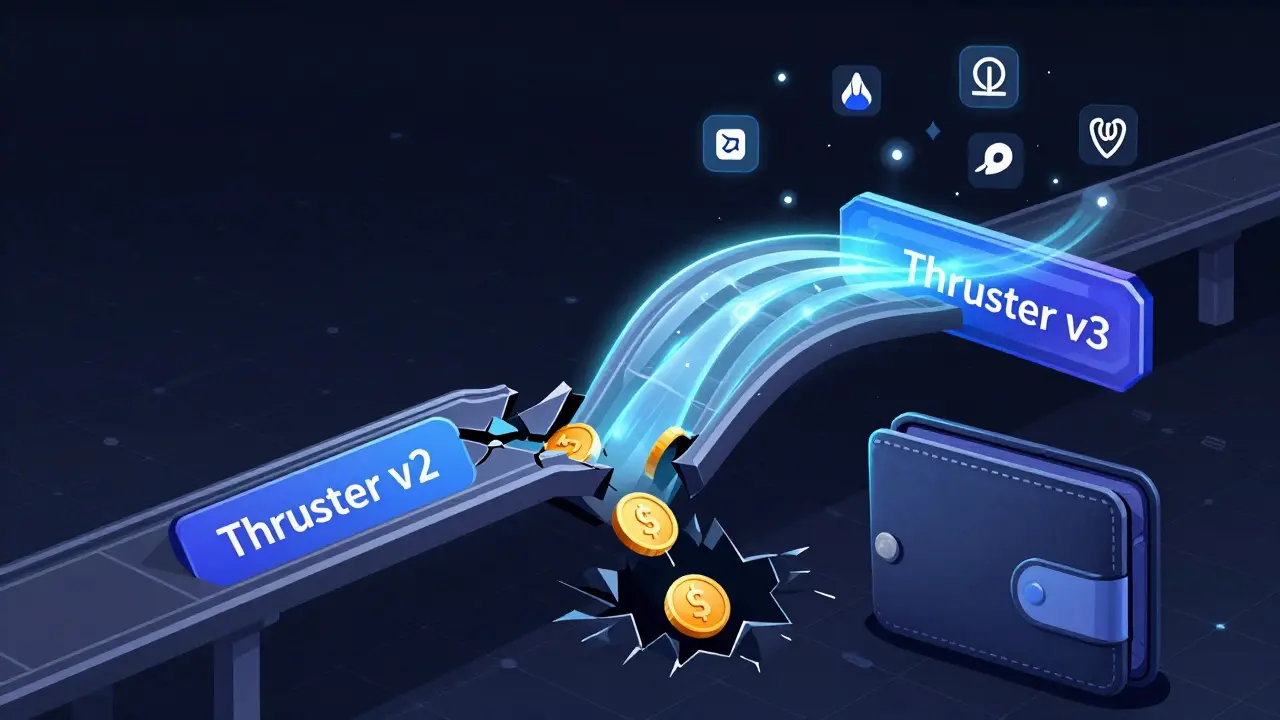
The Blast Foundation made it official in November 2025: "All development resources have shifted to v3, with v2 scheduled for deprecation in Q1 2026." That means by April 2026, the platform could stop working entirely. No warning. No migration tool. Just a dead contract.
Some users hope it’ll be absorbed into v3. Others think it’ll be shut down quietly. Either way, holding assets on Thruster v2 now is like keeping cash in a bank that’s about to close. You might get lucky - but you’re gambling.
Thruster v2 vs Thruster v3: The Real Choice
| Feature | Thruster v2 | Thruster v3 |
|---|---|---|
| Fee per trade | 0.3% | 0.3% (with $BLAST fee discounts) |
| Trading pairs | 23 | 48 |
| Liquidity pools | Single pool only | Concentrated + stableswap |
| Slippage on small trades | 5-10% | 1-3% |
| Charting tools | Basic | Advanced (candlesticks, indicators) |
| Token rewards | None | Treasure Tickets |
| Future support | Deprecating in Q1 2026 | Active development |
If you’re on Blast, use v3. Period. It’s faster, cheaper, safer, and still growing. Thruster v2 is a ghost town.
Final Verdict: Don’t Use It
Thruster v2 (0.3%) isn’t a crypto exchange you should be using in 2026. It’s a historical artifact. A snapshot of what early DeFi looked like before liquidity, user experience, and security became priorities. It’s not broken - it’s obsolete.
If you’re holding Blast-native tokens and need to sell, do it fast. Use v3. If you’re looking to trade, go to 1inch or Jupiter. If you’re just exploring Blast, start with the official bridge and v3. Don’t waste hours on a platform that’s already on life support.
The crypto world moves fast. Thruster v2 didn’t keep up. And if you’re still trading on it, you’re already behind.
Is Thruster v2 still operational in March 2026?
Yes, but only barely. As of March 2026, Thruster v2 is still live and accepting trades, but its daily volume has dropped below $5,000, and the Blast Foundation has confirmed it will be deprecated in Q1 2026. No official shutdown date has been announced, but development has completely stopped. It’s only functional for users who still have assets on it - new users are strongly discouraged from onboarding.
Can I withdraw my funds from Thruster v2 anytime?
Yes - as long as you have access to your wallet private key and are connected to the Blast network. You can swap your tokens out at any time. But be warned: if you’re trying to sell obscure tokens, you may face extreme slippage or no buyers at all. Your best bet is to swap everything into WETH or USDB first, then bridge it off Blast to Ethereum or another chain.
Why is Thruster v2’s fee 0.3% when other DEXs charge less?
Thruster v2 uses a fixed 0.3% fee because it was designed as a simple, no-frills swap tool. Unlike newer DEXs that use dynamic fee models or maker/taker structures, v2 has no incentive system. The fee goes directly to liquidity providers, but with such low volume, most providers have already pulled their funds. That means the fee is mostly just a cost to users - not a reward to anyone.
Is Thruster v2 safer than centralized exchanges?
It’s safer in one way - you control your keys. But it’s far riskier in others. There’s no customer support, no insurance, no audit, and no recovery options if you send funds to the wrong address. Centralized exchanges like Binance or Kraken have fraud protection, withdrawal limits, and help desks. Thruster v2 has none of that. For most users, the trade-off isn’t worth it.
Should I use Thruster v2 if I’m new to crypto?
Absolutely not. Thruster v2 requires you to understand bridging, gas fees, wallet management, and contract approvals. It has no beginner guides, no tooltips, and no error explanations. First-time users report spending hours just to complete one trade. If you’re new, start with a CEX like Kraken or Coinbase - then move to v3 if you’re serious about Blast.
What happens to my tokens if Thruster v2 shuts down?
If the contract stops working, your tokens are still on the Blast blockchain - they’re not lost. But you won’t be able to trade them on Thruster v2 anymore. You’d need to manually interact with the contract using a blockchain explorer like BlastScan, or wait for a third-party tool to build a migration path. There’s no guarantee either will happen. The safest move is to swap your tokens out now.
19 Responses
lol i just tried to swap $MINE for $GAS on thruster v2 and my tx took 17 minutes to confirm... then it failed anyway. 🤡 i think i just paid $3 in gas to learn that this thing is a ghost town. who even still uses this??
I mean... I guess if you’re holding some weird Blast meme coin you can’t sell anywhere else, fine. But why are you even here? Just bridge to v3. It’s not hard. I did it in 10 minutes. Stop being lazy.
There’s something poetic about thruster v2 still running, honestly. It’s like a museum exhibit of early DeFi-raw, unpolished, chaotic. The slippage, the lack of UI, the silent contracts... it’s a time capsule. People who use it now aren’t stupid-they’re archaeologists. They’re digging through the rubble of crypto’s infancy to find something real. Maybe that’s the point. Not efficiency. Not convenience. Just presence. We used to do this for the thrill, not the ROI.
The 0.3% fee is irrelevant. The real issue is liquidity depth. A $12k pool for 23 pairs? That’s not a DEX-that’s a liquidity graveyard. You need to understand that concentrated liquidity pools (like v3) don’t just ‘improve’ slippage-they eliminate it for major pairs. And if you’re still manually adding RPCs and importing token contracts? You’re operating on 2021 tech. This isn’t a critique-it’s a public service announcement.
Anyone still using v2 is either a masochist or a scammer trying to dump their rugpull tokens. There’s no excuse. I’ve seen people lose $800 on a $500 trade because they didn’t check slippage. You’re not ‘supporting the ecosystem’-you’re fueling a Ponzi of ignorance. Delete this app. Now.
I find it profoundly concerning that individuals continue to interact with a non-audited, non-supported, non-maintained smart contract. The absence of a formal deprecation timeline, coupled with the complete cessation of development, constitutes a material risk to asset integrity. One cannot reasonably justify exposure to such an environment under any fiduciary standard.
It’s not about whether it works. It’s about why we still cling to broken things. We say we use it because we have to. But really? We use it because we’re afraid to let go of the past. The real question isn’t ‘should I use v2?’-it’s ‘what am I refusing to leave behind?’
If you're still on v2, you're not a DeFi pioneer-you're a relic. The fact that you think this is 'authentic' just proves you've never used a real DEX. v3 exists. It's better. Move on. Stop romanticizing broken tools.
The continued operation of Thruster v2, despite the explicit cessation of development resources by the Blast Foundation, constitutes a breach of fiduciary duty toward early adopters. The absence of a formal migration protocol, coupled with the lack of audit history, renders any holdings on this platform legally and ethically precarious. One must question the governance transparency of a project that permits such an obsolete interface to remain live without warning.
I get it. You’re attached. Maybe you bought $BLAST when it was $0.02. Maybe you remember the first time you bridged ETH to Blast and it worked. Maybe you still have a little hope that someone will revive this. But here’s the quiet truth: this isn’t loyalty. It’s grief. You’re not preserving a tool-you’re mourning a dream. And that’s okay. But don’t let grief cost you your capital. Swap what you can. Move the rest. The chain doesn’t care if you stay. But your portfolio will.
I used to think v2 was fine. Then I tried to swap $STAKED for $GAS. Slippage was 9.2%. I lost $18 on a $200 trade. That’s not a fee. That’s a robbery. I switched to v3 and now my trades cost $0.80 and finish in 3 seconds. Why did I wait so long? Don’t be me.
v3 is the way. End of story. No drama. No drama. No drama.
If you're new to Blast and you're reading this, please stop here. Don't even open thruster v2. Go to the official Blast website. Use their bridge. Go straight to v3. I've helped five friends this week who were stuck on v2 because they thought it was 'the real one.' It's not. It's a trap. You don't need to suffer to be authentic. Just use v3. It's better. I promise.
I’ve seen people lose their life savings on this thing. Not exaggerating. One guy sent $15k in $MINE to a wrong address because the interface didn’t warn him. No undo. No help. Just silence. If you’re not a dev with a debugger open, you shouldn’t be touching this. I’m not being mean. I’m being real.
I used to think v2 was cute. Like a little glitchy robot that still waved at you even though its arm was broken. But now I see it’s more like a haunted house-everyone who enters leaves a little poorer. I switched to v3 last month. My trades are smooth. My sleep is deep. I miss nothing.
There’s a lesson here beyond just ‘use v3.’ It’s about how crypto evolves. We don’t retire old tools gracefully. We leave them to rot. And we pretend it’s fine because ‘you control your keys.’ But control doesn’t mean safety. It means responsibility. And if you’re holding assets on a dead platform, you’re not a degenerate- you’re a volunteer janitor for a graveyard. Clean up your mess. Move on.
The contractual obligations of the Blast Foundation, as publicly articulated in November 2025, clearly indicate the cessation of all support mechanisms for Thruster v2. To persist in its usage constitutes a deviation from prudent risk management protocols. I would strongly recommend adherence to the officially sanctioned alternative, Thruster v3, as a matter of both operational integrity and financial prudence.
this dumbass platform still exists?? bro it’s like running a 2005 ford taurus in 2026 and calling it ‘authentic.’ you’re not cool-you’re just broke. v3 is free. it’s faster. it’s got rewards. why are you still here??
I know it’s hard to let go. I held on to v2 for months too. I thought I was being loyal. Turns out I was just scared. I finally switched to v3 last week. Took me 15 minutes. Got my $BLAST out. Got Treasure Tickets. Even got a little bonus. I cried. Not because I lost anything. But because I finally stopped being afraid. You can do this. You’re not alone.