

The United Arab Emirates is no longer just a place where you can buy Bitcoin without looking over your shoulder. It is now one of the most strictly regulated-and consequently, most trusted-crypto hubs on the planet. If you are planning to launch an exchange, manage digital assets, or simply trade altcoins in Dubai or Abu Dhabi in 2026, you need to understand that the "wild west" days are officially over.
Since the regulatory framework became fully operational in 2025, the UAE has moved from vague guidelines to hard rules. You cannot just set up a server and start trading. You need a license, you need capital, and soon, you will need to report every transaction to tax authorities under global standards. This guide breaks down exactly how the system works, who regulates what, and what it costs to play by the book.
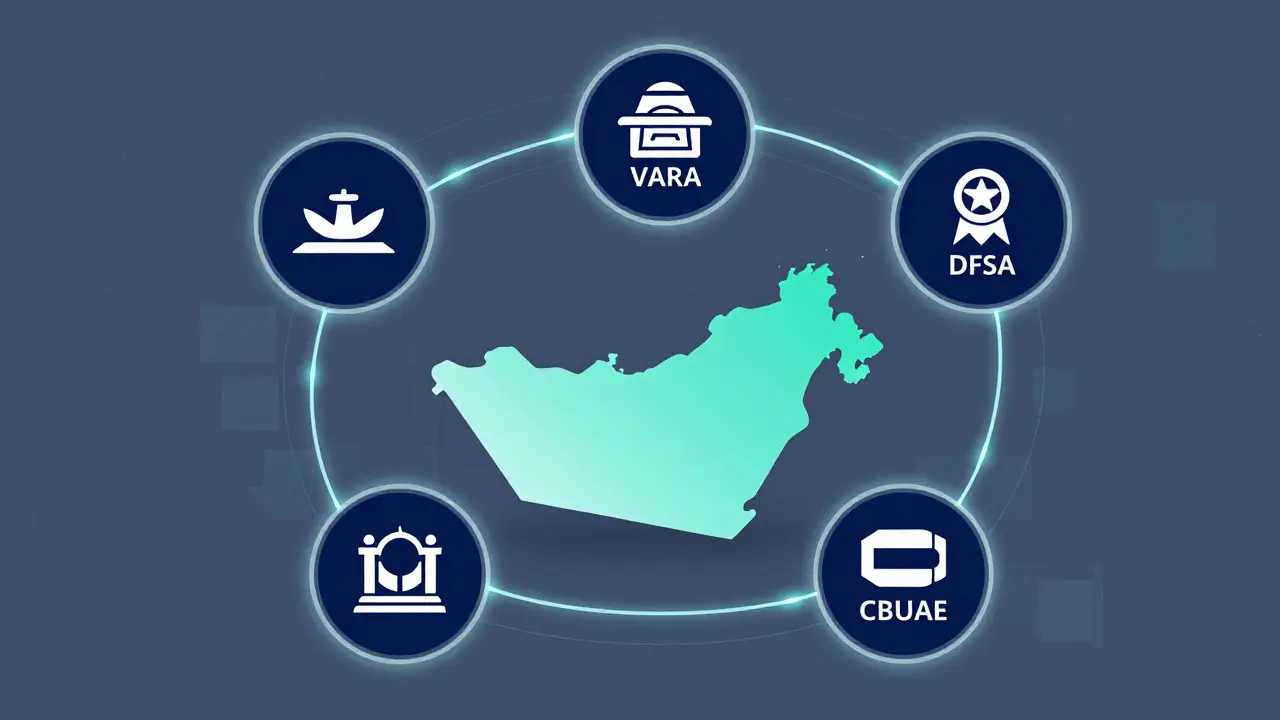
The Five Regulatory Bodies You Need to Know
The first mistake most people make is assuming there is one single agency for all crypto in the UAE. There isn't. The UAE uses a multi-layered approach, meaning the regulator you deal with depends entirely on where your business is located and what you do. Getting this wrong means wasted application fees and rejected proposals.
Here is how the landscape is divided:
- VARA (Virtual Assets Regulatory Authority): The primary regulator for virtual assets in Dubai outside of financial free zones. They handle everything from exchanges to wallet providers.
- DFSA (Dubai Financial Services Authority): Regulates crypto activities within the Dubai International Financial Centre (DIFC). They focus on dealing in investments, custody, and trading facilities.
- FSRA (Financial Services Regulatory Authority): Oversees crypto services in the Abu Dhabi Global Market (ADGM). They cover brokers, custodians, fund managers, and advisers.
- SCA (Securities and Commodities Authority): The federal body that oversees investment-related virtual assets across the entire UAE.
- CBUAE (Central Bank of the UAE): Regulates payment tokens at the federal level, ensuring they don't disrupt traditional banking systems.
If you are building a consumer-facing exchange in mainland Dubai, you talk to VARA. If you are setting up an institutional custody service in DIFC, you talk to DFSA. The distinction matters because their licensing requirements, capital thresholds, and approval timelines differ significantly.
VARA Licensing: The Gold Standard for Crypto Businesses
For most crypto startups, VARA is the name on everyone's lips. Based in Dubai, VARA offers the most detailed and crypto-specific regulatory framework in the Middle East. They categorize Virtual Asset Service Providers (VASPs) into six main types: exchange services, fiat-to-virtual asset brokers, virtual asset-to-virtual asset brokers, transfer services, custody services, and wallet provision.
Getting a VARA license is not cheap, and it is not fast. Here is what you need to prepare financially:
| Requirement Type | Details / Amount |
|---|---|
| Paid-Up Capital | AED 100,000 to AED 1.5 million ($27,000 - $408,000 USD) depending on activity |
| Application Fee | AED 40,000 to AED 100,000 |
| Annual Supervision Fee | AED 80,000 to AED 200,000 |
| Incorporation Requirement | Must be incorporated specifically in Dubai |
Token issuance is treated separately. VARA splits this into two categories. Category 1 tokens require both a license and specific project approval. Category 2 tokens require a licensed distributor, though some closed-loop utility tokens are exempt from full licensing but still remain under VARA oversight. This structure ensures that even if you aren't running an exchange, you can't just mint coins and sell them to retail investors without scrutiny.
Tax Changes: VAT Exemptions and the New CARF Era
One of the biggest draws for crypto businesses moving to the UAE has been the tax environment. As of November 15, 2024, most transactions involving virtual assets-including buying, selling, or exchanging Bitcoin and Ethereum-are exempt from the standard 5% Value Added Tax (VAT). This makes the UAE significantly more attractive than jurisdictions that treat crypto sales as taxable supply events.
However, freedom from VAT does not mean freedom from reporting. The game-changer for 2026 and beyond is the implementation of the Crypto-Asset Reporting Framework (CARF). An OECD-led standard for automatic exchange of information on crypto-assets between tax authorities globally. Announced by the Ministry of Finance in September 2025, CARF aligns the UAE with global tax transparency standards.
Under CARF, crypto service providers (exchanges, brokers, custodians, and wallet providers) must collect and share comprehensive data. This includes account balances, transaction histories, and customer identification details. The timeline is strict:
- Public Consultation: Open until November 8, 2025.
- Final Regulations: Expected in 2026.
- Implementation Begins: January 1, 2027.
- First Data Exchange: Occurs in 2028.
This means that while you might enjoy low taxes today, the era of anonymous crypto wealth in the UAE is ending. By 2028, your crypto holdings will be visible to tax authorities in the same way your bank accounts are now.
Compliance: AML, CFT, and Retail Protection
The UAE’s reputation relies heavily on its ability to prevent money laundering. All licensing applicants undergo enhanced due diligence following Anti-Money Laundering and Combating the Financing of Terrorism (AML/CFT) controls. These align directly with recommendations from the Financial Action Task Force (FATF). The global money laundering and terrorist financing watchdog.
In 2025, regulators expanded coverage to include decentralized finance (DeFi) protocols, non-fungible tokens (NFTs), and tokenized real-world assets. Previously, DeFi projects could operate in a gray area. Now, if your protocol interacts with users in the UAE, you likely need to demonstrate technical competency and implement robust identity verification (KYC) mechanisms.
Retail investor protection has also tightened. After a 12-month grace period that ended in August 2025, all merchants in the UAE (excluding those in Financial Free Zones) are mandated to accept crypto payments only through licensed providers. This protects consumers from fraud and ensures that every satoshi spent is traceable and compliant.
Why Companies Choose the UAE Over Other Jurisdictions
So why do giants like Binance, Crypto.com, and Bybit, along with custodians like BitGo, choose the UAE? It comes down to clarity. In many countries, regulators send mixed signals or ban crypto outright. In the UAE, the rules are written down, published, and enforced consistently.
The multi-regulatory structure allows businesses to pick their jurisdiction based on their model. Want deep integration with traditional banks? Look at DFSA or FSRA. Want a pure-play crypto hub with tailored rules? VARA is your choice. This flexibility, combined with VAT exemptions and a clear path to legitimacy, has attracted over 400 companies to establish operations in the country.
Furthermore, the UAE actively supports innovation in real-world asset (RWA) tokenization. Institutional-grade initiatives receive specific regulatory support, bridging the gap between Web3 natives and traditional finance. This creates a diverse ecosystem where a startup launching an NFT marketplace can coexist with a major bank offering tokenized bonds.
Next Steps for Entrepreneurs and Investors
If you are considering entering the UAE market, start by defining your entity type. Are you a broker, a custodian, or an issuer? Then, identify your geographic focus. Mainland Dubai points to VARA; DIFC points to DFSA. Prepare your capital reserves early, as paid-up capital requirements are strict and non-negotiable.
Keep a close eye on the CARF implementation timeline. Even if you are not yet licensed, understanding the data reporting requirements will save you months of technical debt later. Build your compliance infrastructure now, focusing on KYC, transaction monitoring, and record-keeping. The UAE rewards those who take compliance seriously and penalizes those who try to cut corners.
Can I trade Bitcoin legally in the UAE without a license?
Yes, individual retail trading is legal. However, you must use licensed platforms. Since August 2025, merchants can only accept crypto via licensed providers, and individuals should ensure their chosen exchange holds a valid VARA, DFSA, or SCA license to guarantee security and legal standing.
How much does it cost to get a VARA license?
Costs vary by activity. Paid-up capital ranges from AED 100,000 to AED 1.5 million. Application fees are between AED 40,000 and AED 100,000, with annual supervision fees ranging from AED 80,000 to AED 200,000. Additional costs include legal, compliance, and office setup expenses.
What is CARF and how does it affect me?
CARF is the Crypto-Asset Reporting Framework. For service providers, it means mandatory reporting of user transactions and balances to tax authorities starting in 2027. For individual investors, it means your crypto holdings will be reported to tax agencies automatically by 2028, similar to bank accounts.
Is cryptocurrency subject to VAT in the UAE?
No. As of November 15, 2024, most virtual asset transactions, including the purchase and sale of cryptocurrencies, are exempt from the standard 5% VAT in the UAE.
Which regulator should I choose: VARA or DFSA?
Choose VARA if you are operating in Dubai outside the DIFC and want a crypto-centric framework. Choose DFSA if you are establishing your business within the Dubai International Financial Centre (DIFC) and prefer a traditional financial services regulatory environment.
Are DeFi protocols regulated in the UAE?
Yes. As of 2025 updates, DeFi protocols are included in the regulatory scope. Projects interacting with UAE users must comply with AML/CFT standards and may require licensing depending on their structure and services offered.