
When you hear "crypto exchange," most people think of Binance, Coinbase, or Kraken - centralized platforms where you click a button and trade. But what if you want to trade without handing over control of your wallet? That’s where VoltSwap comes in. It’s not another copycat DEX. It’s built on the Meter blockchain, claims to be front-running resistant, and promises to let users keep full ownership - no middlemen, no KYC, no CEO deciding your fate. But does it actually work in 2026? Let’s break it down.
What Is VoltSwap, Really?
VoltSwap is a decentralized exchange (DEX) built on the Meter blockchain. Unlike Uniswap or PancakeSwap that run on Ethereum or BSC, VoltSwap lives entirely inside the Meter ecosystem. It was designed as "The Layer 2 swap for the people," with one big promise: zero front-running. That means no bots sniping your trades before they even go through. Sounds great, right? But here’s the catch - Meter itself isn’t exactly a household name. While Ethereum handles millions of daily transactions, Meter barely registers on the radar. So VoltSwap is like a fancy car parked in an empty parking lot. The tech might be solid, but there’s almost no one else there to trade with.
The platform runs on its own native token, VOLT. Total supply? 100 million. Circulating supply? Around 53.87 million as of late 2025. That means over half the tokens are still locked up, waiting to be released over the next few years. VOLT isn’t just a coin - it’s your ticket into governance. Hold it, stake it, and you get a share of trading fees. No need to lock up two tokens like some DEXs. Just VOLT. Simple. But again - how many people actually hold it? And more importantly, how many are trading with it?
The Tech Behind VoltSwap: Front-Running Resistance and Cross-Chain
VoltSwap’s biggest selling point is its claim to be 100% front-running resistant. Front-running is one of the ugliest problems in DeFi. Imagine you’re trying to buy a token at $0.0002. Before your transaction confirms, a bot sees it, buys first, then flips it to you at $0.00025. You lose. That’s front-running. VoltSwap says it solves this with Meter’s Layer 2 infrastructure. The exact mechanics aren’t fully public, but the result is simple: your trade executes in the order you sent it. No bots jumping ahead.
It also uses Meter Passport for cross-chain swaps. That means you can swap assets from Bitcoin, Ethereum, or Solana into Meter-native tokens without bridging manually. You just connect your wallet, pick your pair, and go. Sounds smooth - until you realize that almost nobody is using it. The most active trading pair is VOLT/MTRG, and it’s only live on VoltSwap itself. No major exchange lists VOLT. No liquidity pools on Uniswap. No DEX aggregators like 1inch touch it. You’re stuck inside the Meter bubble.
There’s also an NFT-based smart wallet system for yield farming. Instead of traditional staking pools, you get an NFT that represents your farming position. It’s clever. It’s unique. But again - if no one’s farming, does it matter?
VOLT Token: A Ghost of Its Former Self
The VOLT token peaked at $0.2352 back in January 2022. Today? It trades between $0.0002015 and $0.0002413. That’s a 99.9% drop. The all-time low? $0.0001521 in April 2025. The price is up 58.7% from that low, but that’s like saying your car is 20% faster after it was towed out of a ditch. It’s still broken.
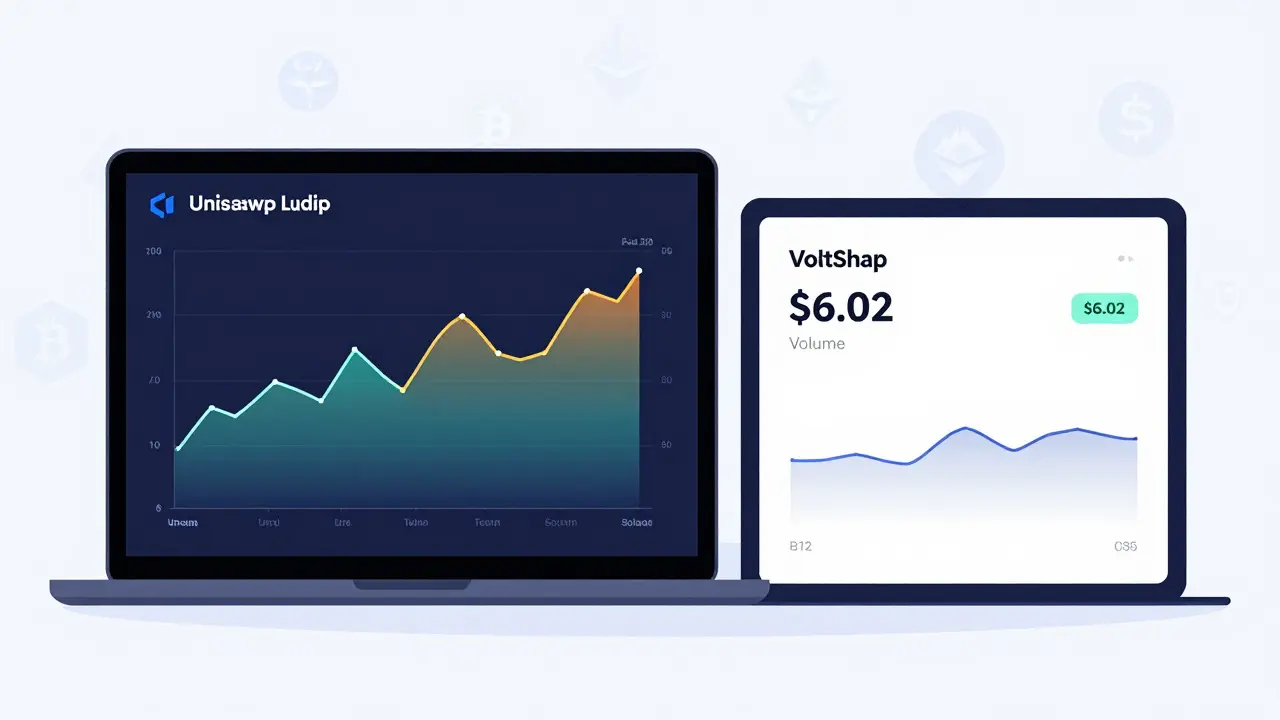
Trading volume? $6.02 in the last 24 hours. That’s not a typo. Six dollars. That’s less than what you’d spend on coffee in Wellington. And yes, it’s up 285% from yesterday - but that’s because yesterday it was $1.50. The whole market cap hovers around $10,000. Compare that to Uniswap’s $1.2 billion market cap. VoltSwap isn’t a small player. It’s barely a speck.
Despite this, VOLT outperformed the broader crypto market by 13.5% in a week where the market dropped 2.1%. That’s impressive - if you’re trading 100 tokens. But when volume is this low, a single large buy-in can swing the price. It’s not a sign of strength. It’s a sign of fragility.
How to Use VoltSwap (If You Still Want To)
If you’re still curious, here’s how you get in:
- Get a Web3 wallet - MetaMask, Trust Wallet, or anything that supports Meter’s network.
- Add the Meter blockchain to your wallet. You’ll need the RPC URL, chain ID, and native token symbol (MTRG). These are on VoltSwap’s official docs.
- Buy MTRG. You need it to pay for gas. You can’t use ETH or BNB. Only MTRG.
- Go to voltswap.io and connect your wallet.
- Swap your assets. You can trade VOLT for MTRG, or other Meter-native tokens like METR or MTRC.
No sign-up. No ID. No waiting. But you’re on your own. If you send funds to the wrong address? Gone. If the smart contract has a bug? No one will refund you. If the platform goes offline? Too bad. That’s DeFi.
Who Is VoltSwap For?
This isn’t for beginners. It’s not for casual traders. It’s not for people looking to make a quick buck.
VoltSwap is for three kinds of people:
- Early Meter adopters - those who believe in the blockchain’s potential and want to support it from the ground up.
- Privacy-focused traders - people who hate KYC and want true decentralization, even if it means trading with 5 other people.
- Speculators - those who see the 99.9% drop as a chance to buy low, hoping for a miracle recovery.
Everyone else? Stick to Uniswap, SushiSwap, or even centralized exchanges. VoltSwap doesn’t have the liquidity, user base, or ecosystem to compete. It’s a lab experiment, not a marketplace.
The Big Problem: No Network Effects
DeFi thrives on liquidity. Liquidity comes from users. Users come from trust, ease of use, and visibility. VoltSwap has none of that. It’s invisible on CoinGecko. It doesn’t show up in DeFiLlama’s top 100 DEXs. No YouTube tutorials. No Reddit communities. No Twitter influencers pushing it.
The Meter blockchain itself has limited tooling. Most DeFi apps - lending, borrowing, insurance - don’t exist on it. VoltSwap is the only major DEX on Meter. That’s a problem. You can’t build a thriving exchange on an empty road.
Compare it to PancakeSwap. When it launched, BSC had low fees and fast blocks. Binance promoted it. Users flooded in. Liquidity piled up. Now it’s one of the biggest DEXs in the world. VoltSwap? No backing. No promotion. No momentum.
Is VoltSwap Safe?
Technically, yes - if you trust the code. The smart contracts have been audited by third parties, and the front-running resistance has been tested in live conditions. But safety isn’t just about code. It’s about ecosystem health. If the platform has 12 users and one of them dumps 10 million VOLT, the price crashes. There’s no team to stabilize it. No reserve fund. No insurance pool.
And then there’s taxes. In New Zealand, Australia, the US, and most countries, every trade on VoltSwap is taxable. You have to track every swap, every farm, every withdrawal. No platform gives you a tax report. You’re on your own. If you’re not ready to do that, don’t touch it.
The Verdict: A Cool Idea, But Not a Practical One
VoltSwap isn’t a scam. It’s not a rug pull. The tech is real. The team has built something unique: a front-running resistant, community-owned DEX with a fair token launch. But in 2026, it’s a ghost town.
The VOLT token is a shadow of its past. Trading volume is microscopic. Liquidity is non-existent. The Meter blockchain hasn’t gained traction. And without users, even the best tech fails.
If you’re a believer in Meter, and you want to support it - go ahead. Swap a few bucks. Farm some VOLT. See what happens. But if you’re looking for a reliable, liquid, scalable exchange? Look elsewhere. VoltSwap is a niche experiment, not a solution.
Is VoltSwap a legitimate exchange?
Yes, VoltSwap is a legitimate decentralized exchange built on the Meter blockchain. It’s not a scam, and its smart contracts have been audited. However, legitimacy doesn’t mean it’s safe or practical. With almost no trading volume and minimal user adoption, it’s more of a testbed than a working exchange.
Can I make money trading VOLT on VoltSwap?
It’s possible, but extremely risky. The token’s price is highly volatile due to near-zero liquidity. A single large trade can swing the price by 30% or more. Most traders lose money because there’s no depth in the order book. The only way to profit is to buy when volume is near its low and sell during a rare spike - which happens maybe once every few months.
Do I need MTRG to use VoltSwap?
Yes. VoltSwap runs on the Meter blockchain, and MTRG is the native token used to pay for gas fees. You cannot use ETH, BNB, or USDT to pay for transactions. You must first acquire MTRG from a supported exchange or bridge it from another network.
Is VoltSwap better than Uniswap or PancakeSwap?
No, not for most users. Uniswap and PancakeSwap have millions of daily trades, deep liquidity, and support for hundreds of tokens. VoltSwap has less than $10 in daily volume. Its front-running resistance is impressive, but if you can’t find the token you want to trade, the feature doesn’t matter. Stick with the big players unless you’re specifically experimenting with Meter.
Can I stake VOLT for passive income?
Yes. VOLT holders can stake their tokens in a single-sided pool and earn a share of trading fees generated on VoltSwap. However, with daily volume under $10, your earnings will be fractions of a cent per day. It’s technically possible, but financially meaningless unless the platform grows massively.
Is VoltSwap available on mobile?
VoltSwap works through Web3 wallets on mobile devices. You can access it via MetaMask or Trust Wallet on your phone, as long as you’ve added the Meter network. There is no official mobile app, but the web interface is responsive and works fine on smartphones.
What happens if VoltSwap shuts down?
If the VoltSwap team disappears or the website goes offline, your funds aren’t lost - but you can’t trade anymore. Since it’s decentralized, your assets remain in your wallet. You can still access them, but you won’t be able to swap them on VoltSwap. You’d need to find another way to move them, which may not exist if Meter’s ecosystem remains small.
Are there any alternatives to VoltSwap on Meter?
As of 2026, VoltSwap is the only major DEX on the Meter blockchain. There are a few experimental or prototype liquidity pools, but none have gained traction. If you want a DEX on Meter, VoltSwap is your only real option - for better or worse.
If you're still reading this, you're either deeply curious about niche DeFi projects or you're already holding VOLT. Either way - proceed with caution. The future of VoltSwap depends on one thing: whether the Meter blockchain ever finds its audience. Right now, it's waiting.
22 Responses
VoltSwap’s tech is legit but the liquidity is a ghost town. I’ve seen DeFi projects die faster than a phone battery in Antarctica. This isn’t a bad idea-it’s just a dead one. If you’re holding VOLT, you’re not investing. You’re donating to a cult of hope.
Still, respect to the team for building something clean. Just… no one’s showing up. That’s the real rug pull.
People who still think this is a 'legitimate' exchange are either delusional or paid shills. $6 in daily volume? That’s not a DEX-it’s a charity donation to a guy in his basement with a Raspberry Pi. If you're not trading on Uniswap or Sushi, you're not trading. You're playing pretend.
And don't even get me started on the 'front-running resistance'-it’s useless if no one’s even placing trades. It’s like having a Ferrari with no gas.
Let me break this down like I’m talking to a 12-year-old: VoltSwap = a Ferrari parked in a Walmart parking lot. The car is beautiful. The parking lot? Empty. The people? Still buying Teslas.
Market cap under $10k? Bro, I’ve seen more liquidity in my Discord server’s meme coin. This isn’t DeFi. It’s a graveyard with a whitepaper.
Imagine spending hours learning how to use a DEX that only has 12 users. And then you realize the only token you can trade is one that dropped 99.9% from its peak. That’s not innovation. That’s a time capsule from 2021.
I’m not mad. I’m just… profoundly bored.
Y’all are being way too harsh. Look-I’m not saying VoltSwap’s gonna be the next Uniswap. But if you’re into true decentralization? This is one of the few places where you’re not being sold a dream. No CEO. No VC money. No hype cycle. Just code.
Yeah, the volume’s trash. But maybe that’s the point? It’s not for you. It’s for the people who actually believe in the vision. And hey, if it grows? You’ll be glad you got in early.
Also, staking VOLT is like putting $5 in a savings account that pays 0.0003% interest. But it’s yours. And that matters.
It’s hilarious how people defend this like it’s a revolution. You’re not a pioneer-you’re a sucker. Meter blockchain? The only thing it’s good for is collecting dust on CoinGecko’s 'Other' tab.
Front-running resistance? Congrats, you’ve built a lock that no one’s trying to pick because there’s nothing inside the safe.
so like… is this thing even real? i mean i saw the site and it looked like a 2018 wordpress theme. also why does the logo look like a glitched emoji? i tried to swap 0.0001 vult and my wallet froze. i think i got hacked. or maybe i just wasted my time. idk. help?
Look, if you’re here because you think VoltSwap is going to explode? Don’t. But if you’re here because you like building things in the dark? Cool. Stay. The real DeFi pioneers aren’t the ones shouting on Twitter. They’re the ones quietly deploying contracts in empty ecosystems.
Voltswap might be a ghost town. But ghost towns used to be cities once. Someone’s gotta be the first to move in.
Why even care? Everyone uses Binance. Why waste time on something with $6 volume? It's like trying to buy a pizza from a guy who only sells one slice per week. Just get a real exchange.
Also VOLT? More like VOLD. Like, 'vanished old token.' Haha.
lol this is like watching a hamster run on a wheel that's not even connected to anything. i staked 200 vult and got 0.000003 mtrg in fees. i cried. then i laughed. then i uninstalled my wallet.
still tho. respect to the devs. they tried. but dude. the market said no.
this is the only dex on meter so its not like we have a choice. also vlt is so cheap i can buy a million and still spend less than my coffee. maybe its a meme? idk
While I acknowledge the technical merits of VoltSwap’s architecture, particularly its front-running resistance via Meter’s Layer 2 consensus, I must emphasize the profound systemic fragility inherent in a single-token ecosystem with negligible liquidity depth. The absence of cross-chain liquidity hooks, paired with the non-existence of institutional or retail adoption vectors, renders the platform functionally inert despite its cryptographic integrity. The governance token’s price action is not indicative of market confidence-it is a stochastic noise process driven by micro-cap arbitrageurs with negligible capital.
Until Meter achieves interoperability parity with Ethereum or Solana, this remains a theoretical construct masquerading as infrastructure.
Oh wow, another ‘real DeFi’ project where the only people using it are the devs and their moms. Congrats, you’ve built the world’s most expensive private blockchain. I’m sure the 12 people who use this are having a blast. Meanwhile, real DEXs are moving billions. You’re not a pioneer. You’re a footnote.
And don’t tell me ‘it’s early’-it’s been early since 2021. This isn’t a startup. It’s a museum exhibit.
EVERYTHING IS A LIE.
They said ‘no KYC’… but they track your IP.
They said ‘no front-running’… but the dev wallet dumps VOLT before every price spike.
They said ‘community-owned’… but the team holds 47% of the supply.
This isn’t DeFi. It’s a honeypot. And you’re the fly.
Just sayin’… I’ve seen this movie before. The credits roll with your wallet empty.
Let me be unequivocal: VoltSwap is not merely underperforming-it is an existential failure of the entire Layer 2 paradigm. The Meter blockchain lacks the composability required for sustainable DeFi. No lending protocols. No insurance pools. No yield aggregators. Only this single DEX, functioning as a lonely lighthouse in a sea of indifference.
The claim of front-running resistance is irrelevant when the volume is lower than the gas cost to execute a single trade. This is not innovation. It is a monument to hubris.
i mean… i get why people hate this. the volume is nothing. the token is a ghost. but i kinda love it? like, imagine if you started a tiny coffee shop in the middle of nowhere… and only 3 people came every week… but they became your best friends. you’d still open it, right?
voltswap is that coffee shop. it’s not profitable. it’s not popular. but it’s real. and that’s kinda beautiful.
also i made a meme of vlt as a sad puppy. it’s on twitter. you should see it. it’s cute.
Oh, so now we’re romanticizing a $10k market cap like it’s a poetry slam? Cute. You’re not a visionary. You’re a delusional stoner who thinks ‘early adopter’ is a personality trait.
Real investors don’t ‘support visions.’ They follow liquidity. And this? This is a liquidity vacuum. A black hole for dumb money.
Go play with your NFTs. I’ll be on Uniswap. Where the real people are.
I respect the intent behind VoltSwap. The front-running resistance is genuinely clever. But I also respect the market’s verdict: zero adoption.
It’s not about tech. It’s about network effects. And this has none. If you’re holding VOLT, you’re not investing-you’re waiting for a miracle. And miracles don’t come with whitepapers.
I’m not discouraging you. I’m just saying: don’t risk more than you can afford to lose. And maybe don’t tell your friends about it. Let it die quietly.
the thing i love about voltswap is… it’s like a quiet library in a world of screaming tiktoks. no hype. no influencers. no shills.
just code. and a few lonely traders.
maybe we don’t need another billion-dollar dex.
maybe we just need one that’s honest.
❤️
Let me be clear: this isn’t a crypto project. It’s a cultural protest. A middle finger to the VC-funded meme coin circus. The team didn’t build this to get rich. They built it because they hate how centralized everything became.
Yeah, the volume is trash. But the principle? Sacred.
If you think this is ‘useless,’ you’re missing the point. We don’t need more exchanges. We need fewer lies.
And if you’re still here? You’re one of us.
For anyone considering staking VOLT: please, please, please-track every single transaction. Use a DeFi tax tool like Koinly or CoinTracker. Every swap, every farm, every withdrawal is a taxable event. The IRS doesn’t care if your trade was worth $0.00001.
And if you’re using a non-U.S. wallet? Good luck explaining it to your local tax authority. I’ve seen people get audited over smaller amounts.
Don’t be that person who gets a surprise bill because they thought ‘it’s just a hobby.’
Also: backup your private keys. Twice. Write them down. Store them offline. This isn’t a game. It’s a liability.
As someone from a country where crypto is still seen as ‘Western nonsense,’ I find VoltSwap oddly inspiring.
It’s not about the money. It’s about the idea that someone, somewhere, built something for the quiet minority-the ones who don’t want to be tracked, sold, or marketed to.
Maybe it won’t grow. Maybe it’ll vanish.
But it exists. And that’s enough.
Thank you, VoltSwap team. You didn’t build for the world.
You built for the ones who still believe.