
Most people think Bitcoin is anonymous. It’s not. Every transaction you ever make with Bitcoin is permanently recorded on a public ledger. Anyone can see how much you sent, when you sent it, and which wallet it went to. If someone links that wallet to your identity-say, through an exchange or a public post-you’re exposed. That’s not privacy. That’s pseudonymity. Privacy protocols in cryptocurrency fix that. They don’t just hide your identity; they make it mathematically impossible to trace your transactions without the right key.
How Privacy Protocols Are Different from Regular Cryptocurrencies
Bitcoin and Ethereum are transparent by design. Your wallet address is visible to everyone. You can look up any transaction ever made from or to that address. That’s great for accountability. It’s terrible for your financial privacy. Imagine if every time you paid for groceries, your name, receipt, and exact amount spent showed up on a public website. That’s what Bitcoin feels like. Privacy protocols change that. They’re built from the ground up to hide three things: who sent the money, who received it, and how much was sent. This isn’t optional. In coins like Monero, privacy is automatic. You don’t need to turn it on. It just works.The Three Core Technologies Behind Privacy Protocols
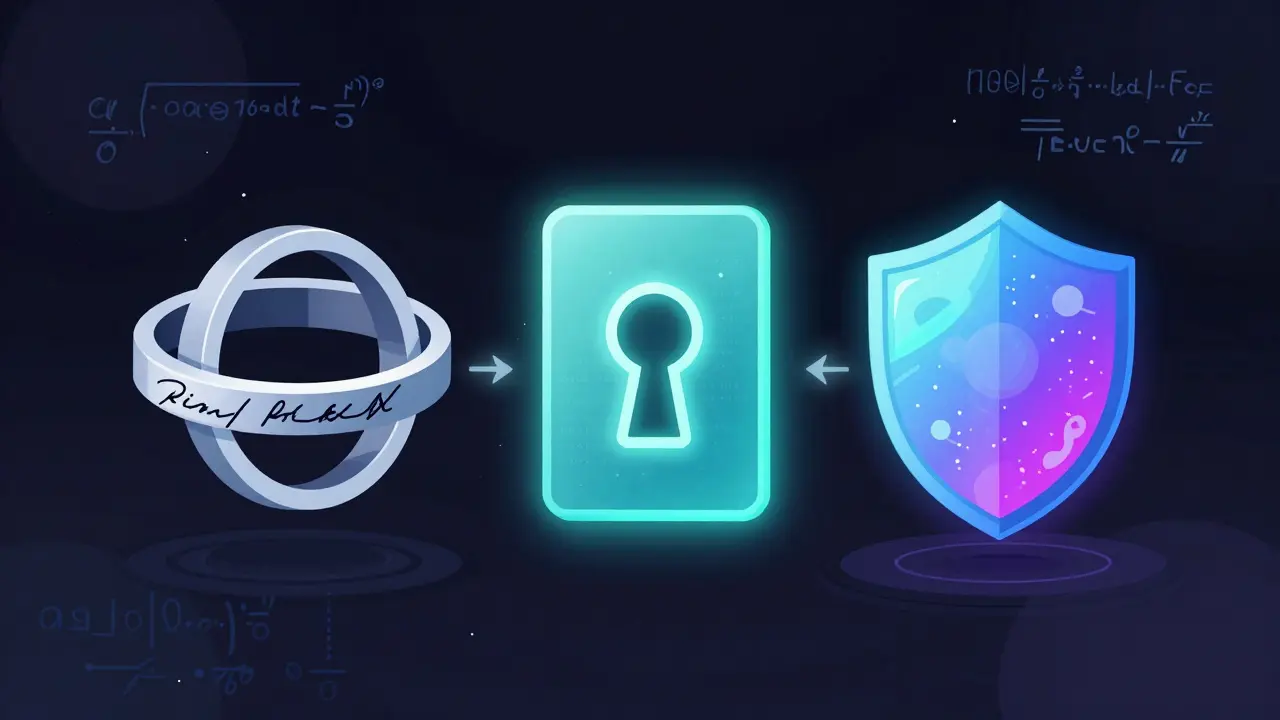
There are three main cryptographic tools that make privacy protocols work. Each tackles a different part of the problem.- Stealth addresses: Instead of using the same wallet address every time, a privacy coin generates a new, one-time address for every incoming transaction. Even if someone watches your public wallet, they can’t see which transactions belong to you. Only you, with your private key, can find and spend the funds.
- Ring signatures: This hides who sent the money. When you send a transaction, your signature gets mixed with signatures from other users on the network. It looks like five people sent the money-but only one actually did. Nobody can tell which one. Monero uses this to obscure sender identity.
- Zero-knowledge proofs (zk-SNARKs): This is the most advanced tool. Zcash uses it to prove a transaction is valid without revealing any details. You can prove you have enough money to send, that the amounts balance, and that no one is cheating-without showing the sender, receiver, or amount. It’s like proving you’re over 21 without showing your ID.
Some protocols combine these. Monero uses stealth addresses + ring signatures + Ring Confidential Transactions (RingCT) to hide everything. Zcash lets you pick: transparent transactions like Bitcoin, or shielded ones using zk-SNARKs.
Top Privacy Coins Compared
| Coin | Privacy Method | Privacy by Default? | Transaction Speed | Exchange Support |
|---|---|---|---|---|
| Monero | Ring signatures, stealth addresses, RingCT | Yes | Slower (2-10 minutes) | Low (delisted on many exchanges) |
| Zcash | zk-SNARKs (optional shielded transactions) | No | Faster (2.5 minutes) | High (available on major exchanges) |
| Dash | PrivateSend (coin mixing via masternodes) | No | Fast (under 2 minutes) | Medium (available but declining) |
| Bytecoin | Ring signatures (similar to Monero) | Yes | Slow | Very low |
Monero is the gold standard. It’s the only coin where privacy is built into every single transaction. That’s why exchanges like Coinbase and Kraken removed it-regulators say it’s too hard to monitor. Zcash is more flexible. You can use shielded transactions when you need privacy, or transparent ones when you don’t. But here’s the catch: over 90% of Zcash users choose transparency. That means most Zcash transactions are just as traceable as Bitcoin.
Dash’s PrivateSend mixes your coins with others to break the trail. It’s easier to use than Monero, but it’s not as strong. Masternodes can be compromised, and the mixing isn’t always perfect. It’s a middle ground.
Why Privacy Protocols Are Under Fire
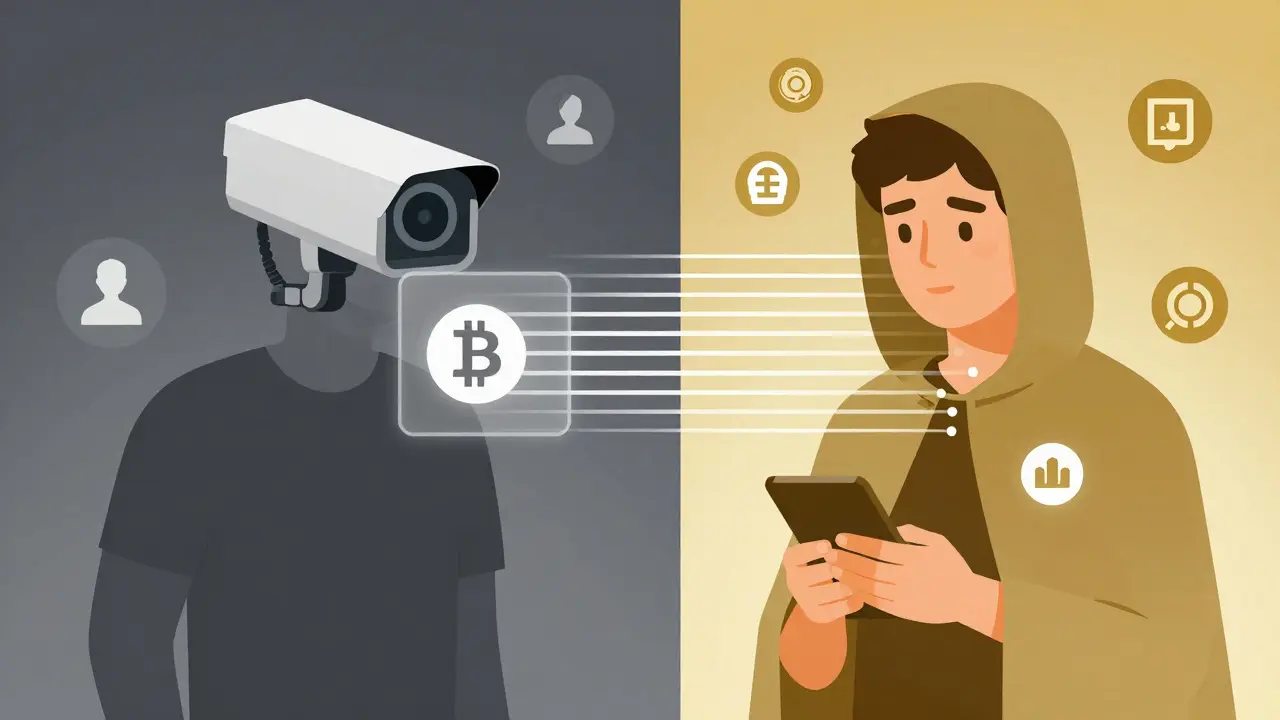
Governments and regulators hate privacy coins. Not because they’re evil-but because they make money laundering, tax evasion, and darknet market transactions harder to track. The Financial Action Task Force (FATF), the global anti-money laundering watchdog, has pushed for bans. Countries like Japan, South Korea, and the Netherlands have delisted Monero. The U.S. Treasury has flagged privacy coins as high-risk.But here’s the problem: if you ban privacy coins, you’re not just stopping criminals-you’re stopping everyone who needs financial privacy. Journalists in authoritarian countries. Activists under surveillance. Small businesses negotiating confidential deals. People living in places with hyperinflation or capital controls. For them, privacy isn’t a luxury. It’s survival.
Privacy protocols don’t make crime easier. They make financial surveillance harder. And that’s a fundamental right.
What You Need to Know Before Using Privacy Coins
If you’re thinking about using Monero, Zcash, or another privacy coin, here’s what to expect:- Slower transactions: Privacy tech adds complexity. Monero transactions take longer to confirm than Bitcoin. Zcash shielded transactions are faster but still slower than transparent ones.
- Larger file sizes: Each privacy transaction is bigger. That means higher fees on some networks.
- Wallet limitations: Many mobile wallets don’t support full privacy features. You’ll need a desktop wallet like Monero GUI or Zcash Shielded Wallet for full security.
- Exchange access is shrinking: If you buy Monero on a small exchange, you might not be able to cash out on Coinbase or Binance. Plan ahead.
- You must use it right: If you send Monero to a Bitcoin address, you break the privacy. If you use Zcash without enabling shielded transactions, you’re not using privacy at all.
There’s no magic button. Privacy requires attention. But if you care about who sees your financial history, it’s worth the effort.
The Future of Privacy in Crypto
Privacy protocols aren’t going away. They’re evolving. New zero-knowledge systems like zk-STARKs are faster and don’t need trusted setup. Layer-2 solutions like the Lightning Network are starting to add privacy features. Even Ethereum is exploring privacy upgrades for its smart contracts.At the same time, central banks are rolling out digital currencies-CBDCs-that can track every dollar you spend. That’s the opposite of privacy. It’s financial control. That’s why demand for privacy coins might grow, not shrink. People will want an alternative to government-monitored money.
But adoption will be slow. Most users don’t care about privacy. They want fast, cheap, easy transactions. Privacy coins will remain niche. But for the people who need them-those who live under surveillance, in unstable economies, or just value their financial autonomy-they’re essential.
Privacy protocols aren’t about hiding from the law. They’re about protecting your right to financial freedom. In a world where every purchase, every transfer, every balance is being watched, that’s not radical. It’s necessary.
15 Responses
Just started using Monero last month and honestly it changed how I think about money. No more sweating when I pay for something online. It just feels right.
It is imperative to underscore that the purported notion of financial privacy as a universal right is not only a fallacious construct but also a dangerous ideological abomination masquerading as civil liberty. The very premise that individuals ought to be shielded from systemic oversight in financial transactions is antithetical to the foundational tenets of modern fiscal accountability, regulatory compliance, and the prevention of illicit capital flows. To equate privacy with autonomy in this context is to confuse obscurity with integrity, and it is precisely this conflation that has enabled the proliferation of ransomware ecosystems, sanctions evasion schemes, and darknet marketplaces that now constitute a multi-billion-dollar underground economy. The argument that privacy coins serve journalists or activists is specious-legitimate actors utilize encrypted communication channels, not obfuscated ledgers. The only entities that benefit from these technologies are those who deliberately seek to evade legal scrutiny, and to legitimize their tools is to become complicit in their misuse.
There's something deeply human about wanting to control who sees your financial life. Not because you're hiding something illegal, but because you're just... human. We don't broadcast our medical bills or salary negotiations on public billboards. Why should our crypto transactions be any different?
Monero is the real deal but good luck finding a wallet that doesn’t crash on mobile. I use the official GUI and it’s a beast but worth it. Also, never send Monero to a BTC address. I learned that the hard way. 💸
Privacy coins are just crypto anarchists trying to be edgy. If you're not doing anything illegal why fear transparency? Also Zcash is useless because 90% of people use transparent mode. So it's just Bitcoin with extra steps.
Let’s be honest, the entire privacy coin movement is a regulatory avoidance play disguised as civil rights rhetoric. Monero’s delisting isn’t because of ‘oppression’-it’s because exchanges can’t comply with AML/KYC without breaking their own legal obligations. If you can’t trace the money, you can’t trace the crime. And yes, that includes the 18-year-old kid in Lagos sending $500 to a Nigerian romance scammer thinking he’s dating a British officer. Privacy isn’t freedom-it’s anonymity with consequences.
I appreciate the technical breakdown but I think the real issue is cultural. Most people don’t even know what a stealth address is. The average user just wants to buy coffee with crypto. Privacy tech is brilliant but it’s like teaching someone to use a lathe when they just need a hammer. The UX is still terrible, and until that changes, it’ll remain a niche for the technically inclined.
What if the government is the one surveilling us and privacy is the only shield we have left? You think they care about your crypto? They care about control. Monero isn’t for criminals-it’s for the people they’re trying to silence
Good summary. I use Monero for sending money to family in India where capital controls are brutal. No one asks questions. No delays. Just works. Privacy isn't a luxury here. It's practical.
Let me drop some jargon for you: zk-STARKs are asymptotically superior to zk-SNARKs in terms of trustless verification and scalability. Monero’s RingCT is elegant but bandwidth-heavy. Zcash’s optional shielded pools create a de facto transparency bias. We need hybrid L2 privacy layers-think ZK-Rollups with stealth address integration. That’s the future. Also, why are we still debating this in 2025? The tech is here. The question is whether society has the moral courage to use it.
I’ve been in crypto since 2015. I used to think transparency was a feature. Now I see it as a flaw. Your money should be yours. Not the exchange’s. Not the government’s. Yours. Simple.
As someone from Nigeria, I see how financial censorship affects ordinary people. When banks freeze accounts for no reason, privacy coins become a lifeline. This isn't about crime. It's about dignity.
Anyone using privacy coins is a criminal waiting to happen. You think you’re safe? You’re just making it easier for terrorists and drug lords. This isn’t freedom-it’s fraud with a fancy name. 🚫
Let me be clear: the future of finance is private, decentralized, and permissionless. If you’re not on board, you’re not just behind the curve-you’re actively resisting progress. Privacy isn’t optional. It’s infrastructure. And Monero is the bedrock.
While I acknowledge the technical merits of privacy protocols, I must emphasize the systemic risk they pose to financial stability. The absence of audit trails undermines the ability of regulatory bodies to enforce anti-money laundering statutes, which in turn erodes institutional confidence in digital asset ecosystems. Furthermore, the disproportionate allocation of development resources toward privacy-enhancing technologies, as opposed to scalability or interoperability, suggests a misalignment of priorities within the broader blockchain community. It is not merely a question of ethics-it is a question of sustainability.