
Bitball Treasure, or BTRS, isn't just another crypto coin. It was built for one very specific job: to buy unique digital treasure items on the BitBall platform. If you're looking for a general-purpose cryptocurrency like Bitcoin or Ethereum, BTRS won't fit. But if you're into collecting rare digital collectibles and want to save on fees while doing it, this coin has a role.
What BTRS actually does
BTRS is the only currency accepted on the BitBall merchandise page. That means if you want to purchase one of their limited-edition digital treasures - think NFTs tied to real-world collectibles, themed digital artifacts, or exclusive membership passes - you need BTRS. No other crypto works here. This isn't a coin meant for paying for coffee or sending money overseas. It's a key that unlocks a closed ecosystem.
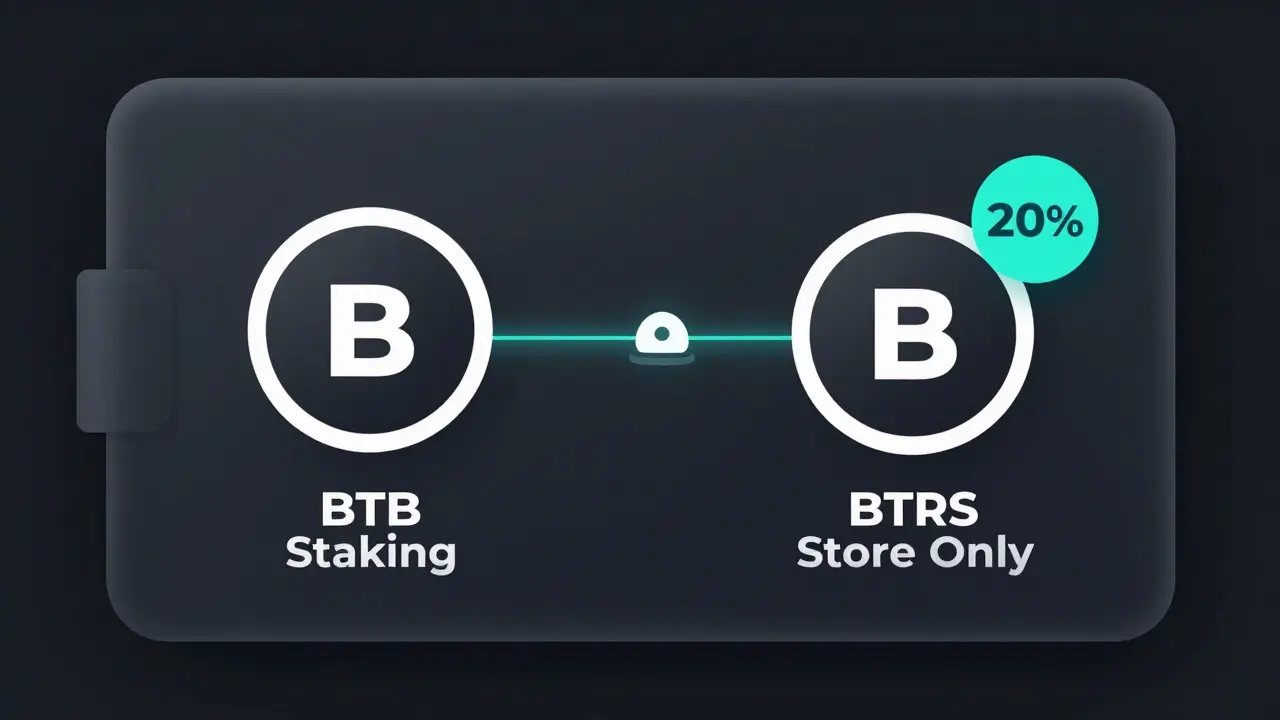
There's also a direct financial incentive: using BTRS to buy VIP items cuts your transaction fees by 20%. That’s not a small perk. On platforms where fees can eat into profits, that discount adds up fast. For frequent buyers, it turns BTRS from a simple payment tool into a savings tool.
How BTRS works under the hood
BTRS runs on the Ethereum blockchain. That means it inherits Ethereum’s speed and smart contract capabilities. Unlike Bitcoin, which can take 10 minutes or more to confirm a transaction, BTRS settles in seconds. It also supports token swaps, integrations with decentralized exchanges, and automated market-making - all thanks to Ethereum’s infrastructure.
It’s also available on Binance Smart Chain (BSC), which gives users cheaper gas fees when trading. You’ll find BTRS listed on Pancakeswap and BitBall’s own AMM (Automated Market Maker). These are decentralized platforms, so you don’t need to go through a bank or exchange like Coinbase to trade it. You just connect your wallet and swap tokens.
Supply and scarcity
BTRS has a hard cap: only 1 million tokens will ever exist. That’s it. No more. Right now, only 450,000 are in circulation. The remaining 550,000 are locked up, waiting to be released over time. This scarcity is intentional. The creators want BTRS to act like digital gold - something that becomes more valuable as fewer tokens are available.
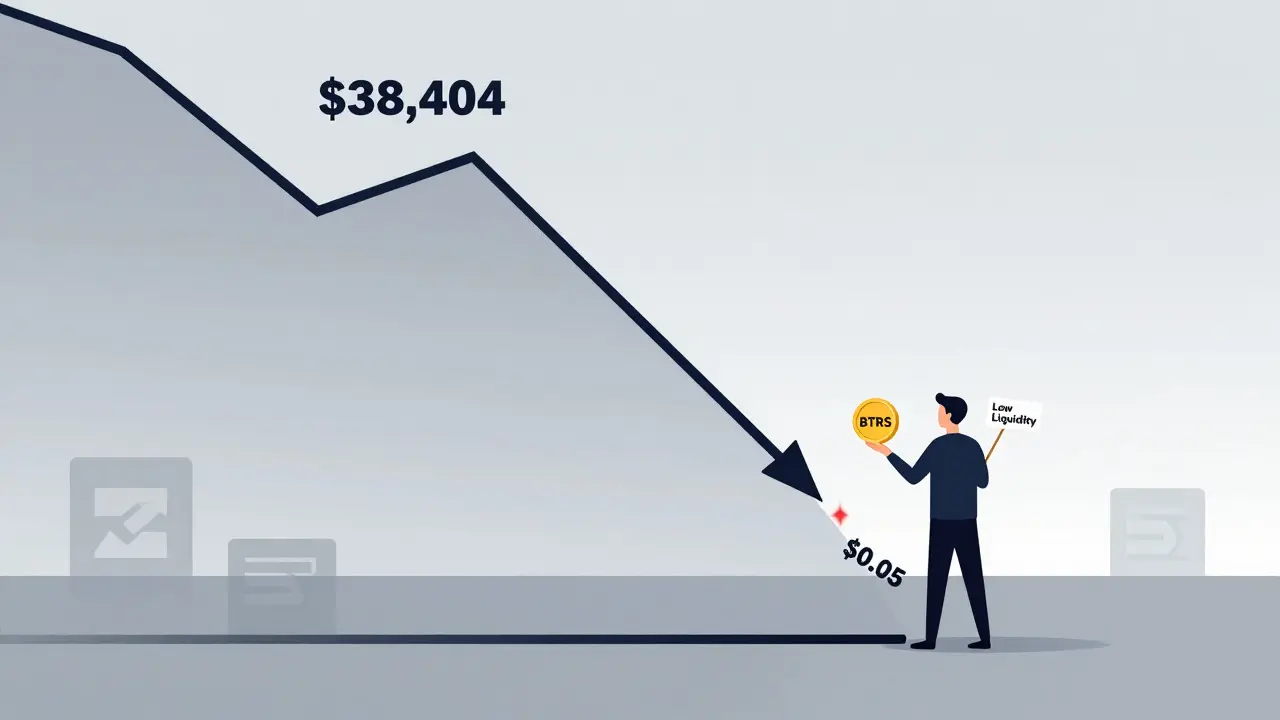
But here’s the catch: the price has crashed hard. BTRS hit an all-time high of $38,404.21. That’s not a typo. At one point, one token was worth more than a luxury car. Today, it trades between $0.015 and $0.052, depending on the exchange. That’s a drop of over 99.95% from its peak.
Why? Because the hype didn’t match the product. People bought BTRS hoping it would become a major coin. But it never left its niche. It doesn’t have broad adoption, big exchange listings, or institutional backing. It’s still tied to a small platform with limited users.
Where you can trade BTRS
BTRS trades on seven different markets, but not everywhere. You won’t find it on Binance for trading - only for price tracking. Coinbase lists it, but with very low volume. The most active trading happens on decentralized platforms like Pancakeswap and BitBall’s own AMM.
Price data varies wildly between exchanges:
- Coinbase: $0.0520 per BTRS
- Binance (price feed only): $0.019293 per BTRS
- Liquidity Finder: $0.01594954 per BTRS
This isn’t normal. Major coins like Bitcoin or Ethereum have nearly identical prices across all exchanges. BTRS’s price swings suggest thin liquidity - meaning there aren’t enough buyers and sellers to keep prices stable. That makes trading risky. A $0.02 coin can drop to $0.01 in minutes if someone dumps a large amount.
Market performance and risks
As of March 2026, BTRS ranks #3086 out of over 25,000 cryptocurrencies by market cap. That puts it in the bottom 1%. Its 24-hour trading volume ranges from $13,000 to $310,000 - tiny compared to coins like Solana or Ethereum, which trade billions daily.
Price swings are extreme. In one 24-hour period, BTRS has jumped from $0.019 to $0.048 - a 152% spike. Then it crashes back down. This isn’t innovation. It’s speculation. People are gambling on whether BitBall will grow, not because the coin has real utility beyond one website.
The fully diluted market cap - if all 1 million tokens were in circulation - is around $19,292. That’s less than what a single Tesla Model 3 costs. For a project that once hit $38,000 per token, this is a massive fall.
Who’s behind it
BitBall Ecosystem was founded in July 2018 by Brij Mohan. The team has only four people. No big names. No venture capital backing. No public roadmap beyond what’s on their website. That’s not necessarily bad, but it’s a red flag for anyone expecting long-term development.
The ecosystem includes other tokens: BTB (the original coin), MEMELON (a meme token with USDT rewards), and tools like BallSwapper and BitBall DEX. But none of these have gained traction outside the BitBall user base. The academy and merchant programs sound good on paper, but there’s little evidence of real-world use.
Should you buy BTRS?
If you already collect digital treasures from BitBall and plan to keep buying - then yes, holding some BTRS makes sense. The 20% fee discount is real. It’s a utility token, not an investment.
If you’re hoping to get rich off BTRS? Forget it. The coin is tied to a small, unproven platform with no growth signals. The price crash from $38,000 to under $0.05 isn’t a correction - it’s a collapse. There’s no reason to believe it will recover unless the entire BitBall platform explodes in popularity, which seems unlikely.
Also, never invest more than you can afford to lose. With low liquidity and wild volatility, you could buy BTRS today and find you can’t sell it tomorrow at any price.
Where to learn more
The official hub is bitball-btb.com. That’s where you’ll find the merchandise store, token details, and links to trading platforms. CoinMarketCap and CoinGecko track BTRS prices, but they’re just data aggregators - they don’t control the coin.
Don’t trust hype. Don’t follow influencers. If you’re curious, try buying $5 worth of BTRS on Pancakeswap. See how the interface works. Test the transaction. Then decide if it’s worth more than that.
Is BTRS a good investment?
No, not as an investment. BTRS has no broad use case beyond the BitBall platform. Its price crash from $38,404 to under $0.05 shows it’s not holding value. The only reason to hold it is if you actively use BitBall’s merchandise store and want the 20% fee discount.
Can I buy BTRS on Coinbase or Binance?
You can see BTRS prices on Coinbase and Binance, but you cannot trade it directly on Binance. Coinbase allows trading, but volume is extremely low. The best places to buy and sell BTRS are decentralized exchanges like Pancakeswap and BitBall’s own AMM.
Why is BTRS so cheap now?
BTRS peaked during a speculative bubble when people mistook it for a major crypto. It never expanded beyond BitBall’s small user base. With no real adoption, low trading volume, and no major exchange listing, demand collapsed. The price reflects reality: it’s a niche token with limited utility.
How many BTRS tokens are in circulation?
As of March 2026, 450,000 BTRS tokens are in circulation. The total supply is capped at 1 million, meaning 550,000 are still locked and not yet released. This scarcity is built into the design, but it hasn’t helped the price.
What’s the difference between BTRS and BTB?
BTB is the original coin of the BitBall Ecosystem, used for rewards and staking. BTRS is the newer token, designed specifically for buying merchandise and getting fee discounts. They serve different purposes within the same ecosystem, but BTRS is the only one accepted on the store.
15 Responses
I've been holding BTRS for months just to use it on BitBall. The 20% fee cut is real and it saves me cash every time I grab a new digital collectible. Not an investment, but a utility. Works for me.
If you're into digital art and rare items this coin actually makes sense dont overthink it just use it if you shop there
USA rules and this is why crypto fails 🇺🇸 Everyone wants to get rich off a token tied to a tiny website lol 🤡
I mean it's funny how people treat this like it's some groundbreaking innovation. It's not. It's a closed-loop token for a niche platform that never scaled. The $38k peak was pure meme energy. Now we're back to reality. And honestly? I'm not surprised.
BTRS is on ethereum and bsc which gives it solid infrastructure but liquidity is dangerously low on most exchanges the price discrepancies between coinbase and pancake swap indicate severe market fragmentation and high slippage risk
Oh wow so this is the coin that went from $38k to 5 cents? Bro that's not a crash that's a nuclear bomb going off in a toy store. Someone got rich off this and everyone else got left holding the bag. Classic pump and dump with a side of digital merch. Pathetic.
It's not about utility. It's about belief. The fact that this token ever hit $38k means something. It was a mirror of human greed. Now it's a mirror of human regret. The price doesn't define the story. The story defines the price. We're all just characters in a decentralized parable.
So let me get this straight - you're telling me a coin that can only buy digital doodads on one website was once worth more than a Lamborghini? And now it's cheaper than a pack of gum? I'm not mad. I'm just impressed. The sheer audacity of the hype cycle here is almost poetic.
Let's be real here. The entire premise is flawed. BTRS was never meant to be a currency - it was a loyalty card disguised as a crypto asset. The fact that it's on Ethereum doesn't make it valuable - it just means it costs more gas to move. The 20% discount? That's a marketing gimmick to keep people locked in. And the supply cap? Cute. But when no one's buying, scarcity doesn't matter. The trading volume is so low that a single whale could wipe out 90% of the market in one transaction. This isn't a token - it's a time capsule of crypto delusion.
btrs is a joke lmao uk guys dont fall for this nonsense
I feel bad for people who bought this at the top 😔 I really do. Like... you thought it was gonna be the next Bitcoin? Sweetheart... it was a digital baseball card with a blockchain sticker on it 💔
The real tragedy isn't the price drop. It's the hope. People believed. They saw a token and imagined a future. And then the future never showed up. It's not about money. It's about the quiet grief of a dream that never left the drawing board.
I read the whole thing. Still don't get it. Why would anyone need a coin that only works on one site? Why not just use a gift card? Or PayPal? Or cash? This feels like a solution looking for a problem. And the problem is... nobody asked for it.
The technical architecture is sound. The blockchain integration is legitimate. The liquidity issues are a function of market demand, not protocol failure. The real issue lies in the misalignment between speculative perception and functional utility. This is not a failure of engineering. It is a failure of narrative.
I remember when this thing was trending. Everyone was posting memes about BTRS being the next Bitcoin. I even bought a few hundred tokens because I thought maybe it was going to explode. I didn't even know what BitBall was. I just saw a chart going up and thought, 'this is my ticket.' Then I checked the website. It looked like it was built in 2012. The merch was overpriced. The interface was clunky. The whole thing felt like a college project that got a little too much attention. Now I just have a bunch of tokens I can't sell without losing 80% of what I paid. I'm not bitter. I'm just... embarrassed. And honestly? I think we all are.