
You don't need to be a cryptographer to use blockchain anymore. That’s the core promise of Blockchain-as-a-Service (BaaS). It is a cloud-based model that lets businesses build and manage blockchain applications without handling the heavy technical lifting themselves. Think of it like renting a server instead of buying one, but specifically tailored for distributed ledger technology.
In 2026, the hype around blockchain has settled into practical utility. Companies aren’t just talking about decentralization; they are using it to track supply chains, verify identities, and automate payments. But setting up a private blockchain network from scratch is expensive, slow, and technically brutal. BaaS solves this by wrapping complex infrastructure in a user-friendly subscription service.
How BaaS Actually Works
To understand BaaS, you first have to look at what it replaces. Traditionally, if a company wanted to run a blockchain, they had to hire specialized engineers, buy hardware, set up nodes, configure consensus mechanisms like Proof-of-Stake or Proof-of-Authority, and maintain security patches. It was a massive overhead.
BaaS flips this script. A third-party provider-usually a major cloud giant-hosts the entire backend. They manage the nodes, handle the data storage, ensure bandwidth is sufficient, and keep the system secure. You, the business, simply access the blockchain via an API (Application Programming Interface). You write your smart contracts, deploy your decentralized applications (DApps), and interact with the ledger, while the provider deals with the plumbing.
This model mirrors other familiar cloud services:
- Infrastructure-as-a-Service (IaaS): You rent raw computing power.
- Platform-as-a-Service (PaaS): You get a development environment ready to code in.
- Software-as-a-Service (SaaS): You use finished software like Gmail or Salesforce.
BaaS sits somewhere between PaaS and IaaS. It gives you the platform to build custom blockchain logic but abstracts away the underlying infrastructure management.
The Main Benefits: Why Companies Switch to BaaS
The shift toward BaaS isn’t just about convenience; it’s about economics and speed. Here is why enterprises are adopting it rapidly in 2026.
1. Drastic Cost Reduction
Building on-chain infrastructure requires significant upfront capital. You need servers, energy, and high-end talent. BaaS operates on a pay-per-use or subscription basis. This turns a fixed capital expense into a variable operational expense, making blockchain accessible to mid-sized companies, not just tech giants.
2. Faster Time-to-Market
Developing a blockchain network can take months. With BaaS, you can spin up a test network in minutes. Providers offer pre-configured templates for popular frameworks like Hyperledger Fabric, Ethereum Enterprise, or Corda. You skip the setup phase and go straight to building your application logic.
3. Built-in Scalability
Blockchains can struggle with throughput. If your app goes viral or your supply chain volume spikes, a self-hosted node might crash. BaaS providers automatically allocate more resources to handle increased load. You don’t need to predict peak usage; the cloud handles the elasticity.
4. Enhanced Security and Compliance
Security is paramount in finance and healthcare. Major BaaS providers invest heavily in cybersecurity, offering encryption, identity management, and audit trails that meet strict regulatory standards like GDPR or HIPAA. For many companies, relying on Amazon or Microsoft’s security team is safer than building their own.
The Trade-offs: Centralization vs. Convenience
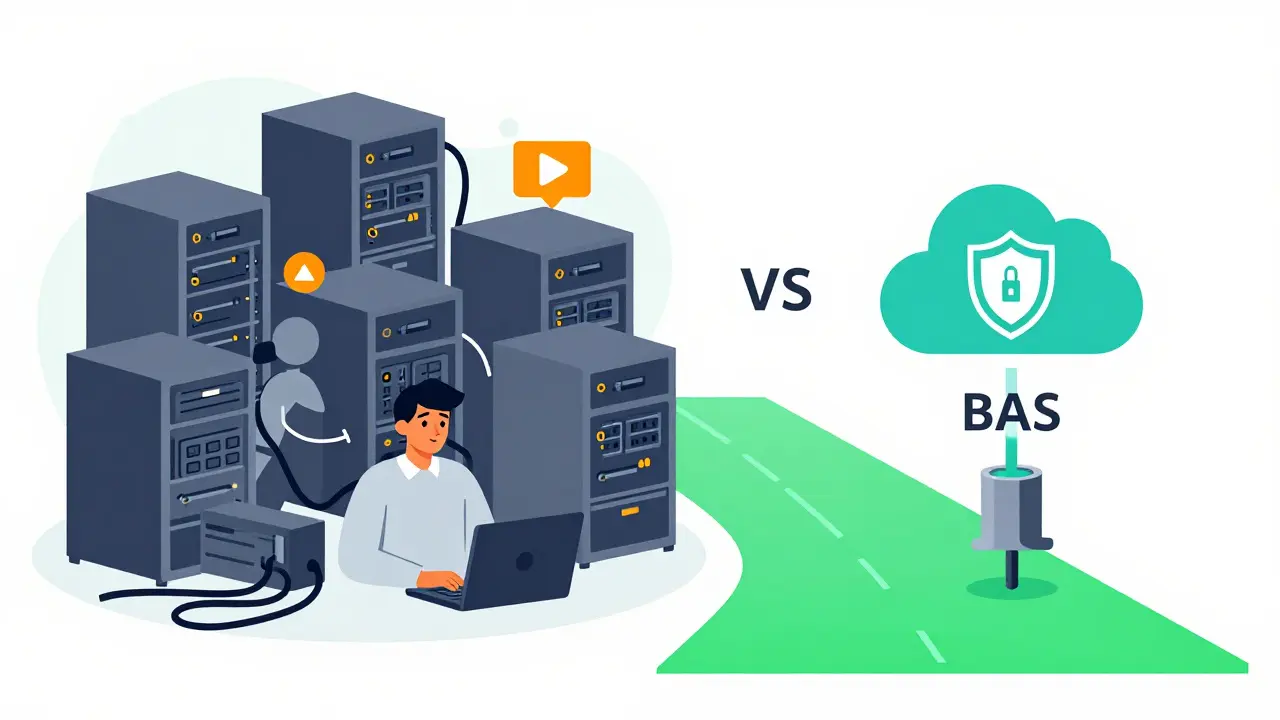
It wouldn’t be fair to ignore the elephant in the room. Blockchain was born from a desire to remove intermediaries and central control. BaaS, by definition, introduces a central intermediary: the service provider.
Critics argue that using BaaS contradicts the spirit of decentralization. If your blockchain runs on AWS or Azure, and that provider decides to shut down your account or experiences a global outage, your decentralized network goes down too. You are trusting a corporation with the integrity of your ledger.
However, for most enterprise use cases, this trade-off is acceptable. These companies care more about efficiency, privacy, and compliance than ideological purity. They often use permissioned blockchains where participants are known and vetted, reducing the risk associated with central points of failure. The goal is business value, not revolution.
Who Are the Major BaaS Providers?
The market is dominated by big-tech players who already control much of the world’s cloud infrastructure. Here is how the key contenders stack up in 2026.
| Provider | Key Features | Best For |
|---|---|---|
| Amazon Managed Blockchain | Supports Hyperledger Fabric and Ethereum; integrates deeply with AWS ecosystem. | Companies already using AWS for other services. |
| Microsoft Azure Blockchain | Strong focus on enterprise governance; partners with ConsenSys and R3. | Large enterprises needing strict compliance and hybrid cloud setups. |
| IBM Blockchain Platform | Deep expertise in supply chain and finance; built on Hyperledger. | Industries requiring complex integration with legacy systems. |
| Oracle Blockchain | Focuses on supply chain transparency and digital identity. | Businesses using Oracle ERP and database solutions. |
Choosing a provider often depends less on the blockchain tech itself and more on your existing IT stack. If you live in the Microsoft ecosystem, Azure makes sense. If you are an AWS shop, Amazon Managed Blockchain reduces friction.
Real-World Use Cases in 2026
BaaS isn’t theoretical. It’s powering real operations across several industries right now.
Supply Chain Management
This is the biggest driver. Companies use BaaS to track goods from factory to shelf. By recording every handoff on an immutable ledger, they can prove authenticity, reduce fraud, and automate payments via smart contracts when conditions are met. For example, a luxury brand might use BaaS to issue digital certificates for each handbag, preventing counterfeits.
Digital Identity Verification
Managing user identities securely is a nightmare for banks and hospitals. BaaS allows these institutions to create self-sovereign identity systems. Users control their data, and organizations can verify credentials without storing sensitive personal information, reducing breach risks.
Financial Services
Beyond cryptocurrencies, traditional banks use BaaS for cross-border payments and trade finance. Smart contracts automate letter of credit processes, cutting settlement times from days to seconds. The transparency provided by the shared ledger reduces disputes between trading partners.
Healthcare Data Sharing
Hospitals and insurers use permissioned blockchains via BaaS to share patient records securely. This ensures that only authorized parties can access specific data, maintaining privacy while enabling better coordinated care.
How to Get Started with BaaS
If you are considering implementing blockchain in your organization, here is a practical roadmap.
- Define Your Problem: Don’t use blockchain because it’s trendy. Ask if you need an immutable, shared record that multiple parties trust. If a simple database works, stick with it.
- Choose Your Network Type: Decide between public (permissionless) and private (permissioned) networks. Most enterprises choose private for control and privacy.
- Select a Framework: Popular choices include Ethereum (for smart contract flexibility), Hyperledger Fabric (for modular enterprise architecture), and Corda (for financial transactions).
- Pick a Provider: Evaluate the BaaS providers based on your current cloud infrastructure, support needs, and cost structure.
- Build a Pilot: Start small. Create a proof-of-concept for one specific process, like tracking a single product line or automating one type of invoice.
- Scale Gradually: Once the pilot proves value, expand the network to include more partners and use cases.
Remember, BaaS lowers the barrier to entry, but it doesn’t remove the need for strategic planning. You still need to design your smart contracts carefully and onboard your partners effectively.
Is BaaS the same as cryptocurrency?
No. Cryptocurrency is a digital asset that runs on blockchain technology. BaaS is a service that provides the infrastructure to build blockchain applications. While some BaaS platforms support cryptocurrencies, many enterprise solutions use private tokens or no currency at all, focusing instead on data integrity and process automation.
Can I switch BaaS providers easily?
It can be challenging. Different providers may use different blockchain frameworks or proprietary APIs. To avoid vendor lock-in, design your application to be framework-agnostic where possible, and ensure your smart contracts are portable. However, migrating active ledgers and node configurations often requires significant engineering effort.
How much does BaaS cost?
Costs vary widely based on usage. Providers typically charge for compute time, storage, and the number of nodes you run. Small projects might cost a few hundred dollars a month, while large-scale enterprise networks can run into thousands. Always check for hidden fees related to data transfer or API calls.
Is my data safe with a BaaS provider?
Generally, yes. Major providers offer enterprise-grade security, including encryption at rest and in transit. However, you are still responsible for securing your access keys and smart contract logic. Additionally, since the provider hosts the nodes, you must trust their internal security practices and compliance certifications.
Do I need coding skills to use BaaS?
Yes, you still need developers. BaaS removes the need for DevOps and infrastructure management, but you still need to write smart contracts (usually in Solidity, Go, or Java) and integrate them with your existing business software. Some providers offer low-code tools, but complex logic will always require programming expertise.