
You might have stumbled across Californium on a list of obscure digital assets and wondered what it actually does. The short answer? It’s a relic from the early days of Bitcoin forks that has effectively stopped functioning as a viable financial instrument. If you are looking for investment opportunities, this is not one of them. But if you are curious about how old crypto projects fade into obscurity, Californium (CF) serves as a perfect case study.
Is Californium (CF) still a valid cryptocurrency?
Technically, yes, but practically, no. While the blockchain may still exist, there is zero trading volume, negligible market capitalization, and no active development. It is considered a "dead coin" by most industry standards.
The Origins of Californium (CF)
Californium launched on April 29, 2015. This was during the first major wave of Bitcoin forks, where developers would take the open-source code of Bitcoin, change the name, and launch a new coin. Back then, anyone could do this with minimal technical knowledge. Californium uses the SHA-256 hashing algorithm, which is the same security protocol that powers Bitcoin.
In 2015, the hype around these altcoins was real. Investors bought in hoping for the next big thing. At its peak on April 21, 2015, just two days after launch, Californium hit an all-time high of $0.20 per token. That sounds small now, but back then, it represented significant speculative interest. However, unlike Bitcoin or Ethereum, Californium never developed a unique use case, a strong community, or a clear roadmap beyond being a copy of Bitcoin's technology.
Why Is the Price So Low?
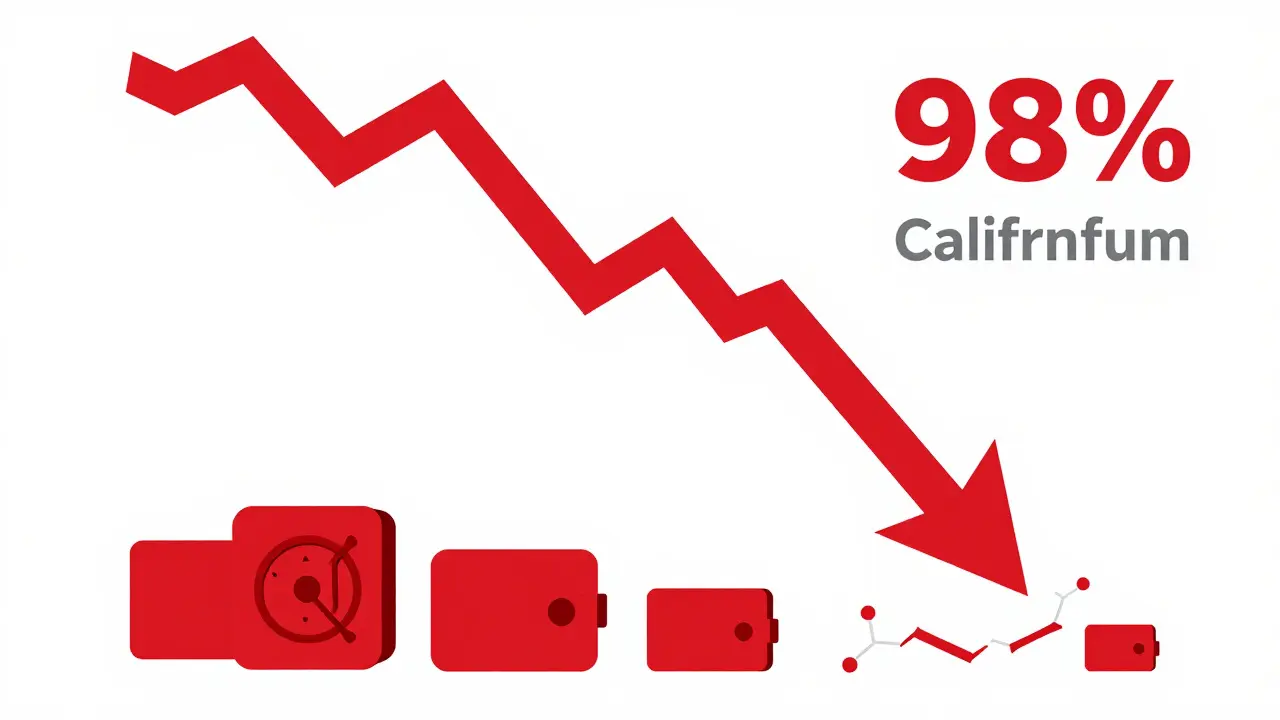
If you check the current price of Californium, you will see numbers like $0.0025 to $0.0042 depending on the exchange. This represents a drop of over 98% from its all-time high. But the price is only part of the story. The real issue is liquidity.
Liquidity refers to how easily you can buy or sell an asset without affecting its price. For Californium, liquidity is non-existent. Recent data shows 24-hour trading volumes of $0.00 USD on major platforms like Coinbase and CoinMarketCap. There is essentially no one buying or selling CF tokens. When you try to trade a coin with zero volume, you face massive slippage or simply cannot execute the trade at all.
| Metric | Californium (CF) | Bitcoin (BTC) | Ethereum (ETH) |
|---|---|---|---|
| Current Price (Approx.) | $0.003 | $103,390 | $2,543 |
| Market Cap | $5,630 | $2 Trillion+ | $300 Billion+ |
| 24h Volume | $0 | $Billions | $Billions |
| Consensus Mechanism | Proof-of-Work (SHA-256) | Proof-of-Work (SHA-256) | Proof-of-Stake |
The Supply Problem: Total vs. Circulating
One of the most confusing aspects of Californium is its supply data. The total supply is listed as approximately 2,446,961 CF tokens. However, the circulating supply is reported as 0 CF. How can a coin exist with no circulation?
This discrepancy usually happens when a project abandons its marketing and distribution efforts. The tokens may be locked in wallets that are no longer accessible, or they are held by a few early miners who have not sold them because there is no market to sell to. In some cases, it indicates that the block rewards were never properly distributed to the public. Without circulating supply, the coin cannot function as a medium of exchange. It becomes a digital artifact rather than a currency.
Mining Californium Today: Is It Worth It?
Since Californium uses Proof-of-Work (PoW), it is theoretically mineable. You can run mining software and try to solve the SHA-256 puzzles to earn CF tokens. However, doing so in 2026 is economically nonsensical.
- Electricity Costs: Mining requires electricity. Even with efficient hardware, the cost of power will far exceed the value of the CF tokens you earn.
- Hardware Competition: Modern ASIC miners are designed for Bitcoin. Using them for a low-difficulty coin like CF is inefficient. Using older GPUs is even less profitable due to power consumption.
- No Reward Value: Since the token has no liquidity, you cannot easily convert your mined CF into fiat currency or other stable cryptocurrencies.
In the early days of Bitcoin, mining on a home computer was profitable. For Californium, even if you mined thousands of tokens, their aggregate value would likely amount to pennies. The network difficulty is likely extremely low because there are almost no miners left, but the reward is worthless.
Why Did Californium Fail?
Thousands of coins launched in 2015. Most failed. Californium is a textbook example of why. Here are the key factors:
- No Unique Value Proposition: It was a clone of Bitcoin with no improvements. Why would users switch from Bitcoin to Californium?
- Lack of Development: After the initial launch, there were no significant updates, no whitepaper revisions, and no community governance. The developers moved on to other projects.
- Security Risks: Old, unmaintained codebases are vulnerable to attacks. With no active developers patching bugs, the network is theoretically insecure, though too small to attract large-scale hackers.
- Regulatory Neglect: As global regulations tightened around cryptocurrencies, small, unregistered coins like CF had no compliance framework. Exchanges delisted them to avoid legal trouble.
Can You Buy Californium Now?
You might find CF listed on a few niche exchanges or legacy platforms like Coinbase (though often in inactive status). However, attempting to buy it carries extreme risk. Because there is no sell-side liquidity, you might be able to place a buy order, but you will never be able to sell it later. Your money would be trapped in a wallet holding a token that no one wants.
Furthermore, many older wallets that supported CF in 2015 are no longer maintained. Downloading unofficial wallet software today poses a severe malware risk. Never download unknown .exe files claiming to be "Californium Wallets" from random forums.
Lessons for Crypto Investors
Studying dead coins like Californium helps you avoid common pitfalls in the crypto market. Always ask these questions before investing in any small-cap coin:
- Is there active development? Check GitHub repositories for recent commits.
- Is there real liquidity? Look at 24-hour volume, not just price.
- Who holds the supply? Avoid coins where a single entity controls most tokens.
- Does it solve a problem? Or is it just a meme or a fork?
Californium fails all these tests. It serves as a reminder that in cryptocurrency, age alone does not equal value. Many old coins are digital graveyards.
What happened to the Californium developers?
There is no public record of active development since the mid-2010s. The original team likely abandoned the project as the market shifted toward more innovative platforms like Ethereum and Solana.
Is it safe to hold Californium tokens?
Holding them is financially risky because they are likely worthless. Technically, storing them in a secure wallet is safe from theft, but you must ensure the wallet software itself is not malicious. Given the lack of official support, caution is advised.
Will Californium ever recover?
It is highly unlikely. Recovery requires active development, community interest, and exchange listings. None of these exist for CF. The window for revival closed years ago.
How does Californium compare to Bitcoin Cash?
Both are SHA-256 PoW coins. However, Bitcoin Cash has a massive market cap, active development, and widespread adoption. Californium has none of these. Comparing them is like comparing a major highway to a dirt path that leads nowhere.
Where can I find the official Californium website?
The domain californium.info exists but may contain outdated information. Be wary of phishing sites that mimic old crypto domains to steal credentials.