
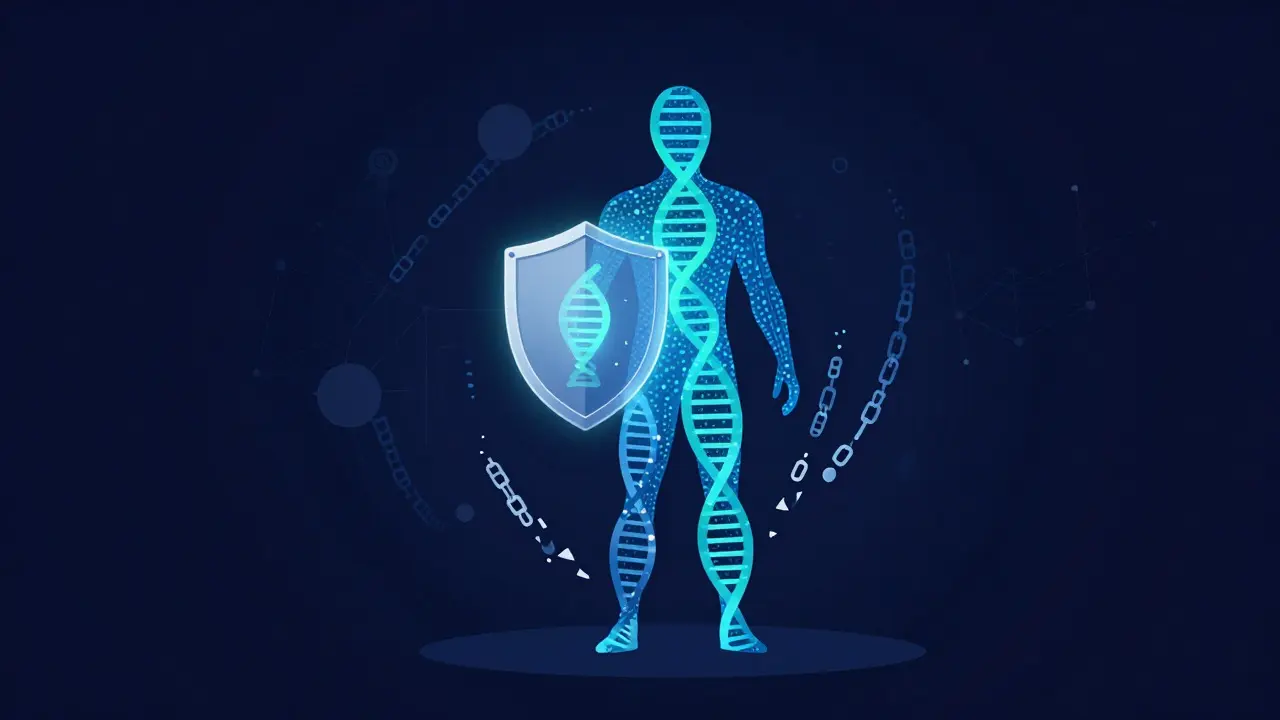
Imagine handing over your DNA to a tech giant. You get a health report, but who owns that genetic blueprint? For years, the answer was rarely "you." That dynamic is shifting with the rise of GenomesDao, a project aiming to put individuals back in control of their genomic data through blockchain technology. At the center of this ecosystem is the GENOME token, a utility and governance asset designed to facilitate safe, private, and auditable monetization of DNA data.
If you have stumbled upon the ticker symbol GENOME on a price tracker, you might be wondering what it actually does. Is it just another speculative coin, or is there real utility behind it? This article breaks down the mechanics, security architecture, and economic model of GenomesDao to help you understand its place in the emerging world of Decentralized Science (DeSci).
The Core Mission: Restoring Data Sovereignty
Traditional direct-to-consumer genetic testing companies often store user data in centralized servers. While convenient, this creates single points of failure and raises serious questions about privacy and ownership. GenomesDao addresses this by building a private, secure DNA data bank where users retain full control.
The platform operates on a simple premise: your genetic data is yours. If a pharmaceutical company or research organization wants to query that data for drug discovery or personalized medicine studies, they must ask permission. When you grant access, you are compensated. This compensation flows through the GENOME token, creating a circular economy that rewards data providers while funding scientific research.
This model aligns closely with the broader Decentralized Science (DeSci) movement, which seeks to remove gatekeepers from scientific funding and data management. By using blockchain as an immutable ledger, every query and payment is recorded transparently, ensuring that no one can access your genome without your explicit consent and a traceable audit trail.
Token Evolution: From GENE/GNOME to GENOME
To understand the current state of the project, you need to look at its history. The ecosystem did not start with the GENOME token. Early iterations relied on two separate tokens: GENE and GNOME. These were deployed across multiple networks, including Ethereum, Solana, and Arbitrum, which created fragmentation in governance and liquidity.
In April 2024, the team announced a major consolidation. They launched GENOME as a single, unified utility and governance token. This move was designed to streamline the ecosystem and provide a clear market capitalization metric. Here is how the migration worked:
- GENE holders: Could swap their tokens to GENOME at a 1:1 ratio.
- GNOME holders: Could swap their tokens to GENOME at a 10:1 ratio.
This consolidation simplified the user experience. Instead of managing assets across different chains and contracts, participants now interact with a single asset. The migration process involved sending legacy tokens to a designated contract on supported networks like Ethereum mainnet, Polygon, or Arbitrum. The system then automatically issued the corresponding amount of GENOME.
Technical Architecture: AMD SEV and Blockchain
One of the most critical aspects of any health-related crypto project is security. Storing raw genomic data requires more than just standard encryption; it needs hardware-level protection. GenomesDao partners with AMD to utilize Secure Encrypted Virtualization (SEV) technology.
Here is why this matters. Standard cloud storage encrypts data at rest, but when that data is processed, it must be decrypted, leaving it vulnerable to memory scraping attacks. AMD SEV allows the data to remain encrypted even while it is being processed in the CPU's memory. This means that even if a hacker gains access to the server's physical memory, they only see gibberish. The data is only readable within a specific, isolated "vault" environment.
Blockchain complements this hardware security. While AMD SEV protects the data itself, the blockchain records the permissions. It acts as the keymaster. When a researcher submits a query, the smart contract checks if the user has approved it. If yes, the query runs inside the secure vault, and the results are returned. The payment in GENOME tokens is then executed automatically. This combination of hardware security and decentralized governance creates a robust framework for handling sensitive biological information.
Tokenomics and Economic Model
The GENOME token is designed as a deflationary utility asset. Its primary function is to serve as the medium of exchange within the GenomesDAO ecosystem. Pharmaceutical companies and research institutes use GENOME to pay for data queries. As demand for genomic data grows, so does the demand for the token.
| Attribute | Value |
|---|---|
| Total Supply | 1,000,000,000 GENOME |
| Networks | Ethereum Mainnet, Base Network |
| Token Type | ERC-20 (Utility & Governance) |
| Minting | Non-mineable (Fixed Supply) |
| Governance | Snapshot-based voting |
The fixed supply of 1 billion tokens ensures scarcity. Unlike inflationary tokens that dilute holder value over time, GENOME’s supply cap provides a clear ceiling. The deflationary aspect comes into play through potential burn mechanisms or redistribution models that reduce circulating supply as the network matures, though specific burn rates depend on protocol updates voted on by the community.
Holders also have governance rights. Through snapshot voting, the community decides on critical protocol parameters, such as adding support for new blockchain networks. This decentralizes decision-making, ensuring that the platform evolves according to the will of its stakeholders rather than a central authority.
Market Status and Liquidity Considerations
As of mid-2026, GENOME remains a micro-cap asset. Market data indicates a trading price in the sub-cent range, with valuations fluctuating based on limited trading volume. For context, snapshots from July 2026 show prices hovering around $0.00038 USD, with daily volumes occasionally dipping below $3 USD on certain aggregators.
This low liquidity is a double-edged sword. On one hand, it reflects the early stage of adoption in the niche DeSci sector. On the other hand, it means that large trades could cause significant price slippage. Investors should approach GENOME with an understanding of these risks. It is not a high-volume trading vehicle like Bitcoin or Ethereum; it is a bet on the long-term viability of user-owned genomic data markets.
The token is listed on major platforms like Coinbase, which provides a layer of legitimacy regarding compliance and listing criteria. However, availability on an exchange does not guarantee sustained liquidity. Traders should monitor order books and consider using limit orders to manage entry and exit positions effectively.

How to Get Started with GenomesDao
If you want to participate in the ecosystem, the process is straightforward for anyone familiar with basic crypto operations. You do not need specialized hardware, just a compatible wallet.
- Set up a Wallet: Use a non-custodial wallet that supports Ethereum and Base networks, such as MetaMask or Rabby.
- Acquire GENOME: Purchase the token from a supported centralized exchange or decentralized exchange (DEX). Ensure you are buying the correct contract address for the network you intend to use.
- Participate in Governance: Connect your wallet to the GenomesDAO interface to vote on proposals. Your voting power is proportional to your token holdings.
- Data Monetization (Future): As the platform expands, users will be able to upload their genomic data to the AMD SEV vaults. You will receive notifications of query requests, approve them via your wallet, and earn GENOME tokens as compensation.
For those holding legacy GENE or GNOME tokens, ensure you have completed the migration to GENOME. Unmigrated tokens may lose utility as the ecosystem focuses entirely on the new standard.
Risks and Regulatory Landscape
No investment is without risk, and projects dealing with health data face unique challenges. Regulatory frameworks like GDPR in Europe and HIPAA in the United States impose strict rules on genetic information. GenomesDao aims to comply with these standards through its privacy-preserving architecture, but the legal landscape is still evolving.
Additionally, the reliance on third-party technology partners introduces dependency risks. While AMD SEV is a proven technology, any vulnerabilities in the implementation layer could impact trust. Independent security audits of the smart contracts and the vault infrastructure are essential for long-term credibility. Investors should keep an eye on the project’s transparency reports and audit publications.
Finally, the speculative nature of the token cannot be ignored. The value of GENOME is tied to the adoption of the data marketplace. If pharmaceutical companies choose not to use the platform, or if alternative solutions emerge, the demand for the token could stagnate. Diversification and thorough due diligence are always recommended.
What is the main use case for the GENOME token?
The GENOME token serves two primary functions: utility and governance. It is used by pharmaceutical and research organizations to pay individuals for accessing their genomic data securely. Additionally, token holders use GENOME to vote on protocol upgrades, such as adding new blockchain networks or adjusting fee structures.
Is GenomesDao safe for storing DNA data?
GenomesDao employs advanced security measures, including AMD Secure Encrypted Virtualization (SEV). This technology keeps data encrypted even during processing, preventing unauthorized access. Combined with blockchain-based permission controls, it offers a high level of security compared to traditional centralized databases.
How does GENOME differ from the old GENE token?
GENOME replaced both GENE and GNOME tokens in a 2024 consolidation. It unifies the ecosystem into a single asset with a fixed supply of 1 billion tokens. GENE holders swapped at a 1:1 ratio, while GNOME holders swapped at a 10:1 ratio. GENOME simplifies governance and liquidity by operating primarily on Ethereum and Base networks.
Can I mine GENOME tokens?
No, GENOME is a non-mineable ERC-20 token. The total supply is fixed at 1 billion units. Tokens are acquired through exchanges or earned by providing genomic data to the platform for research queries.
Which blockchains support the GENOME token?
Currently, GENOME is supported on the Ethereum mainnet and the Base network. The community can vote to add support for additional chains in the future through the DAO’s governance mechanism.