
Have you stumbled across a token called Grafeté with the ticker GRFT? If so, you might be confused. There is no cryptocurrency named "Grafeté." You are almost certainly looking at **Graft (GRFT)**, a project that aims to revolutionize how we pay for things online and in stores. The name "Grafeté" is likely a misspelling or a localized variation of the English word "Graft." Understanding this distinction is your first step toward figuring out what this coin actually does-and whether it still matters in today's market.
Graft was built with a bold vision: to create a decentralized alternative to Visa and Mastercard. It wanted to let anyone buy anything anywhere without needing a bank account or paying high fees. But like many ambitious projects from the 2017-2018 crypto boom, its current reality looks very different from its early promises. Let’s break down what Graft is, how it works, and why you should approach it with caution in 2026.
What Is Graft (GRFT)?
Graft (GRFT) is a blockchain-based, decentralized payment gateway designed to function as a global point-of-sale network. Unlike Bitcoin, which is primarily seen as digital gold or a store of value, Graft was engineered specifically for transactions. Think of it as a credit card processor, but one that runs on code instead of corporate servers.
The core idea behind Graft is simple: remove the middlemen. Traditional payments involve merchants, banks, clearinghouses, and networks like Visa. Each step adds time and cost. Graft attempts to cut out these intermediaries by allowing buyers and merchants to transact directly on its blockchain. This makes payments cheaper and faster, theoretically opening commerce to everyone, regardless of their banking status.
However, there is a catch. While the technology sounds great on paper, execution is everything. For a payment network to work, you need liquidity (people willing to accept the coin), speed (instant confirmations), and stability (predictable prices). As we will see, Graft struggles significantly with all three in the current landscape.
How Does the Graft Blockchain Work?
To understand Graft, you need to look under the hood. It doesn’t use a single consensus mechanism like Bitcoin’s Proof-of-Work (PoW) alone. Instead, it employs a unique dual-layer architecture combining PoW and Proof-of-Stake (PoS).
- Proof-of-Work Layer: This layer secures the base blockchain. Miners solve complex mathematical problems to validate blocks and earn new GRFT coins. This provides the foundational security against attacks.
- Proof-of-Stake Layer: This is where the magic was supposed to happen for payments. Special nodes, often called "supernodes," stake their GRFT tokens to provide services. These services include instant transaction authorizations, similar to when a credit card terminal says "Approved" before the money actually settles.
This hybrid design was intended to solve the biggest problem with early cryptocurrencies: speed. Bitcoin takes minutes to confirm; Graft aimed for seconds. By using off-chain authorizations via the PoS layer, merchants could get immediate confirmation that a customer had funds, reducing the risk of double-spending during a busy checkout line.
Additionally, Graft supports atomic swaps. This means you could potentially pay in one cryptocurrency while the merchant receives another, all happening automatically within the network. In theory, this allows for seamless cross-border trade without relying on centralized exchanges to convert currencies.
The Reality Check: Liquidity and Market Data
Here is where things get tricky. A payment currency is only useful if people can easily buy, sell, and spend it. When we look at the data for Graft (GRFT) in mid-2026, the picture is concerning.
| Data Source | Price (USD) | 24h Volume | Circulating Supply |
|---|---|---|---|
| Crypto.com | $0.00027 | N/A | 591.48 Million |
| CoinMarketCap | Varies | Not Tracked | 0 (Data Missing) |
| Binance | $0.00 | $0.00 | Not Listed |
| WorldCoinIndex | $0.0010 | $0.00 | Not Specified |
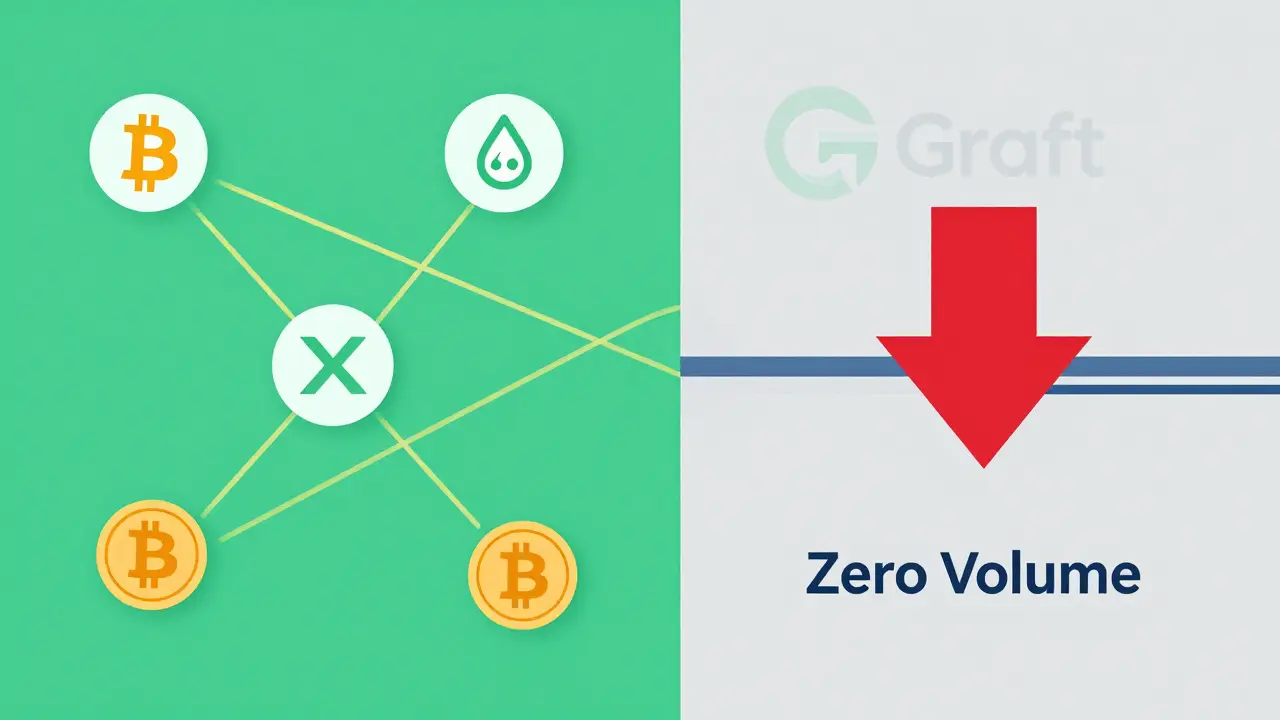
Notice the red flags? Most major platforms report zero trading volume. Binance, one of the world's largest exchanges, lists the price as $0 because it isn't actively traded there. CoinMarketCap shows a circulating supply of zero, which usually means the data feed is broken or the coin is effectively dead in terms of active circulation.
Why does this matter? If you hold GRFT, you cannot easily sell it for cash. If you are a merchant, you cannot easily convert GRFT into dollars to pay your employees. A payment network with no liquidity is like a toll road with no cars-it exists, but it serves no purpose.
Is Graft Still Active?
You might wonder if the team behind Graft is still working on it. The silence is deafening. In the crypto world, development activity is public. We look for GitHub commits, Twitter updates, and roadmap progress reports. For Graft, these signals have largely vanished since its peak around 2018.
The discrepancies in supply data-ranging from 591 million to 1.28 billion tokens depending on who you ask-suggest that the project lacks transparent reporting. Without clear communication from the developers, it is hard to know if the network is secure or if bugs remain unfixed. This opacity is a significant risk for any investor.
Compare this to competitors like Litecoin or Dash, which also focus on payments but maintain active communities, regular software updates, and consistent listings on major exchanges. Graft has fallen behind in the race for adoption.
Risks of Investing in Legacy Coins Like GRFT
If you found GRFT through an old article or a friend’s recommendation, proceed with extreme caution. Here are the specific risks associated with holding or buying Graft today:
- Liquidity Risk: With near-zero volume, you might not find a buyer even if you want to exit your position. The spread between buy and sell orders would be massive, meaning you’d lose most of your value instantly.
- Security Risk: An inactive project may not patch vulnerabilities. If a bug is discovered in the dual-layer protocol, there may be no team left to fix it.
- Opportunity Cost: Money tied up in illiquid assets like GRFT cannot be invested in more promising technologies. The crypto market moves fast; staying parked in a dormant coin means missing out on growth elsewhere.
It is important to distinguish between "undervalued gems" and "abandoned projects." Gems have active teams and growing user bases despite low prices. Abandoned projects simply stop moving forward. All indicators suggest Graft falls into the latter category.
Better Alternatives for Crypto Payments
If your goal is to use cryptocurrency for everyday purchases or to support a payment-focused blockchain, there are much healthier options available in 2026. These projects have solved the liquidity and adoption problems that plague Graft.
- Bitcoin Lightning Network: Allows instant, cheap Bitcoin transactions. Widely supported by wallets and some merchants globally.
- XRP (Ripple): Designed specifically for financial institutions to settle cross-border payments quickly and cheaply. High liquidity and regulatory clarity in many regions.
- Stablecoins (USDC/USDT): Pegged to the US dollar, these offer the speed of crypto without the price volatility. Merchants love them because they don't have to worry about the value dropping between the sale and settlement.
- Dash: Similar to Graft’s original vision, Dash offers private, fast transactions with a dedicated ecosystem and active development.
These alternatives have real users, real volume, and real utility. They represent the future of digital payments, whereas Graft represents a past attempt that didn't quite make the cut.
Conclusion: Should You Buy Grafeté (GRFT)?
So, back to your original question: What is Grafeté? It is a misspelled reference to Graft, a once-promising payment cryptocurrency that has faded into obscurity. While its dual-layer technology was innovative for its time, the lack of liquidity, inconsistent data, and absence of active development make it a poor choice for investment or daily use in 2026.
If you already own GRFT, consider it a speculative hold at best. Do not add more capital to it. Instead, educate yourself on the vibrant, active projects that are actually changing how the world sends money. The crypto space is full of opportunities, but you need to choose ones that are alive and kicking, not those gathering dust.
Is Grafeté (GRFT) a scam?
It is not necessarily a scam in the sense of a fraudulent scheme designed to steal funds directly. However, it exhibits characteristics of an abandoned project. The lack of transparency, zero liquidity, and missing data feeds mean you could lose your entire investment if you try to buy or sell it. Treat it as a high-risk, legacy asset.
Where can I buy Graft (GRFT)?
Major exchanges like Binance do not list GRFT for active trading. You might find it on smaller, niche exchanges or peer-to-peer platforms, but liquidity is extremely low. Be wary of sites claiming to sell it, as the risk of fraud or inability to withdraw is high.
What is the difference between Graft and Bitcoin?
Bitcoin is primarily a store of value and a peer-to-peer electronic cash system with slow confirmations. Graft was designed specifically as a payment gateway with instant authorizations, mimicking credit card networks. Graft uses a hybrid PoW/PoS model, while Bitcoin uses pure PoW.
Why is the price of GRFT showing as $0?
When aggregators show a price of $0, it usually means there are no recent trades to calculate a fair market value. Since no one is buying or selling GRFT on tracked exchanges, the price discovery mechanism has failed, resulting in a placeholder value of zero.
Can I mine Graft (GRFT)?
Technically, yes, because it has a Proof-of-Work component. However, given the negligible value of the coin and the lack of demand, mining it would likely cost more in electricity than the coins are worth. It is not economically viable for miners today.