

Imagine logging into your bank account without typing a single character. No passwords to forget, no two-factor codes to wait for via text message. Just a quick tap on your device, and you’re in. That is the promise behind Remme, a cryptocurrency project designed to replace traditional login systems with a secure, blockchain-based identity system. While the concept sounds futuristic, Remme has been around since 2015, launching its REM token during the initial coin offering (ICO) boom of 2017. Today, it sits at a crossroads: technologically distinct but financially marginalized.
If you are asking "What is Remme?" you likely want to know if it’s still a viable investment or just a relic of the past. The short answer is that Remme remains an active technical experiment in decentralized security, but its market value has collapsed by over 99% from its peak. It serves as a case study in how ambitious blockchain infrastructure projects can struggle to gain mainstream traction despite solving real-world problems like data breaches and phishing.
The Core Problem: Why Passwords Fail
To understand Remme, you first have to understand what it tries to fix. Traditional public key infrastructure (PKI) relies on centralized authorities to issue digital certificates. These certificates prove who you are online. However, this system is fragile. If a central server is hacked, millions of identities are compromised. Worse, most users rely on simple passwords, which are easily stolen through phishing attacks or reused across multiple sites.
Remme proposes a solution called decentralized PKI. Instead of storing trust in one place, it distributes it across a blockchain network. This approach aims to create self-sovereign identities, where users control their own credentials without relying on a single corporate entity. By removing the human element-passwords-from the equation, Remme seeks to eliminate the most common vector for cyberattacks.
How Remme Technology Works
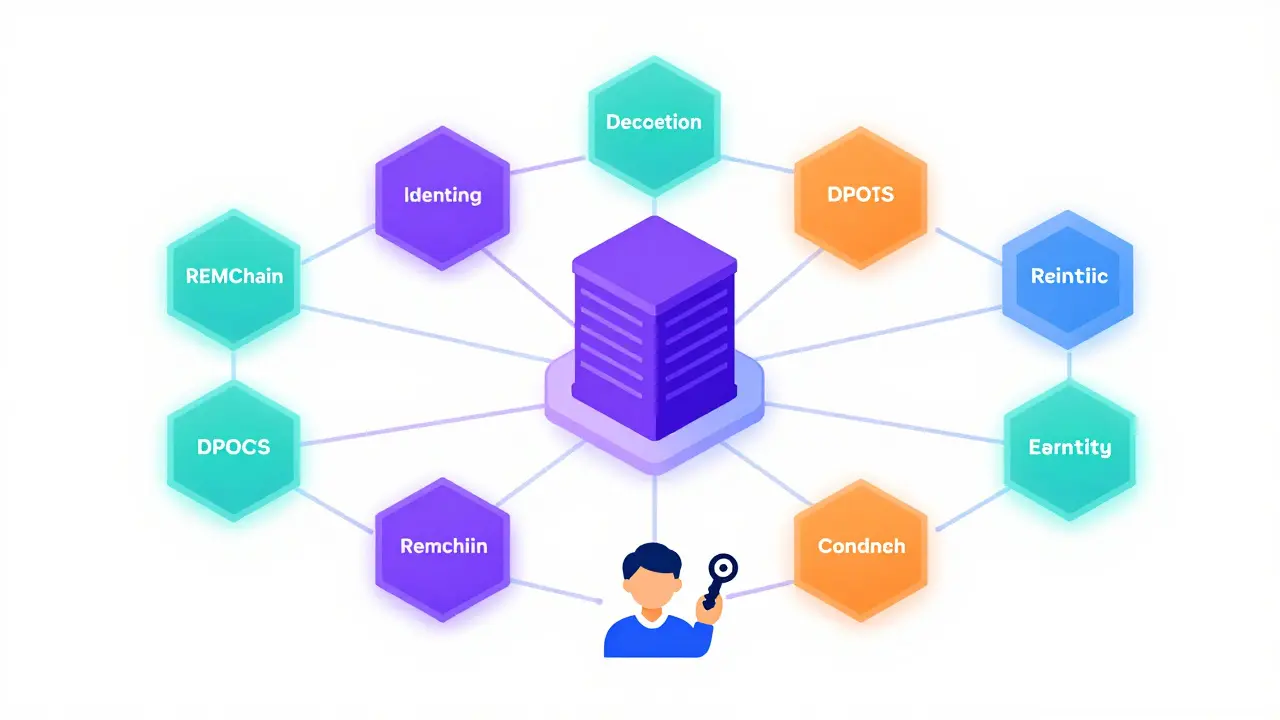
The heart of the Remme ecosystem is not just the token, but the underlying architecture. Here is how the pieces fit together:
- REMChain: This is the independent blockchain that powers the network. Unlike Ethereum, which charges gas fees for every transaction, REMChain uses a Delegated Proof of Stake (DPoS) consensus mechanism. This means token holders vote for block producers who validate transactions. It is built on the EOSIO codebase, known for high throughput and low latency.
- Remme Auth: This is the consumer-facing product. It allows websites to offer passwordless login. When you visit a site using Remme Auth, your browser generates a unique SSL certificate tied to your device. You authenticate with two clicks using the Web Cryptography API. No password is ever sent over the internet.
- Certificate Management: The metadata for these certificates is stored on the blockchain. This makes it extremely difficult for attackers to forge credentials because they would need to compromise the entire distributed ledger, not just a single database.
The REM token acts as the fuel for this machine. You need REM to generate certificates, revoke access if a device is lost, create new nodes, and pay for transaction fees within the ecosystem. It also incentivizes the Block Producers and Guardians who keep the network running.
Tokenomics and Supply Details
Understanding the economics of any crypto asset requires looking at its supply structure. Remme launched as an ERC-20 token on Ethereum before moving to its own chain. Here are the hard numbers:
| Attribute | Value |
|---|---|
| Total Supply | 1,000,000,000 REM |
| Initial ICO Price (2017) | $0.04 USD |
| Hard Cap Target | $20,000,000 USD |
| Blockchain Standard | ERC-20 (Ethereum) / Native (REMChain) |
| Consensus Mechanism | Delegated Proof of Stake (DPoS) |
A critical feature of Remme’s design is interoperability. Users can swap REM tokens between their ERC-20 representation on Ethereum and the native tokens on REMChain. This bridge was intended to provide liquidity and ease of entry for investors familiar with the broader Ethereum ecosystem.
Current Market Status and Price Analysis
This is where the story takes a sharp turn. While the technology persists, the financial reality of Remme is stark. As of mid-2026, the REM token trades at a fraction of a cent. Data from major aggregators like CoinMarketCap and KuCoin shows the price hovering around $0.0000076 USD.
Compare this to the all-time high of roughly $0.054 USD. That represents a decline of nearly 99.99%. For context, if you bought REM at its ICO price of $0.04, your investment has lost over 99.98% of its value. The market capitalization is negligible, often reported under $10,000 USD depending on the exchange feed. Many major platforms, including Coinbase and Crypto.com, list the token for tracking purposes but do not allow active trading, citing insufficient volume or liquidity.
Why the collapse? Several factors contribute:
- Lack of Mainstream Adoption: Despite the clear benefits of passwordless login, few major enterprises have integrated Remme Auth. Without large-scale user adoption, there is no demand for the utility token.
- Competition: The landscape for decentralized identity has evolved. Projects like Polygon ID, Worldcoin, and even traditional tech giants rolling out passkeys (FIDO2 standards) have captured the market attention and developer mindshare.
- ICO Hangover: Like many tokens launched in 2017, Remme suffered from early investor sell-offs and a lack of sustained marketing or development visibility in subsequent years.
Is Remme Still Relevant?
Technically, yes. The REMChain mainnet is live, and the protocol continues to function. Developers interested in building custom identity solutions can still utilize the open-source tools provided by the team. The concept of a decentralized PKI remains valid and increasingly relevant as privacy concerns grow.
However, from an investment perspective, Remme is considered a high-risk, low-liquidity asset. It does not appear on top-tier exchanges, making it difficult to buy or sell significant amounts without slippage. Speculators sometimes hope for a resurgence during bull markets, hoping that renewed interest in "old school" altcoins will drive prices up. But without concrete news of enterprise partnerships or a surge in active users, such growth remains speculative at best.

Comparing Remme to Alternatives
If you are looking for solutions in the identity and security space, Remme is just one option. Here is how it stacks up against other approaches:
| Feature | Remme (REM) | Traditional Passkeys (FIDO2) | Decentralized ID (DID) Standards |
|---|---|---|---|
| Technology Base | Blockchain (EOSIO/Ethereum) | WebAuthn API / Biometrics | W3C Verifiable Credentials |
| Centralization | Decentralized (DPoS) | Device-Centric (Local Storage) | Distributed Ledger / Self-Sovereign |
| Cost to User | Requires REM tokens for some ops | Free (Built into OS/Browser) | Varies by implementation |
| Adoption Level | Niche / Low | High (Apple, Google, Microsoft) | Growing (Govt/Enterprise pilots) |
Traditional passkeys, supported by Apple and Google, offer a similar passwordless experience without requiring a separate blockchain or token. This ease of integration has given them a massive head start. Remme’s advantage lies in its transparency and auditability via the blockchain, but that benefit is only valuable if the stakeholders prioritize cryptographic proof over convenience.
Final Thoughts on Remme
Remme represents a bold attempt to solve a critical security flaw in the internet. Its vision of a world without passwords is shared by many cybersecurity experts. The technology stack, including REMChain and Remme Auth, is functional and innovative. Yet, the crypto market is ruthless. Without widespread adoption, even the best technology can become obsolete in terms of financial value.
For developers, Remme offers interesting tools for building secure, decentralized applications. For investors, it serves as a cautionary tale about the risks of early-stage ICO tokens. The gap between technical merit and market success remains wide, and Remme currently sits firmly on the side of technical curiosity rather than financial powerhouse.
What is the current price of Remme (REM)?
As of mid-2026, the price of REM is approximately $0.0000076 USD. This reflects a decline of over 99% from its all-time high and its initial ICO price of $0.04. Liquidity is very low, and it is not actively traded on major exchanges like Coinbase or Binance.
How does Remme provide passwordless authentication?
Remme uses a product called Remme Auth. It generates unique SSL certificates for each user's device. These certificates are managed on the REMChain blockchain. Users log in by signing a challenge with their private key via the Web Cryptography API, eliminating the need to type or remember passwords.
What is REMChain?
REMChain is the dedicated blockchain network that powers the Remme ecosystem. It operates on a Delegated Proof of Stake (DPoS) consensus mechanism, built on the EOSIO framework. It handles the storage of certificate metadata and facilitates transactions within the Remme identity network.
Can I swap REM tokens between Ethereum and REMChain?
Yes. Remme supports interoperability between its ERC-20 token on Ethereum and the native REM token on REMChain. This allows users to move assets between the two networks, though liquidity bridges may have limited activity due to the token's low market cap.
Is Remme a good investment in 2026?
Remme is considered a high-risk asset. With a near-zero market capitalization and lack of listing on major exchanges, it offers little liquidity. While the technology is sound, there is no strong evidence of growing adoption that would drive price appreciation. Investors should proceed with extreme caution.
Who founded Remme?
Remme originated as a cybersecurity startup founded in 2015. The REM token was later launched in 2017 to fund the platform's operations. The project focuses on identity and access management rather than being a general-purpose currency.