
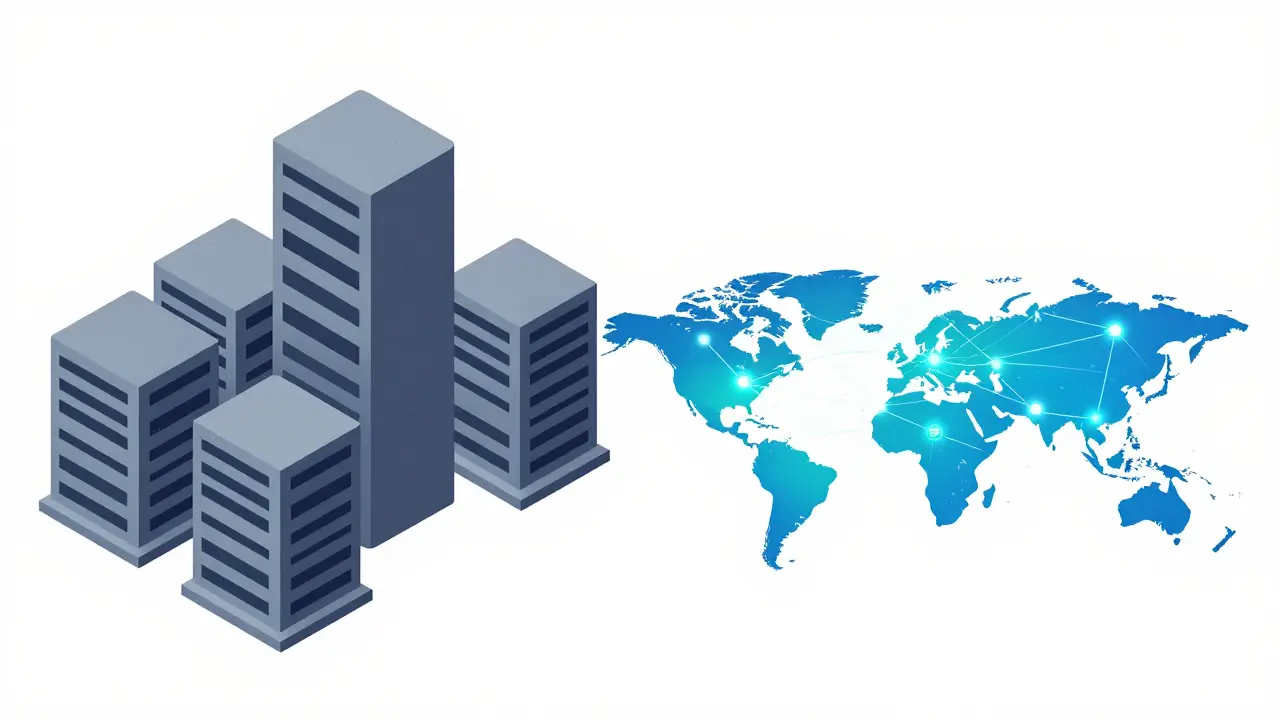
Imagine an internet where no single company owns the servers, and no central authority can flip a switch to shut down your website or leak your private data. Most of us think we're using a "cloud," but in reality, we're just renting space from a few giant corporations. ThreeFold (TFT) is a decentralized Internet and Cloud infrastructure project that aims to replace the corporate-owned web with a peer-to-peer grid. By building a new substrate from the ground up, it attempts to move the actual physical layers of the internet away from centralized data centers and into the hands of individual users.
The Core Mission: Building a Truly Free Internet
To understand ThreeFold, you first have to realize that most "decentralized" apps (dApps) are actually running on centralized servers. If the cloud provider goes down, the dApp goes down. ThreeFold solves this by creating the ThreeFold Grid is the world's largest decentralized grid of self-managing Internet capacity, distributing CPU cores and storage across global nodes.
Instead of relying on the existing internet architecture, the project started from scratch using the Linux Kernel. This allows them to automate everything from the operating system level up to the end-user experience. Essentially, they aren't just building another app; they are building the digital soil that other apps, blockchains, and IoT networks grow in.
How the ThreeFold Token (TFT) Works
The ThreeFold Token (TFT) is a utility token living on the Stellar Blockchain that represents a reservation of computer storage or capacity on the Grid. It isn't just a speculative asset; it's the fuel for the entire ecosystem. If you're a developer wanting to host a digital workload, you use TFT to pay for the resources.
The token economics are designed to reward those who actually provide the hardware. About 75% of the total supply is earmarked for node operators and ecosystem incentives. This ensures that as the network grows, the people providing the "muscle" (the servers) are the ones getting paid. The remaining supply supports the core development team and long-term technology growth.
The Role of Farmers and 3Nodes
You don't need to be a computer scientist to participate in ThreeFold. The project introduces the concept of "Farmers." A Farmer is anyone who buys a 3Node-a specialized server-plugs it in, and connects it to the internet.
Once your node is live, you provide storage and compute power to the grid. In return, you earn TFT. This creates a symbiotic relationship: the grid gets more capacity to host data, and the Farmer gets a monthly income stream. To make this easier, ThreeFold partnered with HP Enterprises to provide high-quality hardware, reducing the barrier to entry for non-technical users.
| Metric | Current Value | Impact |
|---|---|---|
| Total Storage Capacity | 80+ Petabytes | Allows hosting of massive datasets globally |
| Processing Power | 15,000+ CPU Cores | Enables complex computations and smart contracts |
| Global Reach | 21 Countries | Ensures censorship resistance via geographic spread |
Quantum-Safe Storage and Privacy
One of the biggest fears in the crypto world is the arrival of quantum computing, which could theoretically crack most current encryption. ThreeFold tackles this with a dispersed storage algorithm. Unlike many Web3 architectures that simply replicate data across multiple nodes, ThreeFold splits data into pieces and scatters them across the grid.
This approach creates what they call "Quantum-Safe Storage." Because the data is fragmented and distributed at a planetary scale, it's nearly impossible for a malicious actor to piece everything together, even with a quantum computer. This makes the system significantly more efficient-up to 10x more than traditional cloud storage-while keeping privacy locked down.
Developer Tools and the 3Bot SDK
For those who actually build things, ThreeFold provides a suite of tools to move away from Amazon Web Services (AWS) or Google Cloud. The 3Bot SDK is the primary tool here, allowing developers to create and scale IT workloads across the peer-to-peer network.
Developers can deploy an Edge Virtual Data Center or utilize the Quantum Safe Filesystem. This means a developer could launch a decentralized organization (DAO) or a complex oracle network without ever having to trust a single server provider. The infrastructure itself becomes a smart contract, automating the allocation of resources based on demand.
The Trade-offs and Market Reality
While the tech is impressive, the market side of TFT has been a bumpy ride. The token has experienced significant volatility, with prices fluctuating wildly. For some, this is a sign of a young project finding its feet; for others, it's a red flag regarding liquidity. The fully diluted valuation can look intimidating, but it's important to remember that ThreeFold is playing a very long game. They aren't just launching a token; they are trying to rewire the physical plumbing of the internet.
The risk here isn't just price-it's adoption. For ThreeFold to succeed, thousands of people need to be willing to buy and run 3Nodes. This requires a level of trust in the hardware and the long-term viability of the TFT reward system. However, with over $40 million invested by the founders and partners, the project has a substantial foundation compared to many "vaporware" crypto projects.
Is ThreeFold (TFT) a cryptocurrency or a company?
It is both. ThreeFold is a project and a company that builds decentralized internet infrastructure. TFT is the utility token used within that infrastructure to pay for and reserve computing and storage resources.
How do I earn TFT tokens?
The primary way to earn TFT is by becoming a "Farmer." This involves purchasing a 3Node server, connecting it to the ThreeFold Grid, and providing storage and CPU capacity to other users on the network.
What makes ThreeFold different from Filecoin or Sia?
While Filecoin and Sia focus primarily on storage, ThreeFold builds a full-stack substrate. This includes compute (CPU), networking, and storage, all starting from the Linux Kernel level. It's designed to host entire operating systems and applications, not just files.
Which blockchain does TFT use?
The ThreeFold Token (TFT) resides on the Stellar Blockchain, utilizing its efficiency for fast and low-cost transfers of utility value.
What is a 3Node?
A 3Node is the physical hardware (server) required to run a node on the ThreeFold Grid. These are often produced in partnership with companies like HP Enterprises to ensure they meet the technical requirements for the decentralized network.
24 Responses
Sounds cool 🚀
The assertion that this is "quantum-safe" is a gross oversimplification. Data fragmentation is a basic architectural choice, not a novel cryptographic breakthrough. Most people simply do not understand the difference between availability and encryption.
Interesting approach to the physical layer. Truly decentralized.
Who cares about this junk? American companies already run the world and we do it better. This is just a waste of electricity for people who can't get a real job.
Oh great, another way to waste money on hardware that will be obsolete in two years. Just because it's "decentralized" doesn't make it a good product. It's just a fancy way to lose your investment.
It is very inspiring to see the grid expanding to so many countries. I hope this helps small providers grow.
Imagine actually paying for a 3Node server just to be a "farmer." Truly the peak of gullibility. I'm sure the rewards will definitely cover the electricity bill and the hardware cost in like... ten lifetimes.
I love the idea of owning a piece of the internet! 🌟 It feels so empowering to move away from big tech. Let's goooo! 🚀💻
The philosophical implication of removing the corporate middleman from the physical layer is profound. We are essentially discussing the transition from digital feudalism to a digital commons. However, the success of such a system depends entirely on the incentive layer remaining stable enough to prevent the grid from collapsing into a few large, unofficial clusters. If the reward mechanism fails, the altruism required to maintain the grid won't be enough to sustain the infrastructure. It's a delicate balance between capitalist incentives and utopian goals. We must consider if the human desire for profit can ever truly coexist with a non-hierarchical network structure. The technical solve is there, but the social solve is the real challenge. Most projects forget that code is easy, but people are hard. I suspect the long-term viability depends on whether the utility of the grid outweighs the speculation of the token.
This is literally the dream! We're talking about breaking the chains of the corporate cloud and letting the internet breathe again! Imagine the creativity that unlocks when we aren't being throttled by some suit in a boardroom! It's a total revolution of the digital space!
It's really nice that they're trying to make this accessible for people who aren't tech experts. That's a great way to include everyone in the future of the web.
The partnership with HP is quite a strategic move. It provides a level of hardware standardization that is often missing in peer-to-peer grids, which usually struggle with inconsistent node performance.
The terminology is just so pretentious. Calling people "farmers" for plugging in a server is a desperate attempt to make it sound rustic and organic when it's just a bunch of silicon and wires in a basement.
Decentralization is not a silver bullet, but moving the physical substrate is a logical step toward actual autonomy.
The tokenomics are a complete disaster. A 75% allocation to node operators sounds generous until you realize the inherent dilution risk and the lack of organic demand for the compute resources. This is just a glorified Ponzi scheme with a hardware requirement.
I must insist that the 3Bot SDK is actually quite sophisticated for those who understand the kernel level! It is absolutely thrilling to see such a bold attempt at rewriting the internet's plumbing! 🙄
I've spent some time looking into the Linux kernel modifications they used... it's actually very clever!!! Definitely worth a look for anyone into low-level systems!!!
A tedious attempt to reinvent the wheel. The sheer audacity to claim a "new substrate" while relying on Stellar for the token is laughably contradictory. Such pedestrian ambition.
Seems like a cool way to help the planet and the internet at the same time!
I agree that the focus on compute and not just storage is a big advantage over other projects.
Bro the latency on a P2P grid is going to be insane! You can't just run a high-frequency API on some guy's 3Node in his garage and expect AWS-level throughput. The throughput-to-latency ratio is going to be a nightmare for any real enterprise workload!
just a wild dream of a digital garden where no one owns the soil
I'm just happy to see people trying new things! Keep it up! ✨💖
i think its neat but the setup looks knda hard for me lol