
Have you ever tried to find a specific piece of data on the Bitcoin blockchain and felt like you were looking for a needle in a haystack? That is exactly the problem Trac (Ordinals), known by its ticker TRAC, aims to solve. It is not just another meme coin or payment token; it is an infrastructure project built directly on top of the Bitcoin network. Specifically, it acts as a decentralized tracking and indexing system for the growing world of Bitcoin Ordinals.
If you are new to this space, you might be confused by the name. There is a common mix-up between this Bitcoin-based token and an older Ethereum token with the same ticker. This guide will clear that up immediately and explain what TRAC actually does, how it works, and why it matters for the future of Bitcoin data.
The Core Purpose: Indexing Bitcoin's New Data Layer
To understand TRAC, you first need to understand Bitcoin Ordinals. Before Ordinals, Bitcoin was mostly used for simple value transfers. You sent satoshis from one address to another. But with the introduction of inscriptions, people started embedding text, images, and other data directly onto individual satoshis. This created a massive amount of new metadata-domain names, token balances, and digital artifacts-that standard Bitcoin explorers struggle to read efficiently.
This is where Trac comes in. Think of it as a search engine specifically designed for this new layer of Bitcoin activity. Instead of relying on centralized servers that could go down or censor data, Trac provides a decentralized system for tracking and accessing these protocols. It indexes things like BRC-20 tokens, sats domain names, and other inscription-based standards. By organizing this chaotic data, it makes it searchable and accessible via APIs for developers, wallets, and analytics tools.
Tokenomics: Supply, Minting, and Scarcity
One of the most defining features of TRAC is its strict supply cap. Unlike many cryptocurrencies that inflate over time, TRAC has a fixed maximum supply of 21,000,000 tokens. As of mid-2026, 100% of this supply is already in circulation. This means there are no more tokens left to mint, and no new emissions will dilute existing holders under the current protocol rules.
The original deployment happened on May 3, 2023, when the initial inscription was created on the Bitcoin blockchain. At that time, the mint limit per transaction was set at 1,000 TRAC. This constraint was likely put in place to prevent whales from buying up the entire supply instantly, encouraging a more distributed ownership model during the early days. Because the supply is fully circulating, any price movement now depends entirely on market demand and secondary trading rather than new issuance.
| Attribute | Value |
|---|---|
| Total Supply | 21,000,000 TRAC |
| Circulating Supply | 21,000,000 TRAC (100%) |
| Blockchain | Bitcoin (via Ordinals/BRC-20) |
| Mint Limit (Historical) | 1,000 TRAC per transaction |
| Launch Date | May 3, 2023 |
Utility: Governance and Infrastructure
So, what do you actually do with TRAC tokens? The primary utility revolves around governance and securing the network. Since Trac positions itself as a decentralized indexer, it needs a way to coordinate updates and ensure reliability. Holders can use their tokens to vote on new protocols, propose changes to the tracking system, and participate in broader governance decisions.
Additionally, the system is designed to provide incentives for those who help secure the tracking network. This creates a flywheel effect: better indexing attracts more users and developers, which increases the value of the infrastructure, which in turn rewards the participants maintaining it. For developers, this means they can build applications that rely on accurate, real-time data about BRC-20 balances or ordinal inscriptions without having to run their own complex node setups.

Price History and Market Volatility
Like many assets in the Ordinals ecosystem, TRAC has experienced significant volatility. In mid-2025, the token traded in the range of $0.28 to $0.36, giving it a market capitalization of roughly $6 million to $7.5 million. However, by August 2026, prices had drawn down sharply, hovering around $0.018. This represents a drop of over 90% from its previous highs.
This volatility highlights the speculative nature of niche infrastructure tokens. While the underlying technology may have long-term potential, short-term prices are heavily influenced by broader trends in the Bitcoin ecosystem, liquidity conditions, and investor sentiment toward BRC-20 projects. Trading volumes have also fluctuated wildly, ranging from a few thousand dollars on quiet days to over $100,000 during periods of high interest.
Where to Buy and Trade TRAC
If you want to acquire TRAC, you will primarily find it on centralized exchanges rather than decentralized swaps. Major platforms like MEXC, Gate.io, and Coinbase list the TRAC/USDT pair. MEXC and Gate.io tend to see higher trading volumes, making them popular choices for traders looking for liquidity.
Once purchased, you can keep your tokens on the exchange or withdraw them to a Bitcoin wallet that supports Ordinals and BRC-20 tokens. Keep in mind that withdrawing involves Bitcoin network fees, which can vary depending on congestion. Since TRAC is a BRC-20 token, it lives on the Bitcoin blockchain, so you need a compatible wallet to manage it properly off-exchange.
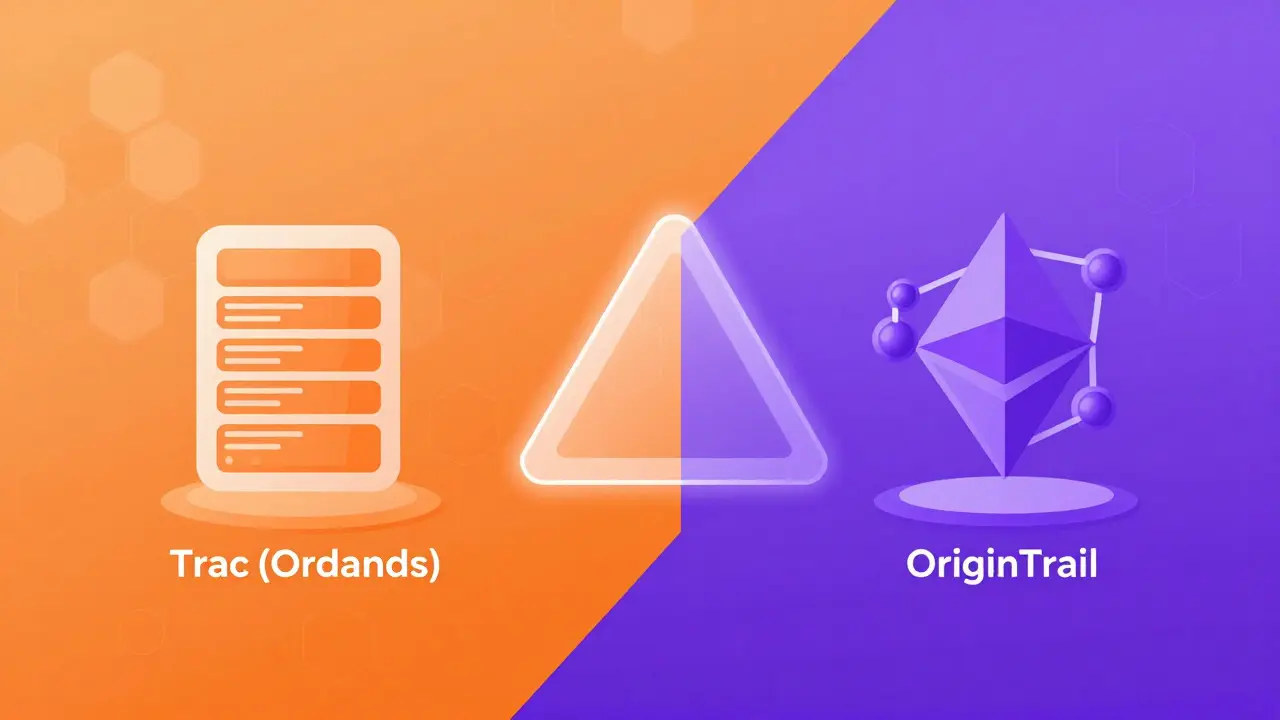
A Critical Warning: Don't Confuse It With OriginTrail
Here is a trap that catches many beginners: there is another cryptocurrency called TRAC, but it is completely different. That token belongs to OriginTrail, an Ethereum-based project focused on a Decentralized Knowledge Graph. It is an ERC-20 token, not a BRC-20 token.
Market data aggregators sometimes mix these two up in their descriptions, leading to confusion. When researching TRAC, always check the blockchain. If it says Ethereum, it is OriginTrail. If it says Bitcoin and mentions Ordinals or BRC-20, it is the Trac (Ordinals) token we are discussing here. Double-checking this detail can save you from accidental purchases or misinformed analysis.
Future Outlook and Risks
The long-term viability of TRAC depends on the continued adoption of Bitcoin Ordinals and BRC-20 standards. If the Bitcoin ecosystem continues to evolve into a hub for digital assets and data storage, the need for efficient indexing solutions will grow. Trac aims to capture that demand by providing essential infrastructure.
However, risks remain. Competition from other indexers, both centralized and decentralized, could challenge its position. Regulatory uncertainty surrounding crypto assets also looms large, particularly for tokens marketed with governance or utility claims. Furthermore, the sharp price declines seen in 2026 suggest that investor confidence can shift quickly. As with any small-cap crypto asset, thorough research and risk management are essential before investing.
Is TRAC (Ordinals) the same as OriginTrail TRAC?
No, they are completely different. TRAC (Ordinals) is a BRC-20 token on the Bitcoin blockchain focused on indexing Ordinals data. OriginTrail TRAC is an ERC-20 token on the Ethereum blockchain powering a decentralized knowledge graph. Always check the blockchain network to avoid confusion.
What is the total supply of TRAC (Ordinals)?
The total supply is hard-capped at 21,000,000 TRAC. As of 2026, 100% of this supply is in circulation, meaning no new tokens can be minted under the current protocol parameters.
How can I buy TRAC (Ordinals)?
You can buy TRAC on centralized exchanges such as MEXC, Gate.io, and Coinbase. Look for the TRAC/USDT trading pair. After purchasing, you can hold it on the exchange or withdraw it to a Bitcoin wallet that supports Ordinals and BRC-20 tokens.
What is the purpose of the TRAC token?
TRAC serves as a governance and incentive token for the Trac indexing network. Holders can vote on protocol updates and new standards, while participants who help secure and maintain the tracking system may receive incentives. It enables decentralized access to Bitcoin Ordinals data via APIs.
Is TRAC (Ordinals) a good investment?
TRAC is a high-risk, speculative asset. Its price has experienced significant volatility, including drops of over 90% in recent years. While it addresses a real need for Bitcoin data indexing, its success depends on the broader adoption of Ordinals and BRC-20 technologies. Investors should conduct their own research and only invest what they can afford to lose.
When was TRAC (Ordinals) launched?
The original BRC-20 inscription for TRAC was created on May 3, 2023. Public market tracking and exchange listings began shortly after, with broader visibility emerging in late 2023.