
Imagine holding a coin that works perfectly in one town but gets rejected at every shop in the neighboring city because it doesn't look like their standard currency. That is exactly the problem Wrapped XDAI (also known as wxDai) was created to solve.
If you are new to decentralized finance (DeFi), you might wonder why anyone would bother "wrapping" a token that is already worth $1. The short answer is compatibility. Native xDai is the fuel for the Gnosis Chain, but many smart contracts and decentralized applications (dApps) only speak the language of the ERC-20 standard. wxDai bridges that gap, allowing your stablecoin to play nicely with the broader Ethereum ecosystem without leaving the Gnosis network.
The Core Problem: Why Native xDai Isn't Enough
To understand wxDai, you first need to understand its parent, xDai. xDai is the native currency of the Gnosis Chain. It functions like Ether on Ethereum or Bitcoin on Bitcoin-it pays for gas fees and secures the network. However, being a "native" coin means it exists outside of the standard token contract rules that most developers build against.
Most DeFi protocols-think lending platforms, automated market makers, and yield aggregators-are built using the ERC-20 standard. This standard defines how tokens behave: how they transfer, how they approve spending, and how they interact with wallets. Native xDai does not follow these specific code instructions by default. If you try to deposit native xDai into an ERC-20-only pool, the transaction will fail. It’s like trying to plug a square peg into a round hole.
This is where wxDai steps in. It is essentially native xDai locked inside a digital wrapper that makes it compliant with the ERC-20 standard. When you wrap xDai, you aren't creating new value; you are just changing the format so other systems can recognize and use it.
How Wrapping Works: The Technical Mechanics
The process of converting xDai to wxDai is straightforward but relies on smart contract logic. Here is what happens under the hood:
- Locking: You send your native xDai to a specific smart contract address on the Gnosis Chain. This address acts as a vault.
- Minting: Once the vault receives your xDai, it mints an equivalent amount of wxDai tokens and sends them to your wallet.
- Usage: You now hold wxDai, which behaves exactly like any other ERC-20 token. You can trade it, stake it, or lend it on compatible platforms.
- Unwrapping: When you are done, you send the wxDai back to the contract. The contract burns (destroys) the wxDai and releases the underlying native xDai back to you.
The official contract address for this operation on the Gnosis Mainnet is 0xe91D153E0b41518A2Ce8Dd3D7944Fa863463a97d. While you rarely need to type this manually anymore, knowing it exists gives you confidence that the process is transparent and verifiable on-chain.
You don't usually interact with the raw contract directly. Instead, you use user-friendly interfaces. Platforms like Wrap Eth allow you to connect your wallet (such as MetaMask) and perform the swap with a single click. Alternatively, decentralized exchanges (DEXs) like Swapr and Honeyswap handle this conversion automatically when you trade, ensuring you always have the correct token format for liquidity pools.
Key Use Cases for wxDai in DeFi
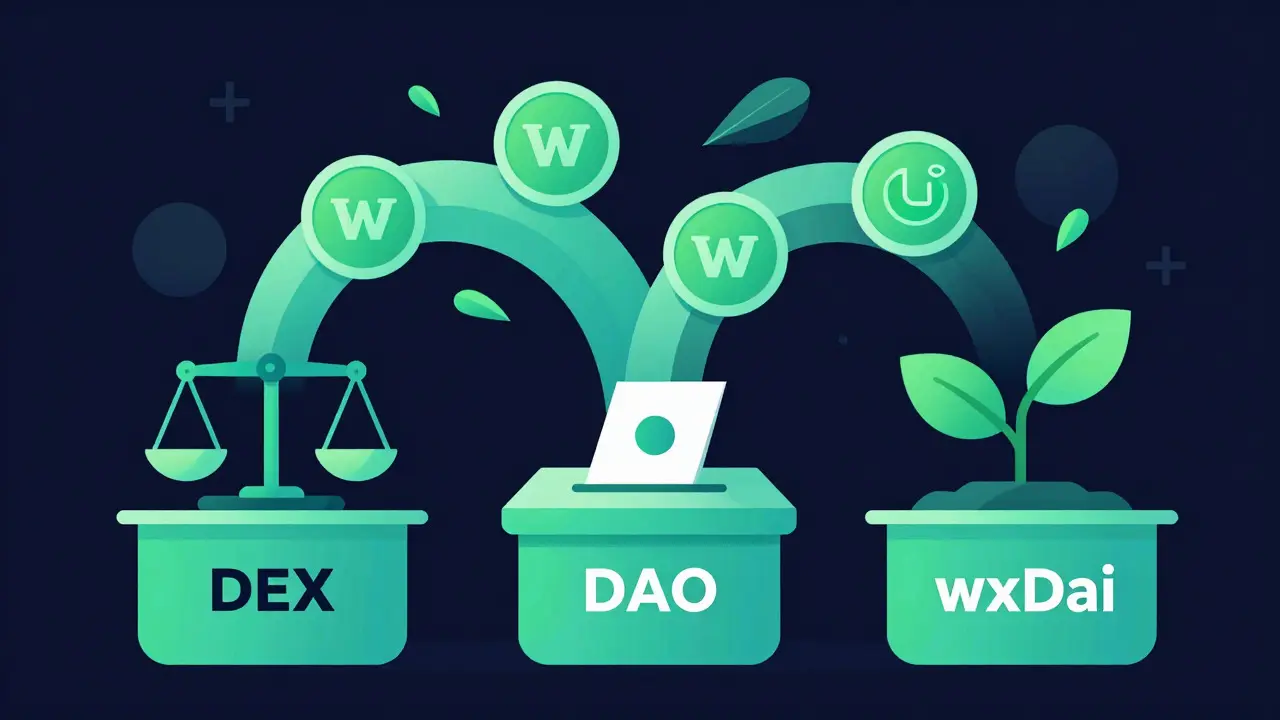
Why go through the trouble of wrapping? Because wxDai unlocks three critical areas of utility that native xDai cannot access easily.
1. Decentralized Exchange Liquidity
DEXs rely on liquidity pairs. To provide liquidity for a pair like wxDai/WETH, both assets must be ERC-20 tokens. If you tried to provide native xDai, the router would reject it. By wrapping, you can participate in trading pairs, earn fees from swaps, and contribute to the depth of the market. This is essential for traders who want to move large amounts of capital without causing significant price slippage.
2. DAO Governance and Operations
Decentralized Autonomous Organizations (DAOs) often require standardized tokens for voting mechanisms and treasury management. Many governance frameworks are built to accept ERC-20 inputs. wxDai allows DAOs to receive donations, pay grants, and execute votes using a stable asset that integrates seamlessly with existing governance tooling. Without wxDai, many DAOs would face friction in managing their finances on the Gnosis Chain.
3. Yield Farming and Staking
Many yield farming protocols offer incentives for providing liquidity or staking specific tokens. These protocols are coded to recognize ERC-20 standards. By holding wxDai, you can lock your assets in staking pools to earn rewards. This turns your stablecoin from a static store of value into a productive asset that generates passive income, contributing to network security and stability in return.
Market Dynamics and Price Stability
As a stablecoin, wxDai is pegged to the US Dollar. In theory, 1 wxDai should always equal $1.00 USD. In practice, you will see minor fluctuations due to supply and demand imbalances in the secondary market.
| Metric | Value / Status | Context |
|---|---|---|
| Price Peg | $1.00 USD | Target value; typically trades between $0.999 and $1.003 |
| All-Time High | $1.20 | Historical anomaly; currently ~16% below ATH |
| Volatility | Low | Minimal change over 24h periods, consistent with stablecoins |
| Trading Volume | ~$156k (24h) | Reflects active usage in DEXs and swaps |
| Exchange Listings | Limited/Centralized | Primarily traded via DEXs; some data suggests limited CEX availability |
It is important to note that while some data sources may report confusing metrics like "$0.00 market cap" or "0 circulating supply," these are often artifacts of how aggregators track wrapped tokens versus native coins. Since wxDai is minted and burned dynamically based on demand, its supply fluctuates constantly. The real indicator of health is the trading volume and the tightness of the peg to the dollar.
Interoperability: The Bridge Between Chains
The true power of wxDai lies in its role as an interoperability bridge. The Gnosis Chain is an EVM-compatible network, meaning it speaks the same technical language as Ethereum. However, cross-chain interactions still require careful handling of asset formats.
By adhering to the ERC-20 standard, wxDai ensures that developers building on Gnosis can reuse code libraries and tools designed for Ethereum. This reduces development time and increases security, as the ERC-20 standard has been battle-tested across thousands of projects. For users, it means that if a new DeFi protocol launches on Gnosis, there is a high probability it will support wxDai out of the box, whereas native xDai might require custom integration work.
How to Get Started with wxDai
If you want to start using wxDai, here is a simple checklist to ensure you do it correctly:
- Set Up Your Wallet: Ensure you have a wallet like MetaMask configured to connect to the Gnosis Chain network. Add the Gnosis Chain RPC details if they aren't pre-loaded.
- Acquire xDai: Buy or transfer native xDai to your wallet. This is your base asset.
- Choose a Wrapper: Navigate to a trusted interface like Wrap Eth or a major DEX like Swapr.
- Execute the Wrap: Connect your wallet, input the amount of xDai you wish to wrap, and confirm the transaction. Pay attention to the gas fee, which will be small since Gnosis Chain fees are low.
- Verify Receipt: Check your wallet balance. You should now see a separate entry for wxDai alongside your native xDai.
A common pitfall for beginners is forgetting to switch networks before interacting with the contract. Always double-check that your wallet is connected to Gnosis Chain, not Ethereum Mainnet, to avoid failed transactions or unnecessary costs.
Risks and Considerations
While wrapping is generally safe, it is not without risks. The primary risk is smart contract vulnerability. Although the wxDai contract is well-established, any interaction with code carries a non-zero chance of bugs or exploits. Always verify the contract address you are interacting with matches the official one.
Another consideration is liquidity fragmentation. In rare cases, the pool for unwrapping wxDai back to xDai might have insufficient liquidity, leading to slight slippage. However, given the high volume of wxDai usage, this is uncommon for standard amounts.
Finally, be aware of the tax implications in your jurisdiction. Some regions treat wrapping and unwrapping as taxable events, while others view it as a like-kind exchange. Consult local regulations to ensure compliance.
Is wxDai the same as xDai?
No, they are different formats of the same value. xDai is the native coin of the Gnosis Chain, used for gas fees. wxDai is an ERC-20 token version of xDai, used for DeFi interactions. They are 1:1 redeemable, but they function differently in smart contracts.
Do I lose money when wrapping xDai?
You do not lose principal value, but you do pay a small gas fee for the transaction. On Gnosis Chain, these fees are typically fractions of a cent, making the cost negligible for most users.
Can I use wxDai on Ethereum Mainnet?
Not directly. wxDai lives on the Gnosis Chain. To use it on Ethereum Mainnet, you would need to use a bridge service to transfer the asset across chains, which involves additional steps and potential risks.
What happens if the wxDai contract gets hacked?
While unlikely given its maturity, if the contract were compromised, your wrapped tokens could be at risk. This is why it is crucial to always interact with the verified contract address (0xe91D153E0b41518A2Ce8Dd3D7944Fa863463a97d) and use reputable interfaces.
Why is the market cap sometimes listed as zero?
This is a data reporting error. Since wxDai is minted and burned on demand, its circulating supply changes constantly. Aggregators sometimes struggle to track this dynamic supply accurately, leading to incorrect market cap figures. Look at trading volume instead for a better sense of activity.