
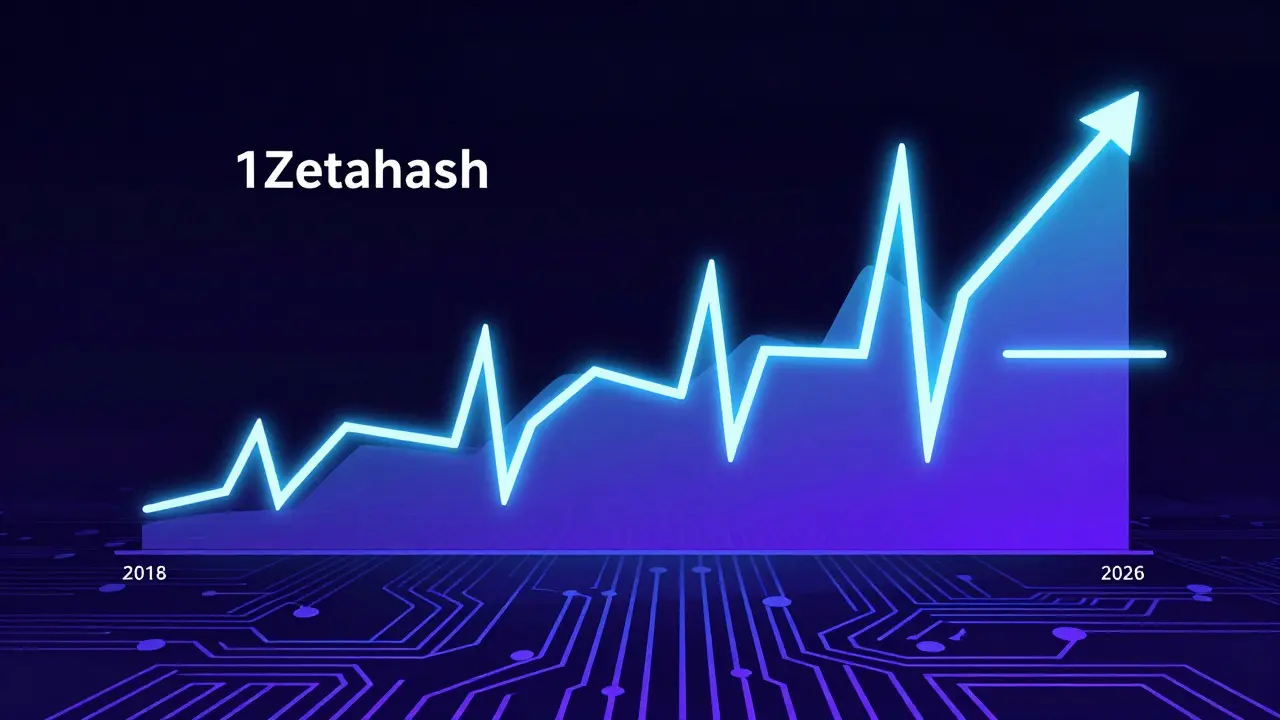
The Bitcoin hash rate is the total computational power dedicated to securing the Bitcoin blockchain, measured in hashes per second. It isn't just a number on a dashboard; it’s the heartbeat of the network’s security. As we move through 2026, the conversation has shifted from "will it grow?" to "how fast will it explode?" With the network recently surpassing the 1 Zetahash (ZH) mark-a sextillion calculations every second-the stakes for miners, investors, and infrastructure planners have never been higher.
If you’re trying to figure out where the market is heading by 2030, you can’t look at price charts alone. You need to understand the engine driving them. This guide breaks down the real numbers behind future hash rate projections, looking at hardware limits, energy costs, and the looming 2028 halving event. We’ll cut through the hype to see what actually drives this growth and what could stop it.
Why Hash Rate Matters More Than Price
You might think Bitcoin’s price is the only metric that matters, but the network hashrate tells a different story. It measures how much work is being done to validate transactions and secure the ledger. When the hashrate goes up, the network becomes exponentially harder to attack. For an attacker to take over Bitcoin, they’d need more computing power than all legitimate miners combined. That barrier gets higher every day.
In early April 2025, the network hit a historic milestone. The 7-day moving average reached 929 Exahashes per second (EH/s), and the daily average briefly broke the 1 ZH barrier. To put that in perspective, when mining started industrializing around 2018, the network was sitting at just 14 EH/s. That means the network has grown roughly 57 times larger in less than eight years. This isn't linear growth; it's exponential. Understanding this trajectory helps you anticipate when profitability windows open or close for miners, and how secure your holdings truly are.
Three Scenarios for 2030 Growth
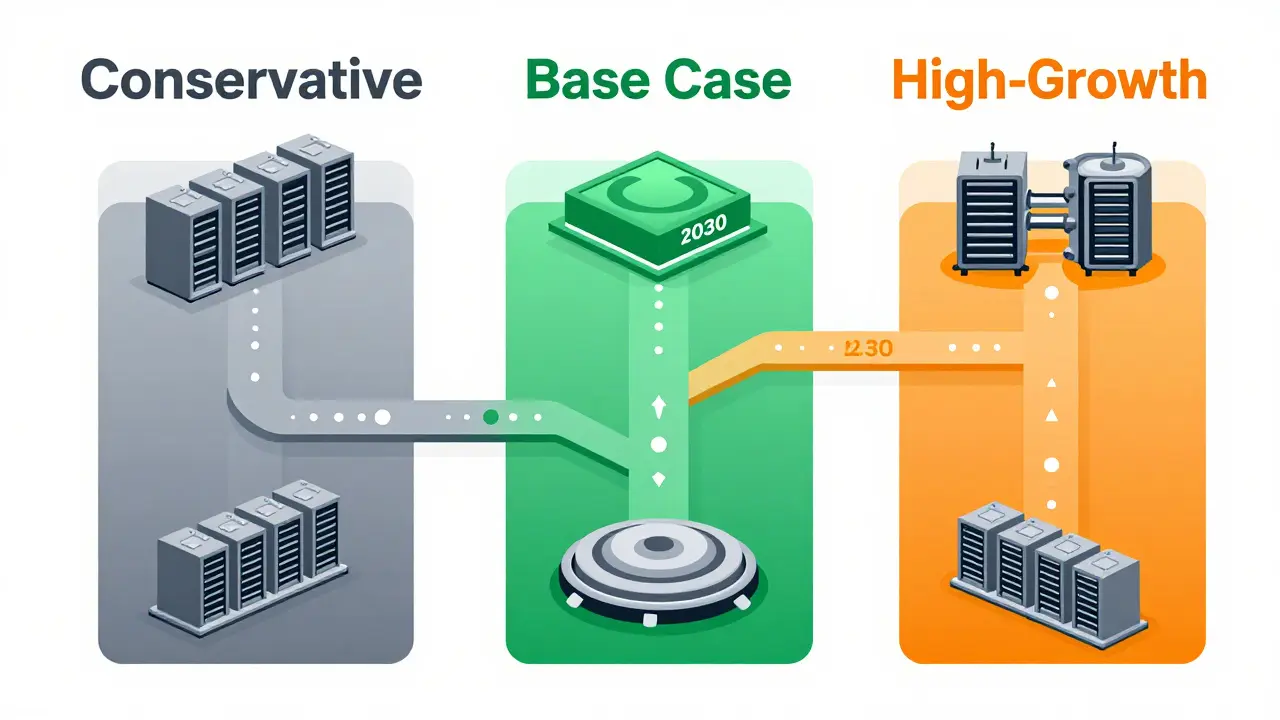
Predicting the future involves guessing variables, but analysts use historical data to build models. There are three main ways experts view the next four years, ranging from cautious to aggressive.
| Scenario | Annual Growth Rate (CAGR) | Projected Hash Rate (2030) | Key Assumptions |
|---|---|---|---|
| Conservative | 35% | ~2,543 EH/s | Regulatory headwinds, slower tech adoption, energy constraints |
| Base Case | 45% | ~4,128 EH/s | Steady institutional investment, moderate regulatory clarity |
| High-Growth | 52.5% | ~6,891 EH/s | Continued industrialization, massive AI/mining synergy, high BTC price |
The high-growth model, popularized by firms like GoMining, assumes the 52.5% compound annual growth rate seen since 2018 continues. This would push the network near 7 ZH by 2030. However, critics argue this ignores diminishing returns. As the network scales, finding cheap energy and building efficient facilities becomes harder. The base case of 45% growth offers a middle ground, acknowledging steady expansion without assuming infinite scalability. Most industry participants seem to be betting somewhere between these two, preparing for significant infrastructure demands regardless of which path wins.
The Hardware Arms Race: ASIC Efficiency
Hash rate doesn't grow out of thin air; it comes from machines called ASICs (Application-Specific Integrated Circuits). These chips do one thing: calculate SHA-256 hashes. The race isn't just about buying more machines; it's about getting more power per watt.
Modern rigs like the WhatsMiner M20S deliver 68 Terahashes per second (TH/s) while consuming between 2,000 and 20,000 watts depending on configuration. But here’s the catch: efficiency dictates survival. If your machine uses too much electricity, you lose money even if Bitcoin’s price stays flat. Analysts point to a "turnoff price"-the minimum Bitcoin price needed to cover costs. For current top-tier ASICs, that floor sits around $5,000 to $6,000. If Bitcoin trades above that, these machines run. Below it, they shut down.
This creates a natural filter. Older, less efficient miners get priced out during downturns, causing temporary drops in hashrate. But as soon as prices recover, new, more efficient hardware floods back in. This cycle ensures that the long-term trend remains upward because each generation of hardware is significantly more powerful than the last. By 2030, we expect to see machines that make today’s S21 Pros look like calculators.
Energy Costs: The Real Bottleneck
You can buy all the ASICs you want, but if you can’t plug them in cheaply, you’re dead in the water. Energy accounts for 40% to 60% of operational expenses for mining operations. This makes location everything.
There’s a massive gap in global electricity rates. In regions like Kazakhstan and parts of Texas, miners can secure power for around $0.045 per kilowatt-hour (kWh). On the U.S. East Coast, rates often exceed $0.12/kWh. That difference determines who profits and who folds. Professional miners now report that staying below $0.05/kWh is essential for consistent profitability given current difficulty levels.
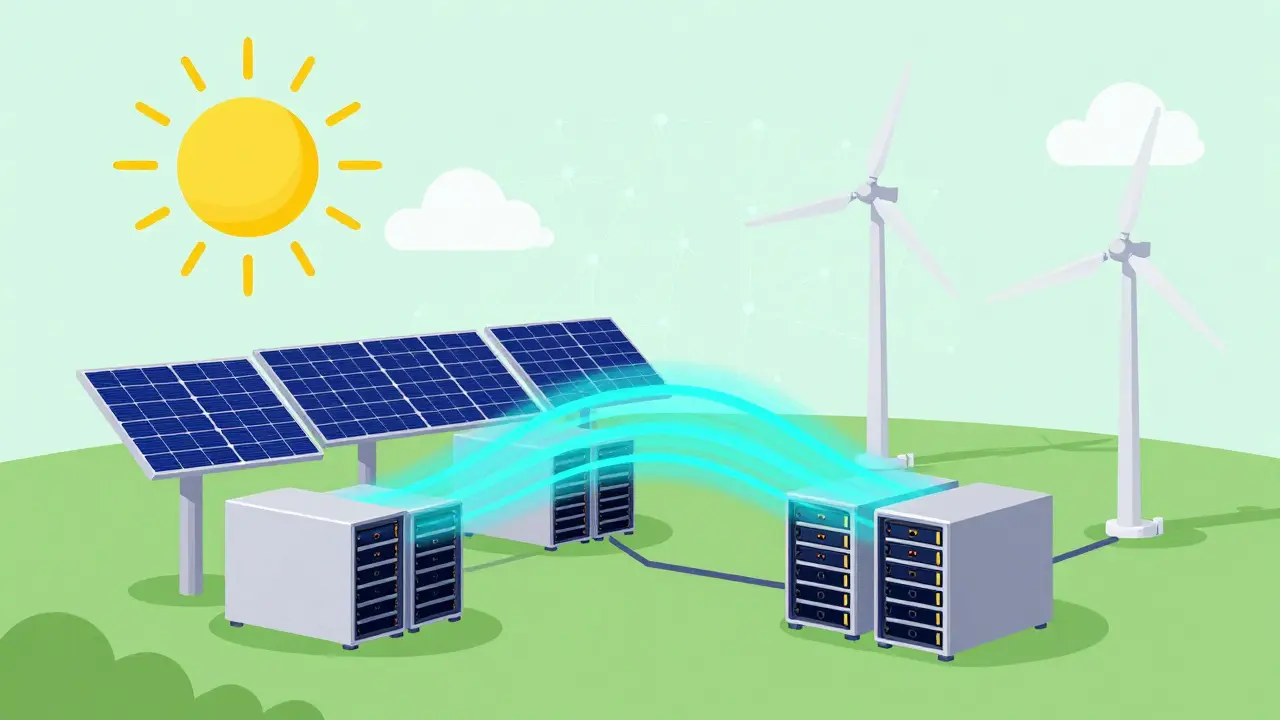
This pressure is driving innovation beyond just digging holes for servers. Companies are integrating with renewable energy grids. According to the Bitcoin Mining Council’s Q3 2025 report, 56.1% of global mining now uses sustainable energy sources. This shift isn't just good PR; it stabilizes costs. Solar and wind farms often sell excess power at rock-bottom prices to miners who can absorb the load instantly. As regulations tighten globally, this ability to pair mining with green energy will likely become the primary driver of future hashrate growth, not just raw hardware purchases.
The 2028 Halving Impact
Every four years, Bitcoin cuts the block reward in half. This mechanism, known as the halving, reduces the amount of new Bitcoin created per block. The next halving is scheduled for 2028. Historically, halvings cause short-term pain before long-term gain.
When rewards drop, marginal miners-who were barely breaking even-become unprofitable. They turn off their machines. This causes the hashrate to dip temporarily. But then, the network adjusts. Difficulty decreases slightly, making it easier for remaining miners to find blocks. Eventually, if Bitcoin’s price rises enough to offset the lower reward, new capital flows in, bringing fresh, efficient hardware online. The hashrate recovers and hits new highs.
Projections for 2030 must account for this dip. Models that ignore the halving risk overestimating growth in 2027-2028. However, if Bitcoin reaches the $1 million+ range projected by some analysts (like AInvest’s August 2025 forecast of $1.16 million), the halving impact becomes negligible. High prices keep even older machines running, smoothing out the transition. The key variable here isn't the code-it's market sentiment and adoption.
Regulation and Geopolitics
No projection exists in a vacuum. Governments play a huge role. China’s 2021 mining ban caused a massive shock, dropping hashrate significantly before it recovered within 12 months. That event proved the network is resilient but also highlighted its vulnerability to policy shifts.
Today, North America dominates mining distribution, followed closely by Europe. But regulatory risks remain high. Analysts warn that potential regulatory cost increases could add up to 150% to operational budgets in strict jurisdictions. Conversely, clear legal frameworks attract institutional money. We’re seeing companies like HIVE Digital Technologies expand rapidly, partly because they operate in regions with supportive policies.
Geopolitical tensions also affect supply chains. ASICs require advanced semiconductors. Any disruption in chip manufacturing-whether from trade wars or local conflicts-could slow hardware deployment. While unlikely to stop growth entirely, such events could delay the timeline, pushing the "high-growth" scenarios further into the future.
AI and Mining Convergence
A surprising new factor is Artificial Intelligence. Data centers built for Bitcoin mining are increasingly dual-purpose. They handle mining loads during peak hours and switch to AI computation tasks when demand spikes elsewhere. This hybrid model improves revenue stability.
Firms like HIVE are converting Tier-1 data centers into high-performance computing facilities. This strategy allows them to monetize their infrastructure beyond just Bitcoin. It also attracts investors who want exposure to both crypto and AI trends. This convergence suggests that future hashrate growth won't come from standalone mining farms, but from integrated tech hubs that serve multiple industries. It makes the entire ecosystem more robust and less dependent on Bitcoin’s price alone.
What does 1 Zetahash mean?
One Zetahash (1 ZH) equals one sextillion hashes per second. It’s a measure of immense computational power. Reaching this milestone signifies that the Bitcoin network is secured by more processing power than most supercomputers ever built.
Will the 2028 halving crash the hash rate?
It may cause a temporary dip as inefficient miners shut down. However, history shows the hashrate always recovers and exceeds previous highs once the market adjusts. If Bitcoin’s price remains strong, the dip will be minimal.
How accurate are these projections?
Projections are estimates based on historical trends and current variables. They are not guarantees. Factors like regulation, energy prices, and technological breakthroughs can change outcomes significantly. Always treat them as directional guides, not exact predictions.
Is Bitcoin mining still profitable in 2026?
Yes, but only for efficient operators. You need access to cheap electricity (under $0.05/kWh) and modern ASIC hardware. Home mining with old GPUs is no longer viable. Institutional players dominate the landscape.
What happens if hash rate stops growing?
If hash rate stagnates, it usually indicates economic stress in the mining sector, such as high energy costs or low Bitcoin prices. Security remains high as long as the existing hash rate is sufficient to deter attacks, which it currently is.