
When Bittrex was active, it wasn’t just another crypto exchange. It was built by former Microsoft cybersecurity engineers who wanted to create a platform that prioritized security above all else. For nearly a decade, it earned trust by never suffering a single major hack. But today, Bittrex doesn’t operate as a trading platform anymore. It’s in liquidation. And if you still have funds on it, you’re not alone - 247,000 users are waiting to get their money out, with strict fees and deadlines looming.
What Bittrex Was Before It Shut Down
Bittrex launched in 2014 with a simple mission: make crypto trading as secure as possible. Unlike many exchanges that chased volume and flashy features, Bittrex focused on one thing - protecting user assets. It stored 95% of all cryptocurrency in cold wallets, spread across geographically separated data centers. Each wallet used multi-signature security, meaning multiple approvals were needed to move funds. Biometric access controls and real-time transaction monitoring were standard. The result? Zero breaches in its entire history.
By 2021, Bittrex listed over 250 cryptocurrencies - far more than competitors like Coinbase, which had around 50 at the time. It was the go-to place for early adopters of obscure altcoins like Grin, Beam, and EOS. Its trading engine handled 350,000 orders per second, making it one of the fastest platforms for spot trading. Fees were competitive: 0.25% for makers and 0.30% for takers, dropping to 0.10% for users trading over $500,000 per month. There were no minimum withdrawal amounts, and withdrawals typically cleared within hours.
Why Bittrex Shut Down
Bittrex’s downfall wasn’t caused by a hack or poor performance. It was caused by regulation.
In 2019, the New Jersey Bureau of Securities issued a cease-and-desist order, claiming Bittrex was selling unregistered securities. That was just the beginning. The U.S. SEC fined Bittrex $29 million in 2022 for servicing users in prohibited jurisdictions. Compliance costs were unsustainable - $47 million a year, compared to Coinbase’s $29 million. Profit margins turned negative. By April 30, 2023, Bittrex shut down its U.S. operations entirely.
The international arm, Bittrex Global, tried to keep going. But regulators in Europe and Bermuda kept closing in. On December 4, 2023, trading stopped. Only withdrawals were allowed. Then, on February 25, 2025, both Bittrex Global GmbH (Liechtenstein) and Bittrex Global Ltd. (Bermuda) entered formal liquidation. ALPS Trust Ltd. was appointed to manage asset recovery.
Your Funds Are Still There - But There’s a Catch
Here’s the critical part: your crypto is still on Bittrex. Not gone. Not stolen. Still there.
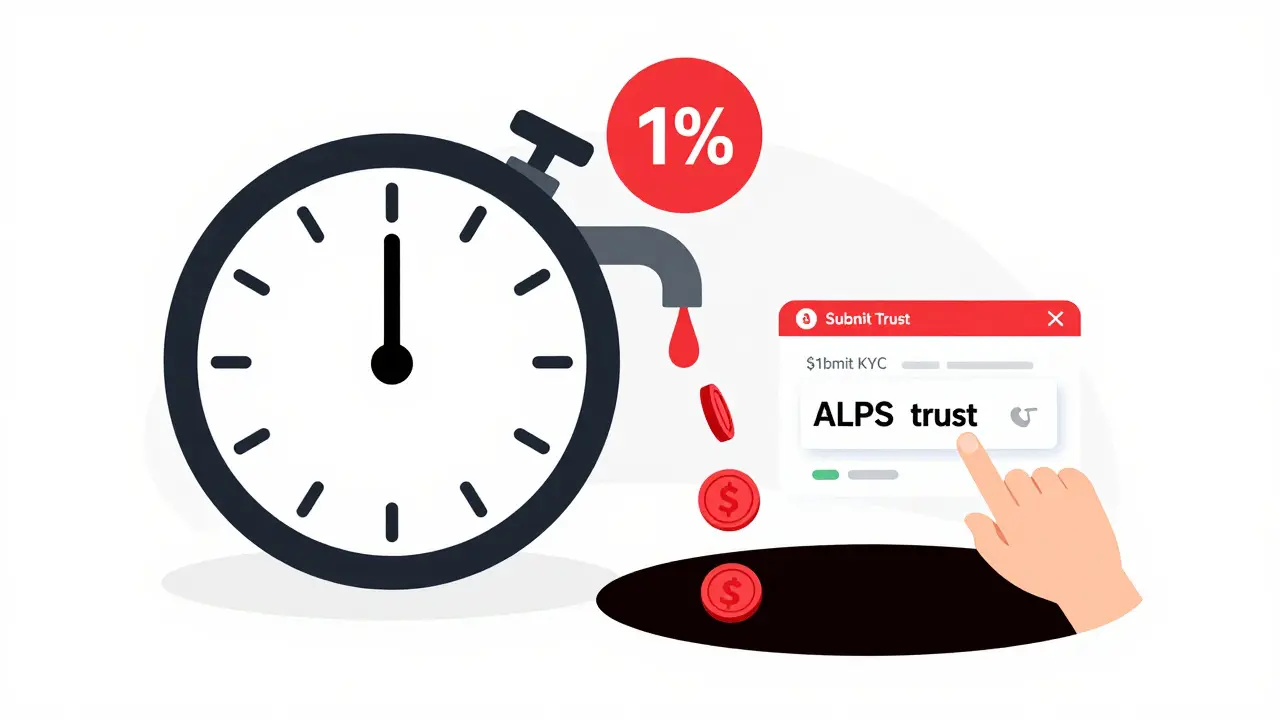
But since February 25, 2025, a new rule kicked in: if you don’t withdraw your assets within 30 days, you’re charged a 1% monthly fee per asset. That’s not a small penalty. If you have $10,000 in ETH and do nothing, you lose $100 in the first month. After six months, that’s $600 gone - nearly 6% of your balance. The minimum fee is $50 per asset per month, so even if you have $1,000 in a coin, you’ll still pay $50.
Withdrawals are active again - but only for users under the Liechtenstein entity. Bermuda users are still stuck waiting for court approval. If you’re in Liechtenstein, you can submit a withdrawal request via the Zendesk portal. ALPS Trust says 92% of compliant requests are processed within 72 hours. But you must re-verify your identity. If your KYC documents expired, you’ll need to upload them again. No exceptions.
How to Get Your Money Out Right Now
If you still have funds on Bittrex, here’s exactly what to do:
- Go to bittrexglobal.zendesk.com
- Log in with your old account credentials
- Submit a support ticket labeled "Withdrawal Request - KYC Re-verification"
- Upload a clear photo of your government-issued ID and a selfie holding it
- Wait for confirmation - usually under 72 hours
- Once approved, initiate your withdrawal immediately
Do not delay. The 1% monthly fee starts ticking the moment you log in. Even if you’re not planning to withdraw right away, log in, submit your documents, and lock in your claim. Once approved, you can wait to withdraw - but the fee clock stops until you initiate the transaction.
What Happens If You Do Nothing
If you ignore Bittrex entirely, your funds won’t vanish. But they’ll keep shrinking.
ALPS Trust has confirmed that fees are automatic and non-negotiable. There’s no appeal process. No grace period beyond the first 30 days. And there’s no guarantee that funds will be recoverable after 2026. Deloitte estimates 95% of assets will be returned - but 12% of users may lose money simply because their fees accumulated to more than their original balance.
Some users on Reddit reported that after 10 months of inactivity, their $5,000 in BTC had been reduced to $4,200 - not because of price drops, but because of fees. That’s not speculation. That’s the policy.
How Bittrex Compared to Other Exchanges
At its peak, Bittrex had three clear advantages:
- Security: 95% cold storage - unmatched at the time
- Altcoin selection: 257 coins vs. Coinbase’s 50
- Zero breaches: A rarity in crypto history
But it had three fatal weaknesses:
- No futures or leverage: You couldn’t trade derivatives
- Only USD on-ramps: No EUR, GBP, AUD - just ACH and wire
- Slow customer support: Average ticket resolution: 72 hours
Compare that to Bitfinex, which had 18 fiat currencies and 0.001-second order execution, or Coinbase, which had institutional OTC desks and 24/7 support. Bittrex wasn’t built for traders. It was built for hodlers. And when regulators came after those who hodled, Bittrex had no lobbying power - just a firewall.
The Legacy of Bittrex
Bittrex is gone. But its influence isn’t.
BitGo’s current custody system - which now secures $90 billion in digital assets - uses the exact same multi-sig cold storage design Bittrex pioneered. The architecture is now an industry standard. Bittrex proved that exchanges could operate without breaches. It also proved that regulatory compliance without political influence is a death sentence.
SEC Chair Gary Gensler called Bittrex’s shutdown a warning: "27 exchanges have failed since 2022 due to compliance gaps." Bittrex didn’t fail because it was bad. It failed because it was too good at security and too stubborn about regulation.
Final Thoughts: Should You Still Use Bittrex?
No. You can’t trade on it. You can’t deposit. You can’t even log in to buy anything.
There’s only one reason to interact with Bittrex today: to get your money out before the fees eat it alive. If you have funds there, act now. Submit your KYC. Withdraw everything. Don’t wait. Don’t hope. Don’t assume someone else will fix it.
The exchange is dead. But your money isn’t - yet.
Is Bittrex still operating as a crypto exchange?
No. Bittrex ceased all trading operations in December 2023. Both its U.S. and global entities are now in liquidation. You cannot buy, sell, or trade on Bittrex anymore. The platform only allows withdrawals under strict conditions.
Can I still withdraw my funds from Bittrex?
Yes - but only if you’re under the Liechtenstein entity. Users in Bermuda are still blocked pending court approval. To withdraw, you must re-submit your KYC documents via the Zendesk portal. Once approved, you can initiate a withdrawal. However, if you haven’t withdrawn within 30 days of logging in, a 1% monthly fee is charged per asset.
What happens if I don’t withdraw my funds?
Your funds won’t disappear, but they’ll shrink. A 1% monthly fee is automatically deducted from each asset you hold after 30 days of inactivity. The minimum fee is $50 per asset per month. Over time, these fees can erase your balance - especially if you hold multiple coins. Deloitte estimates 12% of users may lose funds entirely due to accumulated fees.
Are my funds safe on Bittrex?
Yes - your assets are still secured in cold storage. Bittrex never suffered a breach, and its security infrastructure remains intact. The liquidation process is managed by ALPS Trust Ltd., which has confirmed all user funds are accounted for. The risk isn’t theft - it’s fees and delays.
How long will it take to get my money back?
Once your KYC is approved and you submit a withdrawal request, ALPS Trust processes 92% of requests within 72 hours. However, if you’re in Bermuda, you’re still waiting for court approval. Full liquidation is expected to complete by Q3 2026, but there’s no guarantee on timing.
Why did Bittrex shut down when other exchanges stayed open?
Bittrex refused to lobby regulators or expand into unregulated markets. While competitors like Binance and Kraken expanded globally, Bittrex stuck to strict compliance - even when it hurt profits. That made it vulnerable. When U.S. regulators cracked down, Bittrex had no financial cushion to fight back. It spent $47 million a year on compliance - more than half its revenue.
26 Responses
The Bittrex shutdown is a textbook case of regulatory overreach meeting operational excellence. Their multi-sig cold storage setup was literally copied by BitGo and now secures $90B. But no amount of security matters if you don’t have lobbying power or a political backdoor. This isn’t a failure of technology-it’s a failure of capitalism’s willingness to reward integrity.
Meanwhile, Coinbase just paid their $29M fine and kept trading. Same playbook: comply just enough to stay in the game. Bittrex tried to win the game without cheating. And lost.
I’m not surprised. People who build secure systems without lobbying are the first to be crushed. This is what happens when you refuse to play the game. Bittrex didn’t fail because they were bad-they failed because they were too honest. And honesty doesn’t survive in a system built on corruption disguised as regulation.
I still remember when Bittrex was the only place I could get Grin or Beam. No drama. No delays. Just cold storage and clean trades. It felt like the last honest exchange. Now? I’ve moved everything to Kraken. But I still check Bittrex’s status every few weeks. Just in case.
I logged in yesterday just to see if my ETH was still there 😅
It was. But the 1% fee hit me right in the wallet. $50 for $800? That’s brutal. I just submitted my KYC. Fingers crossed.
If you have funds on Bittrex, DO NOT WAIT. The fee clock starts the moment you log in-even if you don’t withdraw. Submit your documents now. Lock in your claim. Then take your time. But don’t delay the first step. This isn’t about trust-it’s about arithmetic.
I’ve been watching this unfold since 2023. The fact that 92% of compliant withdrawals clear in 72 hours is actually impressive. Most liquidations drag on for years. ALPS Trust is doing better than most. The real villain here is the 1% monthly fee-it’s a slow bleed designed to push people into surrender.
Bittrex was built by engineers, not salespeople. That’s why it worked. That’s why it died. The crypto world doesn’t reward engineers. It rewards hustlers. Binance didn’t win because they were better. They won because they didn’t care about rules. And guess what? Rules don’t care about you either.
I still have about $3,000 in old altcoins on there. I’m not giving up. I submitted my KYC last week. Got the email confirmation. Waiting now. If I lose half to fees, so be it. At least I didn’t lose it all to a hack. Bittrex kept my money safe. That’s more than most exchanges can say.
I’m just glad I cashed out before 2022. Bittrex was cool and all, but I never trusted the U.S. government to leave a clean company alone. This was inevitable. The only surprise? It lasted this long.
The irony is that Bittrex’s security architecture is now the industry standard. Every custodian uses their model. Every wallet provider references their whitepaper. Their legacy lives on-in the very institutions that buried them. They built a cathedral. Then the city council tore it down because it didn’t have a permit for stained glass.
Let me break this down for anyone still confused. Step 1: Log in. Step 2: Submit KYC re-verification. Step 3: Wait 72 hours. Step 4: Initiate withdrawal. Step 5: Don’t log back in until it’s done. Why? Because the 1% fee triggers the moment you access your account. You don’t need to withdraw immediately. You just need to get approved. Once approved, you can wait. But if you don’t get approved? The fees keep eating you alive. And there’s no appeal. No grace. No mercy. This isn’t a platform anymore. It’s a clock. And the clock is ticking.
I’m from the U.S., but I used Bittrex Global. I just got the email that my withdrawal is pending court approval. It’s been 14 days. I’m holding. But I’m also starting to wonder if I should’ve moved everything to Coinbase when I had the chance. I didn’t think it would come to this. I thought they’d just... fix it.
This is what happens when you refuse to bribe regulators. Bittrex didn’t have a lobbyist. Didn’t have a PR team. Didn’t have a political PAC. They had a firewall. And a firewall doesn’t stop a subpoena. The lesson? Build something great? Fine. But if you’re not paying off the people who write the rules? You’re just a target.
You think this is bad? Wait till you see what happens when the 2026 deadline hits. Deloitte says 12% of users lose their entire balance to fees. That’s not a glitch. That’s the business model. They’re not trying to return your money. They’re trying to make you give up. And the longer you wait? The more they win. Don’t be one of the 12%.
Just did it. Logged in. Uploaded my ID. Submitted. Got auto-reply in 10 mins. Took 36 hours to approve. Withdrew 0.8 ETH this morning. Fee was $50. Still got $2,100 net. Worth it. Don’t sleep on this. It’s not a rumor. It’s real. And it’s moving fast.
I still can’t believe people are surprised Bittrex got crushed. It was the only exchange that didn’t have a ‘contact us’ button that led to a chatbot. They actually had humans. And humans cost money. And money? That’s what regulators love to tax. They didn’t fail because they were bad. They failed because they were too human.
I still have my old Bittrex badge in my wallet. Like a trophy. ‘Certified Hodler since 2016.’ I never traded. Just held. And now? I’m holding again. Waiting. Hoping. The irony? I trusted them because they didn’t try to sell me anything. Now I have to sell myself to get my money back.
If you’re in India or Europe, you’re screwed. Only Liechtenstein users can withdraw. That’s not an accident. That’s a legal loophole designed to protect the entity with the weakest jurisdiction. The rest of us? We’re just collateral damage. Welcome to crypto regulation.
I’m not crying. I’m not crying. I’m not crying.
But I had $12,000 in SOL on Bittrex. Now? $10,200. After three months. And I didn’t even touch it. That’s not market risk. That’s theft. And they call it a ‘fee.’ I’m going to write to my senator. I’m going to write to the SEC. I’m going to scream into the void. Because someone has to.
I just submitted my documents. Took 8 minutes. Got confirmation. Waiting now. I have two coins. One I’ll withdraw. One I’ll let the fee eat. $50 for $300? Not worth the hassle. I’m okay with losing $50. It’s the price of learning.
I used to brag about Bittrex. Now I’m embarrassed. We thought we were building the future. Turns out we were just building a monument to a dead ideal. The world doesn’t reward integrity. It rewards flexibility. And Bittrex? It was too rigid to survive. Sad. But not surprising.
The 1% monthly fee is a genius move. It turns passive holders into active users. You log in to check your balance? Boom. Fee triggered. You log in to withdraw? Fee triggered. You log in to cry? Still fee triggered. It’s a trap. And it’s working. I’ve seen users go from $5K to $3K in six months. Not because of crypto. Because of bureaucracy.
The structural flaw in Bittrex’s model was its assumption that compliance = sustainability. It didn’t account for regulatory arbitrage. Competitors moved to Malta, Singapore, Dubai. Bittrex stayed in the U.S. and doubled down on legal rigor. That’s noble. But in finance, nobility doesn’t pay the bills. Profitability does. And when your compliance cost exceeds 70% of revenue? You don’t get to choose your exit. The market does.
I still have 0.3 BTC on there. I’m not withdrawing. Why? Because I don’t trust ALPS Trust. They’re a shell company. What’s stopping them from just… disappearing? The 1% fee? Fine. I’ll let it eat. But I’m not giving them my ID. I’m not giving them my face. I’m not giving them anything. If they want my money? They can find me.
I’m Canadian. Used Bittrex Global. Submitted KYC. Got approved. Withdrew. Took 48 hours. Fee was $50 on $1,200. I paid it. No tears. I’m just glad I didn’t wait. I’ve seen people on Reddit who waited too long. Their $8K is now $5K. And they’re still waiting. Don’t be them.
i just checked my bittrex acc and my eth is still there lol. but i dont care. i lost my whole portfolio in 2022 anyway. this is just the cherry on top. if they want my 50 bucks? go ahead. i got more where that came from. lol