
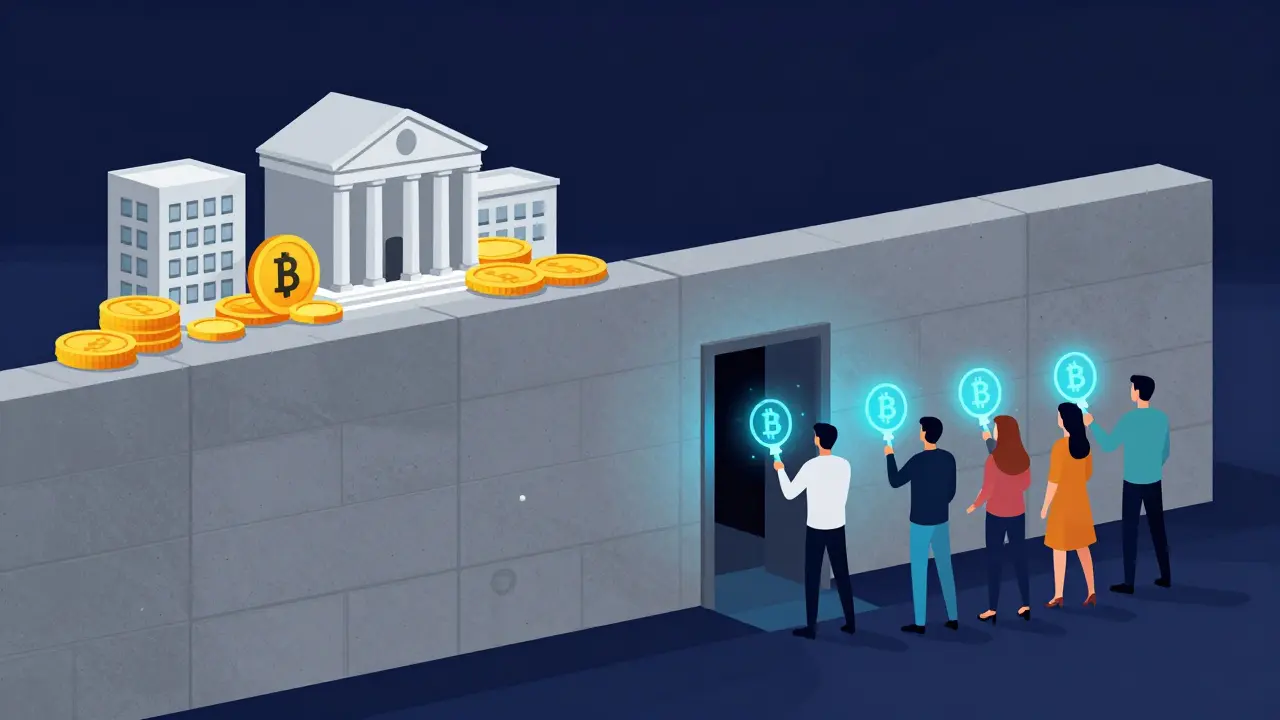
Imagine waking up to find that your bank account is useless for international transfers, and the only way to pay for a simple import or send money to family abroad is through a digital asset. For millions of people in Iran, this isn't a hypothetical scenario-it's daily life. The FATF blacklist is a formal 'Call for Action' by the Financial Action Task Force that identifies countries with severe gaps in their anti-money laundering and counter-terrorist financing systems. Because Iran remains on this list, it is effectively severed from the global financial grid, turning cryptocurrency from a speculative investment into a survival tool.
The Financial Wall: Why the Blacklist Matters
When a country is blacklisted by the FATF, it isn't just a diplomatic slap on the wrist. It triggers mandatory "countermeasures." Global banks are forced to apply extreme scrutiny to any transaction involving Iranian entities. This has led to a collapse in correspondent banking; according to World Bank data, Iran's banking relationships plummeted from 28 in 2018 to just 3 by 2025. When the traditional windows close, people look for the only door left open: the blockchain.
This financial isolation has created a paradox. While the blacklist is meant to stop illicit money flows, it has actually accelerated the adoption of cryptocurrency. By late 2025, an estimated 18.7 million people in Iran-about 42% of the adult population-were using crypto. It's no longer about "trading the dip"; it's about avoiding total economic paralysis.
How Iranian Users Navigate the Crypto Maze
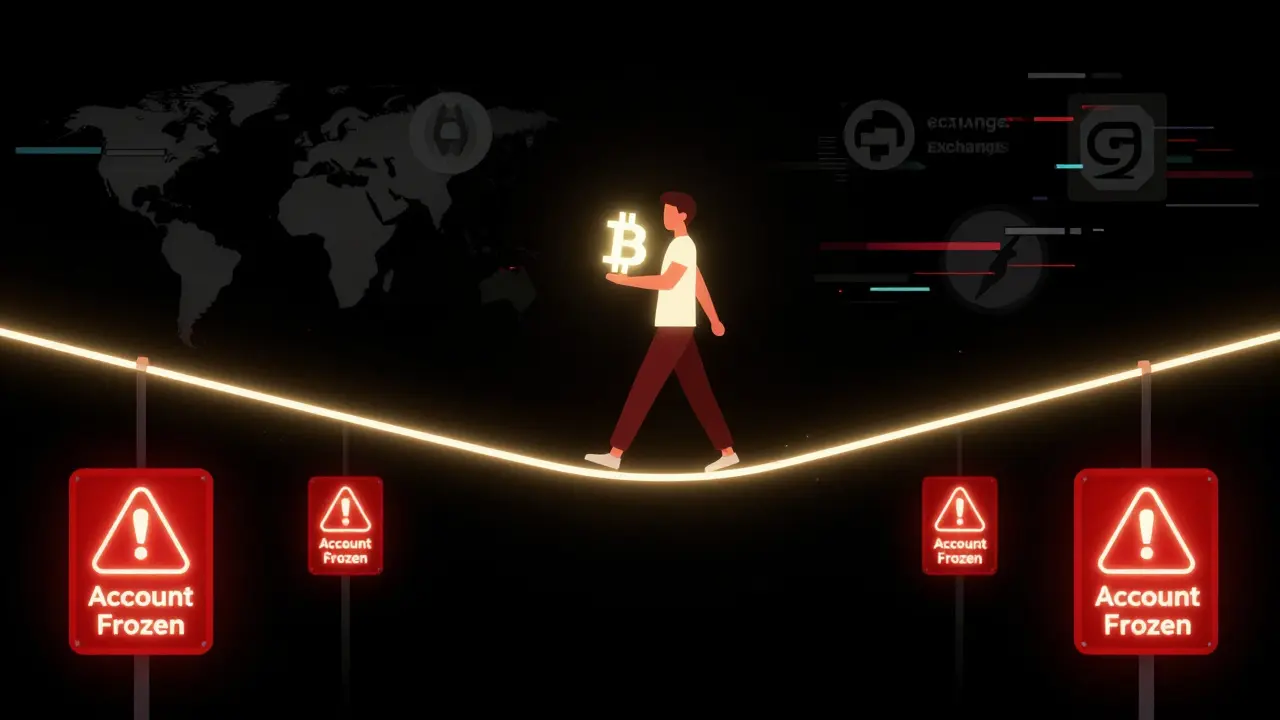
Using crypto in a blacklisted zone is like walking a tightrope. Users generally split their activity between two worlds: domestic exchanges and global platforms. Domestic platforms like Nobitex and Wallex provide a safe harbor for local trading, but they operate under "halal blockchain" frameworks that often block cross-border transfers. To actually move money out of the country, users have to head offshore.
The risks here are massive. Global exchanges like Binance or Bybit require identity verification (KYC) that clashes with the FATF's "Travel Rule." This rule requires exchanges to share sender and receiver information for transactions. For an Iranian user, providing a real ID can lead to an immediate account freeze. In fact, a survey of 14,200 users showed a 33% account freeze rate on global platforms. Many users now try to fly under the radar by keeping transaction values under $1,500 to avoid triggering automatic red flags.
| Method | Success Rate | Primary Risk | Average Cost/Premium |
|---|---|---|---|
| Domestic CEX (e.g., Nobitex) | High | Limited cross-border utility | Low |
| Global CEX (e.g., Binance) | Low/Medium | Account freezes/KYC blocks | Medium |
| P2P Trading (LocalBitcoins) | 78% | Counterparty fraud | 22% Premium |
| DEXs (e.g., PancakeSwap) | 63% | High slippage/Liquidity gaps | 15% Slippage |
The Dominance of Bitcoin and Privacy Tools
When you're fighting a global financial blockade, you want the most censorship-resistant tool available. That's why Bitcoin (BTC) remains the king of the Iranian market, accounting for 78% of transactions in sanctioned zones during 2024. Its decentralized nature makes it the gold standard for those trying to bypass the SWIFT system.
Beyond Bitcoin, there is a growing reliance on non-custodial wallets. Tools like Trust Wallet and Exodus allow users to hold their own keys, removing the risk of a central company freezing their funds. About 92% of Iranian crypto transactions now originate from these mobile wallets. For those needing even more anonymity, Monero (XMR) is used by a smaller but dedicated group to mask transaction trails from both international regulators and domestic surveillance.
The Dark Side: Sanctions Evasion and Systemic Risk
It's not all about individual survival. A significant portion of this activity is focused on high-level sanctions evasion. Reports from the Middle East Institute suggest that 78% of crypto activity in Iran serves as a way to bypass sanctions, with 61% of transactions used specifically to pay for prohibited imports. This has put Iran in the crosshairs of the OFAC (Office of Foreign Assets Control), which continues to designate Iranian crypto mixers as sanctioned entities.
This creates a dangerous environment for the average user. When a major offshore exchange-like the UAE-based Rain-suddenly suspends Iranian accounts following an FATF update, users can lose everything instantly. In one documented case, 317 users lost a collective $4.1 million in a single sweep. The reliability of the infrastructure is fragile, with many users reporting frequent outages due to the Central Bank of Iran throttling internet traffic during peak hours.
Looking Forward: Can Iran Get Off the List?
There have been attempts to play by the rules. Iran has conditionally approved several international conventions regarding the suppression of terrorism and organized crime. However, the FATF is notoriously slow to grant "gray list" status. Until there is a visible shift in how Iran handles its financial reporting and AML frameworks, the blacklist remains the status quo.
Interestingly, the Iranian Central Bank is trying to build its own ecosystem, such as the "Halal Stablecoin" pegged to gold. While it saw an initial surge of 4.2 million users, it remains an island. Without the approval of the FATF, these internal tokens can't easily connect to global liquidity pools, leaving them as a domestic tool rather than a global bridge.
Why does the FATF blacklist specifically hurt crypto users?
The blacklist forces global exchanges to implement strict "countermeasures." This means they must perform enhanced due diligence on anyone from a blacklisted country, often leading to account freezes or the complete blocking of Iranian IP addresses and identities to avoid regulatory penalties.
What is the 'Travel Rule' and how does it affect Iranians?
The Travel Rule requires Virtual Asset Service Providers (VASPs) to exchange sender and receiver information for transactions. For Iranians, this is a major risk because it creates a digital paper trail that can lead to their accounts being flagged and frozen by international exchanges adhering to FATF standards.
Which cryptocurrencies are most popular in Iran?
Bitcoin is the most dominant asset due to its censorship resistance, making up nearly 78% of sanctioned jurisdiction transactions. Ethereum is also used, along with privacy-focused coins like Monero for those seeking to hide their transaction history.
Are non-custodial wallets safer than exchanges for Iranian users?
Yes, generally. Because non-custodial wallets (like Trust Wallet) allow the user to control their own private keys, there is no central authority that can freeze the funds based on a user's nationality or a change in FATF status.
Can Iranian users avoid the 22% premium on P2P trades?
Avoiding premiums is difficult because of the high risk buyers and sellers take. While decentralized exchanges (DEXs) can offer better rates, they often suffer from low liquidity and high slippage, which can sometimes offset the savings compared to P2P markets.
26 Responses
It's really eye-opening to see how people in different parts of the world turn to tech just to survive. The resilience of the Iranian people in finding these workarounds is quite impressive.
The claim that Bitcoin is a 'gold standard' for bypassing SWIFT is a bit of an oversimplification. While it works for small sums, the liquidity issues for large-scale corporate imports are still a nightmare regardless of the blockchain used.
The Travel Rule is basically a death sentence for privacy. It's wild that we're moving toward a world where every single satoshi is tracked by a government agency. For people in sanctioned zones, this isn't just a policy change, it's a direct threat to their financial autonomy.
who actually believes the fatf is about terrorism anyway lol just a tool for big banks to gatekeep the global economy
Non-custodial wallets are the only way to go. If you keep your money on an exchange, you don't actually own it. Simple as that.
Imagining that a 'Halal Stablecoin' would actually gain global traction is just cute. It's a centrally controlled token that'll likely be used for domestic surveillance before it ever hits a liquidity pool. Truly an amateur effort by the Central Bank.
Notice how the 'Travel Rule' is being pushed globally. This isn't about Iran; it's about the total surveillance of all capital. Once they have the infrastructure to freeze Iranian accounts, they'll apply it to anyone who disagrees with the current regime. The blockchain is being hijacked by the very people who claimed it was impossible to regulate.
They are just using crypto to hide the money they steal from the poor. It is all a big scam and the FATF is the only thing stopping them from buying more weapons.
It makes me wonder about the ethical balance here. On one hand, we have international law trying to prevent terror funding, but on the other, we have millions of innocent civilians who can't even send money to their parents. The human cost of these systemic 'countermeasures' is often ignored in the high-level reports.
just use monero and stop complaining lol
The sheer audacity of the global financial system to act as the moral arbiter while simultaneously strangling the average citizen's ability to buy bread is a delicious irony. We're basically watching a real-time experiment in forced evolution where the state is the predator and the blockchain is the only camouflage left.
typical 🙄 people think crypto is the solution but its just another way to gamble away your life savings while the govt laughs at you
That 22% premium on P2P is just heartbreaking... imagine losing a quarter of your money just to move it from one place to another. It's such a wild ride for those users
When we analyze the intersection of geopolitics and decentralized finance, we see that the FATF blacklist serves as a catalyst for an inevitable shift toward non-custodial systems. The traditional banking model relies on trust and central authority, both of which are absent in this scenario, leading to a fragmented financial landscape where the user is forced to become their own bank, not out of ideological preference, but out of sheer necessity for survival in a hostile economic environment.
Oh my goodness, it is just so tragic that people have to risk their entire savings just to avoid a frozen account! My heart goes out to everyone struggling through this systemic nightmare. It's absolutely devastating that a few regulations can cause such immense suffering for innocent famillies.
Love seeing how the community adapts! 🚀 The way people use Trust Wallet to keep their keys safe is the real spirit of crypto. Stay strong everyone! 🌍💪
The obsession with these 'halal stablecoins' is truly laughable. It's an exercise in futility to create a closed-loop system and expect it to function as a bridge to a global economy that fundamentally rejects its origin. 🤡 Absolute mediocrity in financial engineering.
The fact that 78% of this is used for sanctions evasion proves that crypto is just a tool for criminals. Anyone defending this is basically supporting illegal activity.
This whole post is just a glorified manual on how to get your account banned from Binance. Who actually thinks this is useful info?
Our regional financial systems are always the ones getting squeezed by these western rules! It's a total disgrace how they treat the global south! 🇮🇳
absolute joke of a system the fatf is just a puppet for the us treasury and anyone with half a brain can see that the 'blacklist' is just a political tool to keep certain regions in the dirt
Fascinating insight into a very niche but critical use case for BTC.
I wonder if there are ways to help users find safer DEXs that don't have such high slippage. Maybe some community-led liquidity pools could help?
It is quite sobering to reflect upon the fragility of one's assets when relying on centralized entities. Please, exercise extreme caution. 😟
I absolutely agree with the point about non-custodial wallets! It's truly the only way to ensure your funds aren't just vanished by some corporate entity due to a sudden policy shift! The tragedy of the $4.1 million loss is just harrifying!
The contrast between the domestic 'halal' framework and the global offshore struggle is a very specific kind of friction. It creates this weird two-tier system where you're safe but trapped, or free but endangered.