
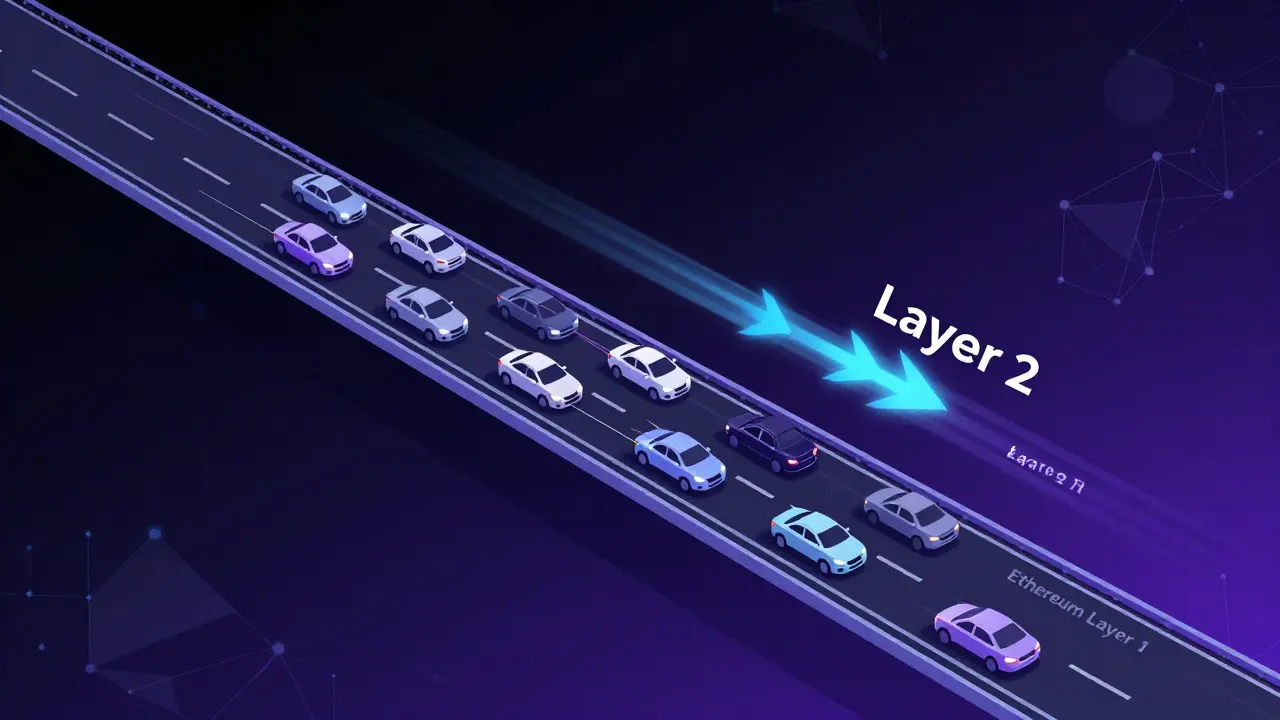
Remember when sending a simple ETH transfer cost $50 and took 10 minutes because the network was jammed? That wasn’t a glitch-it was the norm on Ethereum in 2021. Today, you can swap tokens, mint an NFT, or stake in DeFi for less than a penny and get confirmation in under two seconds. The reason? Layer 2 solutions. They didn’t just improve blockchain performance-they made it actually usable.
Why Layer 1 Just Isn’t Enough
Ethereum, the most popular blockchain for apps, can handle about 25 transactions per second. Bitcoin? Around 7. That’s slower than your old dial-up internet. When millions of people try to interact with DeFi protocols or mint NFTs all at once, the network backs up. Gas fees spike. Transactions sit in limbo. You pay more to get your trade through than the value of the trade itself. This isn’t sustainable. No one’s going to play a game or pay for digital art if every action costs $20 and takes minutes. Layer 1 blockchains were built for security and decentralization-not speed or low cost. They weren’t designed to be global payment rails. That’s where Layer 2 comes in.What Exactly Is a Layer 2?
Think of Layer 1 as the main highway. It’s safe, reliable, and monitored by thousands of nodes. But it’s always full. Layer 2 is like a private express lane built right on top of it. You enter the express lane, do all your driving there-swapping tokens, sending NFTs, executing smart contracts-then when you’re done, you merge back onto the main highway with one single transaction that proves everything you did was valid. This is called off-chain processing. Instead of every single transaction being recorded on Ethereum’s blockchain, only the final summary is. That cuts down the load by 90% or more. The result? Faster speeds, way lower fees, and no more network meltdowns during NFT drops.How Fast Are Layer 2s Really?
Layer 1 confirmation times? 12 to 15 seconds on Ethereum, sometimes minutes during congestion. Layer 2? Most settle in under 2 seconds. Polygon, one of the most widely used, processes blocks every 2.1 seconds. Arbitrum and OP Mainnet are similar. Some, like zkSync and Starknet, can confirm transactions in under a second. Compare that to traditional payment systems. Visa handles around 24,000 transactions per second. Layer 2s aren’t there yet-but they’re close. Polygon can do 65,000 TPS in theory. Even in real-world use, they’re handling 1,000 to 5,000 TPS consistently. That’s enough to support massive gaming platforms, social apps, and DeFi protocols without a single user noticing lag.How Much Do Transactions Actually Cost?
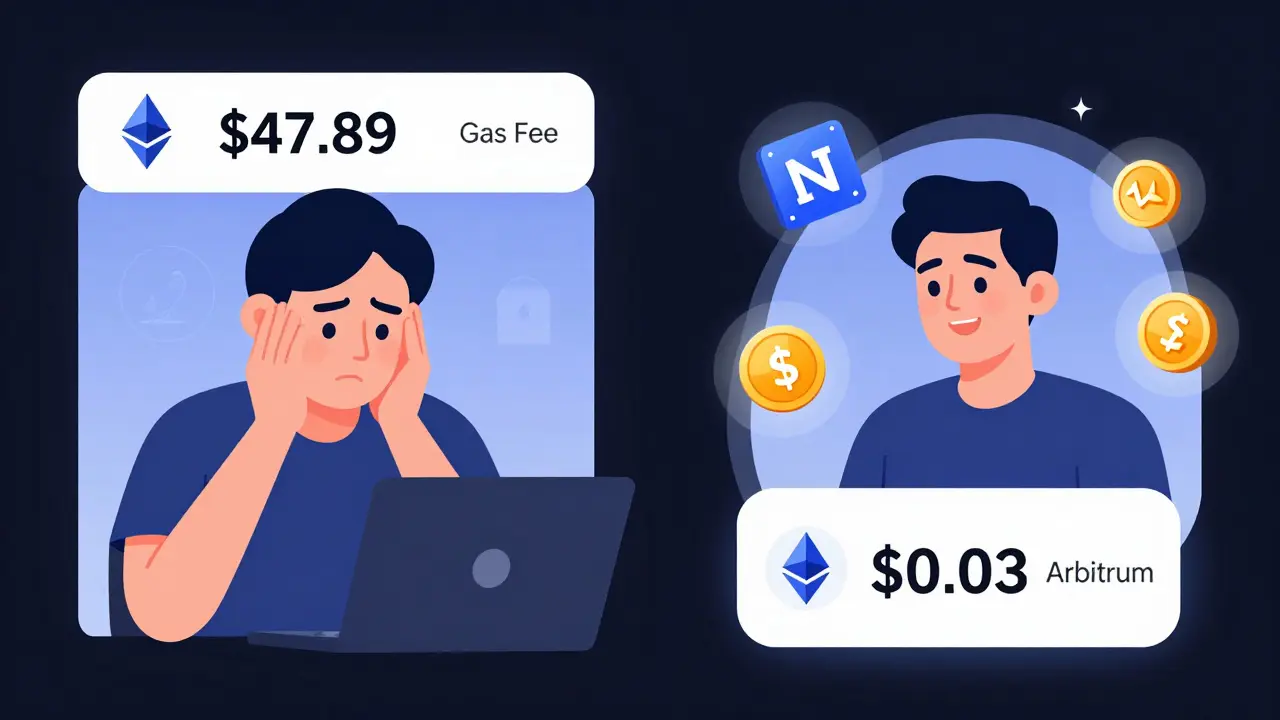
On Ethereum mainnet during peak times, a simple token swap could cost $15 to $50. In 2025, on Arbitrum or Polygon, the same swap costs between $0.01 and $0.10. That’s not a 90% reduction-it’s a 99% drop. Here’s what that means in practice:- Buying an NFT? $0.05 instead of $30.
- Yield farming with frequent deposits and withdrawals? $0.02 per action instead of $20.
- Playing a blockchain game with 10 actions per minute? $0.20 per hour instead of $200.
Rollups: The Engine Behind the Speed
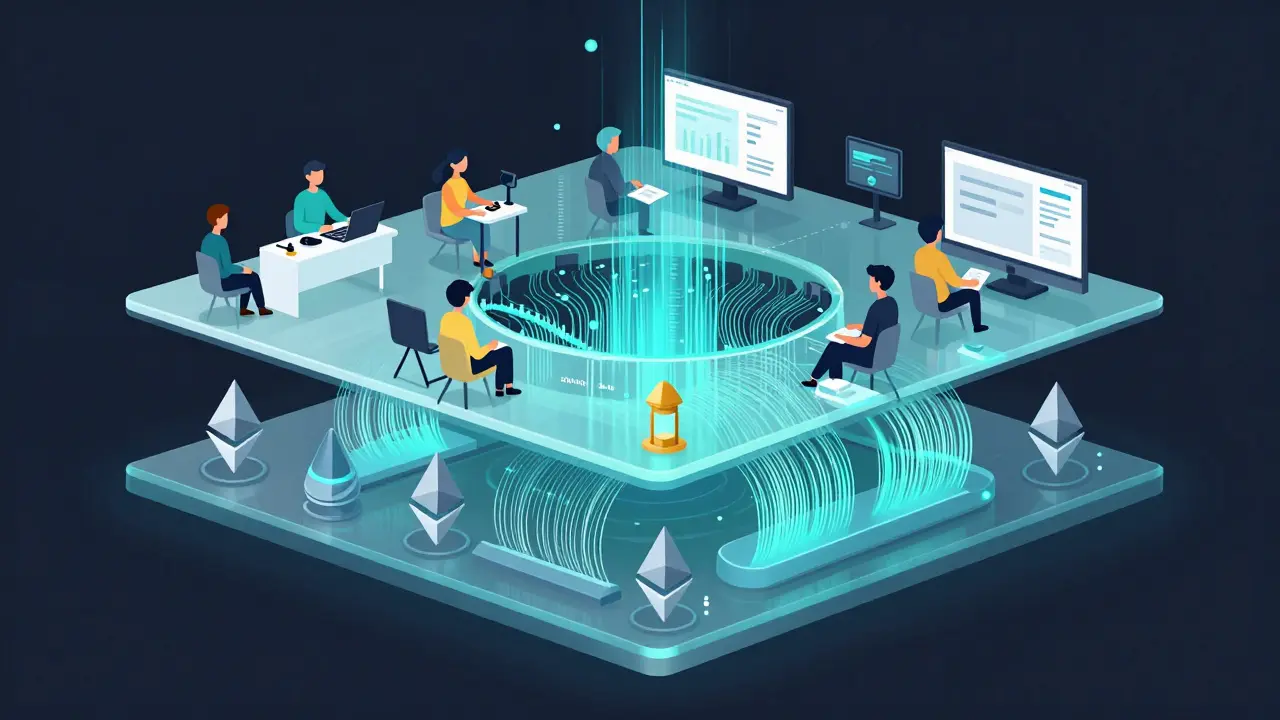
Most Layer 2s today use rollups. There are two main types: Optimistic Rollups and zk-Rollups. Optimistic Rollups assume transactions are valid unless someone proves otherwise. They’re faster to build and compatible with existing Ethereum tools. That’s why Arbitrum and OP Mainnet use them. They’re great for DeFi and apps that need to plug into Ethereum easily. zk-Rollups use zero-knowledge proofs to mathematically prove transactions are correct without revealing details. They’re more secure and faster to finalize. zkSync and Starknet use this. They’re better for high-frequency trading, gaming, and anything where finality matters. Neither is “better.” It depends on what you need. If you’re building a DeFi app, Optimistic Rollups give you faster deployment. If you’re building a game with 100,000 players hitting the blockchain every minute, zk-Rollups give you cleaner, faster settlement.Security: Do Layer 2s Still Trust the Blockchain?
A common fear: “If transactions happen off-chain, are they safe?” Yes. Layer 2s don’t replace Ethereum’s security-they inherit it. All rollups eventually post transaction data back to Ethereum. Even if the Layer 2 node goes down, users can still withdraw their funds directly to Ethereum. That’s the safety net. zk-Rollups are considered more secure because they prove validity mathematically before posting. Optimistic Rollups rely on a 7-day challenge window where anyone can dispute a fraudulent transaction. It’s a trade-off: zk-Rollups are faster to finalize; Optimistic Rollups are easier to build on. Either way, your funds are still anchored to Ethereum. That’s why institutions and big DeFi protocols trust them.What Are the Top Layer 2s in 2026?
Here are the five most used Layer 2s today, and why they matter:- Polygon: The oldest and most adopted. EVM-compatible, low fees, great for NFTs and simple DeFi. Used by Disney, Reddit, and Nike.
- Arbitrum: Leading Optimistic Rollup. High throughput, strong developer tools. Home to Uniswap, GMX, and other top DeFi apps.
- OP Mainnet (Optimism): Also Optimistic Rollup. Focused on sustainability and public goods funding. Used by Coinbase and Aave.
- zkSync: zk-Rollup with near-instant finality. Growing fast in DeFi and gaming. Supports token bridging and wallet integration.
- Starknet: Another zk-Rollup, built for complex smart contracts. Used by major enterprise projects and decentralized AI platforms.
Who’s Using Layer 2s-and Why?
It’s not just traders. Real people are using Layer 2s for things they couldn’t before:- Gamers: Play-to-earn games like Illuvium and Star Atlas run on zk-Rollups. Players can buy skins, trade items, and claim rewards without paying $10 per click.
- Artists: NFT creators mint thousands of pieces on Polygon for under $10 total. No more waiting for gas fees to drop.
- Developers: Building dApps on Arbitrum is 10x cheaper than on Ethereum. Startups can launch without raising $2 million just to cover gas.
- Developing countries: People in Nigeria, Brazil, and India use Layer 2s to send remittances for pennies. No banks. No delays.
How to Choose the Right Layer 2
If you’re using a wallet like MetaMask or Phantom, you don’t need to understand all this. But if you’re building, trading, or investing, here’s what to ask:- Speed: Do you need sub-second confirmations? Go zk-Rollup.
- Cost: Are you doing high-frequency trades? Pick the cheapest option-Polygon or Arbitrum.
- Compatibility: Are you moving an existing Ethereum app? Stick with EVM-compatible chains like Arbitrum or Polygon.
- Security: Are you moving large sums? zk-Rollups offer faster finality and stronger fraud resistance.
- Future-proofing: Is the chain backed by major teams? Arbitrum, Optimism, and Starknet have strong funding and developer support.
The Future: Layer 2s Are Here to Stay
Layer 2s aren’t a temporary fix. They’re the new foundation. Ethereum’s roadmap now assumes Layer 2s are the default. Even Coinbase and Binance have moved most trading volume off their own chains and onto Arbitrum and Polygon. The next wave? Cross-chain bridges between Layer 2s. Imagine sending an NFT from Polygon to zkSync in 3 seconds, with no gas fee. That’s already being built. What’s clear: blockchain’s future isn’t about bigger blockchains. It’s about smarter ones. Layer 2s made that possible. They turned a slow, expensive system into something fast, cheap, and real.If you’re still using Ethereum mainnet for daily transactions, you’re paying a premium for nothing. Layer 2s aren’t optional anymore-they’re the only way to use blockchain without losing your mind.
Are Layer 2s safer than Layer 1 blockchains?
Layer 2s are not safer than Layer 1-they’re built on top of them. Ethereum’s security is still the bedrock. All Layer 2 transactions are eventually settled on Ethereum, so even if a Layer 2 node fails, your funds can still be withdrawn safely. Some Layer 2s, like zk-Rollups, add extra security through cryptographic proofs, making fraud nearly impossible. But the core safety comes from Ethereum.
Can I still use MetaMask with Layer 2s?
Yes. MetaMask automatically supports major Layer 2s like Arbitrum, Polygon, and Optimism. Just click the network dropdown in your wallet, select the Layer 2 you want, and you’re connected. You might need to add a small amount of ETH or native token (like MATIC) to pay for gas on that chain, but the setup takes less than a minute.
Do Layer 2s have their own tokens?
Some do, some don’t. Polygon has its own token (MATIC), used for staking and fees. Arbitrum and Optimism have native tokens too, but they’re mostly for governance. Others, like zkSync and Starknet, are still in early stages and don’t require a token for daily use. You don’t need to buy any token to use a Layer 2-just transfer ETH or another asset from Ethereum mainnet.
Why not just use Solana or Avalanche instead?
Solana and Avalanche are Layer 1s-they’re standalone blockchains. They’re fast and cheap, but they don’t inherit Ethereum’s security or ecosystem. If you want to use Uniswap, Aave, or OpenSea, you need to bridge your assets over, which adds risk and complexity. Layer 2s let you use all of Ethereum’s apps without leaving its security. That’s why they’re the preferred scaling solution for most DeFi and NFT projects.
Will Layer 2s make Ethereum mainnet obsolete?
No. Ethereum mainnet is the anchor. Layer 2s depend on it for security and final settlement. Even as more activity moves to Layer 2, Ethereum will remain the most important blockchain for custody, dispute resolution, and high-value transfers. Think of it like the internet’s backbone: Layer 2s are the local networks, but Ethereum is still the core infrastructure.
25 Responses
This is fire 🔥 No more $50 gas fees? I’m selling my old laptop to buy more ETH.
It’s remarkable how Layer 2s didn’t just optimize the system-they redefined what blockchain could mean for everyday people. The shift from technical novelty to practical utility is one of the most profound transitions in recent tech history.
In India, we’ve been using Polygon for remittances for over a year. My cousin sends money to his family in Kerala for less than the cost of a chai. No banks, no waiting.
So you’re telling me the solution to blockchain’s problems was… more blockchain?
i mean yeah layer 2s are cool but like... dont you think its kinda funny how we're all just building highways on top of highways like its a video game and we just unlocked the expansion pack? 🤔
This is just centralized control with a fancy crypto label. You think zk-proofs make it more secure? Nah. It’s just another gatekeeper with a whitepaper.
I’ve been on Arbitrum for months now. Honestly? I forget I’m even on a blockchain. It just works. Like using Uber but with crypto.
The notion that Layer 2s are ‘the future’ ignores the fundamental flaw: they rely on Ethereum’s security, yet their governance tokens are traded like casino chips. This isn’t progress-it’s financialization dressed as innovation.
Honestly, I used to be skeptical. But seeing how artists in Nigeria and gamers in Brazil are thriving on these networks? It’s not just tech-it’s access. That’s the real win.
America built the internet. Now we’re outsourcing our blockchain future to some zk-Rollup startup in San Francisco? Pathetic.
They’re not solving scalability-they’re creating a new layer of rugpulls. You think your funds are safe? Wait until the L2 sequencer gets hacked. Then you’ll see how ‘decentralized’ this really is.
Look, I get it. Layer 2s are cheaper. But let’s not pretend we’re not just moving the problem elsewhere. The gas fees are lower, sure, but now you’ve got tokenomics, bridge risks, liquidity fragmentation, governance drama, and five different wallet interfaces. It’s like trying to run a restaurant where every dish comes from a different kitchen with a different chef and half the ingredients are expired. We’re not scaling-we’re complicating.
This is a distraction. The real threat is not gas fees-it’s the quiet centralization of sequencers. Who controls the order of transactions? Who audits the proofs? Who owns the data? The answer is never public. This isn’t freedom. It’s surveillance with a blockchain logo.
They say Ethereum is the backbone. But what if the backbone is just a proxy for a few VC-backed teams? What if the ‘security’ is just a legal disclaimer? I’ve seen too many ‘decentralized’ projects vanish overnight.
I’ve used Polygon for a few NFT mints. It’s fast. But I still feel uneasy. I don’t fully understand how the proofs work. I just trust it because everyone else does.
Mate, this is the future. No more waiting. No more crying over gas. Just go and do. 🚀
I just watched my friend lose $8,000 because he bridged from Arbitrum to zkSync and the router got hacked. So yeah, ‘cheap’ doesn’t mean safe. It just means you lose your money faster.
My grandma in Ohio just bought her first NFT on Polygon. She didn’t know what a rollup was. She just clicked ‘mint’ and got a digital cat. That’s the real victory.
All this ‘speed’ and ‘low cost’ is just a bait-and-switch. You think you’re saving money? You’re just paying in attention, data, and trust. The real cost is invisible.
This is the moment blockchain stopped being a tech experiment and became a tool. If you’re still on mainnet, you’re not a pioneer-you’re a masochist.
I switched to zkSync last month. My NFT trading feels like a video game now. No lag. No stress. Just vibes. 🤙
In India, we don’t have credit cards. But we have phones. Layer 2s let us participate in global finance without banks. That’s not tech-it’s justice.
If you’re new to this, just pick one L2 that your favorite app uses. Don’t overthink it. MetaMask auto-detects them. Just add a little MATIC or ETH on that chain and go. You’ll thank me later.
I used to think crypto was for speculators. Now I see friends in rural Texas using Arbitrum to get paid for freelance design work. No PayPal holds. No 3-day waits. Just instant. It’s quiet. It’s powerful.
You people are naive. Layer 2s are just a temporary bandage. Ethereum’s throughput is still capped. The real solution is sharding, not rollups. And even then, you’re still relying on a centralized sequencer. This isn’t decentralization-it’s a corporate rebrand.