

The confusion is common. Many users see the Manta Network mentioned alongside exchanges like Binance or BitMart and assume it's a trading platform. In reality, Manta is the "pipes" that other apps run on. It's a modular blockchain ecosystem that uses zero-knowledge (ZK) technology to let users interact with apps without exposing all their private data. Think of it as a secure foundation for the next generation of DeFi, not a place to swap coins.
What Exactly Is Manta Network?
To understand Manta, you have to stop thinking about it as a store and start thinking about it as a city. It provides the land, electricity, and laws (the infrastructure), and then developers build "houses" (dApps) on top of it. Manta Network is a privacy-focused project that launched its mainnet on May 18, 2022. It doesn't just do one thing; it's split into two primary components that serve different purposes.
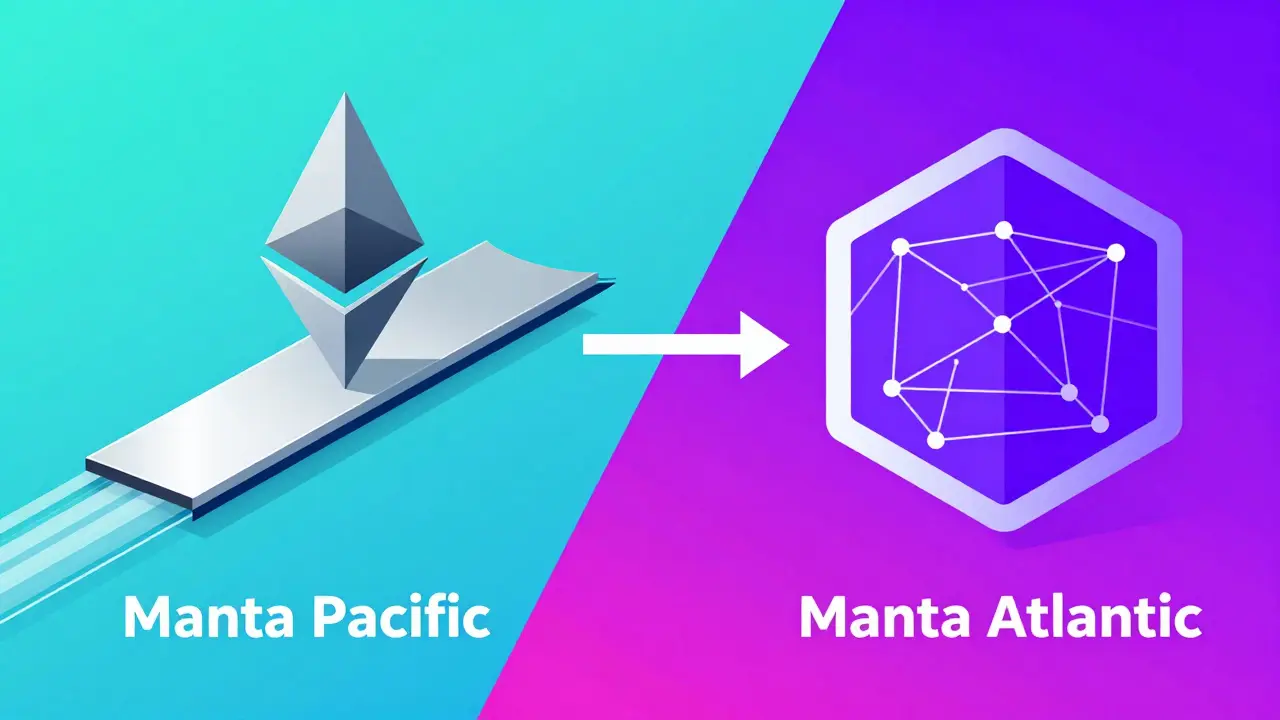
First, there is Manta Pacific. This is an Ethereum Layer 2 network. If you've ever felt that Ethereum is too slow or expensive, Manta Pacific solves that by using ZK-rollups to bundle transactions together and settle them on Ethereum. It's built for EVM-native applications, meaning developers can move their apps from Ethereum to Manta Pacific with very little effort.
Then there is Manta Atlantic. This is a ZK Layer 1 blockchain built on Polkadot. While Pacific focuses on Ethereum compatibility, Atlantic is all about providing a high-performance, privacy-preserving environment from the ground up.
| Feature | Manta Pacific | Manta Atlantic |
|---|---|---|
| Layer Type | Layer 2 (L2) | Layer 1 (L1) |
| Foundation | Ethereum | Polkadot |
| Primary Goal | Scalability & EVM Privacy | High-Performance ZK Privacy |
| Key Tech | ZK-Rollups | Parachain Architecture |
The Role of the MANTA Token
Since Manta isn't an exchange, the MANTA token doesn't function as a "platform coin" for fee discounts. Instead, it's a utility token that powers the entire ecosystem. If you hold MANTA, you're essentially holding a stake in the network's security and governance.
One of the most practical uses for the token is staking. Depending on which part of the network you use, the rules change. In Manta Pacific, you can engage in native staking, though you typically need a minimum of 500 MANTA tokens to get started. Manta Atlantic, on the other hand, supports liquid staking, which allows you to keep your assets more flexible while still earning rewards.
The tokenomics have been a rollercoaster. We've seen the price hit an all-time high of $4.08, but it has since faced massive volatility, sometimes dipping toward $0.11. For an investor, this means MANTA behaves more like a high-risk tech stock than a stable currency. Its value is tied directly to how many developers actually build on the network and how many users engage with the 47 active dApps currently in the ecosystem.
Privacy vs. Regulation: The Great Balance
Most privacy coins, like Monero, are "dark." They hide everything, which is great for privacy but a nightmare for regulators. Manta takes a different approach. It uses a decentralized identity layer. This allows the network to maintain privacy for the user while still providing a way to prove compliance with laws if necessary.
This is a critical distinction. As the European Union's MiCA regulations began taking effect in early 2025, projects that couldn't reconcile privacy with regulation found themselves in hot water. Manta's architecture is designed to survive this regulatory squeeze by offering "programmable privacy." You can choose what to hide and what to reveal, making it much more attractive to institutional players who can't afford to operate in total anonymity.
Is Staking MANTA Worth It?
If you're considering staking your tokens, you need to know that it's not a "set it and forget it" process. The system relies on collators-the people who actually run the hardware to validate transactions. To earn rewards, you have to delegate your tokens to these collators.
Here is the catch: you can't just pick any collator. To keep receiving rewards, you generally need to maintain a position among the top 100 delegators, and your chosen collator must stay within the top 70. If your collator drops in rank, your rewards might be suspended. It's a bit of a game of musical chairs that requires you to monitor the network health every few weeks.
On the plus side, users have praised the non-slashing mechanism. In many other networks, if your validator makes a mistake, the network "slashes" (steals) a portion of your staked coins. Manta's approach is more forgiving, which makes the 4% to 5% APY feel a lot safer for the average person.
The Verdict: Pros and Cons
Since this isn't an exchange, you can't judge it by "trading fees" or "customer support response times." Instead, you have to judge it by its utility as a piece of software. Does it do what it says?
The strengths are clear: it's one of the few projects successfully bridging the gap between Polkadot and Ethereum. The modular ZK architecture is genuinely impressive, and the identity layer solves a massive headache for legal compliance. However, the project has struggled with consistency. Some community members on Reddit have complained that the team hasn't delivered on mainnet promises as quickly as they hoped, and the token price has been punishing for those who bought at the top.
If you are a developer looking for a place to launch a privacy-focused DeFi app, Manta is a top-tier choice. If you are a trader looking for a new exchange, keep looking-Manta is the ground the exchange would be built on, not the exchange itself.
Can I trade crypto directly on Manta Network?
No. Manta Network is not a cryptocurrency exchange. It is a blockchain infrastructure provider. To trade MANTA tokens, you must use a third-party exchange like Binance or BitMart.
What is the difference between Manta Pacific and Manta Atlantic?
Manta Pacific is a Layer 2 network built on Ethereum, designed for scalability and EVM compatibility. Manta Atlantic is a Layer 1 blockchain built on Polkadot, focusing on native ZK privacy features.
How does staking work on Manta?
You delegate your MANTA tokens to a collator. Rewards are distributed every 6 hours. However, you must ensure your collator remains in the top 70 and you are among the top 100 delegators to keep receiving rewards.
Is Manta Network safe from government regulations?
While no project is entirely immune, Manta uses a decentralized identity layer that allows for regulatory compliance, making it more "regulation-friendly" than total-privacy coins like Monero.
What is the minimum amount of MANTA needed for staking?
For native staking on Manta Pacific, the minimum delegation requirement is typically 500 MANTA tokens.
Next Steps for Users
If you're new to the ecosystem, don't start by buying the token. Instead, visit a block explorer for Manta Pacific and look at the active dApps. See if there's a project-like a private lending protocol or a ZK-identity tool-that actually interests you. If the apps are useful, the network has value.
For those who already hold tokens and are seeing red in their portfolio, the move is to evaluate the roadmap. The introduction of cross-chain privacy pools and the full launch of the Atlantic mainnet are the two big catalysts that could determine if the token recovers or continues its slide. Keep an eye on the GitHub activity; as long as the developers are pushing code, the project is alive.
29 Responses
Finally someone clarifies this 🚀
The distinction between the Layer 1 and Layer 2 components is where most people get tripped up. Using ZK-rollups on Pacific effectively solves the gas fee bottleneck while maintaining the security of Ethereum. It is a sophisticated architecture that emphasizes the shift toward modularity in blockchain design, moving away from the monolithic approach where one chain tries to do everything. By separating execution from settlement, Manta can scale without compromising the core tenets of decentralization. This is the only way we actually get to mass adoption in the DeFi space.
It is quite simplistic to suggest that the identity layer solves regulatory issues. In reality, the efficacy of "programmable privacy" depends entirely on the implementation of the ZK-proofs and who holds the keys to the disclosure mechanisms. One must be precise: it is not a total solution, but rather a mitigation strategy against the inevitable clash between anonymity and global financial surveillance.
Oh look, another "groundbreaking" project that promises the moon and delivers a volatile token price. I love how we act surprised when a high-risk tech stock behaves like a high-risk tech stock. Truly a masterclass in financial masochism for the retail investor.
Great breakdown of the ecosystem! For anyone feeling overwhelmed by the technical jargon, just remember that the value comes from the tools developers build. If you are just starting out, maybe explore some of those 47 dApps and see what clicks for you. We are all learning together in this wild space!
It's funny how we focus on the "pipes" while ignoring the moral decay of chasing 5% APY. We've traded actual philosophy for digital tokens. Perhaps we should ask why we need this level of complexity to move value, or maybe we just like the feeling of being fooled by fancy words.
just a heads up for the newcomers if you're looking at staking definitely double check your collator rank every couple of weeks so you dont miss out on rewards
The non-slashing mechanism is basically a participation trophy for validators. It removes the necessary skin in the game that keeps a network truly honest. If there is no penalty for failure, you are just inviting inefficiency into the protocol.
too many words for something that basically just says the token price crashed
This modular hype is just another flavor of the same old soup. Everyone is rebranding "infrastructure" to hide the fact that there is no actual user demand for these specific privacy features in the real world.
My portfolio is bleeding red. Fix it.
Only Americans really get how to run these things right. The rest of the world just copies the code. Simple as that.
Imagine thinking that being in the top 100 delegators is a "game of musical chairs." It's more like a chore list for people who enjoy staring at spreadsheets on a Saturday night. But hey, enjoy those 4% gains while the inflation eats your soul.
Honestly the way this is explained makes it sound okay but if you actually look at the GitHub activity it is practically a ghost town compared to the marketing hype they've been pushing for months 🙄 it's just another project trying to survive the bear market by pretending their "identity layer" is a revolutionary breakthrough when it's really just basic ZK tech that has been around for years now.
I find the bridge between Polkadot and Ethereum to be such a beautiful metaphor for the interconnectedness of our digital future! 🌟 It is so important to approach these technical shifts with a heart of curiosity and a willingness to support the developers who are brave enough to build the foundations of our new world. Even when the market is volatile, we must remember that the true value lies in the utility and the community we build together. Let's keep encouraging each other to learn and grow in this space! 🌈✨
So it is just the base for apps and not a place to trade. Got it.
Who else is staking right now?? 💰 I just moved my bags over to Pacific! 🚀
The energy of this project is so chaotic 🙃 you either love it or you're losing money. There is no middle ground in the ZK world!
A pedestrian analysis. The author fails to grasp the sheer aesthetic tragedy of the token's descent. It is not a "rollercoaster," it is a plummet into the abyss of mediocrity.
I appreciate the clarity provided regarding the distinction between Manta Pacific and Manta Atlantic. It is a helpful summary for those seeking to understand the infrastructure.
the minimum staking amount is just to keep small players out it is not a fair system
This is such a helpful guide!!! I'm so excited to see where Manta goes from here!!!!
I'm just hanging out and watching the charts. Pretty wild ride.
Our tech will surpass this. Irrelevant.
If anyone is struggling to understand the staking part, just think of it like voting for a captain. You want a captain who is good at their job so you both get the rewards. Just keep an eye on them!
i tried to stake but the webiste was actting weird for me lol’ maybe i just did it wrnog
The mention of the MiCA regulations is particularly salient. Institutional adoption will be impossible without the exact type of "programmable privacy" Manta is implementing. Without a compliance bridge, ZK-technology remains a niche tool for cypherpunks rather than a viable financial infrastructure for the global market.
quite a vivid way to describe the network as a city the imagery really helps the concept land
Oh goodness, the volatility of MANTA is simply scandalous! 😱 I cannot imagine holding a bag that swings from $4 to $0.11 without losing my absolute mind! It is a theatrical performance of risk! 🎭