
The landscape of cryptocurrency trading shifted dramatically in 2025. If you hold Monero, Zcash, or Dash, you likely noticed that accessing these assets through major exchanges has become increasingly difficult. This is not a random glitch or temporary outage. It is part of a coordinated global movement known as the privacy coin delisting wave. In 2025 alone, 73 exchanges worldwide removed privacy-focused digital assets from their platforms. That represents a 43% increase from the previous year’s actions.
This surge in delistings stems directly from tightening regulatory pressure. Governments and financial watchdogs are demanding stricter compliance with Anti-Money Laundering (AML) and Counter-Terrorism Financing (CTF) laws. Privacy coins, by design, obscure transaction details, making it nearly impossible for exchanges to meet these new standards. As a result, users are being pushed out of traditional trading venues and into alternative, often less regulated, spaces.
The Regulatory Trigger: FATF Guidance and Global Compliance
To understand why this is happening now, we need to look at the Financial Action Task Force (FATF). In June 2024, the FATF issued updated guidance that fundamentally changed how cryptocurrency exchanges operate. The core issue is the "Travel Rule," which requires exchanges to share customer information for transactions above certain thresholds. For transparent cryptocurrencies like Bitcoin or Ethereum, this is manageable because every transaction is visible on a public ledger. Regulators can see who sent what to whom.
Privacy coins work differently. They use advanced cryptographic techniques to hide sender and receiver identities. When an exchange cannot verify the source or destination of funds, they face significant legal risks. Consequently, 97 countries implemented stricter compliance frameworks since 2024, leading to a 34% surge in regulatory actions against privacy coins. The European Union’s Markets in Crypto-Assets (MiCA) regulation alone reduced privacy coin offerings by 22% due to its transparency requirements.
| Regulatory Body / Law | Impact on Privacy Coins | Key Requirement |
|---|---|---|
| FATF Travel Rule Extension (2025) | Impacted 57% of privacy coin transactions | Mandatory sharing of customer data for cross-border transfers |
| EU MiCA Regulation | Reduced listings by 22% | Strict transparency and auditability standards |
| JFSA Guidelines (Japan) | Complete ban on registered exchanges | No support for non-compliant anonymous assets |
| FINTRAC Regulations (Canada) | Kraken delisted privacy coins in Canada | Enhanced reporting for virtual currency transactions |
Major Exchange Actions: Who Delisted What?
The delisting wave was not subtle. Major players moved quickly to protect their licenses and avoid hefty fines. In February 2025, Binance, the world’s largest cryptocurrency exchange, announced the removal of Monero (XMR), Zcash (ZEC), and Dash (DASH) across its European and US platforms. This single action impacted an estimated $600 million in trading volume. Binance cited compliance with local regulations as the primary reason.
Other exchanges followed suit. Kraken delisted privacy coins from its Canadian platform in March 2025, pointing to non-compliance with updated FINTRAC regulations. In South Korea, the top five exchanges, including Upbit and Bithumb, removed privacy coins in the first quarter of 2025. Upbit specifically delisted six privacy coins on September 30 after issuing a notice on September 20 that referenced FATF guidance. OKEx Korea also removed five privacy coins, ending support on October 10.
Even Poloniex joined the trend, delisting Monero globally in April 2025 after concerns were raised by the US Treasury Department. These actions demonstrate that government pressure is direct and effective. Exchanges are choosing compliance over user choice, prioritizing their operational survival over the availability of privacy-focused assets.
Technical Reasons: Why Privacy Coins Are Hard to Regulate
The conflict between privacy coins and regulators is technical at its core. Standard cryptocurrencies like Bitcoin leave a clear trail. You can trace a transaction from one address to another using blockchain explorers. Privacy coins eliminate this visibility using specific cryptographic methods.
- Ring Signatures: Used by Monero, this technique blends a user’s transaction with others. It makes it computationally difficult to identify the true sender among a group of possible signers.
- Zero-Knowledge Proofs (zk-SNARKs): Employed by Zcash, this allows a transaction to be verified as valid without revealing the underlying data, such as the amount transferred or the parties involved.
- Stealth Addresses: These obscure recipient information by generating unique, one-time addresses for each transaction, preventing linkability between transactions and user identities.
These features are exactly what regulators find problematic. The FATF’s 2025 Travel Rule extension requires exchanges to collect and share customer information. Privacy coins’ architecture makes this impossible to implement effectively. Without the ability to monitor transactions, exchanges cannot guarantee they are not facilitating money laundering or terrorist financing. This technical incompatibility is the root cause of the delisting wave.
User Adaptation: Moving to Decentralized Platforms
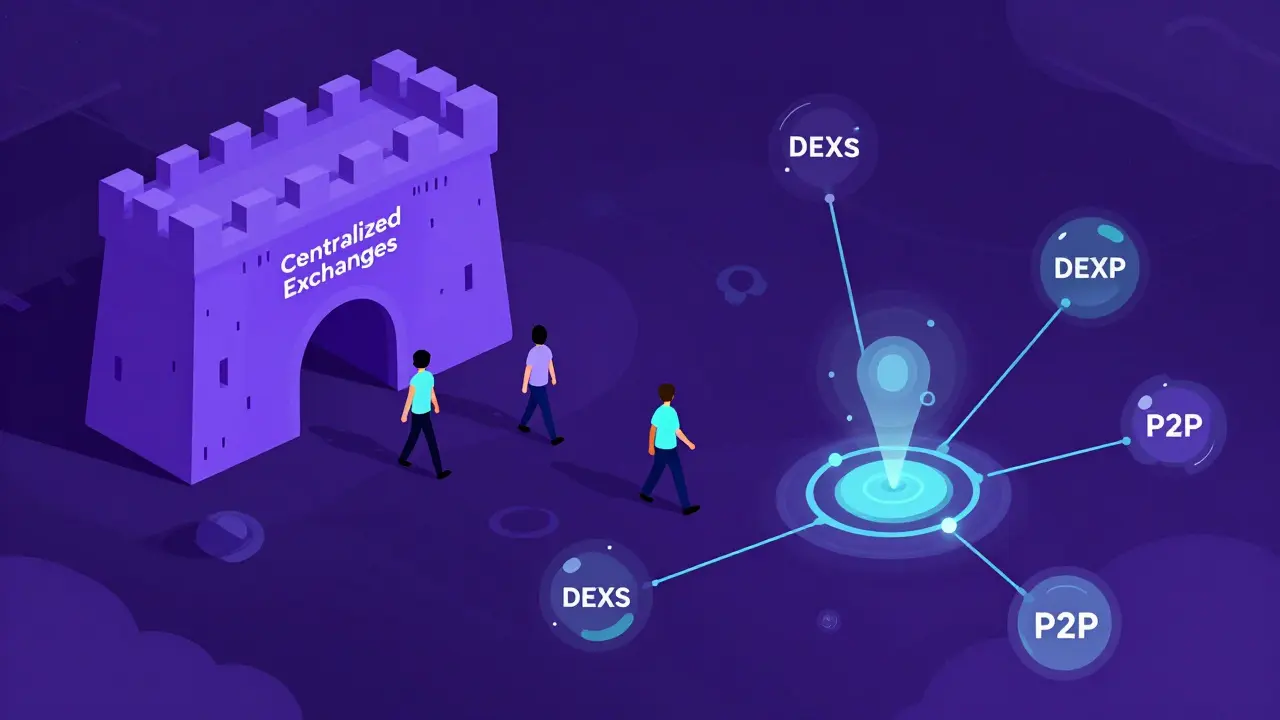
Faced with limited access on centralized exchanges, privacy coin users have adapted. Community sentiment reveals significant frustration but also resilience. Users are migrating to decentralized exchanges (DEXs) and peer-to-peer (P2P) trading platforms. LocalMonero, a P2P Monero trading platform, experienced a 19% uptick in activity following delistings on centralized exchanges.
Social media discussions on Twitter and specialized forums show users advocating for non-custodial solutions. Many criticize exchanges for prioritizing regulatory compliance over user privacy rights. However, there is also a pragmatic shift. Some users accept that regulatory compliance is necessary for mainstream adoption, while others view the delistings as a betrayal of cryptocurrency’s fundamental principles.
This migration creates a fragmented market. Trading volume concentration has shifted toward DEXs and atomic swap technologies. Institutional investors are reportedly showing increased interest in privacy coins as regulatory frameworks stabilize, but retail users face higher barriers to entry. The ease of buying Monero or Zcash has decreased significantly, pushing casual traders away and leaving the space to dedicated enthusiasts and those seeking anonymity for legitimate reasons.
Market Paradox: Price Surges Amidst Restrictions
Despite the negative news, privacy coins performed surprisingly well in 2025. Privacy cryptocurrencies gained 71.6% in value during the year, outpacing major cryptocurrencies like Bitcoin. This rally suggests strong underlying demand despite accessibility challenges. Reduced supply on major exchanges may have contributed to price appreciation, creating a scarcity effect.
However, adoption metrics tell a more nuanced story. Zcash experienced an 8% decline in shielded addresses due to strict KYC measures. This indicates that while speculative interest remains high, actual usage for private transactions is being constrained by regulatory friction. The price surge does not necessarily reflect healthy ecosystem growth but rather a reaction to limited liquidity and perceived risk.
Global Regulatory Landscape: A Patchwork of Rules
Implementation of privacy coin restrictions varies significantly by jurisdiction. This divergence creates geographic trading disparities. In some regions, privacy coins remain accessible under strict oversight, while in others, they are completely banned.
- Switzerland and Liechtenstein: Exchanges continue offering limited privacy coin services under strict Know Your Customer (KYC) and AML frameworks. These countries provide regulatory sandbox environments for continued trading.
- Singapore: Maintains a regulated approach allowing privacy coins with enhanced compliance monitoring.
- Japan: Maintains a complete ban implemented in 2018. All registered exchanges ceased support for privacy coins following JFSA guidance.
- South Korea: Prohibits exchanges from offering privacy coins entirely.
- Australia: Restricts privacy coin access, with institutional clients largely supporting removal to meet AML/CTF obligations.
- Dubai: Joined the prohibition group in 2023.
- European Union: Announced a comprehensive ban on privacy coins and anonymous cryptocurrency accounts starting July 2027 under new Anti-Money Laundering Regulation, affecting all 27 member states.
This patchwork creates complexity for global users. A trader in Singapore might still access Zcash, while a neighbor in Japan cannot. This inconsistency drives users toward borderless decentralized solutions, further reducing the influence of traditional financial institutions.
Future Outlook: Hybrid Solutions and Technological Evolution
The future of privacy coins hinges on technological innovation that balances privacy with compliance. Industry analysts predict that hybrid solutions combining selective transparency with privacy preservation may become the standard. Zero-knowledge proof implementations are being developed to enable AML compliance without completely compromising transaction anonymity.
These technologies could allow privacy coins to meet regulatory requirements while maintaining core privacy features. For example, a system might reveal transaction details only to authorized auditors or regulators when suspicious activity is detected, keeping everyday transactions private. However, 74% of privacy coin developers cite FATF rules as their biggest development challenge. Long-term viability depends on creating technologies that satisfy both user privacy demands and regulatory oversight requirements.
If privacy coins fail to evolve technically, they risk further marginalization in the mainstream cryptocurrency ecosystem. Conversely, successful hybrid models could restore trust with regulators and expand user bases. The next decade will define whether privacy technology survives as a niche tool or integrates into the broader financial infrastructure.
Why are exchanges delisting privacy coins like Monero and Zcash?
Exchanges are delisting privacy coins primarily due to increasing regulatory pressure. Global bodies like the FATF require exchanges to comply with Anti-Money Laundering (AML) and Counter-Terrorism Financing (CTF) laws. Privacy coins obscure transaction details, making it impossible for exchanges to verify the source and destination of funds. To avoid legal penalties and maintain their operating licenses, exchanges remove these assets.
Which major exchanges delisted privacy coins in 2025?
In 2025, several major exchanges delisted privacy coins. Binance removed Monero, Zcash, and Dash from its European and US platforms. Kraken delisted them from its Canadian platform. In South Korea, Upbit, Bithumb, and OKEx Korea removed multiple privacy coins. Poloniex also delisted Monero globally following US Treasury concerns.
How do privacy coins differ from Bitcoin or Ethereum?
Bitcoin and Ethereum transactions are recorded on public ledgers, revealing sender and receiver addresses along with transaction amounts. Privacy coins use cryptographic techniques like ring signatures, zero-knowledge proofs, and stealth addresses to obscure these details. This makes it difficult or impossible to trace who sent or received funds, providing greater anonymity.
Can I still buy privacy coins if they are delisted from exchanges?
Yes, but it is more difficult. Users are migrating to decentralized exchanges (DEXs), peer-to-peer (P2P) platforms like LocalMonero, and atomic swap technologies. While centralized exchanges restrict access, these alternative methods allow trading without intermediaries. However, this often involves higher fees, lower liquidity, and greater technical complexity.
What is the FATF Travel Rule and how does it affect privacy coins?
The FATF Travel Rule requires cryptocurrency exchanges to collect and share customer information for transactions above certain thresholds. This ensures transparency in cross-border transfers. Privacy coins’ technical architecture prevents exchanges from identifying senders and receivers, making compliance with the Travel Rule impossible. This incompatibility is a primary driver of delistings.
Are privacy coins banned in the European Union?
The European Union announced a comprehensive ban on privacy coins and anonymous cryptocurrency accounts starting July 2027 under new Anti-Money Laundering Regulation. This ban will affect all 27 member states. Currently, some EU exchanges may still offer limited access under strict KYC/AML frameworks, but full prohibition is imminent.
Did privacy coin prices drop after delistings?
Surprisingly, no. Privacy cryptocurrencies gained 71.6% in 2025 despite regulatory headwinds. This price surge likely reflects reduced supply on major exchanges and strong underlying demand. However, adoption metrics like Zcash’s shielded addresses declined by 8%, indicating that while speculation is high, actual usage is constrained by regulatory friction.