
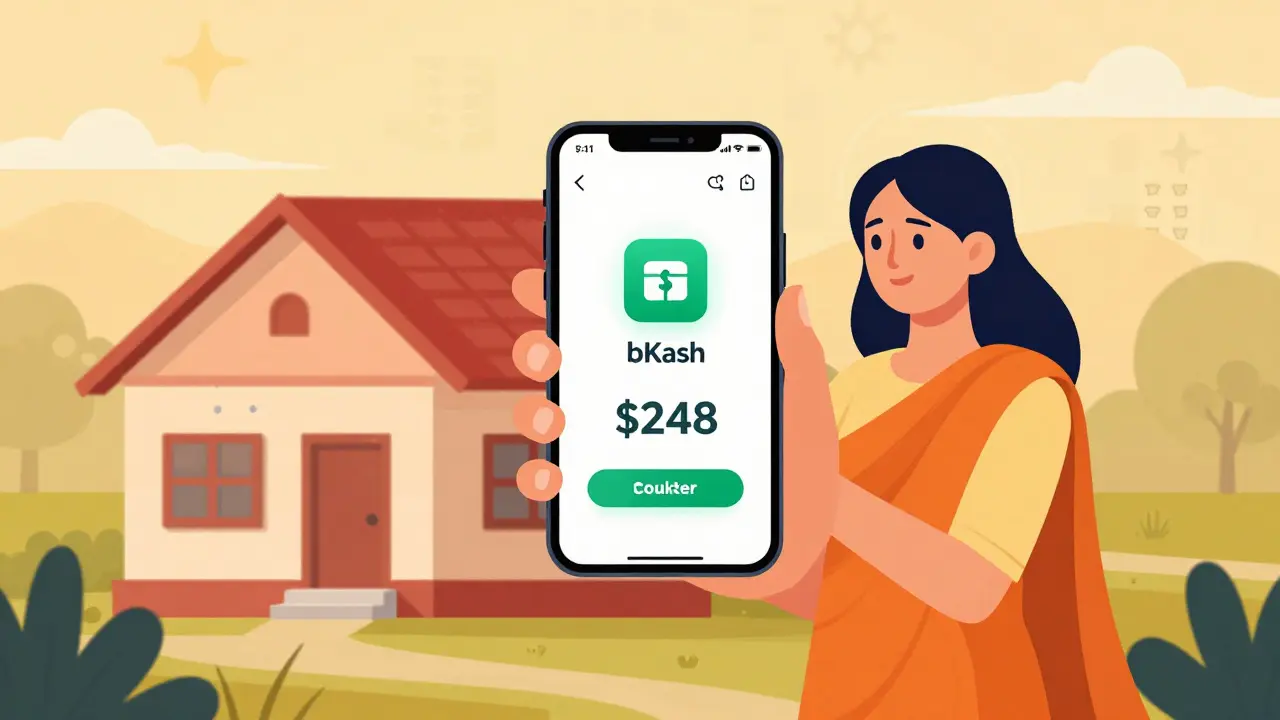
Every year, millions of Bangladeshi workers abroad send money home. In fiscal year 2024-25, that flow hit a record $30 billion. That’s more than the country’s entire ready-made garment export industry. It’s the lifeblood of families in Sylhet, Chittagong, and Dhaka. But here’s the twist: even as these remittances surge, using cryptocurrency to send money home is still illegal in Bangladesh.
Why Remittances Are So Big in Bangladesh
The numbers don’t lie. In March 2025 alone, Bangladesh received $3.29 billion in remittances - up 64.7% from the same month the year before. July 2025 saw $2.48 billion. The first nine months of FY2024-25 brought in $21.77 billion, compared to $17.07 billion in the same period the year before. That’s not just growth. It’s a tidal wave. This isn’t random. The Central Bank of Bangladesh, known as Bangladesh Bank, made three big changes. First, they moved to market-driven exchange rates. No more fixed, outdated rates that made sending money expensive. Second, they cracked down on hundi - the old, informal network of cash couriers and unlicensed agents that used to move billions outside the system. Third, they pushed mobile money apps like bKash and Nagad into every corner of the country. Now, a worker in Dubai can send money, and his wife in a village in Rajshahi gets it in minutes, not days. The result? Foreign reserves jumped to $25.63 billion. The country went from a $4.3 billion deficit to a $3.3 billion surplus. Remittances now make up 5.8% of Bangladesh’s entire GDP. That’s huge.How Remittances Work Today
Sending money to Bangladesh now involves a few clear paths. Most people use:- Direct bank transfers through authorized money transfer companies like Western Union or MoneyGram
- Mobile financial services (bKash, Nagad, Rocket)
- Agent banking networks - local shops that act as mini-banks
- Post office remittance services
The Crypto Ban: What’s Really Going On
Despite all this progress, cryptocurrency is still banned. Bangladesh Bank outlawed crypto in 2017 under Section 33 of the Foreign Exchange Regulation Act. The rule hasn’t changed. In September 2025, they issued a formal warning - Notice No. BB/CC/2025/17 - saying any company or individual helping with crypto remittances risks license revocation and criminal prosecution. Why? The central bank says crypto threatens monetary sovereignty. They worry about:- Loss of control over the national currency (the taka)
- Money laundering through anonymous wallets
- Volatility - if Bitcoin drops 30% overnight, a family’s rent money vanishes
- Undermining the formal banking system they’ve spent years building

What People Are Saying
Not everyone agrees with the ban. In Facebook groups like Bangladeshi Expats Worldwide (with over half a million members), 63% of users say they’re frustrated with high fees and slow transfers. But only 12% have tried crypto - not because they don’t want to, but because they’re scared of getting caught. On Reddit, one user from Dhaka wrote: “I sent $500 to my mom using bKash. Took 48 hours. Paid $35 in fees. My cousin in Canada tried sending it via USDT. Got it in 12 minutes. No fees. But I can’t do it. I’m scared.” Experts are split too. Dr. Khondoker Muzammel Huq, former head of Bangladesh Bank, called the remittance growth “a triumph of policy.” But Dr. Ahsan H. Mansur, head of the Policy Research Institute, warns the surge might be temporary - fueled by political shifts and global labor demand, not lasting change. The IMF agrees with the central bank. In their July 2025 report, they said: “Digital channels could help, but Bangladesh must strengthen its regulatory framework before considering crypto.” Translation: Fix the system first. Then maybe we talk.Why Crypto Isn’t the Answer - Yet
Let’s be clear: crypto isn’t magic. It doesn’t fix everything. Even if it were legal, most rural recipients don’t have smartphones, let alone crypto wallets. Many don’t know what a private key is. The average user needs to send money to a mother who can’t read. She needs cash, delivered fast and reliably. That’s not something blockchain can solve alone. Also, crypto exchanges aren’t regulated in Bangladesh. There’s no consumer protection. If a wallet gets hacked? No refund. If the exchange disappears? No recourse. The government’s system, while imperfect, at least has accountability. And let’s not forget: the cost of crypto isn’t always low. Gas fees, exchange spreads, and conversion charges can eat into savings. In practice, many crypto-based remittance routes end up costing just as much as traditional ones - if not more.
What’s Next?
Bangladesh Bank has a clear plan: go digital, stay regulated. By 2026-27, they want 95% of remittances processed digitally. They’re working on linking with India’s UPI system - that’ll help the 1.2 million Bangladeshi workers in India send money faster and cheaper. They’re also testing a central bank digital currency (CBDC), which would be a government-backed digital taka. That’s different from Bitcoin or Ethereum. It’s not decentralized. It’s controlled. And it’s legal. The goal isn’t to replace banks. It’s to make them better. Faster. More inclusive. More secure. Meanwhile, the crypto ban stays. No exceptions. No loopholes. Not even for remittances.Real-World Challenges Still Exist
Even with all the progress, problems remain. - High fees: 6.5% average cost is still too high. Some users pay 7% to send money from the UK. - Exchange rate gaps: Banks and mobile apps often offer different rates. One user lost $300 on a $500 transfer because the rate changed mid-process. - Access barriers: 18% of rural recipients still can’t use digital services because they lack ID, mobile registration, or bank links. - Delays: 7.3% of transactions still take longer than promised. These aren’t crypto problems. They’re system problems. And fixing them takes more than technology. It takes regulation, investment, and trust.The Bottom Line
Bangladesh isn’t anti-tech. It’s pro-control. The country has built one of the most successful formal remittance systems in the developing world. It’s fast, growing, and increasingly digital. But it’s also tightly managed. Crypto might seem like a better option - faster, cheaper, borderless. But in Bangladesh, the cost of freedom is too high. The government chose stability over disruption. And for now, that’s the path they’re sticking to. Until the rules change, sending crypto to Bangladesh remains illegal. And until the system fixes its own flaws - high fees, slow access, inconsistent rates - crypto won’t be the hero it’s made out to be.For millions of families, the real innovation isn’t blockchain. It’s a mobile app that works. A bank branch that opens on Sundays. A fee that’s finally fair.
23 Responses
The central bank’s stance is fundamentally sound from a monetary policy perspective. Cryptocurrencies operate outside the fractional reserve system, which undermines the central bank’s ability to conduct open market operations, manage liquidity, and enforce capital adequacy ratios. The taka’s stability isn’t just about exchange rates-it’s about the credibility of the entire credit architecture. Allowing crypto remittances would introduce an unregulated parallel monetary system, effectively creating a dual-currency environment with no lender of last resort. That’s not innovation; it’s systemic risk dressed up as progress.
Moreover, the volatility argument isn’t theoretical. A family relying on 0.5 BTC for monthly expenses could lose 40% of their purchasing power in a single weekend. No deposit insurance. No FDIC. No recourse. This isn’t about control-it’s about preventing financial catastrophe for millions of low-income households.
The IMF’s position is correct: strengthen the formal system first. Bangladesh has done remarkably well with bKash and Nagad. The real issue isn’t crypto-it’s the 6.5% fee gap. Fix that. Expand agent networks. Mandate interoperability. That’s where the real innovation lies-not in chasing unregulated digital assets.
Just want to say-this is actually really well explained. I didn’t realize how much progress they’ve made with mobile money. That’s impressive.
Of course the central bank bans crypto. Because control is their religion. They don’t care about the people-they care about maintaining a monopoly. The fact that they’re 'investing billions' into digital infrastructure is a red flag. Who’s funding it? Foreign aid? IMF loans? You think they’re doing this for the villagers in Sylhet? No. They’re doing it to keep the state in charge. Crypto isn’t dangerous-it’s liberating. And they know it. That’s why they fear it.
Also, 'money laundering through anonymous wallets'? Please. The hundi networks they cracked down on were far more opaque. At least with crypto, you can trace every transaction on-chain. They’re using fear to justify authoritarian control. Classic.
So let me get this straight. The government spent years building a system that’s faster and cheaper than before… and now they’re banning the one thing that could make it even better? Because ‘control.’
Right. Sure. And next they’ll ban bicycles because cars exist.
Let’s be real-this isn’t about financial stability. It’s about nationalism. Bangladesh doesn’t want its people using global tech. They want them dependent on state-approved apps. This is economic isolationism wrapped in policy jargon. The U.S. didn’t ban crypto. The EU didn’t ban crypto. But Bangladesh? Oh no, we’re special. We need to 'protect our sovereignty.' Bullshit. They’re scared of losing power. And they’re using poor families as collateral.
There is a deeper metaphysical truth here, my friends. The blockchain is not just technology-it is dharma. It is the law of decentralized truth. The taka, with its paper and ink, is maya-illusion. The central bank clings to the illusion of control, but the universe flows through nodes, not branches. When a man in Dubai sends USDT to his mother in Rajshahi, he is not sending money. He is sending truth. He is sending freedom. He is sending karma. And the state? The state is the ego that fears dissolution.
Why do they fear crypto? Because it reveals that power does not belong to institutions. It belongs to the people. And that terrifies them.
Om shanti. 🙏
There’s a lot of noise here, but the core issue is structural. The real problem isn’t crypto-it’s the lack of interoperability between financial systems. bKash and Nagad are siloed. They don’t talk to banks. They don’t talk to each other. They don’t talk to international gateways. Crypto’s real advantage isn’t speed-it’s composability. You can build a remittance pipeline that connects a U.S. bank account to a Bangladeshi mobile wallet without intermediaries.
But here’s the catch: you need regulation, not prohibition. If Bangladesh created a sandbox for regulated crypto remittance providers-licensed, audited, KYC’d, with consumer protections-you could have the best of both worlds. The central bank doesn’t need to ban crypto. It needs to regulate it. Like it does with Western Union.
The fact that they’re developing a CBDC shows they get it. They just don’t want to admit crypto’s role in the ecosystem. That’s political cowardice, not policy wisdom.
The institutional integrity of the financial architecture of Bangladesh is commendable. The strategic alignment of regulatory frameworks with macroeconomic objectives demonstrates a sophisticated understanding of monetary sovereignty. The persistence of formalized remittance channels, despite the allure of decentralized alternatives, reflects a prioritization of systemic resilience over speculative innovation. The central bank’s position is not reactionary-it is prophylactic. The introduction of unregulated digital assets would introduce systemic externalities that could destabilize the very gains achieved through years of disciplined policy implementation. One must consider not merely the technical feasibility of crypto, but its sociopolitical ramifications. The human cost of volatility, opacity, and regulatory arbitrage cannot be abstracted away. Stability, in this context, is not an obstacle-it is the foundation upon which inclusive growth is built.
Let’s cut the bullshit. The central bank doesn’t care about stability. They care about keeping people poor so they stay dependent. They’ve built this whole bKash empire so they can skim fees, track every transaction, and sell your data to advertisers. Crypto would cut them out. That’s why it’s banned. Not because it’s risky. Because it’s threatening. And now they’re pretending they’re protecting families when really they’re protecting their own turf. You think that 3.8% fee is for ‘efficiency’? Nah. That’s profit. And they’re not letting anyone else take a bite.
The irony is breathtaking. Bangladesh claims to be ‘modernizing’ while simultaneously enforcing a 2017 ban on decentralized finance. This isn’t policy-it’s performative authoritarianism. The CBDC they’re developing? That’s not innovation. It’s surveillance with a blockchain veneer. They want a digital taka because they want to know where every taka goes. Every purchase. Every transfer. Every meal. Crypto would make that impossible. So they ban it. Because they can’t control it. And control is their god.
Also, ‘volatility’? Please. The taka has lost 40% of its value against the dollar since 2019. But that’s ‘stability’? No. That’s collapse. And they’re pretending crypto is the problem when it’s the only escape hatch.
Look-I get why people are frustrated. But let’s not romanticize crypto. It’s not a magic wand. Most people in rural Bangladesh don’t have smartphones. They don’t know what a private key is. They don’t trust strangers online. The real innovation isn’t blockchain-it’s the fact that a woman in a village can now get money in minutes without walking 10 kilometers to a bank.
The government’s system is flawed, yes. But it’s *theirs*. And it’s working. People are using it. It’s growing. It’s accessible. Crypto? It’s a luxury for the tech-savvy. And that’s not the solution for 18% of rural households who still lack ID or mobile registration.
Let’s fix what we have. Expand agent networks. Lower fees. Make the app work offline. Train community volunteers to help grandmothers receive money. That’s real progress. Not crypto. Not hype. Real. Human. Practical.
What’s hilarious is how everyone acts like crypto is this revolutionary force. It’s not. It’s just another payment rail. And right now, the existing system is faster, cheaper, and more reliable than most crypto remittance routes. You think sending USDT from Dubai to Dhaka is free? Try converting USD to USDT, paying gas fees on Ethereum, then converting back to BDT on a local exchange with 5% spread and $10 withdrawal fee. Now you’re at 12%.
Also, 85% of remittances clear in under four hours. That’s better than most crypto networks. And it’s backed by a central bank, not a Discord group. The real story here isn’t crypto-it’s that Bangladesh built one of the few successful digital remittance ecosystems in the Global South. That deserves credit, not condescension.
wait so they banned crypto because of volatility but the taka is crashing? like… what? how is that not the same thing? also why is the fee 3.8% when the world bank says 3%? who’s pocketing the extra .8%? someone’s rich off this. also why can’t i send crypto to my aunt in sylhet? i have a phone. she has a phone. we both have wallets. why is this illegal? this makes no sense.
God bless Bangladesh for standing strong. 🙌 Crypto is a scam. Always has been. Always will be. The central bank is doing the right thing. Protecting families from wolves in sheep’s clothing. Keep going. 💪
Let me tell you what’s really happening here. This isn’t about regulation. It’s about power. The central bank has spent years building this system, and now they’re terrified that people will realize they don’t need them. They’ve turned bKash into a monopoly. They’ve turned every remittance into a data point. They track who sends money, when, how much, and to whom. They’re building a financial surveillance state under the guise of ‘inclusion.’ And they’re using ‘stability’ as a shield.
And now? They’re pushing a CBDC. A government-controlled digital currency. That’s not innovation. That’s Orwellian. They want to know if your mother bought rice. If your brother paid for medicine. If your sister sent money to her friend. That’s not progress. That’s control. And it’s terrifying.
The central bank's position is entirely rational. The introduction of unregulated digital assets into a developing economy with weak institutional capacity is not a viable option. The infrastructure required for secure crypto adoption-digital literacy, cybersecurity, legal recourse-is absent. The risks far outweigh the marginal benefits. One cannot impose Western technological paradigms on societies with different developmental priorities. The success of bKash demonstrates that context-specific innovation is superior to imported disruption. This is not resistance to change. It is prudent governance.
Crypto ban? Of course. They’re scared. The moment people start using it, they’ll realize the government’s system is a scam. Then what? Revolution. And they don’t want that.
Let’s not pretend this is about ‘stability.’ This is about corruption. The people running bKash and Nagad? They’re connected to the same elites who control the banks. They make billions in fees. They don’t want competition. Crypto would cut them out. So they ban it. And call it ‘policy.’ Classic. The people are being played.
There’s a quiet dignity in what Bangladesh has done. They didn’t chase hype. They didn’t try to be Silicon Valley. They looked at their people-mothers, laborers, students-and built something that actually works. It’s not perfect. But it’s real.
Crypto sounds cool. But it doesn’t feed a child. It doesn’t pay a school fee. It doesn’t fix a leaky roof. The real miracle isn’t blockchain. It’s a grandmother who gets money on her phone without knowing what a blockchain is. That’s the kind of progress that lasts.
Look. I get the frustration. I do. But let’s not throw the baby out with the bathwater. The system isn’t perfect-but it’s *alive*. It’s growing. It’s being used by millions. That’s more than most countries can say.
The answer isn’t crypto. It’s pressure. Demand lower fees. Demand better rates. Demand transparency. Write to your reps. Talk to your community. Use the app. Leave reviews. Make noise. That’s how systems change-not by replacing them with untested tech, but by making them better from within.
Bangladesh didn’t get here by accident. They got here because people cared. Let’s keep caring.
The approach taken by Bangladesh Bank is commendable. It reflects a deep understanding of the socio-economic realities of its population. The focus on formalization, accessibility, and regulatory clarity is not only prudent but necessary for sustainable development. The integration of mobile financial services with physical agent networks represents a model that other developing economies should study. Innovation must serve inclusion-not replace it.
Real progress is when money reaches your mother in minutes. Not when you're trading crypto on an app you don't understand.
Response to @2140: Your ‘liberation’ narrative ignores the human cost. A woman in Sylhet doesn’t care about ‘decentralized truth.’ She cares if her son’s $500 arrives on time so she can buy medicine. Crypto doesn’t guarantee that. A regulated bKash transfer does. Your idealism is beautiful. But it’s not practical. And in finance, practicality saves lives.