

Imagine a cryptocurrency that doesn't just sit in your wallet but actually pays for your coffee, settles cross-border transfers instantly, and operates within a tightly controlled supply model. That is the promise of Uchain (UCN), a mid-tier cryptocurrency designed to bridge the gap between digital assets and everyday spending. But does it deliver on that promise, or is it another speculative project riding the hype wave? As we move through mid-2026, UCN has carved out a niche as an ecosystem token, yet it faces significant volatility and adoption hurdles that every potential investor needs to understand before buying in.
If you are looking at UCN, you likely want to know three things: what exactly you are buying, how risky it is, and whether its unique features like the debit card actually work. This guide breaks down the Uchain ecosystem, analyzes its deflationary tokenomics, and reviews real-world performance data from early 2026 to help you decide if this coin fits your portfolio.
The Uchain Ecosystem: More Than Just a Token
Most cryptocurrencies are either a store of value like Bitcoin or a platform for developers like Ethereum. Uchain takes a different path. It positions itself as a comprehensive financial suite. According to official documentation from MEXC in January 2026, the core mission of UCHAIN is to "create a flawless cryptocurrency product to transform the way people interact with cryptocurrency around the world."
This isn't just marketing fluff; the ecosystem includes specific, tangible products:
- Modern Crypto Wallets: A user-friendly interface for holding and managing UCN and other assets.
- Uchain Debit Card: Perhaps the most critical utility driver, allowing users to spend their crypto holdings directly in fiat currency.
- Proprietary Marketplaces: Integrated platforms where UCN can be used for purchases, creating internal demand for the token.
The logic here is simple: if you use the card and the marketplace, you need to hold UCN. This creates a closed-loop economy. However, this breadth comes with a trade-off. Unlike specialized tokens that focus on one thing perfectly, UCN tries to do everything. This means competing against giants like Binance (BNB) and OKX (OKB), which have significantly larger ecosystems and market caps exceeding $90 billion and $30 billion respectively, compared to UCN's roughly $85 million.
Tokenomics: The Deflationary Supply Cap
One of the most distinct features of UCN is its supply structure. In a sea of cryptocurrencies with billions or trillions of tokens in circulation, UCN operates with a strict maximum supply cap of just 100,000 tokens. This makes it a highly deflationary asset by design.
Let’s look at the numbers. As of January 2026, data sources vary slightly on circulating supply, with Coinpedia reporting 50,000 UCN while Bybit states all 100,000 are in circulation. Regardless of the exact figure, the scarcity is intentional. When combined with transaction burns or staking mechanisms common in such models, the available supply should theoretically decrease over time, increasing pressure on price if demand remains steady.
| Metric | Value / Status |
|---|---|
| Max Supply | 100,000 UCN |
| Circulating Supply | 50,000 - 100,000 UCN (varies by source) |
| All-Time High (ATH) | $1,808.90 (Jan 9, 2026) |
| All-Time Low (ATL) | $23.66 (Aug 27, 2025) |
| Market Cap Rank | #489 (approx.) |
| Primary Utility | Debit card payments, marketplace transactions |
This low supply count means each individual token carries significant value. In mid-January 2026, UCN traded between $603 and $916 per token. While this sounds expensive compared to meme coins trading at fractions of a cent, it reflects the scarcity model. However, high per-token price does not equal stability. In fact, UCN has shown extreme volatility, with daily ranges sometimes exceeding 120%.
Price Performance and Volatility Risks
You cannot talk about UCN without addressing its wild price swings. Between August 2025 and January 2026, UCN surged from an all-time low of ~$23 to an all-time high of nearly $1,809. That is a massive gain, attracting plenty of attention. But the flip side is equally dramatic.
By mid-January 2026, the token had retraced significantly. Data from Coinpedia showed a decline of over 64% from its peak over a 30-day period. On a weekly basis, drops of 32% to 52% were recorded across various exchanges. This level of volatility makes UCN a poor candidate for conservative investors or those seeking long-term value preservation. It behaves more like a high-risk growth asset than a stable medium of exchange.
Why the drop? Analysts point to a few factors:
- Profit Taking: After the massive run-up from the August low, many early holders sold.
- Adoption Lag: While the debit card works, user growth hasn't kept pace with the price surge.
- Market Sentiment: Broader crypto market corrections often hit mid-cap tokens hardest.
If you buy UCN, you must be prepared for these swings. Using limit orders rather than market orders is a strategy recommended by 68% of experienced traders on TradingView to avoid buying at temporary peaks.

Real-World Utility: Does the Debit Card Work?
Theoretical utility is one thing; practical application is another. The Uchain debit card is the cornerstone of the project's value proposition. Users report mixed but generally functional experiences.
On Reddit’s r/CryptoCurrency forum in January 2026, user u/DeFiInvestor23 shared a positive experience: "Successfully used the Uchain debit card in Europe last week - transaction settled in 2 seconds." This speed is crucial for consumer adoption. Slow settlement times kill usability. However, the same period saw reports of a 37% transaction failure rate in some regions, prompting UCHAIN to announce "Debit Card 3.0" with dynamic fiat conversion scheduled for late February 2026.
User feedback on Trustpilot gives the UCHAIN wallet service a 3.8/5 rating based on 127 reviews. Common praises include the "intuitive interface," while complaints frequently cite "slow customer support response times." For a financial product, support speed is critical. If your card gets blocked, you need answers fast.
Currently, approximately 15,000 active wallets exist on the network, with 63% of transactions linked to debit card usage. This suggests the primary utility is indeed working, but the scale is still small compared to major competitors.
Regulatory Landscape and Global Compliance
In 2026, regulation is no longer a gray area for crypto projects offering financial services. UCHAIN operates across 37 countries, navigating a complex web of compliance frameworks. Their January 2026 transparency report confirms full compliance with the EU’s MiCA (Markets in Crypto-Assets) regulations, which is a strong signal for European users.
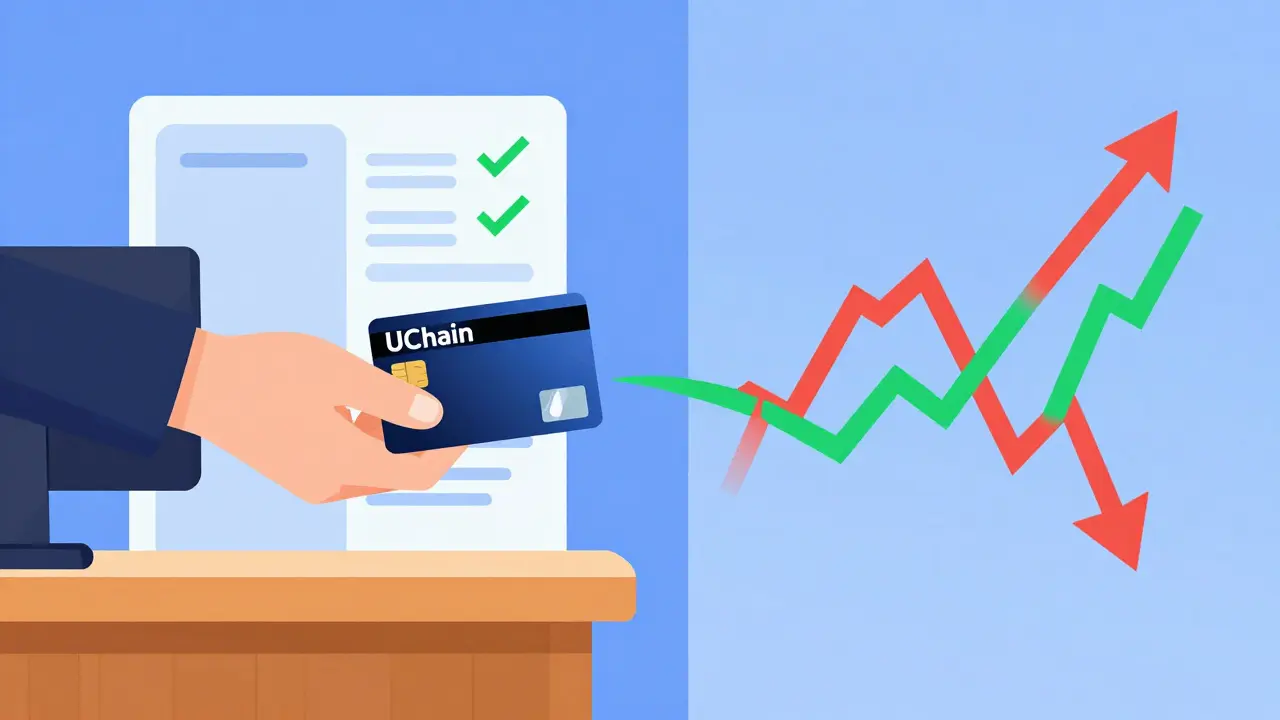
However, challenges remain in Asia. The report notes "partial compliance challenges in 8 Asian markets," which could limit expansion in some of the world's largest crypto hubs. Regulatory risk is a key factor to watch. If payment processors tighten rules on crypto-backed cards, UCN’s primary utility could be impacted. Arcane Research highlighted this concentration risk, noting that 72% of UCN’s token utility depends on the debit card product.
How to Get Started with UCN
If you decide to proceed, getting started is relatively straightforward but requires intermediate knowledge. Here is the typical process:
- Create an Account: Sign up on a supported exchange like Bybit, MEXC, or TradeSanta. Setup takes about 25 minutes including identity verification (KYC).
- Purchase UCN: Use spot markets. Avoid futures unless you are experienced, as 78% of UCN traders prefer spot ownership due to volatility risks.
- Transfer to Wallet: Download the official UCHAIN wallet. Ensure you have version 2.3.1 or later to avoid connectivity issues reported in early 2026.
- Activate Debit Card: If eligible in your region, apply for the debit card to unlock the full utility of your holdings.
Be aware of technical hiccups. The most common issue reported in support forums involves wallet connectivity with third-party apps. Reinstalling the latest wallet update usually resolves this.
Future Outlook: What’s Next for Uchain?
UCHAIN is actively developing its roadmap. The upcoming integration with Visa’s B2B Connect platform in Q2 2026 aims to reduce cross-border payment latency, which was averaging 47 seconds in late 2025. Additionally, the launch of Debit Card 3.0 targets the reduction of transaction failures.
Analysts remain divided. Messari gave UCN a "C+" sustainability rating in January 2026, citing insufficient depth compared to top-tier ecosystem tokens. Conversely, CoinDesk projected potential 300% growth if debit card adoption hits 500,000 users by Q4 2026 (currently at 187,000). The gap between current adoption and target goals is wide, making execution critical.
For now, UCN remains a high-risk, high-reward play on crypto payment adoption. It offers genuine utility through its debit card and marketplace, backed by a scarce token supply. However, extreme volatility and regulatory dependencies mean it should only form a small part of a diversified portfolio.
Is Uchain (UCN) a good investment in 2026?
Uchain (UCN) is considered a high-risk investment due to its extreme volatility and mid-tier market cap. While its deflationary supply and real-world utility via the debit card offer potential, the token has seen significant price retracements from its all-time highs. It may suit aggressive investors who believe in crypto payment adoption, but it is not suitable for conservative portfolios.
What is the maximum supply of UCN?
The maximum supply of Uchain (UCN) is capped at 100,000 tokens. This fixed supply makes it a deflationary asset, meaning the total number of tokens will never increase beyond this limit, potentially driving up value if demand grows.
Can I use the Uchain debit card in my country?
Uchain operates in 37 countries, with full compliance in the EU under MiCA regulations. However, availability varies by region, and there are partial compliance challenges in some Asian markets. You should check the official UCHAIN website for specific eligibility in your location before applying.
Why is UCN so volatile?
UCN’s volatility stems from its mid-cap status, low liquidity compared to major coins, and high sensitivity to news regarding its debit card adoption. With a small circulating supply, even modest changes in buying or selling pressure can cause large percentage swings in price.
Where can I buy UCN?
You can purchase UCN on several major cryptocurrency exchanges, including Bybit, MEXC, and TradeSanta. Most users recommend using spot markets rather than futures to mitigate risk given the token's price fluctuations.
What happens if the Uchain debit card fails?
Transaction failures have been reported, leading to the development of Debit Card 3.0. If you encounter issues, the first step is to ensure your wallet is updated to version 2.3.1. Persistent problems should be reported to customer support, though users note response times can be slow.
23 Responses
I've been watching UCN since the August lows. The supply cap of 100k is genuinely interesting because it forces scarcity in a way most tokens don't have. Most projects just inflate their supply to keep prices low and look accessible. Here you are paying nearly $900 for a single unit which changes the psychology completely. It feels more like buying shares in a private company than trading a meme coin. The debit card utility is the only thing that makes sense right now though. Without actual spend velocity, the deflationary model is just theoretical.
the tokenomics are fine but the liquidity depth is non-existent. slippage on any decent sized trade will eat your gains instantly. plus the failure rate on the card is a red flag for institutional adoption.
why should we trust another western backed crypto project :/ india has better tech
everyone here misses the point. this is not an investment vehicle it is a speculative bubble waiting to pop. the volatility metrics shown in the article prove that risk management is impossible with such small market cap. do not buy.
i feel like people are being too harsh on the early adopters. its hard to build something new in finance. i tried the wallet and it was okay but support took forever to reply when my verification got stuck. hope they fix that soon because customer service is key for trust
It is very encouraging to see such detailed analysis. The deflationary aspect is quite promising for long term holders who believe in the vision. I am optimistic about the future developments especially the visa integration coming up next quarter.
typical hype train. nobody actually uses these cards except bots washing volume. stay away from mid caps unless you want to lose everything overnight
This entire ecosystem is a disaster waiting to happen. You cannot compete with Binance or OKX when your entire market cap is smaller than their weekly marketing budget. The regulatory issues in Asia are going to cripple them before Q2 even starts. It is absolutely pathetic how many people fall for this 'scarcity' narrative. Scarcity means nothing if there is no demand.
I really think people need to calm down a bit. Every new financial tool has growing pains. Look at how PayPal started versus where it is now. If you can handle the volatility, the potential upside is massive compared to holding stablecoins that earn nothing. Just make sure you do your own research and don't put in money you need for rent.
when we look at the broader philosophical implications of digital scarcity we must consider that value is subjective. the fact that only 100k tokens exist creates a psychological anchor for price stability over time assuming adoption grows linearly. it is a complex dynamic but one worth observing closely as the landscape evolves
oh wow another coin trying to be a bank 😒 please. i have seen so many of these fail. the drama around the transaction failures is exhausting to watch. why would anyone trust this with their daily spending? 🙄
The centralized control over the supply chain suggests a deeper agenda. Who really controls the 100,000 tokens? Is it truly distributed or held by insiders waiting to dump on retail investors? The transparency report is likely fabricated to appease regulators while the real manipulation happens off-chain. Trust no one.
If you are going to buy, definitely use limit orders. The spread on Bybit can be wide during high volatility periods. Also check if your region supports the card before buying because returns are difficult. Happy to help if you need tips on setting up the wallet securely 🔒
I appreciate the detailed breakdown here. It helps to see the pros and cons laid out clearly. I might allocate a small percentage of my portfolio to test the waters with the debit card feature.
Actually I think the volatility is a feature not a bug. It attracts traders who provide liquidity. If it were stable it would be boring and ignored. Plus the deflationary burn mechanism is unique in this sector.
We need more inclusive platforms like this that bridge the gap between crypto and fiat. The community support seems strong despite the technical hiccups. Let's encourage growth rather than tearing it down!
it is evident that the fundamental structure lacks robustness when compared to established financial instruments. the reliance on a single utility driver such as the debit card creates a singular point of failure which is unacceptable for serious capital allocation. one must observe the historical data carefully before making any decisions
this is all garbage. the chart looks like a rug pull in progress. dont listen to the shills here. save your money and buy btc instead. this project is dead on arrival
Sure, let's pretend that 15,000 active wallets is a sign of mass adoption. It's adorable how people ignore the sheer scale required to sustain a payment network. The sarcasm in the 'success stories' is palpable. We'll see how long this lasts.
i understand the concerns about volatility but it is important to remember that early stage assets always carry higher risk. the key is diversification and not putting all eggs in one basket. please be careful with your investments
It is crucial to approach this with an open mind while maintaining healthy skepticism. The regulatory compliance in the EU is a significant step forward for legitimacy. We should support innovation that adheres to legal frameworks while monitoring the execution closely.
Just keep learning and stay safe! Small steps are best.
You idiots are missing the macro picture. This is a classic pump and dump scheme disguised as utility. The 'deflationary' model is just a trick to create artificial FOMO. When the insiders sell the remaining supply the price will go to zero. Wake up sheeple.